
Partner Spotlight: WECO and Cannabis Payroll Partners

WECO is a workforce-management company that serves the hemp and legal cannabis industry with payroll, HR onboarding and employee services. A cannabis employer weighing WECO should compare it against two other models: a general payroll provider and an Employer of Record (EOR) built for high-risk industries. Roll With Paid is the EOR option: it takes on payroll execution, workers’ compensation and compliance filings under one agreement for cannabis operators.
TL;DR
- WECO is a cannabis-focused workforce-management company, listed in the National Cannabis Industry Association member directory under professional resources.
- Cannabis payroll differs from ordinary payroll because of Section 280E, state licensing rules and multi-state tax registrations.
- Three provider models exist: general payroll software, bundled cannabis workforce companies, and an Employer of Record. The EOR model moves the most compliance risk off the owner.
- Roll With Paid is an Employer of Record for cannabis and other high-risk industries, with multi-state payroll, workers’ compensation and audit-ready filings.
- Fees are based on gross payroll and vary by worker classification code and headcount, so the right quote starts with your actual roster.
Table of Contents
- What is the WECO Partner Spotlight about?
- Who is WECO and what does it do for cannabis businesses?
- Why is cannabis payroll different from regular payroll?
- How does WECO compare with other cannabis payroll options?
- Which model fits which cannabis business?
- What does a cannabis employer need to keep audit-ready?
- What integrations work best with a cannabis payroll partner?
- What challenges do cannabis employers run into with payroll providers?
- How should you evaluate a payroll partner’s financial model?
- What does the Roll With Paid Employer of Record model include?
- How can Roll With Paid help your cannabis business?
- FAQ
- Sources
What is the WECO Partner Spotlight about?
The WECO Partner Spotlight is a profile of a company that supplies back-office services to hemp and cannabis businesses. Those services center on payroll, HR onboarding, employee benefits and employee records, delivered through a family of related companies rather than a single product.
The reason operators search for it is practical. A cannabis owner is usually choosing between a payroll vendor that will accept the business at all and one that understands the work. The spotlight format puts one vendor in front of that owner. This article does the next step: it places that vendor next to the other ways a cannabis employer can run payroll, so you can see which model fits your license type and headcount.
Who is WECO and what does it do for cannabis businesses?
WECO is a cannabis-industry workforce company that bundles payroll, HR and employee-benefit services for operators. Its listing in the National Cannabis Industry Association member directory places it among the professional resources serving the trade.
The bundled model matters for one reason. Cannabis businesses lose time when payroll, insurance, benefits and HR records sit with four different vendors. A single workforce partner reduces the number of handoffs. That is the right instinct, and it is the same one behind the Employer of Record model we run at Roll With Paid.
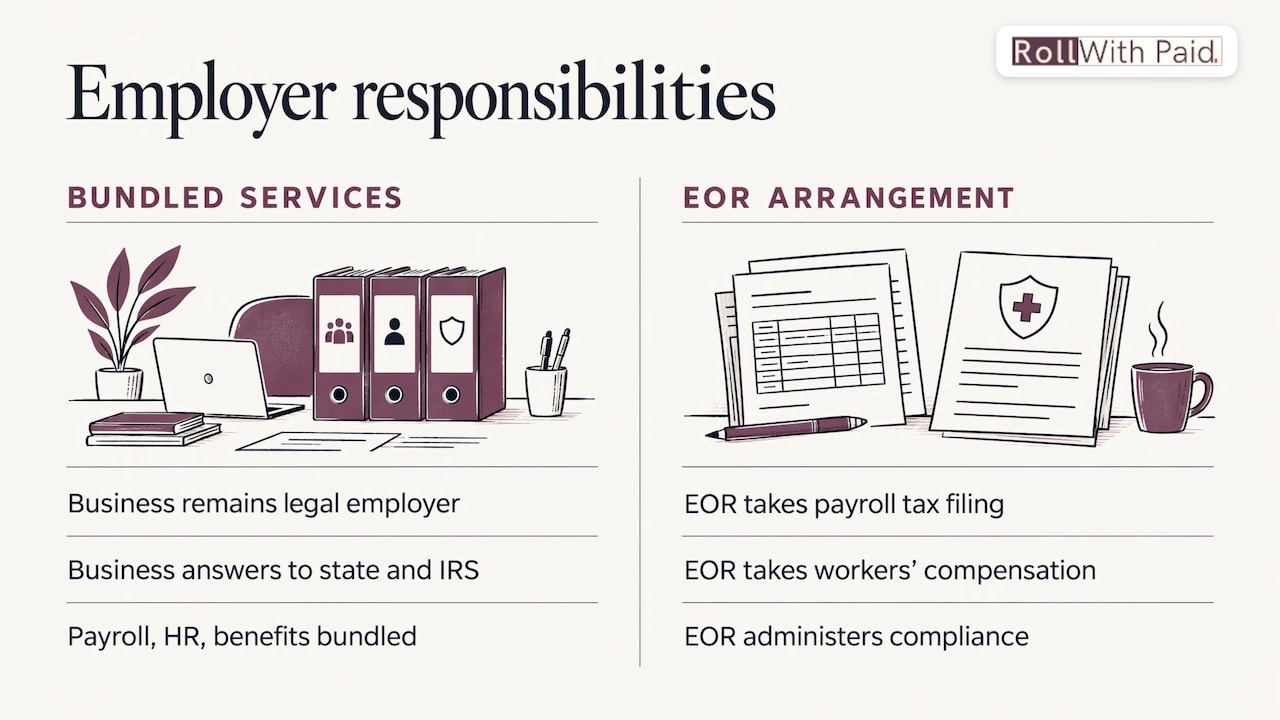
The difference between bundled services and an EOR is who carries the employer obligations. In a bundle, the business is still the legal employer and still answers to the state and the IRS. In an EOR arrangement, the EOR takes on payroll tax filing, workers’ compensation and compliance administration for the workforce. Our guide to Employer of Record for high-risk industries explains how that division of responsibility works.
Why is cannabis payroll different from regular payroll?
Cannabis payroll is different because federal law still treats marijuana as a Schedule I substance, which changes tax treatment, banking and vendor access. Three pressures follow.
How does Section 280E affect payroll?
Section 280E of the Internal Revenue Code denies most business deductions to businesses trafficking in Schedule I or II substances. According to Pease Bell’s 2026 summary of 280E, only properly calculated cost of goods sold stays deductible, and payroll for non-production staff generally does not. That is why how you classify each employee, as production or non-production, shapes your tax bill. A budtender and a cultivation technician are not the same line on your books.
We cover the exposure in detail in Cannabis Payroll: Avoid 280E Exposure. Confirm your allocation method with your CPA, because the IRS expects a documented basis.
How do state payroll taxes apply to cannabis employers?
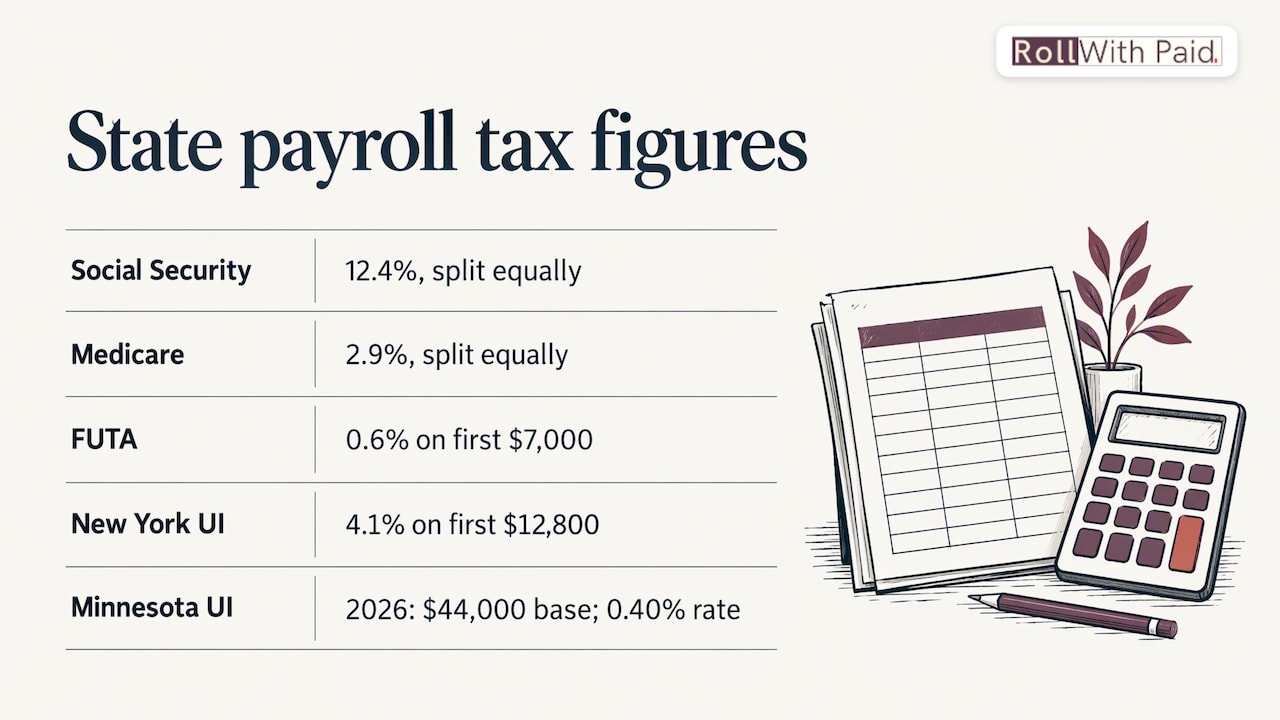
Cannabis employers pay the same payroll taxes as other employers. New York’s Office of Cannabis Management training material, Basics of Cannabis Accounting and Tax for New York State, lists Social Security at 12.4% and Medicare at 2.9%, split equally between operator and employee. It also lists FUTA at 0.6% on the first $7,000 and New York State unemployment insurance at 4.1% on the first $12,800 per employee.
Minnesota works differently. The Minnesota Department of Employment and Economic Development reports a 2026 taxable wage base of $44,000 and a base tax rate of 0.40% for unemployment insurance. Experience rating and assessments change the rate each employer actually pays. Each state publishes its own rates yearly, so a multi-state operator tracks every one.
Why do cannabis employers face extra licensing obligations?
State cannabis regulators add workforce requirements on top of payroll law. In Minnesota, the Office of Cannabis Management explains that a labor peace agreement is an agreement between a cannabis business and a bona fide labor organization, defined in Minnesota Statutes, section 342.01. That agreement must bar the organization from picketing, work stoppages or boycotts against the business. Applicants carry this duty into their HR planning from day one.
How does WECO compare with other cannabis payroll options?
Cannabis employers choose among three models. The table compares them on the points that decide most buying conversations.
| Criterion | General payroll provider | Bundled cannabis workforce company (such as WECO) | Roll With Paid (Employer of Record) |
|---|---|---|---|
| Accepts cannabis businesses | Often declines or restricts | Yes, built for the sector | Yes, built for cannabis and high-risk industries |
| Who is the legal employer | Your business | Your business | Roll With Paid, through the EOR model |
| Payroll execution | Yes | Yes | Yes |
| Workers’ compensation | Usually separate | Offered within the bundle | Included in the EOR model, aimed at lower workers’ compensation costs |
| Multi-state hiring | Varies by product | Varies by service | Multi-state hiring support |
| Audit-ready records | Self-managed | Platform records | Audit-ready processes and I-9 support |
| Fee basis | Per employee or flat | Quote-based | Monthly fee on gross payroll, with an optional flat-rate HR retainer |
The pattern is consistent. General providers are strong on software and weak on cannabis exposure. Bundled workforce companies fix the access problem. An EOR fixes access and also moves the employer-side liability, which is the part owners lose sleep over.
For head-to-head views of named payroll companies, see our comparisons with Paychex, Greenleaf HR and Paragon Payroll.
Which model fits which cannabis business?
The right model depends on the license type, the number of states and how much compliance work the owner wants to keep. Each use case below leads with the answer.
Which model suits a single-state dispensary?
A single-state dispensary needs payroll that tracks tips and hourly staff, workers’ compensation and clean onboarding records. Retail staff turn over often, so onboarding speed matters. Our cannabis dispensary payroll guide walks through the rules and the risks. An EOR suits this operator because new hires are added to an existing, compliant structure.
Which model suits a cultivation facility?
A cultivation facility needs accurate worker classification codes, because workers’ compensation premiums are set by those codes. Misclassification is expensive when a claim or audit arrives. Cultivation also mixes production and non-production labor, which connects directly to 280E. An EOR that sets and maintains classification codes keeps both the premium and the tax position defensible.
Which model suits a multi-state operator?
A multi-state operator needs registrations, unemployment accounts and new-hire reporting in every state where it has employees. Each state has its own rules, forms and deadlines. Our multi-state cannabis payroll guide lays out the work before the first paycheck. Roll With Paid offers multi-state hiring support so one agreement covers each state’s filings.
Which model suits delivery and transport?
Delivery and transport crews carry vehicle, driver and cash-handling exposure that general payroll vendors rarely price correctly. See cannabis delivery payroll and cannabis transporter payroll for how pay, taxes and compliance apply to each.
What does a cannabis employer need to keep audit-ready?
An audit-ready cannabis employer keeps five records current: I-9 forms, payroll registers, tax filings, classification codes and signed policies. Each one answers a different auditor.
- I-9 forms: Federal law requires one for every hire. Roll With Paid provides I-9 support.
- Payroll registers and tax filings: These show wages and deposits for each pay period. Our track record is zero late filings.
- Classification codes: These tie workers to the right workers’ compensation rate.
- Signed policies: Handbooks and acknowledgments prove what employees were told. Our handbook software comparison shows how multi-state firms keep them current.
- New-hire reports: Minnesota requires them, and late or missing reports carry fines. Our Minnesota new hire reporting checklist covers the $25 to $500 penalty range.
Document storage is its own problem. Our review of HR document management tools explains why a managed HR partner keeps records consistent across locations.
What integrations work best with a cannabis payroll partner?
The integrations that work best connect timekeeping to payroll and keep HR records in one place. Time and attendance data should flow into payroll without re-keying, because manual entry is where overtime errors start. Roll With Paid includes time and attendance tools for that reason.
Onboarding should feed the same record. A new hire’s I-9, tax forms and policy acknowledgments belong in one file, which is how our onboarding service is organized. Incident reports belong there too, and our page on incident reporting software for cannabis employers shows how that fits.
Point-of-sale and seed-to-sale systems stay where they are. Payroll does not need to replace them. It needs clean hours and clean classification.
What challenges do cannabis employers run into with payroll providers?
Three problems recur across cannabis operators, and each has a direct fix.
- Account closures. A general payroll provider can freeze or close an account once it learns the business is cannabis, which stops pay mid-cycle. Our page on the payroll software problem describes the exposure. A provider that serves the industry by design removes this risk.
- Misclassification. Wrong codes produce wrong premiums and tax positions. Setting codes at hire, and reviewing them as roles change, prevents the correction later.
- Scattered vendors. Payroll, insurance, benefits and HR in separate places means no one owns the whole picture. A single agreement fixes that.
Our cannabis case study shows how these issues resolve inside one engagement. The same approach also serves trades: see the construction and trades case study.
How should you evaluate a payroll partner’s financial model?
A payroll partner earns recurring monthly revenue, so you should expect a fee tied to your payroll and your headcount. Recurring service fees are a standard B2B structure, and this recurring revenue playbook describes why providers favor it.
At Roll With Paid, the fee is a monthly amount based on gross payroll, with an optional flat-rate HR retainer. Rates vary by worker classification code and headcount. That structure means the quote reflects your real roster. The details sit on our pricing page.
What does the Roll With Paid Employer of Record model include?
Roll With Paid’s Employer of Record model covers payroll execution, HR and compliance solutions, seamless employee onboarding, multi-state hiring support and time and attendance tools. It also covers workers’ compensation, benefits administration, regulatory filings and policy documentation.
We built it for businesses traditional payroll providers turn away. The goal is a business that stays audit-ready while the owner runs operations. Our cannabis industry payroll overview sets out the rules, risks and provider models in full.
Our view on workforce partners
We think the spotlight on companies like WECO points at something true: cannabis operators need workforce partners who already understand the sector. The old pattern of piecing together a payroll vendor, an insurance broker and an HR consultant leaves gaps exactly where regulators look.
We go one step further with the Employer of Record model. When Roll With Paid is the employer of record, payroll, workers’ compensation and compliance filings sit under one agreement, and our process is designed to keep you audit-ready. Our record of zero late filings is the result we hold ourselves to.
For a dispensary owner, a cultivation manager or a multi-state operator, the question is not only who can run payroll. It is who carries the risk when a filing, a classification or a record is wrong. We built our service so that answer is us.
Leah Kollross
How can Roll With Paid help your cannabis business?
If you run a dispensary, a cultivation facility or any high-risk operation, Roll With Paid takes payroll execution, compliance and onboarding off your desk under one Employer of Record agreement. Start on our pricing page to see how fees are structured, or go straight to getting started.
We also publish a newsletter for cannabis and high-risk employers. You can subscribe to our newsletter for compliance updates as they develop.
FAQ
Is WECO a payroll company?
WECO is a workforce-management company for the hemp and cannabis industry, and payroll is one of its services alongside HR onboarding and employee services. It is listed in the NCAI member directory under professional resources. Operators comparing it with other models should line up services, fee structure and who the legal employer is.
Can a cannabis business use a regular payroll provider?
Some general providers accept cannabis clients and many do not. Providers that do accept may restrict features or close accounts. A provider built for cannabis, such as Roll With Paid, removes that access risk from your payroll.
What does an Employer of Record do for a dispensary?
An Employer of Record becomes the employer for payroll, tax filing, workers’ compensation and compliance administration. You keep daily direction of your staff. Our explainer on Employer of Record benefits covers the details.
How much does cannabis payroll cost with Roll With Paid?
Our fee is a monthly charge based on gross payroll, with an optional flat-rate HR retainer. Rates vary by worker classification code and headcount, and no single price applies to every business. Our pricing page explains the structure, and a quote uses your actual roster.
Does 280E change how I run payroll?
280E changes how wages are treated for federal tax, not how employees are paid. Because production and non-production labor are treated differently, accurate classification and records matter. Review your allocation with your CPA.
Sources
- National Cannabis Industry Association member directory listing
- Pease Bell: 280E Demystified, What Cannabis Businesses Can and Cannot Deduct
- New York Office of Cannabis Management: Basics of Cannabis Accounting and Tax
- Minnesota Unemployment Insurance: Tax Rates
- Minnesota Office of Cannabis Management: Frequently Asked Questions
- Recurring Revenue Strategy for B2B: A Practical Playbook
Recommended
- Cannabis Payroll: Avoid 280E Exposure: Roll With Paid vs Greenleaf HR
- Avoid a Payroll Freeze: Roll With Paid vs. Paychex for Cannabis
- Marijuana Moment on Payroll Risk: What Cannabis Employers Should Do
- High Risk Cannabis Payroll: Roll With Paid vs Würk and 4 Numbers
Roll With Paid. is not a law firm and does not provide legal advice. This article summarizes Minnesota law along with other states and jurisdictions law and is for general information only. Before changing a policy, consult employment counsel or contact DLI Labor Standards at 651-284-5075.