
High Risk Cannabis Payroll: Roll With Paid vs Würk and 4 Numbers

If mainstream payroll providers have declined your cannabis business, or your workers’ comp costs keep climbing because nobody wants the liability, an Employer of Record model like Roll With Paid is usually the better fit. If you already run a stable, single-entity operation with an internal HR team and want deep applicant tracking integrations, a cannabis-focused HCM platform like Würk can work well. The catch: an EOR shifts filing risk, but it does not erase tax exposure tied to Section 280E or actual misconduct.
TL;DR:
The Employer of Record model shifts payroll filing, workers’ comp, and liability from your business to the provider, reducing audit and insurance risks.
Pricing for EOR services is usually based on workers’ compensation classification codes and gross wages, often favoring high-risk, multi-state operators.
Managed HCM platforms like Würk keep your business as the legal employer and integrate with applicant tracking systems to streamline onboarding and payroll processes.
Support responsiveness, security standards, and compliance resources are critical; vendors specialized in high-risk industries tend to offer faster, more industry-specific service.
Your growth plans, current risk profile, and liability tolerance should determine whether an EOR or HCM platform best fits your cannabis operation.
Table of Contents
-
What Questions and Numbers Should You Bring to a Vendor Call?
-
How Do Cannabis Payroll Vendors Typically Price Their Services?
-
How Roll With Paid Approaches Cannabis Payroll and Compliance
Roll With Paid vs Würk: Understanding the Core Difference
The single most important question in this comparison isn’t which platform has better software. It’s whose name sits on the W-2.
Roll With Paid operates as an Employer of Record, which means it becomes the sole legal employer of your staff. It owns payroll filings, tax administration, workers’ compensation coverage, unemployment insurance administration, onboarding, I-9 documentation, and benefits access. You retain day-to-day management and direction of the work, but the compliance liability sits with Roll With Paid, not you.
Würk, by contrast, functions as a cannabis-focused HCM (human capital management) platform. It provides timekeeping, scheduling, onboarding tools, benefits administration, and managed payroll services, but your business generally stays the legal employer. Filings go out under your tax ID.
That distinction shapes everything downstream:
-
Audit exposure: with an EOR, the EOR entity typically faces the payroll audit; with HCM software, your business does.
-
Insurance placement: an EOR usually places and owns workers’ comp coverage; an HCM client typically sources and holds its own policy.
-
Control: managed HCM platforms leave more day-to-day employer discretion in your hands, since you remain the employer of record on paper.
Neither model is universally right. It depends on how much liability you’re willing to carry versus hand off.
How Do the Two Models Compare Feature by Feature?
Cannabis operators rarely lose sleep over software features. They lose sleep over who answers for a missed filing or a misclassified worker. Here’s how the two approaches stack up across the axes that actually determine risk and cost.
| Service Axis | Employer of Record (EOR) | Cannabis HCM / Managed Payroll |
|---|---|---|
| Legal employer / W-2 issuer | The EOR entity | Your business |
| Payroll & tax filings | Owned and filed by the EOR | Filed under your tax ID, often processed by the vendor |
| Workers’ comp & insurance | Placed and owned by the EOR | Typically sourced and held by your business |
| Day-to-day operations | You direct work; EOR handles admin | You run payroll and HR with vendor tools |
| Integrations & onboarding | Streamlined intake, EOR manages documentation | ATS integrations (e.g., Greenhouse to Würk) automate data flow |
| Pricing shape | Often tied to workers’ comp classification and gross wages | Often a blended per-employee or per-payroll fee |
| Best fit | High-risk, multi-state, or previously declined operators | Stable single-entity operators wanting deep HR tooling |
A few things stand out here. Pricing tied to workers’ compensation classification and gross wages tends to favor EOR arrangements for cannabis employers, because it aligns cost with actual risk rather than spreading it across a flat rate that may not reflect cultivation or extraction hazards. Meanwhile, industry comparisons consistently note that the decisive question isn’t feature parity. It’s whose name is on the filings when something goes sideways.
What Questions and Numbers Should You Bring to a Vendor Call?
Vendor sales calls tend to move fast, and cannabis operators often walk away with a quote that doesn’t match their actual risk profile because they didn’t bring the right numbers. Prepare these before you dial in.
-
Headcount by workers’ comp classification code. Cultivation, extraction, retail, and delivery staff carry different comp rates, and pricing built on classification code will vary significantly by role mix.
-
Monthly hiring volume and seasonal swings. A dispensary hiring two people a month has very different onboarding needs than a cultivation operation scaling for harvest.
-
Current turnover rate. High turnover multiplies onboarding and I-9 verification workload, which affects both cost and the case for automation.
-
Multi-state or multi-license footprint. Operating across state lines changes tax filing complexity and may push you toward an EOR that already handles multi-state compliance.
On the contract side, ask directly: who is named on the filings if the state audits payroll? Who carries the workers’ comp policy? What happens to payroll continuity if you terminate the contract mid-quarter?
Pro Tip: Pull your last four quarters of payroll registers before any vendor call. Vendors quote faster and more accurately when they can see actual classification mix and wage totals instead of estimates.
How Do Cannabis Payroll Vendors Typically Price Their Services?
Pricing in this space rarely looks like a simple per-employee fee, and the differences matter more than most operators expect going in.
EOR pricing is commonly structured around workers’ compensation classification code and gross wages, meaning a cultivation team with heavier physical risk costs more per head than an admin or retail staff. Managed HCM platforms more often quote a blended per-employee or per-payroll-run fee, sometimes with add-ons for benefits administration, time-tracking hardware, or dedicated support tiers.
Watch for these cost variables before signing anything:
-
Setup or transition fees for migrating historical payroll data.
-
Charges for off-cycle payroll runs or corrections.
-
Whether audit response support is included or billed hourly.
-
Minimum contract terms that lock in pricing before you’ve seen a full quarter of service.
Negotiate a trial period tied to a real payroll cycle, not a demo. Ask explicitly who handles audit response if the state comes calling. Read pay stub requirements that apply in your state before assuming a vendor’s standard stub format meets your obligations.
Why Do Integrations and Onboarding Speed Matter So Much?
An applicant tracking system that doesn’t talk to payroll creates duplicate data entry, delayed start dates, and the kind of manual reconciliation errors that eat an HR manager’s whole afternoon.
Würk’s integration with Greenhouse automates new-hire record creation, compensation sync, onboarding task tracking, and employment status updates. That kind of connection can cut the time from offer acceptance to payroll-ready from roughly 72 hours to under 24, and it meaningfully reduces manual payroll corrections when implemented well.
Rolling one out takes a few deliberate steps:
-
Run a pilot with a small hiring cohort before a full switch.
-
Map fields carefully between the ATS and payroll system; mismatched fields are the top source of post-launch errors.
-
Assign one project owner accountable for the integration, not a committee.
-
Test a full payroll-ready cycle before trusting the system with live wages.
Pro Tip: A poorly mapped integration can create more manual cleanup than no integration at all. Budget a real pilot period before declaring victory.
EOR onboarding runs differently. Instead of syncing an ATS, you’re typically handing over I-9 documentation, tax withholding forms, and classification data directly to the EOR, which absorbs the administrative build.
What Doesn’t an Employer of Record Solve?
An EOR shifts a lot of liability off your plate, but it isn’t blanket immunity, and treating it that way is one of the more expensive misconceptions in this industry.
Competitor comparisons themselves acknowledge that an EOR doesn’t remove your visibility into payroll reporting, and it doesn’t solve every tax or regulatory risk. Section 280E, which disallows standard business expense deductions for cannabis companies at the federal level, is a tax code reality that no payroll structure changes. Understanding how 280E interacts with payroll matters regardless of which model you choose.
A few boundaries worth knowing upfront:
-
An EOR does not shield you from consequences of intentional misclassification or fraud on your end.
-
Managed HCM vendors leave certain audit liabilities with you as the legal employer, since filings carry your tax ID.
-
Implementation timing matters: switching models mid-quarter can create cashflow gaps and hiring delays if lead times aren’t planned around your payroll calendar.
Neither model is a substitute for understanding your own compliance obligations.
How Roll With Paid Approaches Cannabis Payroll and Compliance
Roll With Paid built its model specifically around employers that mainstream providers turn away. The company launched in Minnesota as a payroll and HR provider designed for high-risk industries, with pricing structured by workers’ comp classification and gross wages rather than a one-size-fits-all rate.
Its track record includes zero late filings for clients, a proof point that matters directly to cannabis operators worried about state audits. Beyond payroll execution, Roll With Paid publishes practical compliance resources, including:
-
A breakdown of common payroll mistakes cannabis businesses can’t afford to make.
-
An explainer on what an Employer of Record is and why it matters for benefits access.
-
Guidance tailored to businesses in tribal relations contexts, an area many national providers avoid entirely.
For operators evaluating whether the EOR route makes sense, these resources offer a starting point before a sales conversation.
How Responsive Is Support When Payroll Problems Hit?
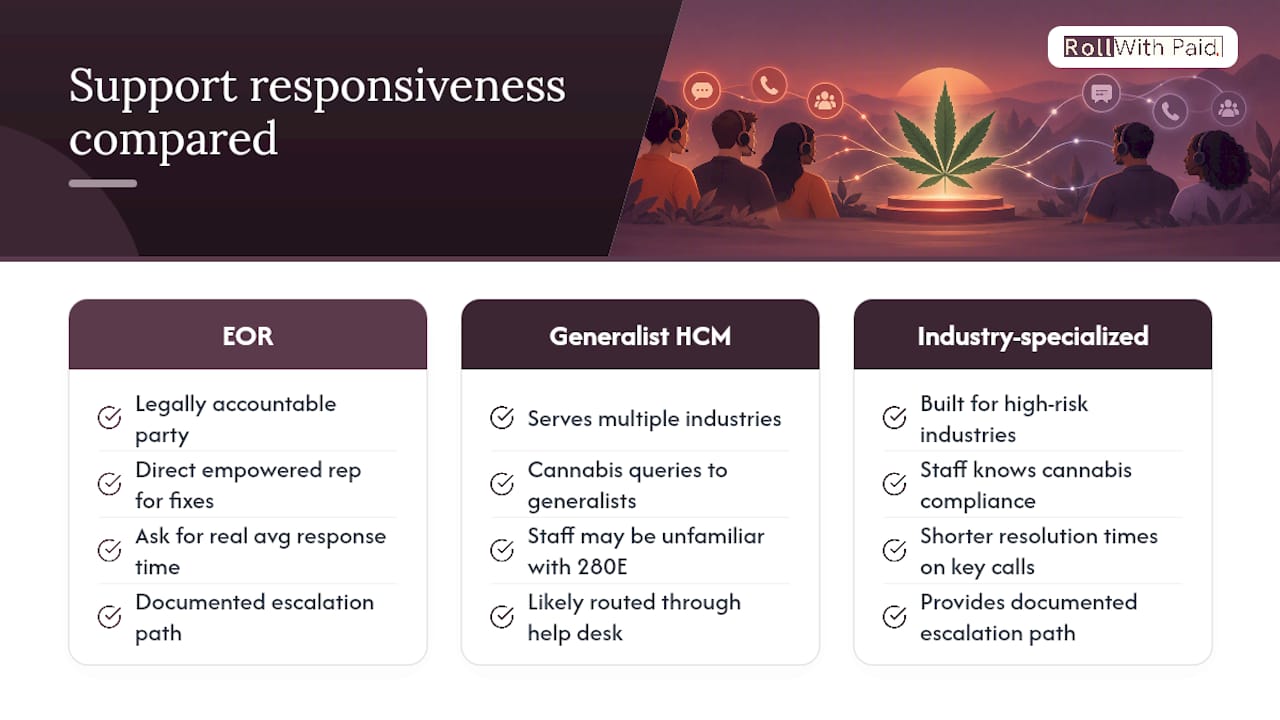
Payroll problems rarely happen on a convenient schedule. A missed direct deposit on a Friday afternoon, or a state notice that arrives with a two-week response deadline, tests a vendor’s support model faster than any sales pitch.
With an EOR, support responsiveness carries extra weight because the EOR is the party legally accountable for the fix. If a filing error occurs, you need direct access to someone empowered to correct it with the state, not a support ticket queue that takes days to escalate. Cannabis operators should ask any vendor, EOR or HCM alike, what the actual response time looks like for a payroll error versus a general question, and whether support includes a named account contact or routes through a general help desk.
HCM platforms serving multiple industries sometimes route cannabis-specific compliance questions to generalist support staff unfamiliar with state cannabis labor rules or 280E nuances. A vendor built specifically for high-risk industries tends to staff support with people who already understand why a cultivation facility’s workers’ comp classification differs from a retail dispensary’s, which shortens resolution time on the calls that matter most.
Before signing, ask for a documented escalation path and a real average response time, not a marketing claim. That single question often reveals more about a vendor’s actual operations than a full features list.
What Security and Privacy Standards Should You Expect?
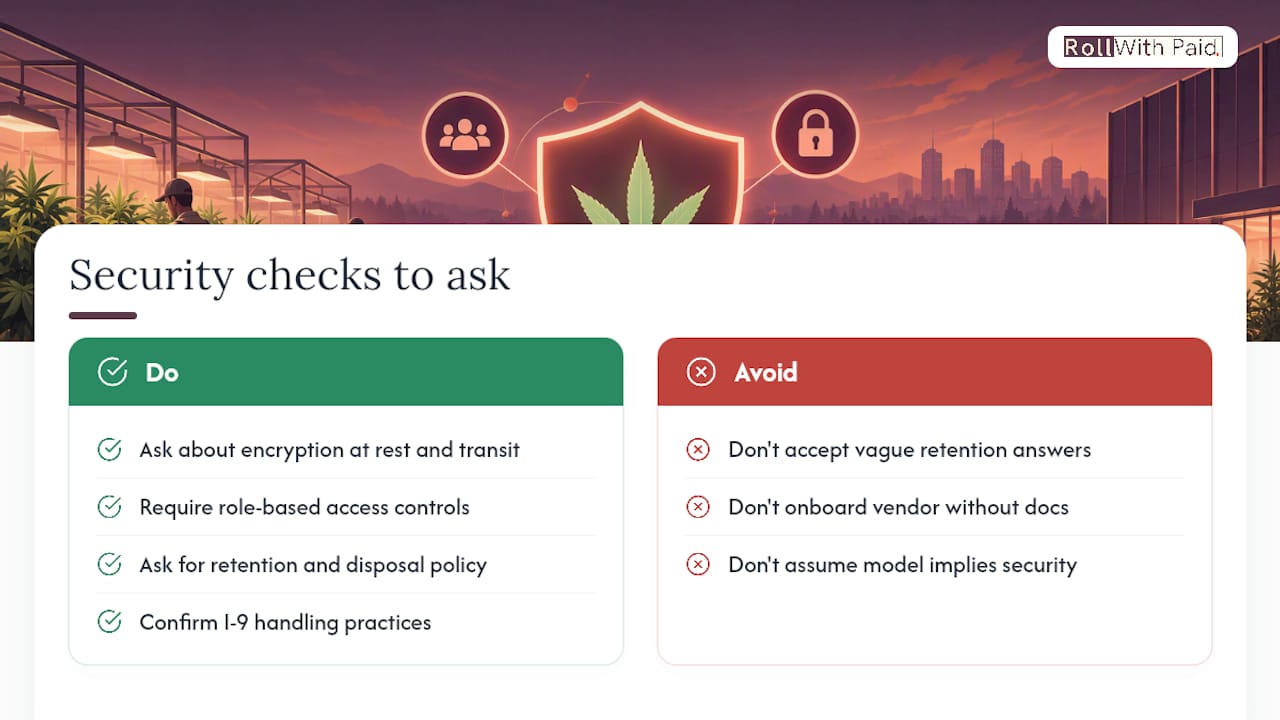
Payroll data includes Social Security numbers, bank account details, immigration status documents, and wage histories. That makes payroll and HR platforms an obvious target, and cannabis businesses face an added layer of scrutiny given the regulatory attention already on the industry.
At minimum, ask any vendor how employee data is encrypted both at rest and in transit, whether access controls limit which staff can view sensitive fields, and how long records are retained after an employee separates or a contract ends. I-9 documentation in particular carries strict handling requirements, and a platform that centralizes this data should be able to explain its retention and disposal practices clearly, not vaguely.
Multi-state operators should also ask whether the platform segregates data by state or license, since some state cannabis programs have their own data handling expectations tied to licensing compliance. A vendor that can’t answer specifics about encryption standards or breach notification procedures on a sales call is worth a second look before you hand over your entire workforce’s personal data.
This is an area where the EOR and HCM models don’t differ structurally. Both process the same categories of sensitive data, so the real differentiator is the specific vendor’s security posture, not the underlying employment model. Ask for documentation, not just assurances.
What Do Real Cannabis Operators Say About Each Model?
Concrete before-and-after numbers from named cannabis operators using either platform are not widely published, so treat any specific percentage you see in a sales deck with some skepticism unless it’s tied to a documented source.
What is more reliably reported is the pattern behind why operators choose one model over the other. Businesses that describe getting declined by traditional payroll providers, often because of banking restrictions or perceived risk, tend to gravitate toward an EOR model that absorbs that risk directly. Operators who already have functioning HR infrastructure and simply want better software to run it more efficiently tend to describe HCM platforms as a natural fit, particularly when they’ve already invested in an applicant tracking system like Greenhouse that benefits from a direct integration.
The honest takeaway: your own situation, not a generic testimonial, should drive this decision. A five-location dispensary chain with high seasonal turnover has different needs than a single cultivation facility with a stable, long-tenured crew. Ask any vendor for references from businesses of a similar size and license type to yours, and treat vague success stories with more caution than specific, verifiable operational details.
Can Your Payroll Setup Handle Rapid Growth?
Cannabis businesses scale unevenly. A dispensary might add a second location within a year, or a cultivation operation might triple headcount ahead of a harvest season. Payroll infrastructure that works fine at 15 employees can buckle at 75, particularly across multiple states with different tax and labor requirements.
An EOR model tends to absorb scaling friction more smoothly, since the EOR already carries the infrastructure for multi-state tax registration, workers’ comp placement, and compliance filings across jurisdictions. Adding a new location under an existing EOR relationship is often a matter of extending the existing agreement rather than starting compliance infrastructure from scratch.
HCM platforms can scale well too, but the compliance groundwork, registering for tax IDs in a new state, securing workers’ comp coverage there, understanding that state’s cannabis labor rules, remains your responsibility as the legal employer. That’s manageable with the right internal HR bandwidth, but it becomes a real bottleneck for a growing operation without dedicated compliance staff.
Before choosing either model, map out your realistic 12 to 24 month growth plan: new states, new license types, projected headcount. A vendor conversation grounded in that specific trajectory produces a far more useful quote than one based on your current headcount alone.
How Flexible Are Contract Terms and Exit Clauses?
Contract terms rarely get the attention they deserve until an operator wants out of an agreement that no longer fits. Ask specifically about minimum term length, whether pricing is locked for that term or subject to change, and what advance notice is required to terminate.
For EOR arrangements, the exit process matters more than it might in a standard HCM relationship, because your employees are legally employed by the EOR. Ask what the transition looks like if you leave: how employees get transferred back to your own tax ID, how quickly historical payroll records get handed over, and whether there’s a transition fee.
For HCM platforms, since you remain the legal employer throughout, exiting is often more straightforward. You’re changing software and possibly a managed service, not an employment relationship. Still, ask about data portability: can you export full payroll history in a usable format, or does the platform hold your historical data in a proprietary format that complicates a future migration?
Either way, get exit terms in writing before signing, not after you’ve decided to leave.
Does Compliance Support Cover More Than Payroll?
Payroll compliance is only one piece of what cannabis operators actually navigate. State licensing requirements, seed-to-sale tracking obligations, and state-specific cannabis labor laws, some states mandate specific cannabis worker training or background check procedures, all sit adjacent to payroll but carry their own compliance burden.
An EOR built specifically for high-risk industries often has more direct familiarity with how cannabis licensing intersects with employment, since that’s the operator base it serves exclusively. That can mean faster answers to questions like whether a budtender’s required state certification affects onboarding timelines, or how a license suspension might affect payroll continuity.
General HCM platforms serving multiple regulated industries may have broader software capability but less specific institutional knowledge about cannabis licensing quirks in your particular state. Ask any vendor directly whether they have cannabis-specific compliance resources, or whether cannabis is just one vertical among many they serve. The answer tells you a lot about how deep their institutional knowledge actually runs.
A Straight Answer on Which Model to Choose
Most cannabis operators overthink the feature comparison and underthink the liability question. If your business has been declined by mainstream providers, operates in multiple states, or simply wants someone else’s name on the line when a state audit letter arrives, the EOR model solves a real problem that software alone cannot. If you already have stable HR operations and want better tools to run them, a managed HCM platform can serve you well.
Pull your payroll numbers, list your growth plans for the next two years, and get both kinds of vendors on a call before deciding.
— Leah
Get a Clear Payroll Quote Built Around Your Risk Profile
Some providers price around actual workers’ compensation classification and gross wages, not a generic industry rate, so quotes reflect real risk exposure rather than a one-size-fits-all number.

If mainstream providers have turned you away, or you’re tired of carrying compliance risk that a specialized partner could absorb, bring your headcount by classification code and your last quarter of payroll data to a conversation with Roll With Paid. Review the Employer of Record model to see exactly what shifts off your plate, then check the service rate and HR retainer options to request a quote built around your actual numbers.
Sources
FAQ
Is Würk a Good HR Software for Cannabis Businesses?
Würk works well for cannabis operators who want to remain the legal employer while using cannabis-specific HR and payroll tools. It’s a strong fit for businesses with existing HR infrastructure and applicant tracking systems like Greenhouse, since the integration automates onboarding and payroll data flow.
What Are the Alternatives to Würk?
The main alternative is an Employer of Record model, such as Roll With Paid, which takes on legal employer status and absorbs filing, tax, and workers’ comp liability rather than providing software you manage yourself. The right choice depends on whether you want to retain employer control or shift that liability to a specialized partner.
What Are the Benefits of Using Würk?
Würk’s core benefits include cannabis-tailored timekeeping, scheduling, and payroll tools, plus integrations with applicant tracking systems that reduce manual data entry. Its managed payroll option can run payroll processing while you remain the legal employer of record.
Can Würk Integrate With Other Software?
Yes. Würk integrates with applicant tracking systems including Greenhouse, automating new-hire record creation, compensation sync, and employment status updates. A well-mapped integration can meaningfully reduce onboarding delays and payroll corrections.
Is Roll With Paid Worth It for a Cannabis Business?
Roll With Paid tends to be worth it for operators who’ve been declined by mainstream payroll providers, operate across multiple states, or want to shift filing and workers’ comp liability off their own books. Pricing is structured by workers’ comp classification and gross wages, and current rates are available directly on the site.
Recommended
Roll With Paid. is not a law firm and does not provide legal advice. This article summarizes Minnesota law as of August 2026 and is general information only. Tip arrangements are fact-specific; before changing a policy, consult employment counsel or contact DLI Labor Standards at 651-284-5075.