
Cannabis Manufacturing Payroll: 280E, Taxes and Compliance

Cannabis manufacturing payroll follows the same federal and state payroll rules as any other employer, plus a tax layer most payroll tools ignore: IRC §280E. Section 280E denies deductions to businesses trafficking in Schedule I or II substances, so how you classify each manufacturing worker’s wages decides how much of that labor cost you can recover through cost of goods sold. Payroll taxes are still owed in full.
TL;DR
- Section 280E does not excuse withholding, reporting or paying employment taxes. Cannabis manufacturers file Form 941 quarterly and, in most cases, Form 940 annually.
- Labor tied to producing the product may count toward cost of goods sold. Labor tied to selling, admin or compliance generally does not. Classification follows actual duties, not job titles.
- Split-role employees need contemporaneous, activity-based time records to support any allocation.
- State rules differ. Minnesota’s Paid Leave premium for 2026 and 2027 is 0.88% of wages, and other states add their own filings.
- A payroll partner built for cannabis, including an Employer of Record model, reduces filing risk and keeps records audit-ready.
Table of Contents
- What makes cannabis manufacturing payroll different from ordinary payroll?
- How does IRS Section 280E affect manufacturing wages?
- Which federal payroll requirements must a cannabis manufacturer follow?
- What state payroll rules should a cannabis manufacturer check?
- Where do cannabis manufacturers run into payroll trouble?
- What questions do manufacturers ask us most?
- How do manufacturing use cases compare?
- How should a cannabis manufacturer choose payroll support or an Employer of Record?
- Perspective: Why we treat manufacturing payroll as an audit file
- Can Roll With Paid handle cannabis manufacturing payroll?
- FAQ
- Sources
What makes cannabis manufacturing payroll different from ordinary payroll?
The difference is tax treatment, not payroll mechanics. State agencies apply ordinary payroll rules directly to cannabis businesses. California’s EDD states that cannabis employers must withhold, report and remit payroll taxes, including cash and noncash compensation, bonuses, overtime, commissions and tips.
The extra layer is federal. The Congressional Research Service explains that marijuana income is taxable federally even when the sale is legal under state law, while §280E denies deductions and credits to businesses trafficking in Schedule I or II controlled substances. Properly calculated cost of goods sold is not disallowed.
For a manufacturer, that sentence turns payroll into a tax-planning question. Extractors, infusion technicians, packagers and quality staff all sit close to production. Your operations manager, HR coordinator and delivery driver do not. Every paycheck needs to be coded so that the books reflect that difference.
Beyond 280E, manufacturing adds practical complexity:
- Shift work and overtime. Production runs often create uneven hours across extraction, packaging and cleaning.
- Hazard exposure. Solvent-based extraction and equipment use raise workers’ compensation classification questions.
- Mixed roles. Small processors often have one person handling production, inventory and customer calls in the same week.
- Banking friction. Payroll funding and tax deposits can stall when a provider or bank is uncomfortable with the industry.
How does IRS Section 280E affect manufacturing wages?
Section 280E bars deductions for a trade or business trafficking in controlled substances, so only wages that qualify as cost of goods sold reduce taxable income. The Tax Court decision in Alternative Health Care Advocates reiterates this and adds that taxpayers carry the burden of keeping records sufficient to substantiate their costs.
The working rule we give manufacturers is simple: production labor is a candidate for COGS, and everything else is a 280E-limited expense. Redbud Advisors advises that labor treatment depends on day-to-day duties, not job title. A “production lead” who spends half the week on scheduling and vendor calls is a split-role employee.
The same source says split-role employees require time allocation by function to support any COGS position. It also says contemporaneous, activity-based tracking helps, and that an estimate made after the fact may not hold up. Your tax adviser decides the final COGS treatment. Payroll’s job is to produce records that adviser can rely on.
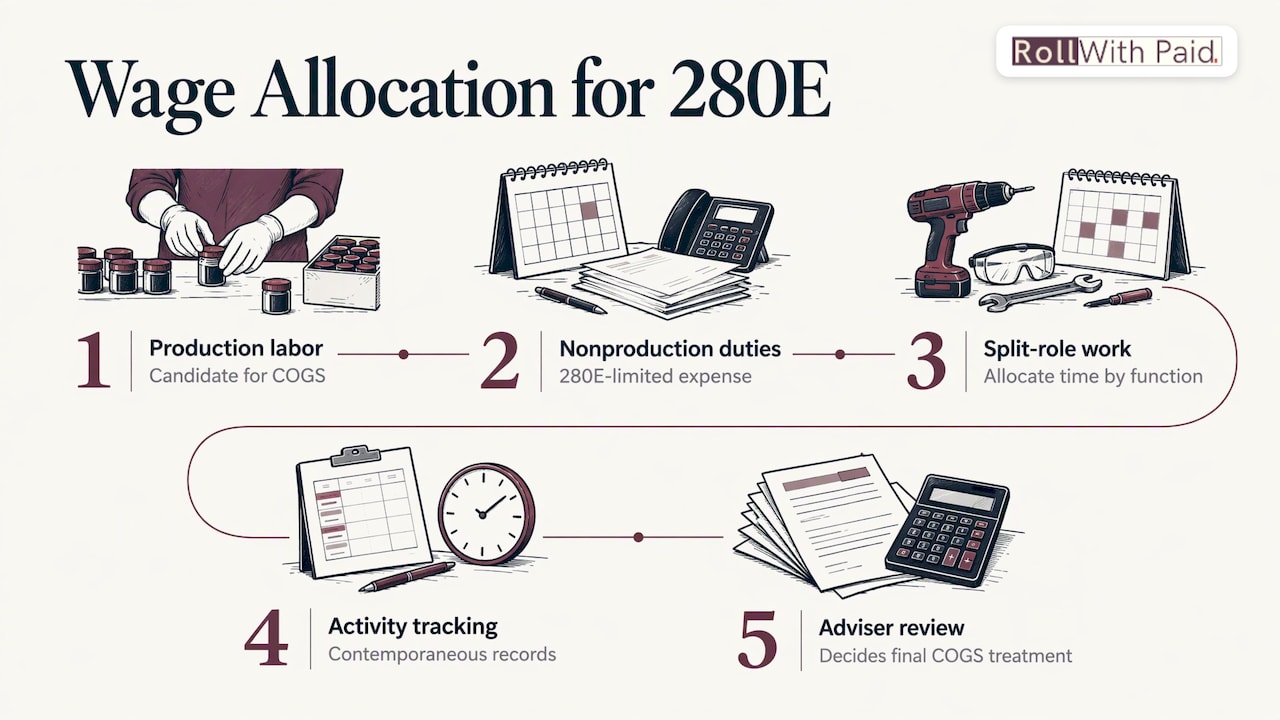
For the wider cost picture, a framework such as overhead allocation across product lines shows why labor and shared costs need a documented method rather than a year-end guess. For our own view of the payroll side, see our guide to 280E and payroll.
Which manufacturing roles usually sit where?
This table shows the typical starting point for a conversation with your tax adviser. It is not a ruling on any individual employee.
| Role | Primary duties | Typical starting treatment |
|---|---|---|
| Extraction technician | Producing concentrates | Production labor, COGS candidate |
| Packaging and labeling staff | Preparing finished product | Production labor, COGS candidate |
| Production supervisor (split role) | Oversight plus scheduling and admin | Allocate by tracked time |
| Sales representative | Wholesale accounts | Not COGS |
| HR and office staff | Administration | Not COGS |
The split-role row is where audits get difficult, which is why the time-tracking data matters more than the label.
Which federal payroll requirements must a cannabis manufacturer follow?
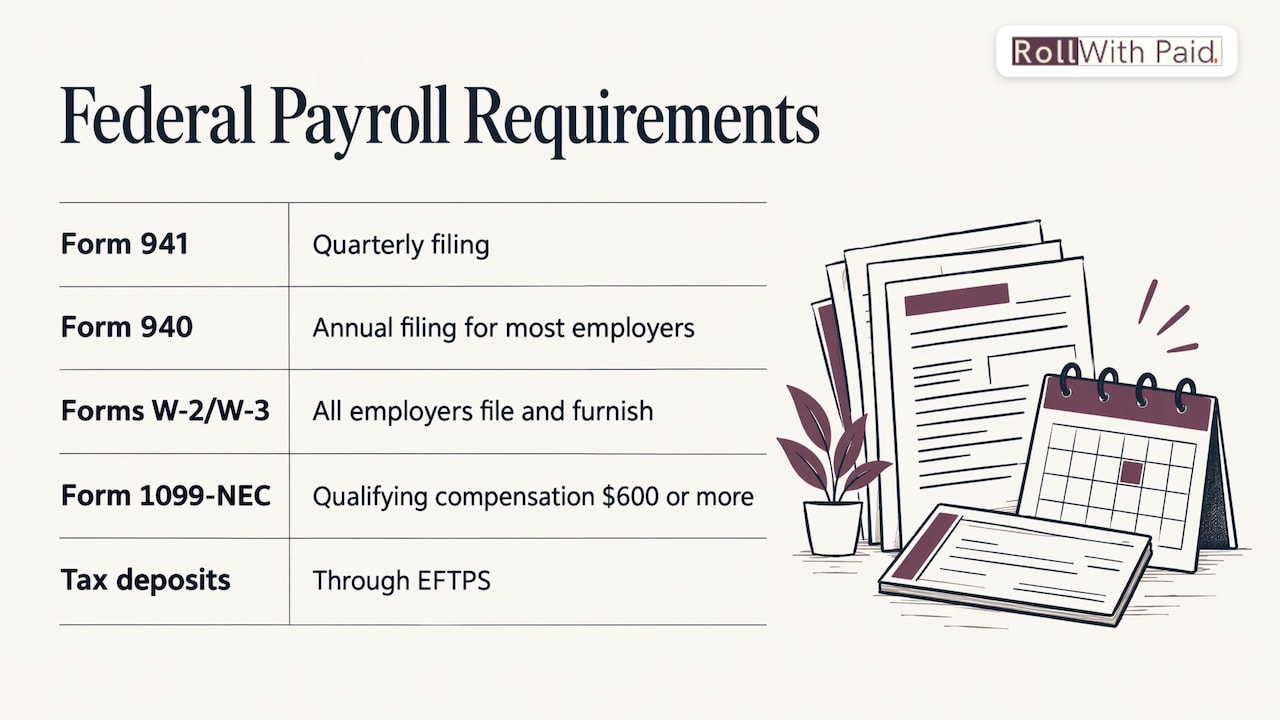
A cannabis manufacturer must file Form 941 quarterly, most must file Form 940 annually, and all must file and furnish Forms W-2 and W-3. Qualifying nonemployee compensation of $600 or more is reported on Form 1099-NEC. Federal tax deposits go through EFTPS, according to this employment tax summary from McCarter & English.
IRS Publication 4268 defines employment taxes as employee income-tax withholding, employee Social Security and Medicare withholding, and the employer share of FICA. IRS Publication 15 guidance requires keeping employment-tax records for at least four years, including wage amounts and dates, names and Social Security numbers, Forms W-4, deposit records and filed returns.
The Congressional Research Service’s central point is worth repeating: §280E limits deductions, but it does not excuse withholding, reporting or payment of employment taxes. A late 941 is a late 941, whatever the product.
Contractors are a recurring trap in manufacturing, because processors often bring in outside trimmers or equipment technicians. A refresher on 1099 filing requirements helps you decide who must receive which form. Misclassifying an employee as a contractor creates payroll tax exposure on top of the 280E issues. We cover the most common errors in 5 payroll mistakes cannabis businesses can’t afford.
For new hires, Form I-9 applies like any other employer. Our I-9 and E-Verify guide for cannabis employers covers it in detail.
What state payroll rules should a cannabis manufacturer check?
Every state adds its own registration, withholding, unemployment insurance and leave programs, and cannabis employers must follow general state employment law as well as cannabis-specific rules. Cannabis Business Times reports that multi-state operators should adapt HR policies for each operating state.
What does Minnesota require?
Minnesota’s Paid Leave program charges a premium of 0.88% of wages for 2026 and 2027, according to the Minnesota Paid Leave premium page. That covers Family Leave at 0.27% and Medical Leave at 0.61%. Employers may collect up to 0.44% from employees. Small employers with 30 or fewer workers and qualifying average wages pay a reduced 0.66%.
What does California require?
California’s EDD says cannabis employers pay employer unemployment insurance and Employment Training Tax, and withhold Personal Income Tax and State Disability Insurance. They generally file quarterly DE 9 and DE 9C returns. Employers should register with the EDD within 15 days of paying more than $100 in quarterly wages, submit filings and deposits electronically, and keep payroll records for at least four years, per the EDD cannabis payroll guidance. The EDD’s employer guide lists trimmers, cultivators, testers, budtenders and security guards as typical cannabis-industry employees, and requires reporting names, Social Security numbers and wages.
What does New York expect?
The New York Office of Cannabis Management recommends accounting systems that connect payroll, accounting, inventory or seed-to-sale tracking, cash controls and documented internal controls. Its cannabis accounting and tax training material frames this as audit readiness.
Three states, three different filing sets. Cannabis Business Times adds that employment compliance can hide inside licensing rules, so payroll procedures should be reviewed next to your license obligations, not as generic manufacturing administration. Our multi-state cannabis payroll guide walks through how we approach a new state before the first paycheck.
Where do cannabis manufacturers run into payroll trouble?
In our work with cannabis employers, the same problems come up again and again. These are patterns our business development and implementation teams see, not a statistical claim.
- Payroll software built for low-risk industries. Generic platforms have no concept of a COGS-versus-non-COGS code, so owners reconstruct allocations in spreadsheets at year end. See our note on the payroll software problem.
- Frozen or terminated payroll accounts. Some providers drop cannabis clients once they learn the industry, which can leave a team unpaid on a Friday. Our comparison of Paychex and Roll With Paid addresses this directly.
- Time records that do not match job duties. A person coded as production who actually spends most of the week on admin invites questions in an audit.
- Workers’ compensation misclassification. Classification codes drive premiums, and an inaccurate code can increase cost or create audit adjustments.
- Late or missing state filings after expanding into a second state.
What issues have we worked through with customers?
The fixes are usually unglamorous. We move manufacturers from year-end estimates to weekly activity-based time capture. We rebuild payroll codes so that production and non-production wages land in separate buckets. We document policies so that onboarding, I-9 completion and handbook acknowledgments are on file before the first shift. Our time and attendance guide for 280E audits explains why the clock-in record is the foundation.
Which integrations work best?
Based on what our teams see, the connections that matter are the ones that remove retyping between systems:
- Time and attendance feeding payroll, so hours by task flow into wage codes automatically.
- Payroll feeding accounting, so COGS and non-COGS labor post to the right accounts.
- Payroll aligned with seed-to-sale or inventory data, which supports the connected systems the New York OCM material describes.
- HR document storage tied to onboarding, so I-9s, policies and acknowledgments sit in one place. See our look at HR document management options.
Any single integration matters less than whether your records agree with each other.
What questions do manufacturers ask us most?
These are the kinds of questions owners bring to our team, with the short answers we give.
“Can we deduct our payroll like any other manufacturer?” Only the portion that qualifies as cost of goods sold. Section 280E denies other deductions, so classification of each worker’s duties matters. Your tax adviser makes the final call.
“Our lead operator does production and admin. Which bucket?” Both, in proportion to tracked time. Redbud Advisors notes that split-role employees require time allocation by function.
“Does 280E mean we pay less in payroll taxes?” No. Employment taxes are separate from income-tax deductions, and withholding, reporting and payment still apply.
“We just opened a second location in another state. What changes?” New state registration, withholding, unemployment insurance and any state leave program, plus state-specific HR policies.
How do manufacturing use cases compare?
Different manufacturers need different things from payroll. These are illustrative use cases, not named customers.
| Use case | Main payroll pressure | What to prioritize |
|---|---|---|
| Single-site extraction lab | Production versus admin coding | Task-level time tracking, workers’ comp class accuracy |
| Infused-products kitchen | Mixed roles, shift overtime | Overtime rules, role-based wage codes |
| Multi-state processor | Different filings per state | State registrations, consistent HR policies |
| Manufacturer with a retail arm | Two cost structures in one entity | Separate coding for production and retail staff |
How should a cannabis manufacturer choose payroll support or an Employer of Record?
Choose a provider that already runs cannabis payroll, produces 280E-friendly records and does not drop clients over industry risk. Our view of the choices looks like this:
| Option | Strength | Gap for cannabis manufacturers |
|---|---|---|
| Mainstream payroll provider | Familiar interface | May not serve cannabis or may freeze accounts |
| In-house payroll | Full control | Heavy filing burden, key-person risk |
| Hybrid payroll model | Mixed support | See our comparison with hybrid payroll |
| Employer of Record | Shared employer duties, workers’ comp, benefits | Fit depends on scope |
We also compare ourselves with Greenleaf HR and Paragon Payroll on our own site. When you evaluate any provider, ask whether it supports your classification codes, handles multi-state filings, stores records for at least four years, and can describe its onboarding. Our explainer on Employer of Record for high-risk industries covers the model.
Perspective: Why we treat manufacturing payroll as an audit file
Most payroll providers see a paycheck. We see the first page of a future audit file. In cannabis manufacturing, every wage code is a statement about what that person actually did, and that statement has to hold up months later.
That is why we start with duties and time records before we touch a pay run. When the classification is right and the clock-in data supports it, filing on time becomes routine instead of a quarterly fire drill.
Our Employer of Record model is designed for businesses that traditional providers turn away. It pairs payroll execution with HR compliance, workers’ compensation and onboarding, so owners can spend their time on production and growth.
Leah Kollross
Can Roll With Paid handle cannabis manufacturing payroll?
Yes. We provide payroll execution, HR and compliance solutions, onboarding, multi-state hiring support, time and attendance tools and Employer of Record services for cannabis and other high-risk businesses. Our model is designed to keep you audit-ready and to reduce legal liability and workers’ compensation cost.

Fees are based on gross payroll, with an optional flat-rate HR retainer, and rates vary by worker classification code and headcount. See our pricing page or explore our payroll and Employer of Record services to talk through your manufacturing operation.
FAQ
Is payroll an allowable deduction for cannabis manufacturers?
Only to the extent it is part of properly calculated cost of goods sold. The Congressional Research Service notes that §280E denies deductions and credits but does not disallow COGS. Wages for administration or sales generally fall outside COGS.
How long should cannabis payroll records be kept?
IRS Publication 15 guidance calls for at least four years of employment-tax records. California’s EDD also requires at least four years. Keep time records, W-4s, deposits and filed returns together.
Do cannabis manufacturers file the same payroll forms as other employers?
Yes. Form 941 is filed quarterly, most employers file Form 940 annually, and W-2 and W-3 are required. Qualifying contractor payments of $600 or more go on Form 1099-NEC. State filings come on top.
What is the Minnesota Paid Leave premium for 2026?
The Minnesota Paid Leave premium is 0.88% of wages for 2026 and 2027. Employers may collect up to 0.44% from employees. A reduced 0.66% rate applies to qualifying small employers.
Sources
- Cannabis Industry Payroll Tax Reporting, California EDD
- Cannabis Industry Businesses: State Employment Payroll Tax, California EDD
- Marijuana and Federal Tax Law: In Brief, Congressional Research Service
- Alternative Health Care Advocates, Petitioner, Tax Court
- Payroll and Labor Cost Classification Under 280E, Redbud Advisors
- Correcting Employment Tax, McCarter & English
- IRS Publication 4268
- IRS Publication 15 (2024)
- Cannabis Employment Compliance, Cannabis Business Times
- Basics of Cannabis Accounting and Tax, New York Office of Cannabis Management
- Premium rate and contributions, Minnesota Paid Leave
Recommended
- 280E and Payroll: What Cannabis Employers Need to Understand
- Pass a 280E Audit: Cannabis Time and Attendance for U.S. Operators
- Cannabis Payroll: Avoid 280E Exposure: Roll With Paid vs Greenleaf HR
- Avoid 280E Risk: Roll With Paid vs Paragon for Cannabis Employers
Roll With Paid. is not a law firm and does not provide legal advice. This article summarizes Minnesota law along with other states and jurisdictions law and is for general information only. Before changing a policy, consult employment counsel or contact DLI Labor Standards at 651-284-5075.