
Avoid 280E Risk: Roll With Paid vs Paragon for Cannabis Employers

An Employer of Record model built around audit readiness rather than a payroll system retrofitted for a regulated industry can be a recommended choice for cannabis operators and other high-risk employers. The reason comes down to structure: EOR risk transfer, compliance-first onboarding, and personalized support designed for businesses that traditional providers often decline. Operators with in-house tax counsel or large multi-entity national footprints may find a payroll-only or PEO arrangement better suited to their scale. Discover how to avoid payroll risk with Roll with Paid vs. Paragon Payroll.
TL;DR:
- Selecting an Employer of Record model provides high-risk employers with better compliance management and liability transfer but at a higher cost.
- Operators must verify that payroll providers support 280E-aware labor allocation, real-time tracking, and clear offboarding data export policies to ensure audit readiness.
- Multi-state cannabis operators should prioritize vendors offering banking contingency planning and support for complex filings across state lines.
- Support responsiveness and familiarity with cannabis-specific regulations are essential, as generic providers often lack the expertise needed during payroll crises or audits.
- Proper implementation, including data mapping, test payrolls, and contingency planning, is critical to prevent disruptions and ensure accurate, compliant payroll processing.
Table of Contents
- How Roll With Paid compares to other cannabis payroll service models
- What to evaluate when comparing payroll partners
- Why 280E turns payroll into a tax document
- How the Employer of Record model works for high-risk employers
- Getting through onboarding without disrupting a pay cycle
- What cannabis payroll actually costs, and where the fees hide
- A decision checklist you can paste into an RFP
- Comparing support quality and responsiveness
- Where most operators go wrong on payroll compliance
- How Roll With Paid supports high-risk employers
- Sources
- FAQ
How Roll With Paid compares to other cannabis payroll service models
Cannabis and high-risk payroll providers generally fall into three service categories, and the differences matter more than any feature list. An Employer of Record model, which is how Roll With Paid operates, takes on a share of employment tax and compliance responsibility alongside the client. A payroll-only provider processes wages and files taxes on the employer’s behalf but leaves liability, banking relationships, and misclassification risk entirely with the business. A PEO sits somewhere between the two, co-employing staff under a shared services agreement that can bring cost efficiencies but also new contractual complexity.
Who actually deposits taxes and files returns depends on which model you sign. Some third-party payer and CPEO arrangements shift specific employment tax filing responsibilities, but the employer is never fully off the hook for verifying that deposits and filings happen correctly.
- EOR arrangements generally take on more compliance responsibility but come at a premium price.
- Payroll-only providers are cheaper but leave audit and misclassification exposure with the operator.
- PEOs can lower benefits costs through pooled purchasing but require careful review of co-employment terms.
- Banking continuity, meaning whether the provider can keep processing payroll if a bank exits the cannabis sector, should factor into any decision regardless of model.
A payroll-only provider is often sufficient for operators with strong internal HR and accounting capacity. EOR tends to make more sense when the business wants to offload liability, not just paperwork.
What to evaluate when comparing payroll partners
Vendor calls tend to focus on price and software screenshots. The more useful conversation covers these points in order.
- Confirm compliance coverage: federal and state filings, W-2 and W-3 processing, and deposit schedules tied to EFTPS requirements.
- Ask whether the provider supports 280E-aware labor allocation workflows, including documentation practices that hold up under examination.
- Get clarity on the service model: EOR, third-party payer, or PEO, and who is legally the employer for payroll tax purposes.
- Ask about implementation support: is there a dedicated lead, what phone support looks like, and what the contingency plan is if something breaks mid-cycle.
- Verify banking relationships and ask directly what happens to direct deposit if the provider’s bank exits cannabis banking.
- Request data portability terms in writing: CSV exports, W-2 files, and a cap on offboarding fees.
- Ask for a transparent rate sheet, not just a quote, so you can see where add-on charges live.
Pro Tip: Ask every vendor the exact same seven questions in the same order, then compare answers side by side. Inconsistent or vague answers on banking continuity are the biggest red flag.
Why 280E turns payroll into a tax document
Section 280E disallows most business deductions for cannabis companies, but direct labor properly allocated to cost of goods sold can still reduce taxable income. That single distinction is why payroll records stop being an HR formality and become the primary evidence in a tax dispute.
Examiners reviewing a 280E audit typically request payroll registers, timesheets broken out by activity, job descriptions, and production logs tied to specific job codes. Records assembled after the fact, rather than kept in real time, generally do not hold up.
Roll With Paid outlines this exposure in detail in its guide to 280E and payroll for cannabis employers.
Four controls consistently separate audit-ready operators from exposed ones:
- Defined labor pools that map every role to a COGS or non-COGS category.
- Real-time labor tracking, not a spreadsheet built at year-end.
- A written allocation methodology that an examiner can follow without asking questions.
- Monthly reconciliation between the payroll register and the allocation policy.
Practitioner guidance is consistent on this point: contemporaneous timesheets and a written allocation methodology are the baseline examiners expect to see, not a bonus. Operators who skip real-time tracking commonly end up with reduced deductible labor and additional tax exposure once an audit starts.
How the Employer of Record model works for high-risk employers
An Employer of Record takes on legal employment status for payroll tax purposes, which changes who is responsible for deposits, filings, and much of the liability that follows a misclassified worker or a missed deadline. Roll With Paid uses this model specifically for cannabis and other high-risk clients, pairing it with audit-ready processes and personalized onboarding support.
Before signing with any EOR, ask these questions:
- What exactly is in scope: payroll only, benefits, workers’ compensation, or all three.
- What indemnity language protects the business if the EOR makes a filing error.
- What the reporting cadence looks like, and whether you get real-time access to payroll registers.
- What remains your responsibility even under an EOR arrangement, since some employer duties never fully transfer.
EOR is not the right fit for every operator. A business with an established internal payroll and legal team, or one operating at a scale where a dedicated in-house function is more cost-effective, may find the added service layer unnecessary. Roll With Paid explains the tradeoffs further in its overview of what an Employer of Record does for benefits and liability.
Getting through onboarding without disrupting a pay cycle
Implementation quality tends to matter more than the feature list on a sales page. A multi-state cannabis operator’s playbook puts hands-on implementation and integrated timekeeping ahead of software checklists, and that holds true regardless of provider.
- Data mapping comes first: employee records, pay rates, and job codes get transferred and verified before anything goes live.
- Job-cost setup follows, aligning labor pools to the 280E allocation categories your accountant will rely on later.
- A test payroll cycle catches formatting and tax setting errors before real wages are on the line.
- Live payroll begins only after the test cycle reconciles cleanly against expectations.
Confirm timekeeping and HCM export formats before go-live so month-end reconciliation does not become a manual project. A payroll integration guide from Kloqk is a useful reference for the technical checks worth running. Ask, too, about contingency wording in the contract for banking disruptions, since cannabis banking relationships can change with little warning.
What cannabis payroll actually costs, and where the fees hide
Pricing generally follows one of three shapes: a per-employee-per-month rate, a percentage of gross payroll, or a flat HR retainer alongside payroll execution. Cannabis-specialized providers commonly price 15 to 30 percent higher than mainstream payroll services, with multi-state base pricing often landing between $12 and $30 per employee per month before add-ons.
- Ask specifically about multi-state filing fees, benefits administration charges, and any EOR premium layered on top of base pricing.
- Offboarding fees are where surprises tend to show up, so ask for the number in writing before signing anything.
- A transparent rate sheet, rather than a bundled quote, makes it far easier to compare providers apples to apples.
Pro Tip: Negotiate a cap on offboarding fees before signing, not after you decide to leave. It is a five-minute conversation at contract stage and a much longer one afterward.
A decision checklist you can paste into an RFP
Score each prospective vendor against these eight checkpoints before making a final call.
- Does the provider offer a genuine EOR option, not just payroll processing branded as one.
- Does it support 280E-aware labor allocation with a written methodology.
- Are offboarding rights and data-export formats specified in the contract.
- Is there documented banking contingency planning for cannabis-specific disruptions.
- Is a dedicated implementation lead assigned during onboarding.
- Can the provider handle multi-state filings if you operate across state lines.
- Is there a stated SLA for filing deadlines and deposit accuracy.
- Will the provider export data in standard CSV and W-2 formats on request.
Weight these differently depending on size: a single-location dispensary may prioritize price and support responsiveness, while a multi-state cultivator should weight banking contingency and multi-state filing capability more heavily.
| Checkpoint | Why it matters |
|---|---|
| EOR availability | Determines who carries payroll tax liability |
| 280E workflow support | Substantiates labor as COGS under audit |
| Data export rights | Prevents vendor lock-in at offboarding |
| Banking contingency | Protects pay cycles during bank disruptions |
Comparing support quality and responsiveness
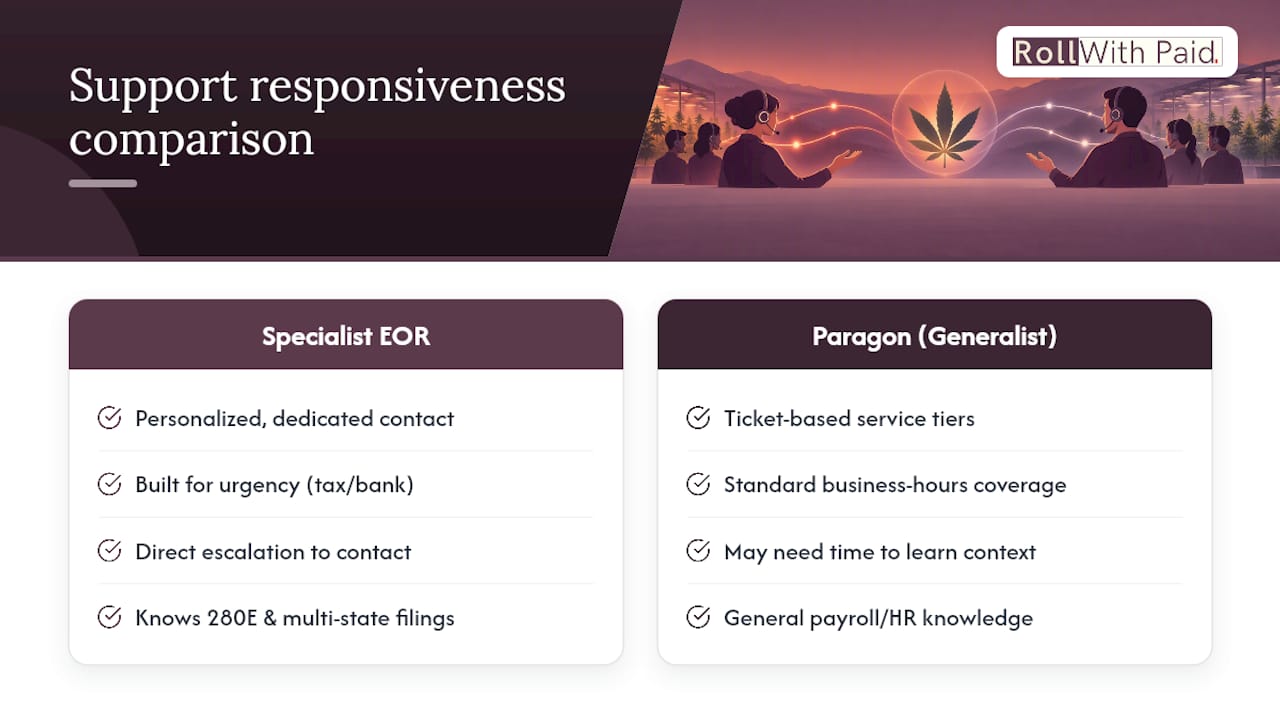
Support responsiveness separates specialist providers from mainstream ones once something goes wrong mid-cycle, and cannabis employers cannot afford a payroll issue sitting in a generic ticket queue for two days. Some providers offer personalized support and a dedicated relationship rather than a tiered help desk, which can be critical during tax season or banking disruptions when speed determines whether a filing deadline gets missed.
Paragon Payroll, evaluated as a general payroll and HR services category rather than a cannabis specialist, follows a more conventional support structure typical of mainstream providers: ticket-based service tiers, standard business-hours coverage, and account management that scales with plan level. That structure works well for low-risk industries with predictable payroll cycles, but it is not built around the compliance urgency that cannabis employers face when a bank exits the space or an examiner requests documentation on short notice.
The practical difference shows up in escalation paths. A specialist EOR model built for high-risk industries typically assigns a dedicated point of contact who already understands 280E labor allocation and multi-state cannabis filing requirements, so there is no education gap during a crisis. A generalist provider’s support team may need time to understand the regulatory context before they can even address the issue. For an operator weighing providers, the question is not just how fast the phone gets answered but whether the person on the other end already speaks the language of cannabis compliance.
Where most operators go wrong on payroll compliance
The most common mistake I see is treating timesheets as an afterthought. Contemporaneous, job-coded time tracking is the difference between a defensible 280E allocation and a spreadsheet an examiner discredits on sight. The second is signing contracts without negotiating offboarding rights, which turns a provider switch into a costly, drawn-out process. The third is hiring a general payroll vendor without confirming multi-state cannabis filing capability, then discovering the gap after expansion.
My recommended habit: reconcile the payroll register against departmental labor allocations every month, not once a year. Roll With Paid documents more of these patterns in its rundown of common payroll mistakes cannabis businesses can’t afford.
— Leah
How Roll With Paid supports high-risk employers
Some services build their offerings around the specific compliance burden cannabis and other high-risk operators carry, using an EOR model paired with audit-ready documentation and onboarding support designed for businesses many mainstream providers turn away.

The core services include:
- Employer of Record for liability and risk transfer
- Payroll execution with compliance-first filing practices
- HR and compliance solutions built around 280E documentation needs
- Seamless employee onboarding across multiple states
- Multi-state hiring support and time and attendance tools
Before committing, review the pricing and HR retainer options, ask for sample allocation workpapers, and confirm offboarding and data-portability terms directly in the agreement. Explore the full range of services and Employer of Record options to see what fits your operation, or reach out to request a demo tailored to your headcount and state footprint.
Sources
- Cannabis Payroll Compliance: Avoid 280E Audit Risks and Costly IRS Mistakes
- How cannabis businesses can ensure 280E tax compliance | BTCpa
- Multi-State Cannabis HR: 2026 Operator’s Playbook
FAQ
What are people saying about Paragon Payroll?
Paragon Payroll is generally discussed as a conventional payroll and HR services provider rather than a cannabis specialist, with support structured around standard business tiers. Reviews tend to focus on general payroll functionality rather than 280E-specific compliance features, which matters if your business is in a high-risk category.
What are the four types of payroll?
Payroll is commonly categorized by pay frequency: weekly, biweekly, semimonthly, and monthly, each affecting cash flow and administrative workload differently. The right frequency depends on state wage payment laws and the operational rhythm of the business, so it is worth confirming state rules before choosing one.
How does payroll work?
Payroll involves calculating gross wages, withholding taxes and deductions, and depositing the withheld amounts with the correct government agencies on a set schedule. Employers must also file returns like Form 941 and Form 940 and issue W-2s to employees by January 31 each year.
Does Roll With Paid offer an Employer of Record model?
Yes, Roll With Paid operates using an Employer of Record model designed for cannabis and other high-risk industries, pairing it with audit-ready payroll processes. Details on scope and setup are available through Roll With Paid’s pricing and service pages.
What should I ask a cannabis payroll provider about 280E?
Ask whether the provider supports contemporaneous, job-coded time tracking and a written labor allocation methodology, since these are what examiners request during a 280E audit. Also confirm whether monthly reconciliation between payroll registers and allocation policy is part of their standard process.
Recommended
- 280E and Payroll: What Cannabis Employers Need to Understand
- 5 Payroll Mistakes Cannabis Businesses Can’t Afford
- What Is an Employer of Record — and Why It Matters for Your Benefits
- I-9 and E-Verify: A Compliance Guide for Cannabis Employers
Roll With Paid. is not a law firm and does not provide legal advice. This article summarizes Minnesota law as of August 2026 and is general information only. Tip arrangements are fact-specific; before changing a policy, consult employment counsel or contact DLI Labor Standards at 651-284-5075.