
Cannabis Delivery Payroll: Rules, Risks and Setup
Cannabis delivery payroll is regular payroll with higher stakes. Drivers are usually employees, mileage and tips need clean records, and banking limits can interrupt direct deposit. Federal tax deposits and filings apply in every state, and your state’s delivery rules sit on top of them.
TL;DR
- Treat delivery drivers as employees unless counsel confirms otherwise. Minnesota law allows delivery by workers “employed by or contracted with” the service, but misclassification still triggers back taxes.
- Reimburse vehicle costs. The IRS business mileage rate is 76 cents per mile for July 1 to December 31, 2026.
- Plan for banking disruption. GAO reports that payroll providers can suspend service and account closures can disrupt payroll.
- Deposit and file on time. The IRS Failure to Deposit Penalty runs from 2% to 10% of the underpayment, depending on how late the deposit is.
- Keep audit-ready records for every driver, route and pay period.
Table of Contents
- Who counts as a cannabis delivery worker, and are drivers employees or contractors?
- How do overtime, tips and mileage work for cannabis delivery drivers?
- Can cannabis delivery drivers be paid by direct deposit?
- What federal payroll taxes and deadlines apply to cannabis delivery employers?
- What penalties hit cannabis delivery payroll when deposits or filings go wrong?
- How do state rules change cannabis delivery payroll in Minnesota, California and multi-state operations?
- What challenges do delivery operators bring to us, and how do we work through them?
- Which payroll provider models work for cannabis delivery?
- Does this apply beyond cannabis? Use cases in other high-risk industries
- Perspective: why we build delivery payroll around audit readiness
- What does cannabis delivery payroll cost with Roll With Paid.?
- FAQ
- Sources
Who counts as a cannabis delivery worker, and are drivers employees or contractors?
Most cannabis delivery drivers should be paid as W-2 employees. Delivery is core to a licensed retailer’s business, and the licensing rules in several states assume the driver works for the licensee.
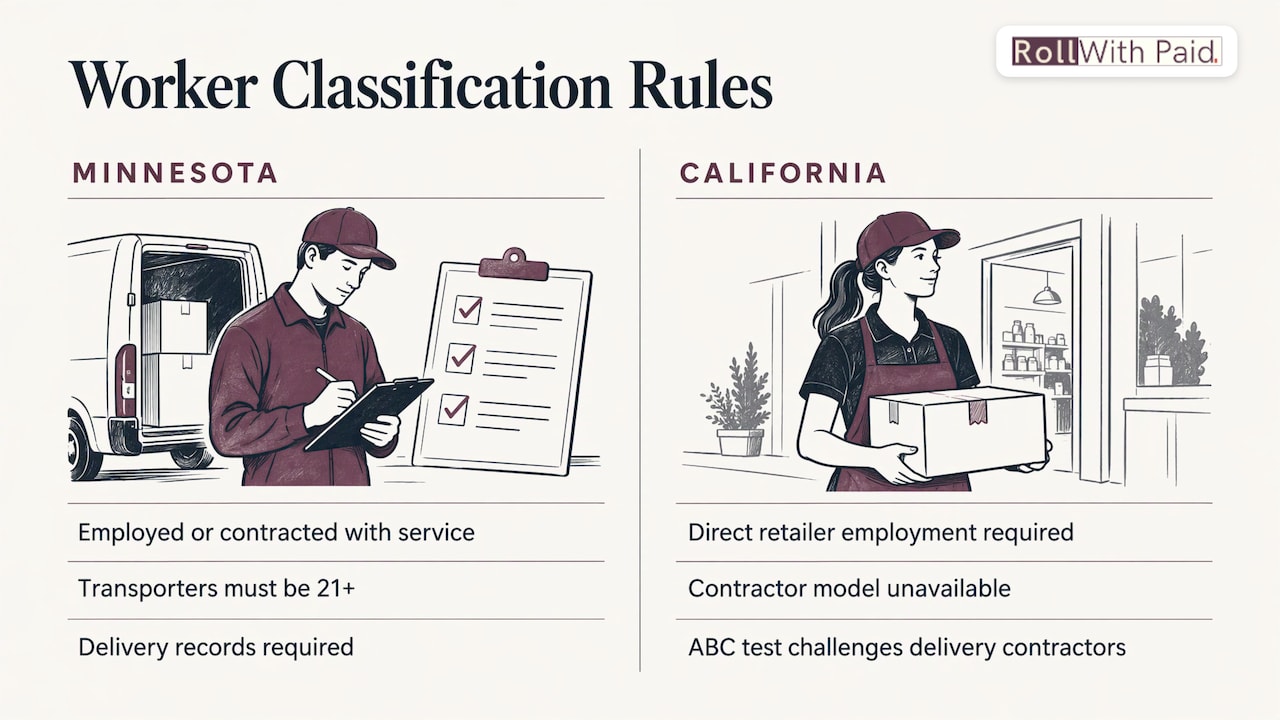
Minnesota is a clear example. Minnesota Statutes section 342.42 says only a cannabis worker employed by or contracted with the cannabis delivery service, and at least 21 years old, may transport cannabis products. The statute also requires delivery records, including proof of delivery to people who are 21 or older or enrolled in the registry program. Those records are compliance records and payroll records at the same time, because they show who was on the road and when.
California is stricter. In California, cannabis deliveries must be made by employees directly employed by the licensed retailer. Contractor models are not an option there. California’s ABC test also makes contractor status hard to defend. Commentary on the test describes three prongs, including whether the work falls outside the hiring party’s usual course of business. A dispensary’s delivery driver almost never passes that prong.
The cost of getting it wrong is the same everywhere. A misclassification finding can lead to back payroll taxes, penalties and interest. We see misclassification as one of the most expensive avoidable errors in this industry, because it surfaces during an audit, a workers’ compensation claim or an unemployment claim, never on a schedule you choose.
Employee vs. contractor: a quick comparison
| Question | W-2 employee driver | 1099 contractor driver |
|---|---|---|
| Employer withholds payroll taxes | Yes | No |
| Overtime owed under state rules | Yes, where the state requires it | Generally no, if classification holds |
| Vehicle expense reimbursement | Required in some states, such as California | Driver bears costs, if classification holds |
| Workers’ compensation coverage | Required in most states | Often disputed after an injury |
| Audit exposure | Lower | High for core delivery roles |
The contractor column looks cheaper until a reclassification happens. Then the employer owes the taxes and penalties anyway.
How do overtime, tips and mileage work for cannabis delivery drivers?
Overtime, tips and mileage follow your state’s wage rules, and drivers’ hours are the field most likely to be recorded wrong. California shows the high end of the range. Overtime there is time and a half after 8 hours in a day or 40 in a week, and double time after 12 hours in a day. Many other states, Minnesota included, calculate overtime on weekly hours. Check your state’s labor department for the rule that applies to your drivers.
Tips need their own handling. Wages, tips and other compensation are reported on Form 941, so tips that drivers receive through any channel belong in the payroll record. Where a driver’s compensation includes tips, track them per driver, per pay period, in the same system that runs payroll.
Mileage is where delivery payroll differs from a counter job. The IRS publishes the standard mileage rates: 72.5 cents per mile for January 1 to June 30, 2026, and 76 cents per mile for July 1 to December 31, 2026. Many employers use this rate as a benchmark for reimbursement.
California adds a legal floor. Commentary on Labor Code section 2802 says employers must indemnify employees for necessary expenses, and that a flat per-delivery fee can fall short of full reimbursement. Confirm the specifics with employment counsel before you set a reimbursement formula.
Time tracking that supports payroll
A driver’s day has loading, routes, waiting, returns and end-of-shift reconciliation. If the clock only captures “in” and “out,” meal breaks and overtime disputes turn into guesswork. We build delivery payroll around time and attendance tools that feed hours straight into the payroll run, so there is one record and no spreadsheet re-keying. Our related guide on biometric time clocks covers how owners cut manual exports.
Can cannabis delivery drivers be paid by direct deposit?
Yes, but it depends on the provider and the bank behind it. Direct deposit is a bank transaction, and banks assess marijuana-related businesses against federal anti-money-laundering obligations.
The GAO’s August 2026 report on cannabis banking found that payroll providers can suspend services, and that account closures can disrupt payroll. It also found that limited payment options push businesses into cash-heavy workflows with added fees and safety problems. FinCEN’s guidance explains the bank’s side: a financial institution decides on each account using its own factors, and customer due diligence is central, including verifying state licensing and monitoring activity over time.
A real example of the disruption: in 2023, Paychex stopped processing direct deposits for cannabis-related businesses and offered check-based services instead. Operators who relied on that setup had to rebuild their pay process on a short timeline. We wrote up the lesson in our comparison, Roll With Paid vs. Paychex for cannabis.
Direct deposit vs. paper checks vs. cash
| Method | Strength | Risk for a delivery operator |
|---|---|---|
| Direct deposit | Fast, traceable, no cash on drivers | Depends on a bank and provider that accept cannabis clients |
| Paper checks | Works when electronic rails fail | Slower, check-cashing friction for drivers |
| Cash | No bank needed | Safety exposure, fees, and tax-payment complications |
Cash deserves a warning for drivers specifically. They already carry product and payments on the road. The GAO also noted that an industry representative said the IRS may charge a penalty on taxes paid in cash. Paying wages by traceable methods protects both the driver and the audit trail.
What federal payroll taxes and deadlines apply to cannabis delivery employers?
Cannabis employers owe the same federal employment taxes as every other employer. The IRS employment tax due dates set the rhythm:
- Form 941 reports wages, tips and other compensation each quarter. It is generally due by the last day of the month after the quarter ends.
- Form 940 is filed annually for most employers.
- Forms W-2 and W-3 are due to the Social Security Administration by January 31.
- A due date that lands on a weekend or legal holiday moves to the next business day.
Deposits come first. The IRS says employers generally deposit taxes reported on Form 941 or 944 on a monthly or semiweekly schedule, and the schedule depends on prior reported liability. A growing delivery team can push a company from monthly to semiweekly deposits without anyone noticing.
Do cannabis businesses owe more tax than other businesses?
Section 280E of the Internal Revenue Code limits deductions for businesses trafficking in controlled substances, so how payroll costs are allocated matters for cannabis operators. That is a tax-planning question for your CPA, but your payroll records feed it. We cover the payroll side in our guide on avoiding 280E exposure.
What penalties hit cannabis delivery payroll when deposits or filings go wrong?
The IRS Failure to Deposit Penalty applies when deposits are late, short or made the wrong way. The IRS manual sets the rate by how late the deposit is: 2% for 1 to 5 days late, 5% for 6 to 15 days late, and 10% for more than 15 days. The IRS also publishes the penalty’s general rules.
The larger exposure is personal. The Trust Fund Recovery Penalty can be assessed against responsible persons for willfully failing to collect or pay withheld employment taxes. The amount equals the unpaid trust fund balance. For an owner, that means the problem follows you, not just the company.
In our experience, three delivery-specific errors lead to those penalties:
- Drivers added mid-quarter without a payroll setup, so wages go unreported.
- Mileage and tips handled outside payroll, so withholding is wrong.
- A bank or provider interruption that delays a deposit, with nobody watching the calendar.
Our article on five payroll mistakes cannabis businesses cannot afford goes further on the pattern.
How do state rules change cannabis delivery payroll in Minnesota, California and multi-state operations?
State rules decide who may deliver, how records are kept and what you owe on top of federal taxes. Parallel examples show the difference.
Minnesota
Minnesota Statutes section 342.42 allows delivery only by a cannabis worker who is at least 21 and employed by or contracted with the delivery service. The state’s Office of Cannabis Management sets delivery record-keeping and transport-limit rules by rule, and deliveries are recorded in the statewide monitoring system. Payroll should tie each delivery shift to a named, age-verified worker.
California
California requires employee drivers for retail deliveries and full reimbursement of necessary vehicle expenses. The state’s EDD says employers must report all wages, including noncash payments such as cannabis products and meals or lodging. EDD also requires payroll records for at least four years, or at least eight years for non-subject employers, and electronic filing of returns, wage reports and deposits.
One point matters for banking-limited operators. EDD says a cannabis business without a bank account must still pay payroll taxes electronically, or submit an E-File and E-Pay Mandate Waiver Request (DE 1245W).
Multi-state operators
A multi-state operator faces a separate registration, tax account and wage rule set per state. A driver who crosses a state line in the course of a shift is not a typical case, because cannabis cannot legally cross state lines, but staff who work across locations in different states are. Hiring, onboarding and tax setup must match the state where the work is performed. Our guide to audit-ready multi-state cannabis payroll lays out what to set up before the first paycheck.
What challenges do delivery operators bring to us, and how do we work through them?
Our business development and implementation teams hear the same four situations from delivery operators.
A processor that pulled out. The operator’s payroll provider stops serving cannabis, and a pay date is days away. We work through it by building the pay process on a provider structure designed for high-risk industries, and by confirming how and when drivers will be paid before the first run.
Drivers paid as contractors. The owner started with 1099 drivers for speed, then learned how classification works. We move the drivers onto payroll, set up onboarding and I-9 support, and review workers’ compensation classification codes.
Mileage handled by hand. Reimbursements are in a spreadsheet, apart from payroll. We bring mileage into the payroll record so each pay period shows one consistent figure per driver.
A new state. The operator wins a license in a second state and needs registrations, wage-rule review and hiring support before hiring anyone.
Questions operators ask us
“Can we just pay delivery drivers in cash to avoid the bank problem?” We advise against it. Cash adds safety risk for drivers, and payroll taxes still apply to cash wages. A traceable payment method protects your records.
“Do we pay drivers for time waiting between orders?” Generally yes, hours worked under direction count as hours worked. Your state’s wage rules set the details, so confirm them with your state labor department or counsel.

“Will our workers’ compensation cost more for drivers?” Premiums depend on classification code and headcount, which is why correct coding matters. Our Employer of Record model is designed to help reduce workers’ compensation cost.
Which payroll provider models work for cannabis delivery?
The right model depends on whether a provider will serve cannabis, who carries the compliance burden and how the money moves.
| Model | What it means | Fit for delivery operators |
|---|---|---|
| Mainstream payroll software | You run payroll yourself on general-purpose software | Works only if the provider and its bank accept cannabis clients |
| Cannabis-specific payroll service | Provider built for the industry | Better fit for audit readiness and banking limits |
| Employer of Record (EOR) | Provider becomes the employer of record for payroll, taxes and HR administration | Shifts administrative and liability load, and suits teams adding drivers fast |
Our own comparisons cover Greenleaf HR, Paragon Payroll and Clutch. Our deeper explainer on Employer of Record for high-risk industries shows how the model works.
Does this apply beyond cannabis? Use cases in other high-risk industries
The same payroll pressure shows up wherever drivers, tips and risk classifications meet. A bar or restaurant running delivery has tipped staff, mileage and workers’ compensation to coordinate. A construction or trades crew has job-site travel, multiple pay rates and high-risk classification codes. Our construction and trades case study shows that work. The lesson carries over: one payroll record, correct classification, and deposits that never depend on a single fragile bank relationship.
Perspective: why we build delivery payroll around audit readiness
Delivery payroll fails in small, ordinary ways. A driver is added on a Friday. A mileage claim lives in a text message. A bank flags a payment on deposit day. Each is minor alone, and together they become the quarterly fire drill.
We built Roll With Paid. for operators that traditional payroll providers turn away. Our Employer of Record model is designed to put classification, tax filing, workers’ compensation and onboarding in one place, so your team can focus on routes and customers.
Our goal is simple: on-time filings, clean records and a payroll process you can explain to an auditor without scrambling.
Leah Kollross
What does cannabis delivery payroll cost with Roll With Paid.?
We bill a service fee based on gross payroll, with an optional flat-rate HR retainer. Rates vary by worker classification code and headcount, so we quote each operator individually. See how it works on our pricing page.

If you are adding drivers or opening delivery in a new state, our team can set up payroll execution, Employer of Record and HR compliance together. For updates on payroll risk and regulation, subscribe to the Roll With Paid. newsletter.
FAQ
Are cannabis delivery drivers paid hourly or per delivery?
Most employers pay hourly, often with tips and mileage reimbursement on top. Per-delivery pay is possible, but wage and overtime rules still apply to total hours worked. Confirm minimum wage compliance against your state rules.
Can a cannabis delivery business use ordinary payroll software?
Sometimes, but the software provider and its bank must accept cannabis clients. GAO reports that payroll providers can suspend services. Confirm the provider’s policy in writing before you run your first payroll.
How long should cannabis payroll records be kept?
California’s EDD requires at least four years, or at least eight for non-subject employers. Other states differ, so check your state’s employment agency. Keep delivery shift, mileage and tip records alongside wage records.
Who is liable if our payroll taxes are not paid?
The business is liable, and the IRS can also assess the Trust Fund Recovery Penalty against responsible persons. The penalty equals the unpaid trust fund taxes. Using a provider that files and deposits on time reduces that exposure.
Sources
- Minnesota Statutes 342.42, cannabis delivery service operations
- IRS standard mileage rates
- Cannabis Worker Rights in California
- California Delivery Driver Misclassification
- California Labor Code 2802 guide
- Is Paying Cannabis Employees Legal?
- GAO-26-107498, Banking Services
- FinCEN FIN-2014-G001
- MJBizDaily on Paychex ceasing direct deposits
- IRS employment tax due dates
- IRS Topic no. 757
- IRS Failure to Deposit Penalty
- IRM 20.1.4 Failure to Deposit Penalty
- IRS Trust Fund Recovery Penalty
- EDD Cannabis Industry Payroll Tax Reporting
Recommended
- Cannabis Industry Payroll: Rules, Risks and Provider Models
- Cannabis Transporter Payroll: Pay, Taxes and Compliance
- Cannabis Payroll: Avoid 280E Exposure: Roll With Paid vs Greenleaf HR
- Before Your First Paycheck: Audit Ready Multi-State Cannabis Payroll
Roll With Paid. is not a law firm and does not provide legal advice. This article summarizes Minnesota law along with other states and jurisdictions law and is for general information only. Before changing a policy, consult employment counsel or contact DLI Labor Standards at 651-284-5075.