
Avoid a Payroll Freeze: Roll With Paid vs. Paychex for Cannabis

For cannabis dispensaries, cultivators, and other high-risk businesses, a specialist payroll and Employer of Record provider like Roll With Paid is the safer choice over a mainstream processor like Paychex. The rationale is straightforward: specialist providers maintain banking continuity, structure payroll with 280E-aware labor allocation, and keep your records audit-ready. Your next move, before anything else, is to confirm your current provider’s continuity plan and gather your payroll and tax documents in case you need to migrate quickly.
TL;DR:
- Mainstream payroll providers may exit cannabis clients suddenly, risking missed taxes, frozen accounts, and payroll disruptions.
- Cannabis-related wages often cannot be deducted unless properly allocated to cost of goods sold, increasing after-tax labor costs.
- Specialized providers include audit-ready workflows, cannabis-compliant banking solutions, and employer of record structures to mitigate legal risks.
- Transitioning payroll requires careful steps such as notifying banks, securing funds, and testing new systems to avoid missed pay cycles.
- Effective modeling of labor costs must separate production wages eligible for COGS from nondeductible retail and administrative wages.
Table of Contents
- Why mainstream providers can suddenly become unavailable and what that means for you
- How 280E actually affects payroll, deductions, and audit risk
- What specialized cannabis payroll/EOR providers do differently
- Concrete, prioritized checklist to move payroll with minimal risk
- Modeling the true after-tax cost of labor under 280E
- Vetting checklist: exact questions and red flags to use when interviewing providers
- Why a dedicated provider matters more than operators expect
- How Roll With Paid can help
- Primary sources and authoritative references
- Sources
- FAQ
Why mainstream providers can suddenly become unavailable and what that means for you
Mainstream payroll companies are not built for the banking and compliance exposure that cannabis creates, and some have pulled back when that exposure felt too great. Paychex suspended key services for cannabis clients in 2023, scaling back direct deposit, tax administration, and timekeeping support and forcing numerous operators into rapid, unplanned migrations. A comparison of Paychex’s services is available on its own site, though it does not address cannabis-specific risk.
When a provider exits abruptly, the fallout is operational, not just administrative. You can face:
- Missed federal or state tax deposits, which trigger penalties almost immediately.
- Frozen payroll accounts if your bank reacts to the provider’s own risk posture.
- Payroll interruptions that leave workers unpaid on schedule.
- Licensing jeopardy, since many cannabis regulators treat payroll and labor compliance as part of your operating standing.
These decisions trace back to banking relationships. A payroll processor’s own bank sets the risk tolerance, and cannabis deposits sit well outside what most mainstream banks will carry without a dedicated compliance structure behind them.
How 280E actually affects payroll, deductions, and audit risk
IRC Section 280E denies ordinary business deductions to companies that traffic in a Schedule I substance, and the IRS has confirmed that marijuana remains Schedule I, so 280E’s restrictions still apply unless federal law changes. For payroll, that means most wages are not deductible unless they can be properly allocated to cost of goods sold.
Deposit penalties escalate with lateness, starting at low percentages and increasing significantly as delay continues, according to guidance on cannabis payroll compliance, which makes timely, correctly classified payroll deposits a genuine compliance priority rather than a paperwork formality.
In practice, this breaks down as follows:
- Employer-side payroll taxes (FICA, FUTA, SUI) generally remain deductible regardless of 280E.
- Wages for cultivation and production roles can often be allocated to COGS, preserving some deductibility.
- Wages for retail, sales, and administrative roles typically cannot, and are treated as nondeductible.
- Reconstructing these allocations after the fact, rather than logging them in real time, is one of the clearest audit red flags examiners look for.
Contemporaneous timekeeping tied to specific roles and production activity is not optional diligence. It is the documentation an auditor expects to see when your COGS allocation gets questioned.
What specialized cannabis payroll/EOR providers do differently
A payroll provider built for mainstream, low-risk employers rarely has the plumbing cannabis operators actually need. Cannabis-focused providers build three things into their core workflow that mainstream platforms usually treat as an afterthought, if they address them at all.
- Audit-ready workflows: role tagging, paired timekeeping, and, where relevant, integration with point-of-sale or seed-to-sale systems so labor hours can be matched to production records.
- Banking and payments: acceptance of cannabis clients as a matter of course, plus contingency pay methods such as checks or armored cash delivery when direct deposit is restricted, each paired with signed receipts to avoid frozen funds.
- Employer of Record structure: centralized tax deposits, liability management, multi-state hiring support, and reduced workers’ compensation exposure through a single employment relationship.
Guidance on cannabis payroll compliance notes that when electronic banking is unavailable, acceptable fallbacks such as signed checks or armored cash disbursement must carry unique identifiers linking the payment to recorded hours worked, or they will not hold up under audit scrutiny. A deeper look at how the EOR model reduces legal and administrative exposure is worth a read if you have not weighed this structure before.
Pro Tip: Ask any prospective provider to show you, not describe, how a single pay period’s hours trace from timeclock to paycheck to tax deposit. If they cannot produce that trail on request, assume an auditor would have the same problem.
Concrete, prioritized checklist to move payroll with minimal risk
A provider transition does not have to mean a missed payroll cycle, but it does require sequence discipline. Work through these steps in order:
- Notify your bank of the pending change and freeze any pending payroll modifications.
- Secure current payroll funds and calendar every upcoming tax deposit deadline.
- Export and hand off documentation: timesheets, tax payment history, worker classifications, and I-9 records.
- Set up accounts with the new provider and run a test payroll before going live.
- Arrange a fallback pay method in case electronic transfers are delayed.
- Confirm state electronic funds transfer schedules so deposits land on time under the new system.
Once the new provider is live, verify the handoff worked before you fully let go of the old one.
- Run parallel payroll for at least one cycle to compare results line by line.
- Confirm that tax deposits actually posted, not just that they were submitted.
- Retain signed receipts for any cash or check payroll runs as part of your permanent record.
The common payroll mistakes cannabis businesses make during transitions are worth reviewing before you start.
Modeling the true after-tax cost of labor under 280E
Hiring decisions in cannabis need a different cost model than most industries use, because 280E changes what a dollar of wages actually costs you after tax. Employer-side FICA, FUTA, and state unemployment insurance remain deductible, but most wages do not unless they are allocated to COGS, which means your effective labor cost can run meaningfully higher than the gross payroll number suggests.
- Employer payroll taxes stay deductible regardless of 280E’s restrictions.
- Cultivation and production wages are the strongest candidates for COGS allocation.
- Retail and administrative wages are typically treated as nondeductible expenses.
- Benefits and most administrative compensation should be modeled as nondeductible when forecasting margin.
Tax advisers who specialize in cannabis recommend splitting production and retail into separate entities where feasible, since isolating cultivation wages under a dedicated entity makes a stronger case for COGS treatment under IRC 263A. Payroll service fees and workers’ compensation premiums belong in this same model. Read our guide to 280E’s effect on payroll for a fuller walkthrough of the allocation mechanics.
Vetting checklist: exact questions and red flags to use when interviewing providers
Before signing with any provider, mainstream or specialist, ask direct questions and watch how confidently they answer.
- Do they have documented experience serving cannabis or other high-risk clients specifically?
- What banking partners do they use, and will those partners accept cannabis-related deposits without restriction?
- What happens to your tax deposits if their banking relationship changes?
- Do they have a contingency payroll plan for banking disruptions, and have they used it before?
Red flags include evasive answers about banking partners, no documented contingency plan for deposits, and vague or generic explanations of how they handle 280E-related allocations. Ask for a sample reconciliation, their onboarding checklist, and references from other cannabis clients before you commit.
Why a dedicated provider matters more than operators expect
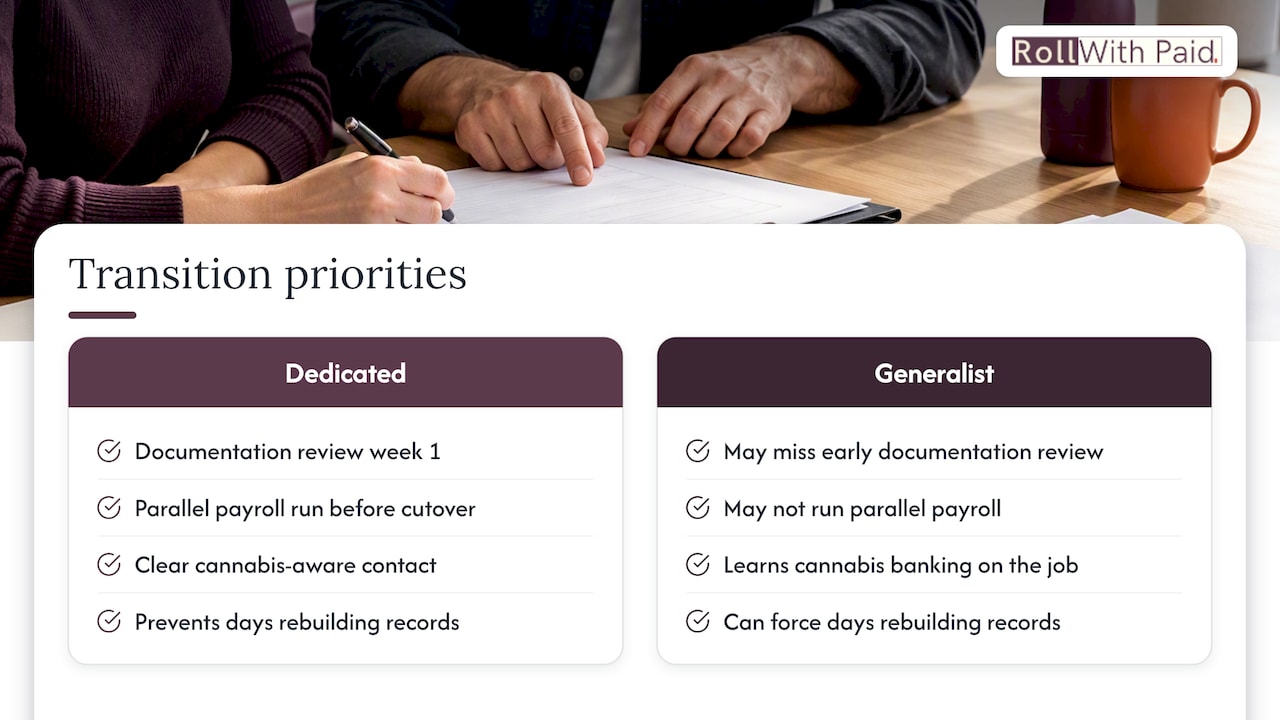
A dedicated provider specializing in payroll and HR solutions for high-risk industries can demonstrate particular value during a provider transition, where generalist platforms may encounter challenges. Operators who migrate without a specialist partner often lose days reconstructing timekeeping records that should have existed all along.
With the right onboarding, you should expect a documentation review in the first week, a parallel payroll run before full cutover, and a clear point of contact who already understands cannabis banking constraints rather than learning them on your account.
— Leah
How Roll With Paid can help
Switching payroll providers under deadline pressure is stressful, but you do not have to rebuild your compliance plumbing from scratch. Roll With Paid maps directly to what cannabis operators need: Employer of Record structure, payroll execution, audit-ready documentation, and multi-state hiring support in one relationship.

- Employer of Record services that centralize tax deposits and reduce your workers’ compensation exposure.
- Payroll execution built around contingency banking and documented labor allocation.
- Multi-state hiring and I-9 support for operators expanding across licenses.
Onboarding typically starts with your current timesheets, tax payment history, and worker classifications, the same records your migration checklist above should already have ready. Review the service rate and HR retainer options or visit the Roll With Paid homepage to book a consultation and get a transition timeline for your business.
Primary sources and authoritative references
The guidance above draws on federal tax authority, direct industry reporting, and cannabis-specific accounting expertise.
- Reporting on Paychex’s 2023 service withdrawal from cannabis clients.
- Cannabis payroll and employment tax guidance under IRC 280E.
- Payroll outsourcing guidance for vetting third-party partners.
Sources
- HR Company Paychex To Stop Serving 300+ Cannabis Companies
- Cannabis payroll and employment tax under IRC 280E
FAQ
Is Roll With Paid better than Paychex for cannabis businesses?
For cannabis and other high-risk employers, a specialist provider is generally the stronger choice because it builds banking continuity and 280E-aware labor allocation into its core service, something mainstream processors are not structured to guarantee. Roll With Paid is built specifically around this risk profile through its Employer of Record model.
What happened with Paychex and cannabis clients?
Paychex scaled back services for cannabis clients in 2023, cutting direct deposit, tax administration, and timekeeping support and forcing many operators to migrate providers on short notice. This is the main reason cannabis operators now vet payroll providers for continuity risk before signing on.
How does 280E affect my payroll costs?
IRC Section 280E denies deductions for most ordinary business expenses in cannabis, which means wages for retail and administrative roles are typically nondeductible unless they qualify as cost of goods sold. Employer-side payroll taxes remain deductible regardless, but production wages need contemporaneous documentation to support COGS allocation.
How long does a payroll provider migration take?
Timelines vary by headcount and documentation readiness, but a parallel payroll run before full cutover is the standard way to confirm a new provider’s setup works correctly. Expedited onboarding is possible when a deadline forces it, though skipping the parallel run increases the risk of a missed payroll cycle.
What should I do first if my current provider drops cannabis clients?
Notify your bank, freeze pending payroll changes, and secure your current funds before anything else, since frozen accounts and missed deposits are the most immediate risks. From there, export your timesheets, tax history, and worker classifications so a new provider can pick up without delay.
Recommended
- 5 Payroll Mistakes Cannabis Businesses Can’t Afford
- 280E and Payroll: What Cannabis Employers Need to Understand
- I-9 and E-Verify: A Compliance Guide for Cannabis Employers
Roll With Paid. is not a law firm and does not provide legal advice. This article summarizes Minnesota law as of August 2026 and is general information only. Tip arrangements are fact-specific; before changing a policy, consult employment counsel or contact DLI Labor Standards at 651-284-5075.