
Cannabis Cultivator Payroll: Rules, Taxes and Provider Models

Cannabis cultivator payroll is ordinary employer payroll with higher stakes: the same withholding, deposits and wage-and-hour rules apply, plus Section 280E cost treatment, state-specific overtime and a stricter audit posture. Cultivators that document every wage, classify every worker correctly and file on time stay audit-ready. Cultivators that treat grow staff as a loose crew do not.
TL;DR
- Cannabis status relaxes no payroll rule. Registration, withholding, wage reporting and electronic deposits all still apply.
- Direct labor in a grow, including wages, overtime and payroll taxes, can be a production cost under the IRS’s 280E training material.
- Overtime for grow workers depends on the state and on the task: California, Oregon, New York and Maine each treat cultivation differently.
- Multi-state operators need one payroll calendar built from each state’s rules, not one template copied across states.
- Roll With Paid. runs payroll, HR compliance and Employer of Record services for cannabis and other high-risk employers.
Table of Contents
- How is cannabis cultivator payroll different from standard payroll?
- How does Section 280E affect cultivation payroll?
- What federal payroll taxes and deadlines apply to cannabis cultivators?
- How do overtime and classification rules differ for grow employees by state?
- How should multi-state cannabis operators handle payroll?
- What payroll records keep a cultivation business audit-ready?
- What should a cultivator do after finding a payroll error or missed filing?
- Which payroll models do cannabis cultivators use?
- What challenges do cultivators face when moving payroll to a specialist?
- What do cultivation payroll use cases look like?
- What questions do growers ask about payroll?
- Why do we run cultivation payroll through an Employer of Record model?
- Can Roll With Paid. take cultivation payroll off your desk?
- FAQ
- Sources
How is cannabis cultivator payroll different from standard payroll?
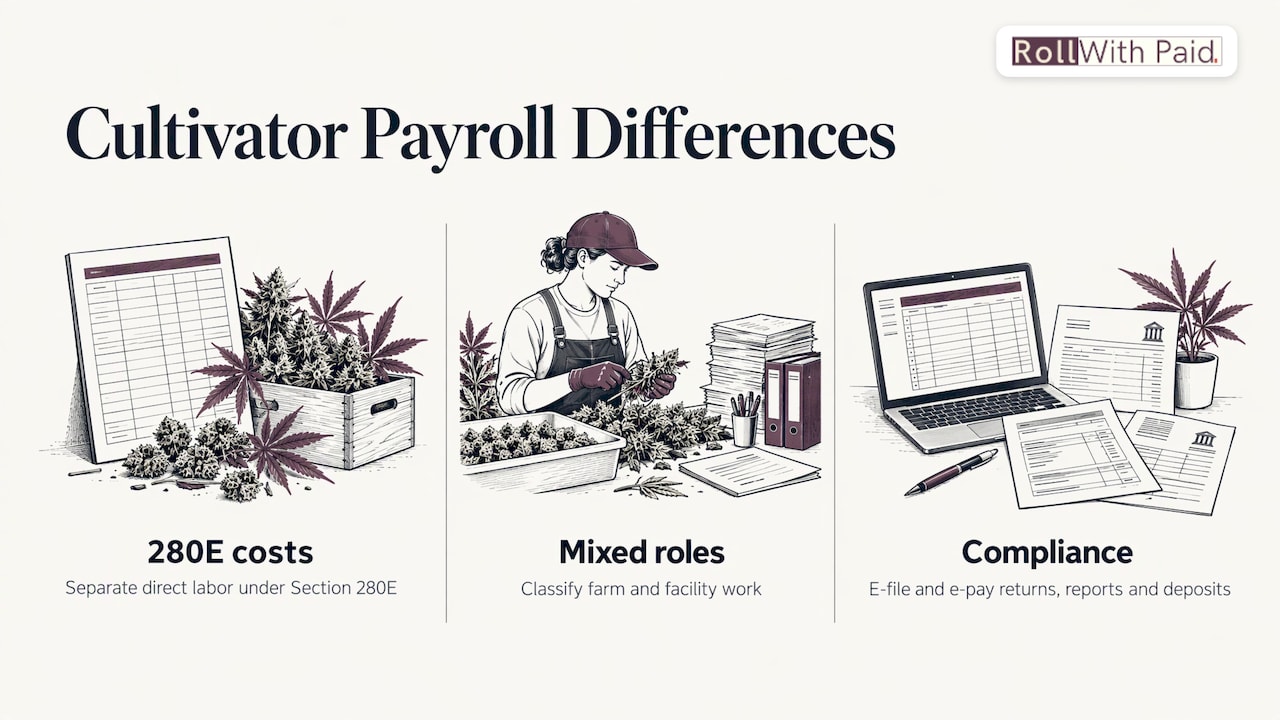
Cultivator payroll differs from standard payroll in three ways: cost allocation under Section 280E, mixed agricultural and non-agricultural job duties, and heavier scrutiny from regulators and banks. The mechanics of paying people are the same.
California’s EDD makes the baseline clear. Its cannabis payroll guidance says cannabis businesses with employees must withhold, report and remit payroll taxes, and it lists cultivators and trimmers among typical covered roles. Its DE 643 guide adds that employers must e-file and e-pay returns, wage reports and deposits.
The difference is in the consequences of getting it wrong. A grow has a large seasonal or batch-driven workforce, trimmers paid by shift or by output, and supervisors whose duties blur between farm work and facility work. Each of those creates a classification question. Payroll for a cultivator is therefore as much a documentation exercise as a payment exercise.
For the wider picture across the industry, see our guide to cannabis industry payroll rules, risks and provider models.
How does Section 280E affect cultivation payroll?
Section 280E affects cultivation payroll by limiting which labor costs a plant-touching business can recover through cost of goods sold. Direct labor in a grow is the strongest candidate, so how you record it matters.
The IRS’s 2022 cannabis training material lists direct labor costs, basic compensation, overtime, vacation and holiday pay, sick leave, shift differential and payroll taxes as potential direct-cost or production-cost components in cost-of-goods-sold analysis. It also identifies payroll taxes as part of inventory cost computations.
In practice, that means a cultivator’s payroll register should be able to separate:
- Hours and wages for workers who handle plants (planting, trimming, harvest, drying).
- Hours and wages for administrative, sales or executive staff.
- Mixed-role employees, whose time needs a documented split.
Payroll that lumps everyone into one department makes that split a year-end reconstruction. Your tax advisor decides the final treatment, but the payroll system should hand the advisor clean, role-level data. We cover the subject in more depth in 280E and payroll: what cannabis employers need to understand and in our guide to manufacturing payroll and 280E.
What federal payroll taxes and deadlines apply to cannabis cultivators?
Cultivators owe the same federal employment taxes as any employer: income tax withholding, Social Security and Medicare, and FUTA. The deposit schedule depends on your tax liability.
- Deposit frequency. IRS Topic 757 says employers with $50,000 or less in lookback-period employment taxes generally deposit monthly, by the 15th of the following month. Employers above $50,000 generally deposit semiweekly, based on payday.
- Deposit method. The same IRS page requires electronic deposits through EFTPS, an IRS Business Tax Account or IRS Direct Pay for Businesses.
- Quarterly or annual return. The IRS’s 2026 Publication 15 says agricultural employers generally file Form 943 annually, while other employers file Form 941 quarterly. The annual filing deadline is generally January 31 when deposits were timely. Whether grow staff count as agricultural labor depends on the work performed, so confirm the filing form with your CPA.
- FUTA. The IRS says a FUTA deposit is required for a quarter when FUTA due exceeds $500, generally by the end of the month after quarter-end.
The cannabis-specific complication is banking. If a cultivator cannot hold a stable business checking account, deposits still must be made. California’s EDD states that inability to maintain a checking account does not remove the duty to pay payroll taxes, and tells employers to contact their local Employment Tax Office to arrange deposits. Settle the deposit route before your first payroll, not after your first missed deadline.
How do overtime and classification rules differ for grow employees by state?
Overtime for grow employees depends on the state and on whether the worker performs agricultural or non-agricultural tasks. Four states show how far the rules diverge.
California
California places cannabis cultivation under Wage Order 4, not the agricultural Wage Order 14. The state’s DIR says cultivation employees receive overtime after eight hours in a day or 40 hours in a week, with specified double-time rules. Labor contractors that supply cultivation workers must hold a farm labor contractor license.
On classification, the EDD says workers are generally employees unless they meet the ABC or Borello test or another specific legal rule. Labels such as part-time, temporary, day-labor or probationary do not by themselves remove employee status. For California-specific finance and payroll resources, see these California payroll compliance resources.
Oregon
Oregon cannabis-farm guidance says employees doing agricultural work for 100 percent of the workweek may be exempt from overtime, while employees performing non-agricultural tasks must receive overtime for hours over 40. A small-farm minimum-wage exemption may apply under federal law when the employer did not exceed 500 man-days of agricultural labor in any preceding-year quarter. Employers must test both federal and state exemptions.
New York
Cornell’s ILR employer guide states that most covered employees receive overtime at 1.5 times the hourly rate after 40 hours. New York farm laborers receive 1.5 times pay after 56 hours and a full 24-hour rest day each week. A grow that mixes farm-style and facility-style duties needs to know which rule governs each role.
Maine
Maine’s 2025 cannabis employment guide says the $14.65 minimum wage and overtime after 40 hours apply to cannabis businesses, with no cannabis-specific wage-and-hour exemption. It also says all employers must register for Paid Family and Medical Leave and began contributions on January 1, 2025.
For the retail side of the same question, our page on dispensary overtime rules shows how the analysis changes when plants are not involved.
How should multi-state cannabis operators handle payroll?
Multi-state operators should run one payroll calendar built from each state’s separate rules, because cannabis licensing, wage law, unemployment insurance and paid leave all stay state-specific. No single template survives contact with the second state.
The four states above already show the problem: California daily overtime, Oregon agricultural exemptions, New York’s 56-hour farm threshold and Maine’s paid leave registration all sit side by side. A grower with sites in two of them has two overtime engines, two registration sets and two sets of quarterly filings.
What works in practice:
- Register as an employer in each state before the first hire there, not after the first shift.
- Tag every employee to a work state, a job role and a cost category (direct production or not) at hire.
- Keep one master calendar of federal and state deposit and filing dates.
- Treat employees who cross state lines as a separate review item.
This is where an Employer of Record structure often earns its place, since one compliance owner handles the registrations and filings. Our guide to audit-ready multi-state cannabis payroll walks through the pre-launch setup, and our multi-state hiring support covers the hiring side.
What payroll records keep a cultivation business audit-ready?
An audit-ready cultivator keeps wage records by employee, role and workweek for at least three years, and ties payroll to accounting and inventory controls. The three-year figure comes from FLSA guidance.
The National Council of Agricultural Employers says FLSA records should include employee identity and address, occupation, workweek start, daily and weekly hours, pay basis, earnings, additions and deductions, retained for at least three years.
New York’s cannabis training material goes further and frames payroll as part of a system. It advises documented accounting and tax SOPs, a description of accounting, payroll and inventory systems, and assigned responsibility for internal controls. Payroll that cannot be reconciled to inventory and the general ledger is the weak link in a cultivation audit.
A short working list:
- Time records that match the hours paid, with edits logged.
- Written job descriptions that match actual duties.
- I-9 files complete for every employee.
- Quarterly wage detail (names, Social Security numbers, wages) that matches payroll registers.
- Written payroll and timekeeping policies, signed by employees.
What should a cultivator do after finding a payroll error or missed filing?
A cultivator that finds a payroll error should correct it promptly with the matching IRS form and document the fix. Speed limits the penalty and interest that build up.
The IRS says employers should correct employment-tax errors using the corresponding 94X-X form, such as Form 941-X for an erroneous Form 941. Form 940 errors use an amended Form 940, and Form 843 can request penalty or interest abatement. The same page says federal withholding errors generally can be corrected only if discovered in the same calendar year wages were paid, and over-collected amounts generally must be repaid or reimbursed to employees that year.
That same-year rule is why a November discovery is more urgent than a January one. Check state wage reports and deposits at the same time, since a federal fix does not repair a state filing.
Which payroll models do cannabis cultivators use?
Cultivators generally choose among four models: in-house payroll, a mainstream payroll provider, a cannabis-focused payroll vendor, or an Employer of Record. The right one depends on who carries compliance risk.
| Model | Who carries filing and compliance work | Fit for a cultivator |
|---|---|---|
| In-house payroll | Your team | Workable for one state and a small, stable crew with a strong bookkeeper |
| Mainstream payroll provider | Mostly you, with the provider processing | Some providers decline cannabis or high-risk accounts |
| Cannabis-focused payroll vendor | Shared | Better industry knowledge, though HR and workers’ compensation are often separate |
| Employer of Record | The Employer of Record handles payroll, HR compliance and workers’ compensation | Suited to multi-state growth and risk reduction |
We publish side-by-side pages if you are weighing vendors, including Clutch versus Roll With Paid, Greenleaf HR versus Roll With Paid and Paragon Payroll versus Roll With Paid. Our explainer on Employer of Record for high-risk industries covers how the model shifts liability.
What challenges do cultivators face when moving payroll to a specialist?
The challenges that come up most with growers are misclassification, messy time records, unclear cost categories and missed state registrations. These are the patterns our business development and implementation teams plan around.
- Misclassification. Crew members paid as contractors, or exempt supervisors who spend their days on the floor. We review duties against the rules for the state before the first payroll.
- Time capture. Paper sheets and shared logins make it hard to prove hours. Time and attendance tools solve that, and our page on biometric time clocks explains what to look for.
- Software sprawl. Payroll, scheduling and HR files sit in separate systems that do not agree. Our page on the payroll software problem describes how that plays out.
- Late filings. Our clients’ track record is zero late filings, which depends on one owner for the calendar.
- Incident and leave tracking. Workplace incidents, PTO and FMLA are handled in spreadsheets until something goes wrong. See our guides to incident reporting software, PTO tracking and FMLA tracking.
What do cultivation payroll use cases look like?
These are illustrative scenarios, not client case files. They show where cultivator payroll tends to break.
A single-site indoor grow adding a night shift. Daily overtime and shift differential now apply. Shift differential is a listed direct-cost component in the IRS training material, so the payroll register needs a clean shift-pay code to support cost-of-goods-sold treatment.
A two-state operator opening a second cultivation site. The operator needs a new employer registration, new unemployment and paid leave accounts, and a second overtime ruleset. An Employer of Record can onboard the new site’s team under existing compliance structures.
A grower with trimmers paid per pound. Piece-rate pay still requires hours records and overtime calculation in most states. The payroll file must show both output and time.
A cultivator whose bank closed the payroll account. Deposits must still be made. The fix is a deposit route that does not depend on a single account, set up before the next due date.
What questions do growers ask about payroll?
Growers tend to ask the same few questions when they call us. Here are the most common, with direct answers.
“Can I pay my trimmers as 1099 contractors?” Usually not. California’s EDD says workers are generally employees unless they meet the applicable legal test, and temporary or day-labor labels do not change that.
“Is my grow crew exempt from overtime because it is farm work?” Sometimes, in some states. Oregon guidance ties the exemption to doing agricultural work 100 percent of the workweek, while California rejects the agricultural order for cannabis cultivation entirely.
“Can payroll taxes go into cost of goods sold?” The IRS training lists payroll taxes among direct-cost components for analysis. Your tax advisor makes the final call.
We share updates like these in our newsletter, Roll Call.
Why do we run cultivation payroll through an Employer of Record model?
Cultivators rarely lose money on payroll because they paid people too little. They lose it through late filings, misclassified workers, weak records and workers’ compensation costs that nobody has reviewed.
That is why we built Roll With Paid. around the Employer of Record model. We carry payroll execution, HR compliance, onboarding and workers’ compensation together, so the grow’s owner is not stitching four vendors into one audit file. Our process is designed to keep every client audit-ready, and our results include zero late filings.
We also serve businesses that traditional payroll providers turn away. Cannabis is a high-risk category for them. For us it is the core of the work, and we treat each registration, each classification and each deposit date as something the owner should never have to chase.
Leah Kollross
Can Roll With Paid. take cultivation payroll off your desk?
Roll With Paid. provides Employer of Record, payroll execution, HR and compliance solutions, employee onboarding, multi-state hiring support and time and attendance tools for cannabis cultivators and other high-risk employers. Fees are based on gross payroll, with an optional flat-rate HR retainer, and rates vary by worker classification code and headcount.

See how the service is priced on our pricing page, or start from our Employer of Record and payroll services.
FAQ
Does cannabis cultivator payroll require a specialized provider?
Not legally, but many mainstream providers decline cannabis accounts, and cultivation adds 280E cost tracking and state overtime questions. A provider that understands those issues reduces the risk of errors and late filings.
How often must a cannabis cultivator deposit payroll taxes?
IRS Topic 757 says employers with $50,000 or less in lookback-period employment taxes generally deposit monthly. Employers above that threshold generally deposit semiweekly. Deposits must be made electronically.
Do cultivation workers get overtime?
Often yes. California gives cultivation workers overtime after eight hours a day or 40 a week, and Maine applies overtime after 40 hours. Oregon may exempt workers who do only agricultural work all week.
What is the safest way to fix a payroll tax mistake?
Correct it promptly using the matching IRS form, such as Form 941-X, and fix any state filing too. Withholding errors generally must be corrected in the same calendar year the wages were paid.
Sources
- California EDD: Cannabis Industry Payroll Tax Reporting
- California EDD: DE 643 Cannabis Industry Businesses
- IRS: Cannabis Reporting training material (2022)
- IRS: Topic no. 757, Forms 941 and 944 deposit requirements
- IRS: 2026 Publication 15
- IRS: Depositing and reporting employment taxes
- IRS: Correcting employment taxes
- California DIR: FAQs Regarding Cannabis Cultivation in California
- Harris Sliwoski: Paying Oregon Cannabis Farm Workers
- Cornell ILR: Know Your Rights and Responsibilities, A Guide for Employers
- Maine Employment Laws 2025: Guide for Cannabis Businesses
- NCAE: Responding to Wage & Hour Investigations
- New York OCM: Basics of Cannabis Accounting and Tax
Recommended
- Cannabis Industry Payroll: Rules, Risks and Provider Models
- Cannabis Payroll: Avoid 280E Exposure: Roll With Paid vs Greenleaf HR
- Protect Cannabis Payroll From 280E: Roll With Paid vs Hybrid Payroll
- Cannabis Manufacturing Payroll: 280E, Taxes and Compliance
Roll With Paid. is not a law firm and does not provide legal advice. This article summarizes Minnesota law along with other states and jurisdictions law and is for general information only. Before changing a policy, consult employment counsel or contact DLI Labor Standards at 651-284-5075.