
What Is Human Capital Management? A Guide for Employers
Human capital management (HCM) is the set of practices and tools a business uses to attract, develop, pay and keep its workforce so that people produce measurable business value. HR is the function that usually runs HCM, but HCM is broader: it ties hiring, payroll, benefits, training and compliance to business goals. For employers in regulated, high-risk industries, payroll accuracy and compliance are the foundation the rest of HCM sits on.
TL;DR
- HCM is a strategic approach to managing people. HR is the department accountable for carrying it out.
- HCM software combines payroll, time, benefits, onboarding and talent tools in one system. HRIS and HRMS are narrower categories.
- In cannabis, hospitality and construction, HCM starts with clean payroll, correct worker classification and audit-ready records.
- An Employer of Record (EOR) model can carry much of the compliance and workers’ compensation load for high-risk employers.
- Choose HCM tools by risk first and features second.
Table of Contents
- What is human capital management, and what does human capital mean?
- What are the main practices in human capital management?
- How is human capital management different from HR?
- What does human capital management software include?
- Why do cannabis, hospitality and construction employers need a different HCM approach?
- What challenges do employers face when adopting HCM?
- What questions do operators ask about HCM?
- How do HCM practices reduce payroll and compliance risk?
- What use cases show HCM working in high-risk industries?
- How do the main HCM options compare?
- What does our team think about HCM?
- How can Roll With Paid. support your HCM needs?
- FAQ
- Sources
What is human capital management, and what does human capital mean?
Human capital management is a strategic approach to attracting, developing and organizing a workforce. Accenture describes it as turning people into measurable business value rather than only an administrative cost.
The U.S. government gives the formal version. The Office of Personnel Management (OPM) defines HCM as interrelated strategies and practices, aligned with an organization’s mission, for selecting, developing, training and managing a high-quality workforce. OPM’s Human Capital Framework has four systems: Strategic Planning and Alignment, Talent Management, Performance Culture and Evaluation. They are codified in 5 C.F.R. 250, subpart B.
Human capital itself is the economic value of workers’ experience, skills, education, training, health and reliability. Investopedia calls it an intangible asset that can raise productivity and profitability.
For a dispensary, a restaurant group or a framing contractor, that definition has a practical meaning. Your people are your largest controllable cost and your largest source of legal exposure. HCM is the discipline of managing both at once.
What are the main practices in human capital management?
The main HCM practices are workforce planning, recruiting, onboarding, training, performance management, compensation, benefits, time and attendance, payroll and compliance. Different sources group them differently, but the list is consistent.
The U.S. Government Accountability Office (GAO) lists workforce planning, training, performance management, recruitment and hiring, diverse workforces, succession planning and employee engagement as key practices.
APQC’s Process Classification Framework puts HCM under category 7.0 with eight process groups:
- HR planning, policies and strategies
- Recruiting, sourcing and selecting
- Onboarding, training and development
- Employee relations
- Rewarding and retaining
- Redeploying and retiring
- Employee information and analytics
- Employee communications
IBM adds benefits administration, time and attendance, payroll, self-service and reporting to its component list.
Small and mid-size employers rarely run all of these at full depth. The practical question is which practices carry the most risk in your industry, and we take that up below.
How is human capital management different from HR?
HR is the organizational function. HCM is the practice it is accountable for. APQC states that HR is accountable for HCM, while business leaders and managers also carry HCM responsibilities.
The vocabulary difference is real too. The International Social Security Association (ISSA) says human resource management refers to any system that manages the people in an organization. It describes HCM as treating people as assets to invest in through training, mentoring and talent development. ISSA also notes that HRM was once called personnel management, which dealt mostly with recruitment, payroll, leave, discipline and records.
NetSuite’s 2025 guide frames the split this way: HRM is tactical and covers accurate paychecks and tax documents, while HCM is strategic and focuses on employee potential and business alignment.
| HRM | HCM | |
|---|---|---|
| Focus | Day-to-day operations | Long-term workforce value |
| Typical tasks | Payroll, records, leave, labor-law compliance | Workforce planning, learning, culture, analytics |
| Owner | HR department | HR plus business leaders |
| Question it answers | Did everyone get paid correctly? | Do we have the right people and skills for our plan? |
Both halves matter. A strategic talent plan fails if payroll filings are late, and flawless payroll does not build a workforce. In regulated industries, the operational half is where penalties land first.
What does human capital management software include?
HCM software combines payroll, HR records, time and attendance, benefits and hiring in one system. SHRM explains that HRIS stores core employee data, HRMS adds functions like time, benefits or payroll, and HCM usually means end-to-end software covering the lifecycle from recruiting to succession planning.
SAP describes HCM as the umbrella concept that includes HRMS and HRIS, joining administrative functions such as payroll with strategic ones such as talent development.
HRIS vs. HRMS vs. HCM
| Category | What it does | Best fit |
|---|---|---|
| HRIS | Stores employee records and core HR data | Small teams with simple payroll handled elsewhere |
| HRMS | HRIS plus payroll, time, benefits | Growing employers who want one operational system |
| HCM | Full lifecycle, analytics, talent tools | Larger or multi-site employers with a talent strategy |
Why integration matters most
Dayforce notes that integrated HCM connects employee data, time records and pay calculations, so a timesheet or record change reaches the next pay run without re-entry. Our implementation work points the same direction. The integration that pays off first is time and attendance feeding payroll directly. Manual handoffs between a time clock and a payroll file are where hours get dropped.
If you are comparing time-clock options, our guide to biometric time clocks covers the use cases. For leave tracking, see our review of PTO tracking software.
Why do cannabis, hospitality and construction employers need a different HCM approach?
These industries need a different approach because their payroll carries higher risk: tax rules, classification codes, workers’ compensation exposure and licensing scrutiny. Generic HCM platforms assume a low-risk workforce.
Cannabis
Cannabis employers face federal tax treatment that other businesses do not. Section 280E of the Internal Revenue Code applies to businesses trafficking in Schedule I substances, and the Congressional Research Service notes that Schedule I status means marijuana businesses are treated differently for tax purposes. How wages are allocated and documented therefore matters. We cover the payroll side in cannabis payroll and 280E exposure. Multi-state operators also need an audit-ready setup before the first paycheck, which we outline in multi-state cannabis payroll.
Other legal adult-use markets, such as California, Colorado, Illinois, Michigan and New York, each have their own licensing and labor rules. A multi-state operator is effectively running several HCM programs under one brand.
Hospitality
Restaurants, bars and social venues run on shift work, tipped wages, high turnover and variable schedules. Time and attendance accuracy and onboarding speed matter more here than talent-analytics dashboards. See our hospitality payroll and HR case study.
Construction and trades
Trades employers deal with classification codes, crew turnover and job-site injury risk. Premiums rise and fall with how workers are coded and how claims are managed. Our construction and trades case study shows how that plays out.

Minnesota employers
Minnesota requires employers to carry workers’ compensation. The Minnesota Department of Labor and Industry states that all employers must buy coverage or become self-insured. New hires also trigger state reporting duties, covered in our Minnesota new hire reporting checklist.
What challenges do employers face when adopting HCM?
The most common challenges are disconnected systems, limited internal resources, resistance to change and difficulty aligning people strategy with business goals. CBIZ lists exactly these four as common implementation obstacles.
Our business development and implementation teams see the same pattern in high-risk industries, with some additions:
- Mainstream software that does not fit. Operators arrive after a general-purpose payroll tool has left gaps around industry-specific compliance. We describe this in our payroll software problem page.
- Document sprawl. I-9s, handbooks and policy acknowledgments sit in different places. See HR document management for the options.
- Multi-state complexity. Each added state brings new filings, new rules and new onboarding steps.
- Compliance owned by no one. In small companies, the owner or an office manager handles payroll and HR on top of another job.
Issues we work through with clients usually start with an audit of worker classification, then a clean onboarding workflow, then moving filings onto a calendar so nothing depends on memory.
What questions do operators ask about HCM?
These are the kinds of questions owners raise when they weigh HCM tools against a managed model. Our answers reflect our own approach.
“Do I need HCM software or just payroll?” If you have a handful of employees in one state, payroll plus a records system may be enough. Once you add locations, states, tipped or hourly shifts, or classification-sensitive roles, a connected system saves rework.
“Will my current provider handle cannabis?” Many mainstream providers decline high-risk industries. We specialize in them, so a cannabis operator is our core customer rather than an exception.
“Who is liable if a filing is late?” Under a standard payroll product, the employer. Under an Employer of Record model, responsibilities are divided by agreement. Read the responsibility terms closely. Our responsibility matrix shows how we lay this out.
“Can I keep my benefits and still switch?” Benefits administration can move to an EOR arrangement. We explain the effect in what an Employer of Record means for your benefits.
How do HCM practices reduce payroll and compliance risk?
HCM practices reduce risk by making hours, leave, pay and filings flow through one record. IBM notes that time, attendance and payroll practices support accuracy and compliance by tracking hours, leave and schedules and automating payroll.
People risk also extends past payroll. Deloitte advises employers to define workforce risk broadly, monitor it with real-time data, build mitigation strategies and give clear ownership across HR and other functions.
If you use AI in hiring or scheduling, add controls. Littler’s 2026 employer survey found that 79% of respondents were concerned about AI-related litigation, with employee and candidate data privacy among the leading worries. The Institute of Internal Auditors recommends inventorying AI tools used for people decisions and keeping human review for hiring, firing and promotion.
Wage data also shapes how employees manage money, and employee financial wellbeing is part of total rewards. An AI financial wellness app is one example of the tools some employers point staff toward.
What use cases show HCM working in high-risk industries?
Three use cases show the pattern.
A dispensary adding a second location. The owner needs a new worksite on payroll, new hire reporting, I-9 verification and updated policies. A single system with onboarding, document storage and filings avoids rebuilding the process.
A restaurant group with seasonal staffing. Time and attendance data flows into payroll each period, and onboarding runs from a standard workflow so new hires are set up before their first shift.
A trades contractor with mixed crews. Classification, premium and claims are reviewed together, because a misclassified worker affects both payroll tax and workers’ compensation cost.
In each case, the owner’s goal is the same: fewer manual handoffs and records that hold up to an audit.
How do the main HCM options compare?
The main options are a self-run HCM platform, a general PEO or payroll provider, and a specialized Employer of Record. The right one depends on how much risk you carry and how much administration you want to hold.
| Option | Strength | Consideration for high-risk employers |
|---|---|---|
| Self-run HCM platform | Full control and deep features | You own every filing and classification decision |
| General payroll or PEO provider | Familiar, broad market | Some decline cannabis and other high-risk work |
| Specialized EOR (Roll With Paid.) | Compliance and workers’ compensation handled within the model | Fits operators who want to delegate administration |
We have published side-by-side pages on how we compare with Paragon Payroll, Greenleaf HR, Green Leaf Business Solutions, PeopleGuru and hybrid payroll. For regulated employers weighing ADP and Gusto, see when an EOR is safer.
What does our team think about HCM?
We see human capital management as two jobs that get treated as one. The strategic job is deciding what kind of workforce you need. The operational job is paying people correctly, filing on time and keeping records that survive an audit.
In high-risk industries, the second job comes first. A talent strategy built on shaky payroll is a plan built on sand. That is why we built our service around payroll execution, HR and compliance, onboarding and an Employer of Record model, so owners can spend their time on growth.
Our own record, as we report it, is zero late filings. We treat that as the baseline for every client, not a bonus.
Leah Kollross
How can Roll With Paid. support your HCM needs?
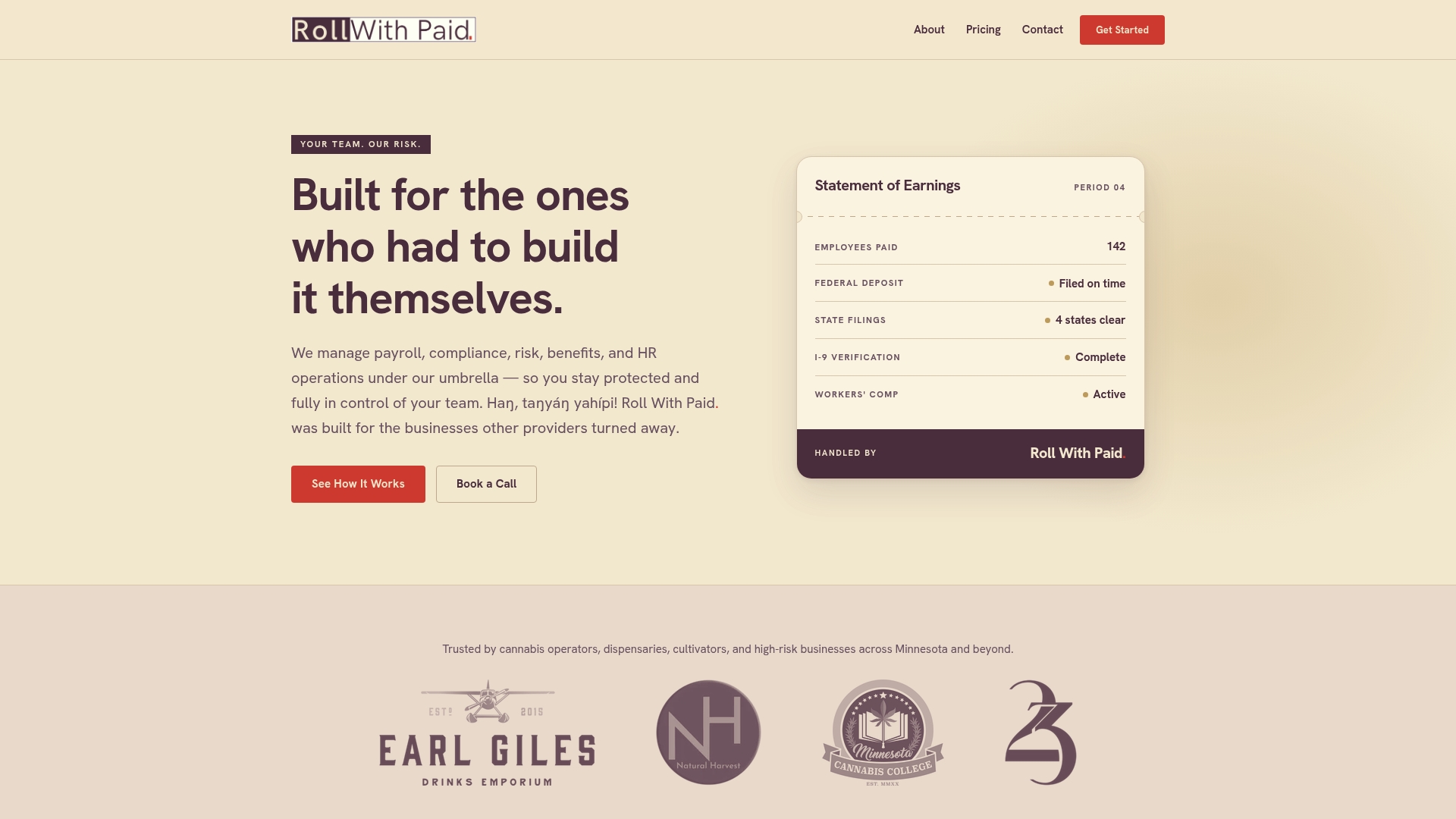
We provide payroll execution, HR and compliance solutions, employee onboarding, multi-state hiring support, time and attendance tools and Employer of Record services for cannabis and other high-risk employers. Pricing is based on gross payroll, with an optional flat-rate HR retainer, and rates vary by worker classification code and headcount. See the pricing page for how it works.
If you want to understand the model first, read about Employer of Record for high-risk industries, or start at rollwithpaid.com. Our newsletter, Roll Call, covers payroll and compliance updates for regulated employers.
FAQ
Is HCM the same as HR?
No. HCM is the strategic practice of managing talent to reach business goals, and HR is the function accountable for it. Business leaders and managers share HCM duties, according to APQC. In daily use, many employers treat the two as overlapping.
What are the three types of human capital?
Common frameworks split human capital into skills and knowledge, health and wellbeing, and motivation or engagement. Sources vary, and no single legal standard exists. The definitions that matter for employers center on the value of workers’ skills, experience and training.
What is the difference between HCM and HRIS?
HRIS stores employee records and core HR data. HCM covers the full employee lifecycle, from recruiting to succession planning, usually with payroll, time and analytics included. SHRM describes HRMS as the middle step between the two.
Does a small cannabis business need HCM software?
A small operator needs accurate payroll, correct classification, I-9 records and timely filings first. Full HCM tools become useful as headcount, locations or states increase. A managed model can supply those basics without building a system in-house.
Sources
- OPM Workforce Planning Guide
- Investopedia: Human Capital
- Accenture: What Is HCM
- IBM: What is HCM
- U.S. GAO: Human Capital Management
- APQC: HR vs. HCM
- ISSA: HRM or HCM
- NetSuite: HRM vs. HCM
- SHRM: Understanding HR Technology
- SAP: What is HCM
- Dayforce: What is HCM software
- CBIZ: What is HCM
- Deloitte: Managing workforce risk
- Littler 2026 Employer Survey
- The IIA: Human capital risk in an AI world
- Congressional Research Service: Section 280E
- Minnesota DLI: Mandatory coverage
Recommended
- HR Document Management: 9 Tools, or a Managed HR Partner?
- Pick the Right Tier: Employee Handbook Software for Multi State Firms
- Best Cannabis HRIS in 2026: What to Compare Before You Buy
- HR Teams: Match FMLA Tracking Software to Risk and Roll Out in 90 Days
Roll With Paid. is not a law firm and does not provide legal advice. This article summarizes Minnesota law along with other states and jurisdictions law and is for general information only. Before changing a policy, consult employment counsel or contact DLI Labor Standards at 651-284-5075.