
Cannabis Industry Payroll: Rules, Risks and Provider Models

Cannabis industry payroll follows the same federal tax rules as every other employer, but it runs under extra pressure from banking limits, Section 280E and state licensing rules. Operators must withhold, deposit and report payroll taxes on time, and late deposits cost 2% to 15% of the unpaid amount. Most cannabis operators handle this with a payroll partner that accepts cannabis clients and keeps records audit-ready.
TL;DR
- Federal payroll taxes apply to every plant-touching and ancillary cannabis employer: withholding, Social Security, Medicare, Form 941 and Form 940.
- Cash-heavy operations and limited banking make payroll harder to automate, so many mainstream providers decline cannabis clients.
- The IRS charges 2% to 15% for late deposits, and the Trust Fund Recovery Penalty can reach owners and bookkeepers personally.
- Multi-state operators must set up payroll, unemployment insurance and withholding in each state where employees work.
- An Employer of Record (EOR) model shifts payroll execution, workers’ compensation and HR compliance to one accountable partner.
Table of Contents
- What makes payroll different for cannabis employers?
- What federal payroll obligations apply to a cannabis business?
- What penalties do cannabis employers face for late or wrong payroll filings?
- How do state rules change cannabis payroll, including in Minnesota?
- What extra payroll steps do multi-state cannabis operators face?
- What is an Employer of Record, and how does it compare with other payroll models?
- When should a cannabis business bring in outside payroll or HR support?
- What problems do operators bring to our team most often?
- What questions do cannabis employers ask before they switch?
- What do real use cases look like?
- Do the same payroll risks apply to other high-risk industries?
- Perspective
- Ready to move payroll off your plate?
- FAQ
- Sources
What makes payroll different for cannabis employers?
Cannabis payroll differs because marijuana remains illegal under federal law, which limits banking, narrows the pool of willing providers and raises scrutiny. The payroll math itself is ordinary. The surrounding conditions are not.
Three pressures show up again and again:
- Banking friction. Banks resist handling cash from plant-touching marijuana companies, and some mainstream payroll providers will not serve the industry for the same reason.
- Cash and manual work. When a business deals in cash, ACH automation cannot be used, so the payroll processor has to perform one-off processes, according to the same MJBizDaily report.
- Tax exposure. Section 280E generally disallows deductions and credits for businesses trafficking in Schedule I or II substances, yet payroll tax duties still apply in full.
The practical result: a payroll mistake in cannabis costs more than the same mistake at a retailer of any other kind, because the business has less margin for penalties and less room to shop for a replacement provider mid-quarter.
What federal payroll obligations apply to a cannabis business?
A cannabis employer must withhold federal income tax, withhold Social Security and Medicare, pay the employer share, and report everything to the IRS. The IRS employment tax overview lists Form 941 (quarterly) and Form 940 (FUTA) as the core returns, with income tax withholding driven by each employee’s Form W-4.
Deposits have their own rule. Federal tax deposits must be made by electronic funds transfer. That is the sticking point for cash-based operators. A Congressional Research Service brief notes that cash-based operations created by banking impediments cause problems under the requirement to pay payroll taxes electronically.
Section 280E is a separate issue from payroll tax, but the two meet in practice. How labor costs are classified affects tax exposure, and we cover that connection in our guide to 280E and payroll.
Does banking access change who handles the deposits?
Banking access changes how deposits reach the IRS, not whether they are due. Operators with a stable electronic payment setup have more options. Operators who depend on cash need a payroll partner with a tested process for electronic deposits. Payment infrastructure matters here too: high-risk merchant and ACH tools, such as those described in this overview of cannabis merchant accounts and payments, can reduce the cash that has to be handled by hand.
What penalties do cannabis employers face for late or wrong payroll filings?
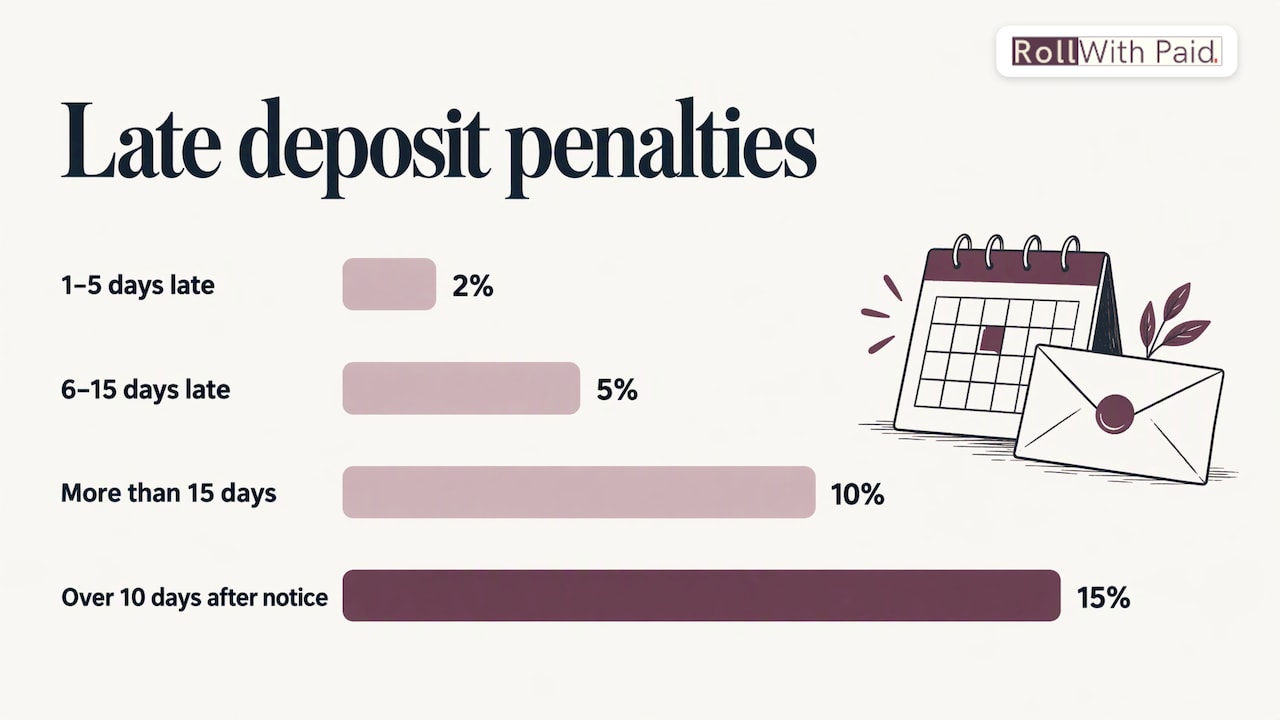
The IRS Failure to Deposit Penalty runs from 2% to 15% of the unpaid deposit, depending on how late it is. The IRS penalty schedule sets the tiers:
| Days late | Penalty |
|---|---|
| 1 to 5 calendar days | 2% of the unpaid deposit |
| 6 to 15 calendar days | 5% |
| More than 15 calendar days | 10% |
| More than 10 days after a first IRS notice | 15% |
The tiers do not stack. A deposit more than 15 days late carries a 10% penalty in total, not 2% plus 5% plus 10%. Interest is charged on top.
The larger risk is personal. The IRS states that the Trust Fund Recovery Penalty makes the responsible person liable for 100% of the unpaid trust fund taxes. Owners, officers and bookkeepers can all be treated as responsible persons. One cannabis tax consultancy also points out that businesses can be penalized for payroll-tax errors even when they outsource, which is why the contract and the responsibility split matter as much as the provider’s name.
How do state rules change cannabis payroll, including in Minnesota?
State rules add registration, withholding and reporting layers on top of federal duties, and each state sets its own. California is a clear example. The California EDD cannabis payroll tax page requires an employer to register within 15 days of paying more than $100 in wages in a calendar quarter. Businesses without a bank account must still pay electronically or request a waiver.
Minnesota operators face their own layer. Minnesota’s Office of Cannabis Management requires licensed businesses to hold a labor peace agreement with a bona fide labor organization, as the OCM FAQ explains under Minnesota Statutes, section 342.01. That ties employment practices directly to licensing, so worker records and HR policies are part of license readiness, not just payroll housekeeping.
For day-to-day employment issues in licensed facilities, our HR compliance tips for dispensaries and cultivations go through the recurring trouble spots.
What extra payroll steps do multi-state cannabis operators face?
Multi-state operators must decide which state’s tax law applies to each employee, register in each state and file there separately. A multistate payroll guide lists the main questions: state income tax withholding (including reciprocity where it applies), nexus for state employment laws, and state unemployment insurance contributions in states where you have employees.
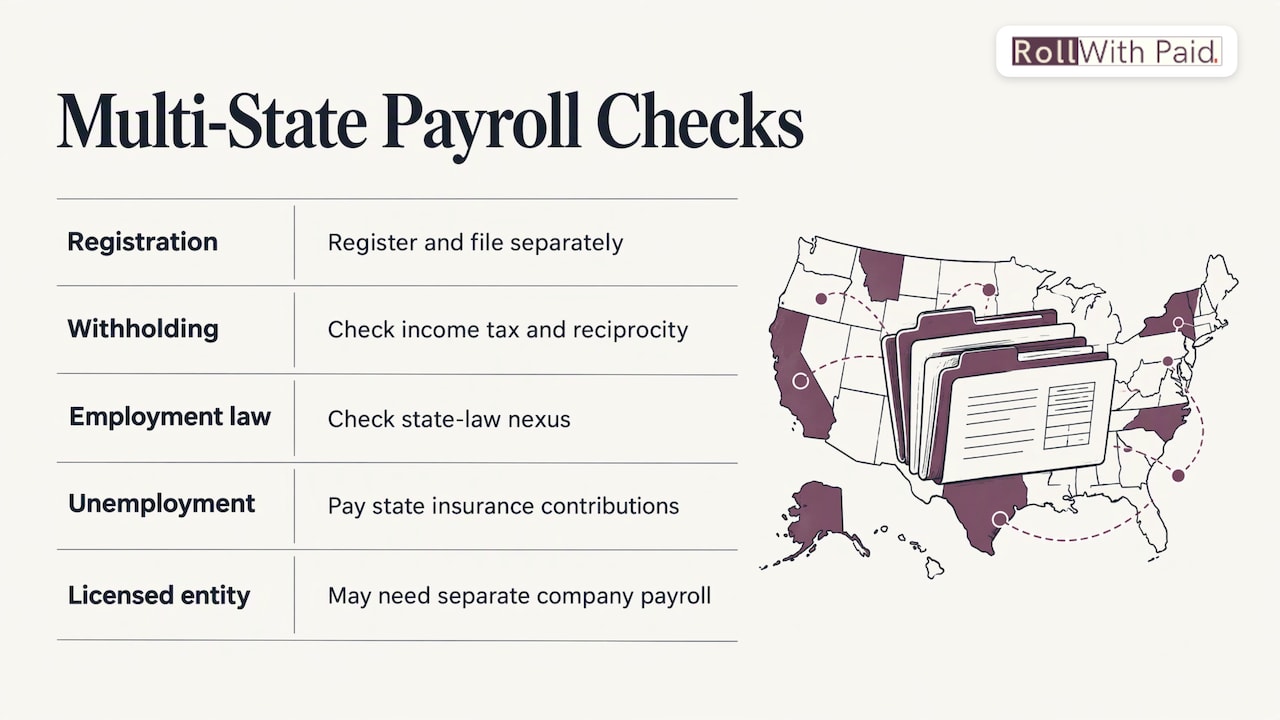
Cannabis adds a wrinkle because licenses do not cross state lines. Each state entity may be a separate licensed company with its own payroll, even when ownership overlaps. Our team’s recurring observation is that operators who expand state by state often discover that the first state’s payroll setup cannot simply be copied. Our page on audit-ready multi-state cannabis payroll walks through what should be settled before the first paycheck in a new state.
What is an Employer of Record, and how does it compare with other payroll models?
An Employer of Record is a partner that becomes the legal employer for payroll, tax filings, workers’ compensation and HR compliance, while you keep day-to-day management. The comparison below shows how the three common models split responsibility.
| Factor | Payroll software only | Standard payroll provider | Employer of Record (our model) |
|---|---|---|---|
| Who runs payroll | You | Provider, with your inputs | Roll With Paid. |
| Cannabis-specific cash and banking handling | Not built in | Often declined or limited | Designed for it |
| Workers’ compensation | Separate vendor | Separate vendor | Included in the model |
| HR compliance and policy documents | You | Usually extra | Included in the model |
| Audit readiness | Your responsibility | Shared, depends on contract | Part of the service |
The table describes categories, and individual providers vary. For more on our model, see what an Employer of Record is for high-risk industries and how it affects benefits.
How do named cannabis payroll providers compare?
Operators researching this topic commonly shortlist Gusto, Wurk, Greenshades, Paragon, Paychex, Greenleaf HR and Hybrid Payroll. We have written side-by-side comparisons on the contract questions that decide risk, including Roll With Paid. vs Paragon Payroll, vs Greenleaf HR, vs Hybrid Payroll, vs Greenshades and vs Paychex. The same questions apply to all of them:
- Who is the employer of record on the quarterly returns?
- Who pays the penalty if a deposit is late?
- How is payroll handled if your bank account is closed?
- How are workers’ compensation class codes assigned?
- What records can you produce within a day if an auditor asks?
When should a cannabis business bring in outside payroll or HR support?
A business should bring in outside support when payroll work starts competing with operations, or when a missed filing would put the owner at personal risk. Four signals show up most often in conversations with operators:
- Payroll is run by someone who also manages the floor or the grow.
- The business has added a second state, location or license.
- A bank or processor has dropped the account, or cash is used for any part of payroll.
- Workers’ compensation premiums rise without a clear reason, often tied to class code assignment.
Cannabis payroll is also a retention issue. Accurate, on-time pay supports workforce stability and regulatory readiness, a point made in a cannabis payroll industry analysis.
What problems do operators bring to our team most often?
The problems our business development and implementation teams hear most often fall into five groups. We describe them as patterns, not as individual client stories.
- A provider that quietly stops serving cannabis. The operator learns about it when a payroll run is frozen. We cover this scenario in our page on avoiding a payroll freeze.
- Payroll software that does not match the legal reality. Software handles calculation well, but filings, notices and classification stay with the employer. See our note on the payroll software problem.
- Worker classification confusion. Our fees vary by worker classification code and headcount, so getting the code right matters for cost and for compliance.
- Onboarding gaps. Missing I-9s, inconsistent policies and incomplete personnel files surface at the worst time, during an audit or a license review.
- Time tracking by spreadsheet. Hours exported to CSV and re-keyed produce errors. Our write-up on biometric time clocks explains why clean time data matters.
Which integrations work best?
The integrations that matter most connect time and attendance, onboarding and payroll so that hours and new-hire data are entered once. We offer time and attendance tools as part of the service for that reason. Point-of-sale and payment tools are a second area. The goal is fewer manual handoffs, because every re-keyed number is a place for a filing error.
What questions do cannabis employers ask before they switch?
These are the questions operators ask most when they evaluate a payroll partner.
“If you run payroll, are we still liable?” The employer’s ownership of the business does not disappear. As noted above, penalties can attach to a business even when payroll is outsourced. An EOR arrangement changes who files and who is the legal employer, so the contract language on responsibility is the first thing to read.
“We still use some cash. Can that work?” Cash payroll is the hardest case, since federal deposits must be electronic. The answer is a defined process where wages and tax deposits are handled in a documented, traceable way.
“We are adding a second state. What changes?” New state registrations, new unemployment insurance accounts, new withholding rules and often a new licensed entity. Plan these before the first hire, not after.
“What will it cost?” Our fees are based on gross payroll, with an optional flat-rate HR retainer, and rates vary by worker classification code and headcount. Current terms are on our pricing page.
What do real use cases look like?
Three situations illustrate how operators use an EOR and payroll partner.
A single-site dispensary opening in Minnesota. The owner needs payroll, onboarding, policies and workers’ compensation in place before opening day, and wants employment records ready for licensing review.
A cultivation facility with seasonal staffing. Headcount swings by harvest cycle, so onboarding speed, I-9 handling and correct classification codes drive both cost and risk.
A multi-state operator with separate entities. Each state needs its own registrations and filings, but leadership wants one view of labor cost and compliance. Our cannabis case study shows how this kind of engagement is structured.
Do the same payroll risks apply to other high-risk industries?
Yes. Hospitality, restaurants, bars, construction and the trades share several of the same pressures: high turnover, tipped or variable pay, elevated workers’ compensation class codes and heavy documentation needs. Providers that avoid higher-risk employers leave these businesses with the same gaps cannabis operators face. We serve high-risk industries beyond cannabis, and our construction and trades case study shows the same model applied outside the dispensary.
Perspective
Cannabis operators rarely lose sleep over the arithmetic of payroll. They lose sleep over the quarterly fire drill: a deposit that cannot move through a bank, a provider that sends a termination notice, a filing nobody is sure was made.
We built Roll With Paid. for the businesses traditional payroll providers turn away. Our Employer of Record model puts payroll execution, workers’ compensation, onboarding and HR compliance under one accountable roof, and we design every process to be audit-ready from day one.
Our view is simple: payroll in a high-risk industry should be run as a compliance function that happens to pay people, not as a software subscription that happens to file taxes. That is the standard we hold ourselves to, and it is why zero late filings is the measure we put in front of clients.
Leah Kollross
Ready to move payroll off your plate?
If payroll and HR compliance are taking time you would rather spend on operations, we can take them over. Roll With Paid. provides Employer of Record services, payroll execution, HR and compliance solutions, onboarding, multi-state hiring support and time and attendance tools for cannabis and other high-risk businesses.

See how the model fits your headcount and states on our pricing page, or start from the Roll With Paid. home page.
FAQ
Is cannabis payroll legal if marijuana is federally illegal?
Yes, paying employees and filing payroll taxes is required. A Congressional Research Service brief states that marijuana sellers must comply with federal tax laws on withholding and payment of payroll taxes. Providers may decline the work, but the tax duties remain.
Can a cannabis business pay employees in cash?
Wages may be paid in cash in some situations, but federal tax deposits must still be made electronically. Ask your tax adviser and payroll partner to document the process in writing. In California, businesses without a bank account must pay payroll taxes electronically or request a waiver from the EDD.
What happens if a payroll tax deposit is late?
The IRS charges 2% for deposits 1 to 5 days late, 5% for 6 to 15 days and 10% beyond that, and 15% after a first notice goes unanswered. Interest also applies. Contact your payroll partner and a CPA as soon as you spot a missed deposit.
Does an Employer of Record remove all payroll risk?
No arrangement removes every risk, and owners should read how responsibility is allocated in any contract. An EOR model is designed to move payroll execution, filings, workers’ compensation and HR compliance to one partner, which reduces the number of handoffs where errors occur.
Sources
- IRS: Understanding employment taxes
- IRS: Depositing and reporting employment taxes
- IRS: Failure to Deposit Penalty
- IRS Internal Revenue Manual: Trust Fund Recovery Penalty
- Congressional Research Service: Marijuana and Federal Tax Law
- California EDD: Cannabis Industry Payroll Tax Reporting
- Minnesota Office of Cannabis Management FAQ
- MJBizDaily: Why marijuana operators need a reliable payroll provider
- Uzio: Navigating multistate payroll
- Bridgewest Consulting: Ask the Cannabis Expert
- PEO Blueprint: Why payroll is more complicated for cannabis companies
Recommended
- Cannabis Payroll: Avoid 280E Exposure: Roll With Paid vs Greenleaf HR
- High Risk Cannabis Payroll: Roll With Paid vs Würk and 4 Numbers
- Protect Cannabis Payroll From 280E: Roll With Paid vs Hybrid Payroll
- Avoid 280E Risk: Roll With Paid vs Paragon for Cannabis Employers
Roll With Paid. is not a law firm and does not provide legal advice. This article summarizes Minnesota law along with other states and jurisdictions law and is for general information only. Before changing a policy, consult employment counsel or contact DLI Labor Standards at 651-284-5075.