
Payroll Tax Remediation: What It Is and How It Works

Payroll tax remediation is the work of finding, correcting and paying payroll taxes that were missed, filed wrong or filed late, then putting controls in place so the problem does not repeat. The IRS can assess a failure-to-deposit penalty of up to 15% of the amount not deposited on time (IRS Publication 594, Rev. 1-2026). For cannabis and other high-risk employers, we handle this under our payroll administration services, priced to the scope of the work and typically on a one-time contractual basis.
TL;DR
- Payroll tax remediation covers the full cycle: reconcile past payroll, correct returns with Form 941-X or the matching 94X-X form, pay what is owed and fix the process.
- Unpaid trust fund taxes can create personal liability through the Trust Fund Recovery Penalty (TFRP), even when the business is still operating.
- A business owing $25,000 or less in assessed payroll taxes, penalties and interest may qualify for an online payment plan, and all required returns must be filed first.
- Cannabis employers draw payroll tax scrutiny: California’s EDD audited cannabis employers each year from 2021 to 2023.
- Our remediation work sits inside our payroll administration services and is scoped per engagement.
Table of Contents
- What is payroll tax remediation?
- How does Roll With Paid handle payroll tax remediation?
- What taxes are involved when payroll deposits are missed?
- When are payroll tax deposits due?
- What penalties and personal liability can follow unpaid payroll taxes?
- How do you correct payroll tax errors with the IRS?
- Can penalties be removed after late payroll taxes are fixed?
- What payment options exist for payroll tax debt?
- Why do cannabis businesses face extra payroll tax risk?
- How does remediation compare with ordinary payroll processing?
- What use cases lead cannabis employers to remediation?
- What do employers commonly ask about payroll tax remediation?
- Can Roll With Paid correct my back payroll taxes?
- FAQ
- Sources
What is payroll tax remediation?
Payroll tax remediation is a structured clean-up of payroll tax errors. It starts with a reconciliation of what was withheld, deposited and reported, and ends with corrected filings, payments and a fixed process.
The work usually covers four things:
- Deposits: whether withheld income tax and Social Security and Medicare taxes reached the IRS on the right schedule.
- Returns: whether quarterly and annual returns were filed and match payroll records.
- State filings: withholding, unemployment insurance and new hire reporting in each state where employees work.
- Worker classification: whether people treated as contractors or paid off the books were employees.
Remediation is different from routine payroll. Routine payroll runs forward. Remediation goes back through closed periods, often several quarters, and repairs them.
How does Roll With Paid handle payroll tax remediation?
Payroll tax remediation is a service we deliver for clients under our payroll administration services. We define the scope from the periods and states involved, so pricing varies with the work and is typically set on a one-time contractual basis.
Our clients are cannabis dispensaries, cultivation facilities and other high-risk businesses that traditional payroll providers often turn away. Our approach is built around audit-ready processes, an Employer of Record model and personalized support. Once the back periods are corrected, the same business can move to ongoing payroll execution and HR compliance so deposits and filings stay on schedule.
What taxes are involved when payroll deposits are missed?
The core federal taxes are income tax withheld from wages, the employee share of Social Security and Medicare, and the employer share of those same taxes. The IRS calls the withheld portions trust fund taxes because the employer holds them for the government (IRS Publication 5146, Rev. 1-2026).
For 2026, the Social Security wage base is $184,500 at 6.2% for each side, and Medicare is 1.45% for each side (IRS Publication 15, 2026). Those figures are set annually, so check Publication 15 for the year you are correcting, because older periods used different rates and wage bases.
Federal unemployment tax (FUTA) follows separate rules under the Form 940 instructions (IRS Notice 931, Rev. September 2026). State withholding and state unemployment insurance sit on top of the federal layer.
When are payroll tax deposits due?
Federal employment-tax deposits follow either a monthly or a semiweekly schedule. The IRS sets the schedule from the total tax liability reported during a lookback period before each calendar year (IRS Notice 931, Rev. September 2026).
A next-business-day rule overrides both schedules. An employer that accumulates $100,000 or more in taxes on any day of a deposit period must deposit by the next business day. An employer that deposits all taxes on time and in full may file the return by the 10th day of the second month after the period ends (IRS Publication 509, 2026).
These deposit timing rules are where most remediation cases begin. A late deposit that looks small in one quarter becomes a pattern across several.
What penalties and personal liability can follow unpaid payroll taxes?
The IRS assesses a failure-to-deposit penalty of up to 15% of the amount not deposited timely. It may also file a Notice of Federal Tax Lien, take levy action, and refer serious cases to the Department of Justice for civil collection or criminal prosecution (IRS Publication 594, Rev. 1-2026).
What is the Trust Fund Recovery Penalty?
The Trust Fund Recovery Penalty (TFRP) equals the unpaid trust fund taxes: the withheld income tax plus the employee share of withheld Social Security and Medicare taxes. The IRS can assess it against any responsible person who willfully fails to collect or pay those taxes. That includes corporate officers, directors, shareholders, payroll service providers and PEOs. The business does not have to have closed (IRS: Employment taxes and the TFRP).
Once the penalty is asserted, the IRS can file a federal tax lien or levy personal assets. That is why owners of closely held dispensaries and grows treat missed trust fund deposits as a personal exposure, not only a company problem.
How does the TFRP process work?
When the IRS proposes a TFRP, the person receives Letter 1153 and Form 2751. An individual who agrees signs and returns Form 2751 within 60 days. An individual who disagrees has 10 days to notify the IRS and 60 days from the letter date to appeal (IRS Publication 594, Rev. 1-2026).
To contest a TFRP in court, a taxpayer must pay the portion tied to one employee for each quarter charged and file a Form 843 refund claim for each quarter. Suspending collection also requires a bond of one and a half times the balance owed (IRS: Understanding your CP15B notice). Because the penalty carries personal stakes, a tax attorney or CPA should review any Letter 1153 before you sign.
Can unpaid payroll taxes become a criminal matter?
Yes, in serious cases. The AICPA’s Tax Adviser reports that liabilities across many periods, called pyramiding, or across several entities are more likely to be referred for criminal review. It also notes that a state may prosecute when a federal case turns criminal (The Tax Adviser, February 2018). Fast correction of back periods is the practical answer to that risk.
How do you correct payroll tax errors with the IRS?
The IRS directs employers to correct errors with the matching 94X-X form, such as Form 941-X for a Form 941 error, as soon as the error is found. There is no X form for Form 940, so the amended box on Form 940 is used instead (IRS: Correcting employment taxes).
Four details trip up employers:
- Payment timing. An employer correcting an underpayment must pay the amount owed by the time the X form is filed. Payment goes through EFTPS, IRS Direct Pay, card, or check payable to “United States Treasury” with the EIN, form number, quarter and year.
- Separate forms. If a period has both under-reported and over-reported amounts, two separate X forms are required.
- Penalty relief. Form 843 is the claim for abatement of assessed penalties and interest.
- Limits on Form 843. Form 843 cannot be used to request a refund or abatement of FICA tax or income tax withholding. A claim for credit or refund generally must be filed within 3 years of the original return or 2 years of payment, whichever is later (Instructions for Form 843, Rev. December 2024).
The clock matters on the IRS side too. A Form 941, 943, 944 or 945 filed before April 15 of the following year is treated as filed on April 15, and the 3-year assessment period runs from that date (IRS Publication 5146, Rev. 1-2026).
Can penalties be removed after late payroll taxes are fixed?
Sometimes. Form 944 filers may qualify for the Automatic Exemption from Penalty if they filed and paid on time for the prior 3 years, or the prior 12 quarters if Form 941 was previously required. Those who do not qualify may request relief based on reasonable cause (Instructions for Form 944, 2026).
Reasonable cause is easier to document when payroll records, bank deposits and filings are already reconciled. That reconciliation is the first deliverable of a remediation project.
What payment options exist for payroll tax debt?
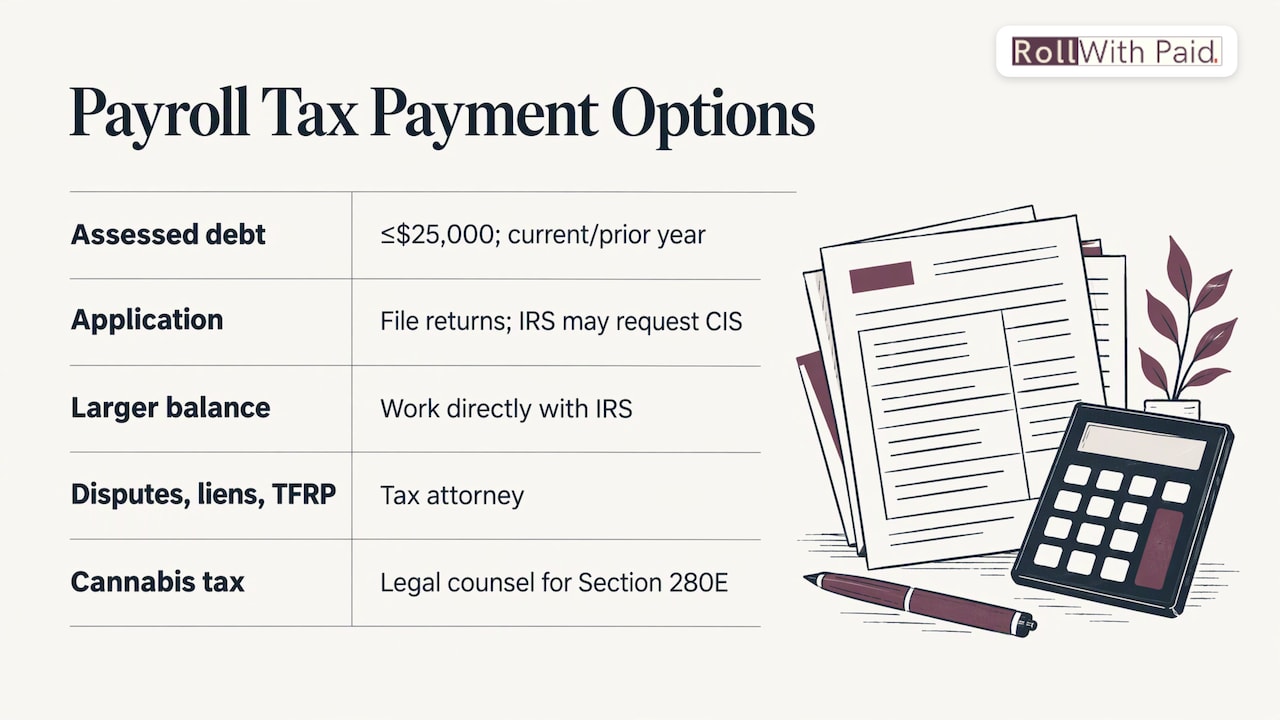
A business owing $25,000 or less in assessed payroll taxes, penalty and interest for the current and prior calendar year can apply for a payment plan through the IRS Online Payment Agreement application. Every required return must be filed first, and the IRS may ask for a Collection Information Statement (IRS Publication 594, Rev. 1-2026).
Larger balances need direct work with the IRS. For disputes, lien questions or a proposed TFRP, speak with a tax attorney. For cannabis-specific tax questions, legal counsel for cannabis tax matters can address how Section 280E interacts with payroll costs. Section 280E denies deductions and credits for businesses trafficking in Schedule I or II controlled substances, which includes state-legal marijuana businesses (Congressional Research Service).
Why do cannabis businesses face extra payroll tax risk?
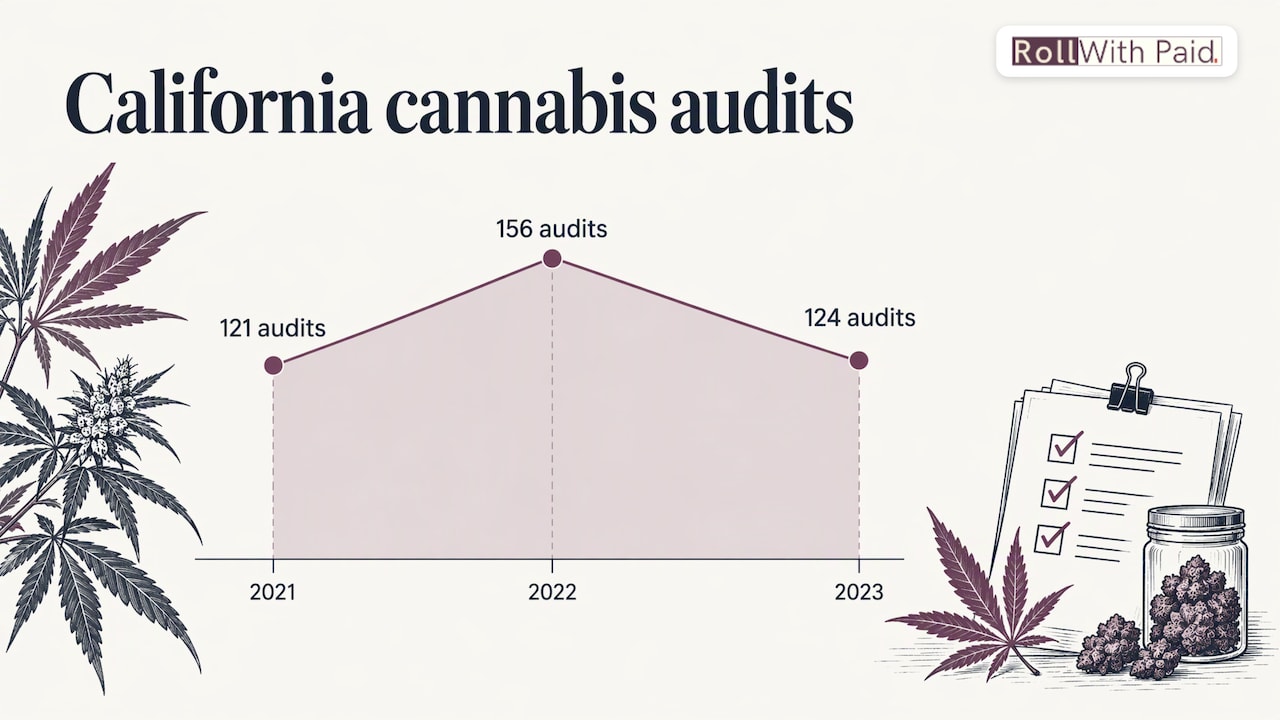
Cannabis employers face more audit attention and more worker-classification exposure than most industries. California’s Employment Development Department began payroll tax audits of cannabis businesses in 2021. It completed 121, 156 and 124 audits in 2021, 2022 and 2023, with assessments of $4,987,955, $5,271,029 and $3,949,177. Those audits identified 1,357, 1,153 and 955 misclassified or unreported workers (California EDD Joint Enforcement Strike Force report).
The same report names construction, restaurants and cannabis among the primary industries for joint site inspections in 2023. Restaurants, bars and construction trades share the same profile: high turnover, tipped or variable pay, and many workers who may be mislabeled as contractors.
For Minnesota employers, state law adds its own exposure. Minnesota Statutes section 289A.31 covers who is liable for withholding tax, and for partnerships and S corporations it makes a person with control of or responsibility for the withholding personally liable (Minnesota Revisor of Statutes). Confirm how your entity type is treated with counsel.
Multi-state operators carry the risk in every state they hire in. Our guide to audit-ready multi-state cannabis payroll explains how registrations and filings line up before the first paycheck, and five payroll mistakes cannabis businesses can’t afford lists the errors that most often lead back to remediation.
How does remediation compare with ordinary payroll processing?
Remediation repairs closed periods, while ordinary payroll processing runs current ones. The two need different skills and different deliverables.
| Ordinary payroll processing | Payroll tax remediation | |
|---|---|---|
| Time frame | The current pay period | Past quarters and years |
| Main output | Paychecks, deposits, current filings | Reconciliation, corrected returns, payments |
| Typical trigger | Every pay cycle | Notice, audit, missed deposit, provider change |
| Pricing at Roll With Paid | Monthly fee based on gross payroll | Scoped to the work, typically one-time contract |
| Ends when | You change providers | Back periods are corrected and controls are in place |
A tax resolution firm negotiates with the IRS after a debt exists. Our remediation work is part of payroll administration, so the same team that corrects the back periods understands how your payroll runs and can keep it compliant afterward.
What use cases lead cannabis employers to remediation?
Four situations bring most employers to remediation:
- A dispensary that changed payroll providers and finds deposits or filings missing in the transition quarter.
- A cultivation facility that paid trimmers as contractors and now needs to reclassify them and correct returns.
- A multi-state operator that hired in a new state before registering for withholding and unemployment insurance there.
- A business that received an IRS or state notice and needs the underlying periods reconciled before responding.
In each case the first move is the same: gather payroll registers, bank records and filed returns, and find the gap. Our payroll software problem page describes how software alone can leave gaps like these.
What do employers commonly ask about payroll tax remediation?
Employers ask whether they can fix it before the IRS finds it, whether the owner is personally exposed, and what it costs. The answers: yes, correct errors as soon as they are found with the matching 94X-X form (IRS); yes, if you are a responsible person and trust fund taxes went unpaid; and cost varies with the work. We scope each engagement individually, so there is no single published figure.
What does our perspective say about payroll tax remediation?
We treat payroll tax remediation as part of payroll administration, not a separate crisis service. Cannabis and other high-risk employers get hit hardest when payroll, HR and compliance are handled by different parties who never compare records.
Our Employer of Record model, audit-ready processes and personalized support are built so deposits, filings and worker classification are handled in one place. The fix for a past gap and the control that prevents the next one belong in the same engagement.
We would rather reconcile your back periods once, on a defined scope, and move you onto a clean payroll than leave you with a quarterly fire drill.
Leah Kollross
Can Roll With Paid correct my back payroll taxes?
If your business has missed deposits, late filings or a notice you cannot explain, we can scope the remediation under our payroll administration services. We serve cannabis dispensaries, cultivation facilities and other high-risk employers, and pricing depends on the work involved. See how our fees are structured.

After remediation, ongoing payroll execution and Employer of Record services keep filings on schedule. For broader context on building HR leadership around compliance, read our guides on fractional CHRO leadership and human capital management. Our newsletter, Roll Call, covers payroll and compliance updates for high-risk employers.
FAQ
Is not paying payroll taxes a crime?
Willful failure to collect or pay over trust fund taxes can lead to criminal prosecution as well as civil penalties. The IRS may refer cases to the Department of Justice (IRS Publication 594). Cases spanning many periods draw more risk, so correct the back periods promptly and consult a tax attorney if you have received a notice.
Can I be personally liable for my company’s payroll taxes?
Yes. The TFRP can be assessed against any responsible person who willfully fails to pay trust fund taxes, including officers, directors, shareholders and payroll service providers. It applies even if the business is still operating (IRS TFRP page).
How do I report corrected payroll taxes to the IRS?
Use the 94X-X form that matches the original return, such as Form 941-X for Form 941. For Form 940, use the amended box on the form. Pay any amount owed by the time the X form is filed (IRS: Correcting employment taxes).
How much does payroll tax remediation cost with Roll With Paid?
Pricing varies with the periods, states and number of filings involved, and the work is typically done on a one-time contractual basis. We scope it after reviewing your records.
Sources
- IRS: Employment taxes and the Trust Fund Recovery Penalty
- IRS: Correcting employment taxes
- IRS: Instructions for Form 843 (Rev. December 2024)
- IRS: Publication 594 (Rev. 1-2026)
- IRS: Publication 5146 (Rev. 1-2026)
- IRS: Publication 509 (2026)
- IRS: Publication 15 (2026)
- IRS: Notice 931 (Rev. September 2026)
- IRS: Instructions for Form 944 (2026)
- IRS: Understanding your CP15B notice
- The Tax Adviser: Employment tax penalties
- California EDD: Joint Enforcement Strike Force report
- Minnesota Statutes 289A.31
- Congressional Research Service: Section 280E and marijuana businesses
Recommended
- Protect Cannabis Payroll From 280E: Roll With Paid vs Hybrid Payroll
- 280E and Payroll: What Cannabis Employers Need to Understand
- Cannabis Cultivator Payroll: Rules, Taxes and Provider Models
Roll With Paid. is not a law firm and does not provide legal advice. This article summarizes Minnesota law along with other states and jurisdictions law and is for general information only. Before changing a policy, consult employment counsel or contact DLI Labor Standards at 651-284-5075.