
What Is a CHRO? Role, Pay and the Fractional Alternative

CHRO stands for chief human resources officer, the senior executive who owns a company’s people strategy, HR compliance and workforce risk, and who usually reports to the CEO. A full-time CHRO in the United States averages $317,510 in base salary, so many small and mid-sized employers in regulated industries cover the same ground with a fractional HR model instead. Roll With Paid offers an HR retainer and Employer of Record services built for high-risk industries such as cannabis.
TL;DR
- A CHRO is the most senior HR leader, typically reporting to the CEO and partnering with the CFO and board on enterprise risk.
- Average CHRO base pay is $317,510 (Salary.com, May 2025), and total direct compensation at large public companies is far higher.
- Employers with a few hundred workers, multiple states or a heavily regulated workforce often need CHRO-level judgment before they need a CHRO-level payroll line.
- A fractional HR model pairs senior HR and compliance guidance with execution: payroll, onboarding, filings and documentation.
- Roll With Paid’s HR retainer and Employer of Record model are designed for cannabis, construction, hospitality and other high-risk employers.
Table of Contents
- What does CHRO stand for?
- What does a chief human resources officer actually do?
- What compliance work does a CHRO own?
- Is a CHRO higher than a vice president?
- How much does a CHRO make in the United States?
- How long does it take to become a CHRO?
- When does a business need CHRO-level expertise?
- How does a fractional HR model compare with a direct-hire CHRO?
- How does an Employer of Record model support a CHRO-style function?
- Which HR tools and integrations work best alongside a fractional CHRO model?
- How do Roll With Paid and other payroll providers compare for regulated employers?
- What does Roll With Paid offer in place of a full-time CHRO?
- Our perspective on CHRO-level HR for high-risk employers
- FAQ
- Sources
What does CHRO stand for?
CHRO stands for chief human resources officer. Josh Bersin’s 2025 report notes that the title also appears as CPO (chief people officer) or SVP/EVP of HR, and that the CHRO is generally the most senior HR leader in the organization.
The abbreviation has a second meaning. In Connecticut, CHRO also refers to the state’s Commission on Human Rights and Opportunities, an agency that enforces civil rights laws. That agency has nothing to do with the executive job described in this article.
What does a chief human resources officer actually do?
A CHRO leads HR strategy and the experience of people at work, and makes sure HR priorities support business goals. ADP’s glossary entry describes the role as shaping culture, strengthening leadership and planning future workforce needs, and it may include advice on senior hiring, succession and executive reward.
Forbes (October 2025) describes the CHRO as responsible for workforce planning, culture, compensation, inclusion, learning and succession. The same article says the CHRO typically reports to the CEO and works closely with the CFO and board on growth strategy and enterprise risk.
The operational scope is wide. Oracle’s overview lists these areas under the CHRO:
- Recruiting and staffing
- Compensation and benefits
- Employee and labor relations
- Training and development
- Payroll
- Compliance with local and federal law
What compliance work does a CHRO own?
A CHRO owns regulatory compliance across employment and workplace law. Oracle names antidiscrimination, minimum wage, employee data privacy, workplace safety and family and medical leave among the obligations.
Compliance is also where the job has grown. Deloitte Insights (April 2025) reports that skills pertaining to labor compliance jumped more than 90% between 2018 and 2024 as HR leadership expanded into technology, strategy and business growth.
For a cannabis operator, a restaurant group or a trades contractor, that compliance load is the daily job. Misclassified workers, late filings, uneven workers’ compensation coding and inconsistent state rules are all CHRO-level problems, whatever the title on the door.
Is a CHRO higher than a vice president?
Yes, in most organizations a CHRO sits at the C-suite level, above an HR vice president and HR director. Ohio University describes the usual HR ladder as HR manager, then HR director, then CHRO, with the CHRO reporting to the CEO and serving on the executive team.
In some companies the CHRO is called SVP or EVP of HR, so the title varies while the reporting line stays close to the CEO. The scope matters more than the label.
How much does a CHRO make in the United States?
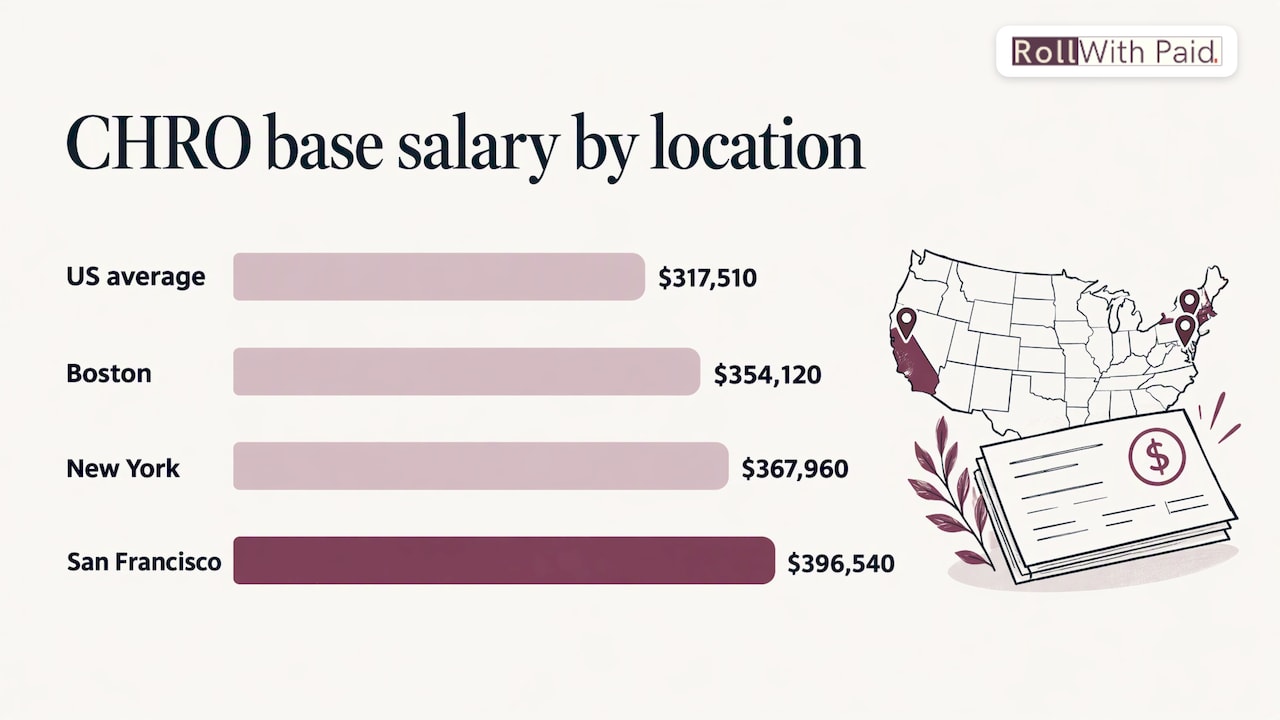
The average US CHRO base salary is $317,510 as of May 1, 2025, according to Salary.com. Typical pay runs from $291,790 to $357,950. Location moves the number: Salary.com reports $354,120 in Boston, $367,960 in New York and $396,540 in San Francisco.
Total compensation is much higher at large public companies. ClearBridge Compensation Group reports median CHRO total direct compensation of about $1.7 million. Median total direct compensation is about $1.0 million at companies under $1 billion in revenue, and nearly $3.0 million at companies with $10 billion or more.
Midsize employers see lower base pay. Equilar’s 2025 midyear recap, cited by Forbes, puts base salaries at $325,000 to $450,000 in midsize firms. For context, PRL International cites a Bureau of Labor Statistics median of $140,030 for human resources managers in May 2024.
What does a direct-hire CHRO cost beyond salary?
Base pay is only the first line. PRL International notes that for a mid-sized company with a large workforce, base can reach $320,000 and total compensation $550,000 once bonus, equity and a sign-on are counted. Recruiting time, benefits and the team the CHRO needs underneath add to that.
How long does it take to become a CHRO?
Most CHROs arrive after roughly 18 to 25 years of progressive HR or business leadership, according to HR Degree, which also reports that about half of recently appointed CHROs followed the traditional HR generalist track. Josh Bersin’s report describes three paths: the Career CHRO who moves between companies, the Company CHRO who rises internally, and the Business CHRO who comes from another area such as operations or sales.
This is why the role is hard to hire for. A candidate with the right depth is scarce, expensive and usually looking at much larger employers than a 150-person dispensary group or a regional contractor.
When does a business need CHRO-level expertise?
A business needs CHRO-level expertise when the cost of an HR mistake exceeds the cost of senior guidance. That usually happens with multiple states, a licensed or regulated workforce, high workers’ compensation exposure or rapid hiring.
PRL International explains the spread in pay by what the role carries: a CHRO at a 200-person single-site company holds a different job from one at a 2,000-person company with several sites, a union and an acquisition pipeline. The same logic applies in reverse. A growing employer carries much of that risk with a fraction of the staff.
Use case: a multi-state cannabis operator
A cannabis operator with dispensaries in two states faces separate wage rules, separate filings and licensing scrutiny. Federal tax treatment under Section 280E adds pressure on how labor costs are classified. The owner needs a senior HR decision-maker and a payroll process that stays audit-ready. Our guide to audit-ready multi-state cannabis payroll covers the payroll side, and our comparison of Roll With Paid and hybrid payroll addresses 280E.
Use case: restaurants, bars and other social venues
Hospitality employers deal with high turnover, tipped wages, scheduling rules and alcohol-related liability. A CHRO-level view sets consistent hiring, onboarding and documentation policy across locations, so one manager’s shortcut does not become the company’s exposure.
Use case: construction and trades
Trades employers carry workers’ compensation classification risk, crew-based hiring and project-based staffing. Our construction and trades case study shows how HR and payroll look in that environment.
How does a fractional HR model compare with a direct-hire CHRO?
A fractional HR model gives an employer senior HR and compliance guidance on a recurring basis without a full executive salary. A direct-hire CHRO gives one person’s full attention and a seat in the C-suite. The right choice follows headcount, complexity and budget.
| Factor | Direct-hire CHRO | Fractional HR model with Roll With Paid |
|---|---|---|
| Cost structure | Executive salary, bonus and often equity. Average base is $317,510 (Salary.com, May 2025). | Monthly service fees based on gross payroll, with an optional flat-rate HR retainer. |
| Time to start | Executive search and notice periods. | Onboarding process designed to be streamlined. |
| Payroll and filings | Needs a payroll provider and HR staff underneath. | Payroll execution, regulatory filings and I-9 support sit in the same relationship. |
| Workers’ compensation | Needs a broker and carrier coordination. | Employer of Record model aims to reduce workers’ compensation costs. |
| Multi-state hiring | Built through hires and vendors. | Multi-state hiring support is part of the service. |
| Best fit | Large enterprises with a board-level people agenda. | Owners and operators in high-risk industries who want compliance and execution handled. |
The fractional model fits employers whose main HR challenge is compliance and risk, not building a global talent strategy. Roll With Paid’s rates vary by worker classification code and headcount, so the pricing page is the place to start.
How does an Employer of Record model support a CHRO-style function?
An Employer of Record (EOR) takes on the employment relationship for payroll, tax filings, workers’ compensation and compliance, which supports the risk side of a CHRO’s job. Roll With Paid’s EOR model is designed to mitigate legal liabilities and reduce workers’ compensation costs for high-risk employers.
For the detail, read what an Employer of Record is and why it matters for benefits and our overview of Employer of Record for high-risk industries.
Common challenges high-risk employers bring
The issues that most often push employers to look for senior HR help are consistent across cannabis, hospitality and trades:
- Payroll software that cannot handle industry-specific rules. See our note on the payroll software problem.
- Late or missed filings, including new hire reporting. Minnesota, where we operate, has its own process: see our Minnesota new hire reporting checklist.
- Records scattered across inboxes and spreadsheets.
- Providers that turn away cannabis and other high-risk businesses.
Roll With Paid reports zero late filings for its clients and builds its processes to stay audit-ready.
Which HR tools and integrations work best alongside a fractional CHRO model?
The tools that work best connect payroll, time and attendance, documents and benefits so data is entered once. Our team’s guides cover the main categories:
- Cannabis HRIS options
- Biometric time clocks
- PTO tracking software
- FMLA tracking software
- HR document management
- Employee handbook software for multi-state firms
Roll With Paid includes time and attendance tools in its offering, so hours flow into payroll without CSV exports. Mapping those workflows before buying anything is the step most employers skip. A practical walkthrough of human resources process improvement shows how to find where manual HR work leaks time and money.
How do Roll With Paid and other payroll providers compare for regulated employers?
Roll With Paid is built for cannabis and other high-risk employers that traditional payroll providers often turn away. Many mainstream platforms process payroll but leave classification, compliance and risk with the employer.
We have published side-by-side pages for those comparing options: Roll With Paid vs Greenleaf HR, Roll With Paid vs Paragon Payroll, and when an EOR is safer for regulated employers.
The criteria that matter most:
- Does the provider accept cannabis and other high-risk businesses?
- Does it take on employer liability through an EOR model?
- Does it file on time across every state you operate in?
- Does it include HR support, not only payroll?
Roll With Paid is built to meet all four.
What does Roll With Paid offer in place of a full-time CHRO?
Roll With Paid combines Employer of Record, payroll execution, HR and compliance solutions, onboarding, multi-state hiring support and time and attendance tools, with an optional flat-rate HR retainer. The aim is to remove administrative work so owners can focus on growth.
Explore the full list of services and the HR retainer and service rates.
For owners who want ongoing guidance, our newsletter, Roll Call, shares updates for regulated and high-risk employers.
Our perspective on CHRO-level HR for high-risk employers
We think the title matters less than the function. A business owner in cannabis, hospitality or the trades needs someone accountable for compliance, classification and workforce risk, and needs that person’s decisions carried out correctly every pay period.
A direct-hire CHRO is the right answer for some companies. For many operators, the more practical route is a partner that pairs HR guidance with the payroll, filings and Employer of Record structure that put the guidance into practice. That is how we built our HR retainer and EOR model.
Compliance should not be a quarterly fire drill. When filings are on time, records are audit-ready and workers’ compensation is coded correctly, owners get their time back.
Leah Kollross
FAQ
What does CHRO stand for?
CHRO stands for chief human resources officer. It is the most senior HR executive in an organization and is also called chief people officer. The role typically reports to the CEO.
What is the CHRO in CT?
In Connecticut, CHRO also refers to the state’s Commission on Human Rights and Opportunities, which enforces civil and human rights laws. It is a government agency, separate from the corporate chief human resources officer role.
What is a CHRO salary?
The average US CHRO base salary is $317,510 as of May 2025, according to Salary.com. Total compensation at large public companies is much higher, with ClearBridge reporting a median of about $1.7 million.
Can a small business use a fractional HR model instead of a CHRO?
Yes. A fractional model gives an employer senior HR and compliance support at a recurring monthly cost instead of an executive salary. Roll With Paid offers an optional flat-rate HR retainer alongside payroll and Employer of Record services for high-risk employers.
Sources
- What is a CHRO? (ADP)
- Understanding the Path to CHRO (Josh Bersin, 2025)
- Evolving CHRO competencies (Deloitte Insights)
- What Is A CHRO? (Forbes)
- How to Become HR Director (Ohio University)
- CHRO Salary in the United States (Salary.com)
- Pay Trends and the Expanding Role of the CHRO (ClearBridge)
- What Does a CHRO Make in a Mid-Market Company? (PRL International)
- CHRO career paths (HR Degree)
- Human Resources Process Improvement (Raremind)
Recommended
- Roll With Paid vs Greenleaf HR
- Cannabis Payroll: Avoid 280E Exposure: Roll With Paid vs Greenleaf HR
- HR Document Management: 9 Tools, or a Managed HR Partner?
- Protect Cannabis Payroll From 280E: Roll With Paid vs Hybrid Payroll
Roll With Paid. is not a law firm and does not provide legal advice. This article summarizes Minnesota law along with other states and jurisdictions law and is for general information only. Before changing a policy, consult employment counsel or contact DLI Labor Standards at 651-284-5075.