
Marijuana Moment on Payroll Risk: What Cannabis Employers Should Do

If you landed here after searching for Marijuana Moment, you probably know it as the daily news source for cannabis politics, business and science. One of its recent pieces deserves a closer read from anyone who signs paychecks in this industry: an op-ed by our founder, Leah Kollross, on why payroll can disappear overnight for hemp businesses moving toward cannabis-style scrutiny. This article walks through what that piece argues, why it matters for dispensaries, cultivators and hemp operators alike, and what to do about it before your provider makes the decision for you.
TL;DR
- Marijuana Moment published an op-ed by Leah Kollross of Roll With Paid. arguing that payroll is infrastructure, and that a provider can sever it with very little notice.
- Hemp businesses are about to face the risk-profiling that marijuana operators have lived with for years, because the federal hemp definition is changing, with portions taking full effect on December 11, 2026.
- Losing a payroll provider can leave as little as two weeks to migrate, which is rarely enough to avoid missed paychecks and filing errors.
- Not being able to bank does not excuse you from electronic payroll tax deposits, and penalties can reach 10% of the taxes paid.
- Ask your provider directly whether it knows what you sell and whether its banking partners do. An Employer of Record model is one way to reduce the exposure.
Table of Contents
- What the Marijuana Moment op-ed says
- Why hemp operators are suddenly in the same boat
- Marijuana is still a special case, even after rescheduling news
- What happens when you cannot bank, but payroll taxes are still due
- Three questions to ask your payroll provider this week
- A contingency checklist for operators
- Why Employer of Record is part of the answer
- Our perspective
- How Roll With Paid. can help
- FAQ
- Sources
What the Marijuana Moment op-ed says
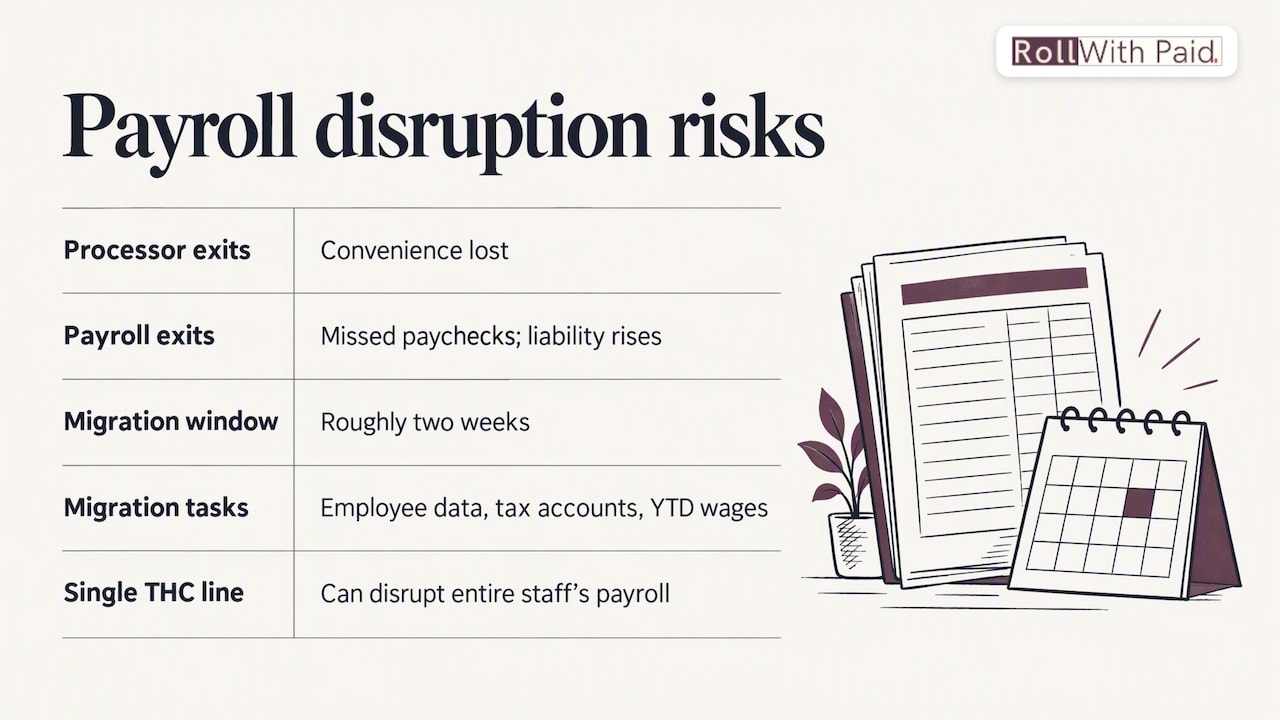
The core argument is simple and uncomfortable. When a payment processor leaves a business, the business loses convenience. When a payroll provider leaves, people miss paychecks and the employer’s liability rises sharply. Operators tend to put their attention on licensing and product tax strategy, and payroll sits in the background until something breaks.
The op-ed frames payroll as infrastructure, not a back-office service. Your provider is connected to banks, tax agencies and benefit carriers, and every one of those relationships carries its own risk appetite. If a bank behind the provider decides your industry is outside that appetite, the provider may end your service, and you are the one left holding the calendar.
That calendar can be brutal. As the piece describes it, a provider that terminates because of industry risk-profiling can leave you roughly two weeks to migrate. Moving payroll in two weeks means collecting employee data, rebuilding tax accounts, reconciling year-to-date wages, and doing it all without missing a pay date. Most teams cannot.
It is also a reminder that you do not have to touch the plant to be affected. The op-ed points to businesses such as co-packers or craft breweries with a single THC product line. Risk-averse providers and banks often profile the whole operation, so an entire restaurant staff or administrative team can lose pay infrastructure because one product line triggered a review.
Why hemp operators are suddenly in the same boat
Marijuana operators learned this lesson through years of account closures. Hemp businesses are now approaching the same lesson from a different direction, and the trigger is federal law.
The Congressional Research Service explains that the FY2026 agriculture appropriations law amends the statutory definition of hemp in 7 U.S.C. 1639o. The definition now counts total THC, including THCA, at no more than 0.3% on a dry weight basis. Portions of the change are set to take full effect on December 11, 2026, and exclusions for synthetic cannabinoids were scheduled to begin November 12, 2026.
CRS also describes the background: the November 2025 appropriations act reimposed federal controls over certain hemp products. For a hemp brand that built a business on products now outside the definition, the legal risk is obvious. The payroll risk is less obvious, and arrives faster. A bank or payroll provider does not need a court ruling to reassess you. It only needs to decide that your product mix no longer fits its policy.
If you run a hemp business, the practical question is not whether your products are legal today. It is whether the institutions your payroll depends on still agree with you, and whether they know what you sell.
Marijuana is still a special case, even after rescheduling news
Cannabis operators sometimes assume the rescheduling headlines have made the problem go away. They have not. The Department of Justice placed FDA-approved marijuana products and products containing marijuana under a qualifying state license in Schedule III, and an expedited process for broader rescheduling remained ongoing as of late 2026. Marijuana is not federally legal for recreational use as of October 2026.
That split status is exactly what makes risk teams at banks and national payroll vendors cautious. A partial change in the schedule does not rewrite their policies. Your provider’s compliance department will keep asking the same question it has always asked: is this client worth the risk? If the answer is no, the notice arrives with little warning.
What happens when you cannot bank, but payroll taxes are still due
The financial side of a payroll disruption is where small problems become expensive. Employers must withhold and deposit federal income, Social Security and Medicare taxes, which are trust fund taxes. A Congressional Research Service brief on marijuana and federal tax law notes that penalties for failing to comply with electronic payment mandates can reach 10% of the taxes paid. It also explains that the IRS has generally not accepted the inability to secure a bank account as reasonable cause for failing to pay electronically.
Put those two points together. If your provider drops you, your bank is shaky, and you scramble to pay by paper check or in cash, you may still owe the penalty. The IRS guidance for businesses with employees is the starting point for your basic obligations, including correctly classifying workers as employees or independent contractors. Misclassification is another place where a rushed migration creates risk, because someone moved off the payroll in a panic can end up on a 1099 by accident.
If you have questions about your specific penalty exposure or an abatement request, talk to a CPA or tax attorney who works with cannabis clients. Your facts matter, and the rules for trust fund taxes are not forgiving.
Three questions to ask your payroll provider this week
The op-ed offers a practical test. Ask your payroll provider directly whether it knows what you sell, and whether its banking partners do. If your provider has never asked about product compliance, it is probably uninformed, and you are one audit away from a major disruption.
Turn that into a short conversation with three questions:
- Do you know exactly what we sell, and is it in your underwriting file? A provider that onboarded you as a generic retailer or farm has not assessed your real risk.
- Do your banking partners know? The bank behind the provider is the party that can force a termination, so its knowledge matters more than the sales rep’s.
- What is your written notice period, and what do you provide if you exit? Ask for the timeline, the data export format and who handles final filings.
Write down the answers and date them. If the answers are vague, treat that as information.
A contingency checklist for operators
You cannot control a bank’s risk policy, but you can control how exposed you are when it changes. Here is a checklist we use when we talk with cannabis and hemp employers about continuity.
- Keep a current employee master file offline. Names, addresses, pay rates, withholding elections, year-to-date earnings and I-9 status, exported every quarter.
- Know your filing calendar. Quarterly wage detail, federal deposits and state unemployment are the dates that suffer in a rushed migration. Our Cannabis HR Calendar lays out IRS deadlines, OSHA scrutiny and DEA changes for the year.
- Document your policies. Handbooks, timekeeping rules and incident procedures should live somewhere you control, not only inside a vendor portal.
- Map your multi-state obligations. If you hire across state lines, every state adds registrations and tax accounts. See how we approach audit-ready multi-state cannabis payroll.
- Centralize business records. Audit readiness depends on being able to find things quickly, which is why centralizing business data for audits is worth the effort even for small teams.
- Test the exit. Once a year, ask what it would take to move payroll in 14 days, and see where the plan breaks.
If you are in Minnesota, add state-specific items to the list. Our Minnesota new hire reporting checklist covers a filing that is easy to miss when you onboard quickly.
Why Employer of Record is part of the answer
The op-ed highlights the Employer of Record model as a strategic response to this risk. In an EOR arrangement, the provider becomes the legal employer for payroll, tax filing and workers’ compensation purposes, while you keep day-to-day direction of the work. The point is that the provider is built for high-risk environments, so the compliance gaps and liability pitfalls that appear when a traditional payroll platform abruptly ends service are less likely to land on you.
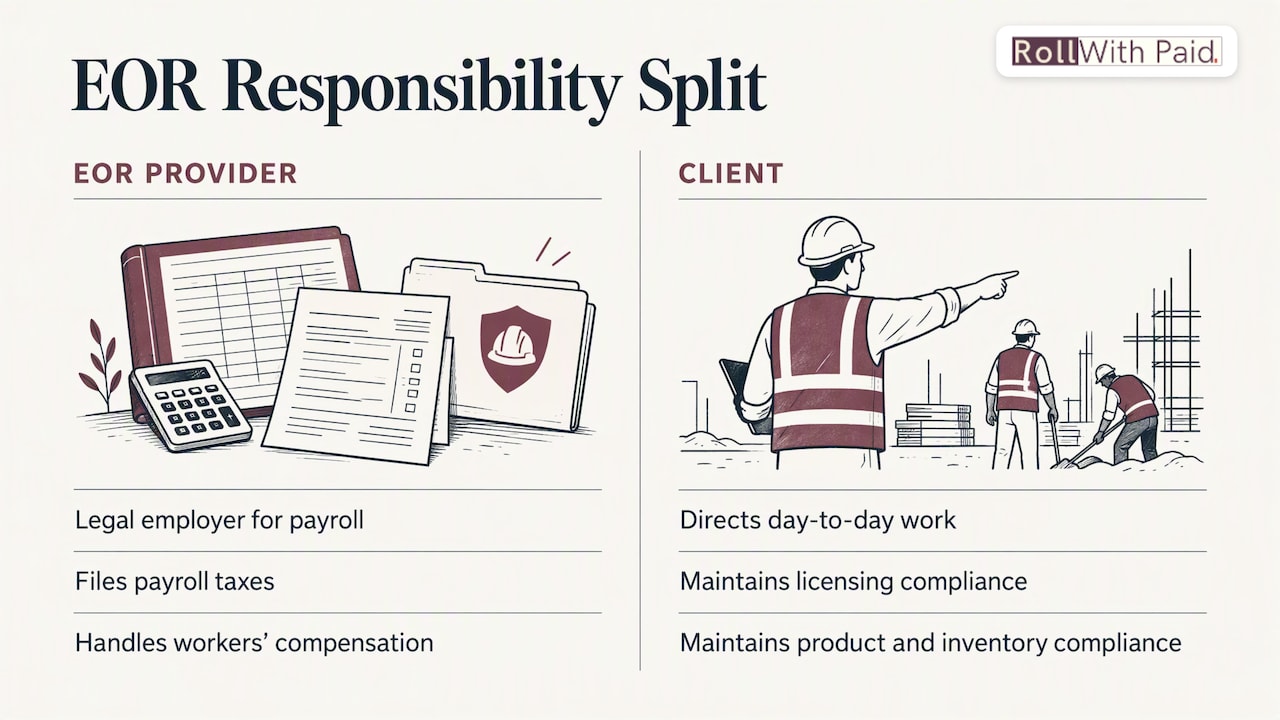
It is not a magic fix, and it does not replace your own compliance on licensing, product or inventory. But it changes who sits between your workforce and the banking system, and whether that party was designed for your industry in the first place. If you want the mechanics, we explain them in what an Employer of Record is and why it matters for your benefits and in our guide to Employer of Record for high-risk industries.
If you are comparing options, we have also written side-by-side pieces on how we differ from mainstream providers, including an overview of payroll freeze risk against Paychex and a look at why generic payroll software fails cannabis employers.
Our perspective
We wrote the op-ed because we keep meeting operators who find out the hard way. They did everything right on licensing and product taxes, and then a payroll notice arrived with a deadline that no one could meet.
Here is what we believe, based on the work we do every day. Payroll is not an administrative errand. It is the promise you make to every person on your team that they will be paid on time and correctly, and it depends on relationships you may never see. The employers who stay calm are the ones who asked the uncomfortable questions early: does my provider understand my business, and does the bank behind it?
We built Roll With Paid. for the businesses traditional payroll providers turn away. That means audit-ready processes, an Employer of Record model that moves the legal employer role to a provider built for this environment, customized onboarding and personal support from people who know the industry. It also means we are comfortable with the question that makes other vendors uneasy: tell us exactly what you sell.
The hemp industry is about to learn what cannabis operators already know. The good news is that you do not have to learn it the way they did.
— Leah Kollross
How Roll With Paid. can help
If your payroll provider has never asked what you sell, or you want a second opinion on your exposure, we can help. Our services include Employer of Record, payroll execution, HR and compliance solutions, onboarding, multi-state hiring support and time and attendance tools, all designed for cannabis and other high-risk employers. Pricing depends on gross payroll, worker classification codes and headcount, with an optional flat-rate HR retainer, so we scope it to your business. See how our service rate and HR retainer work, or start from the Roll With Paid. home page to see everything we offer.
FAQ
What is Marijuana Moment?
Marijuana Moment is a news outlet covering cannabis and marijuana policy, business, science and culture at the federal, state and international levels. It describes itself on social media as a top source for updates on the most important cannabis news, and its editor is Tom Angell. The payroll op-ed discussed here ran on its site.
Is marijuana federally legal now?
No. As of October 2026, marijuana is not federally legal for recreational use. The Department of Justice has placed FDA-approved products and products containing marijuana under a qualifying state license in Schedule III, while a broader rescheduling process continues. State-licensed operators should keep treating federal risk as live.
Why would a payroll provider drop a cannabis or hemp client?
Usually because the provider or its banking partner reassesses the risk of the industry. The op-ed notes that risk-profiling can cover a whole business, so even a company with one THC product line can be affected. That is why you should ask whether your provider knows what you sell and whether its banks do.
Can I be penalized if my bank closes my account and I miss an electronic deposit?
Potentially, yes. CRS reports that penalties for failing to follow electronic payment mandates can reach 10% of the taxes paid, and the IRS has generally not treated lack of a bank account as reasonable cause. Talk to a cannabis-experienced CPA or tax attorney about your situation before you decide how to handle deposits.
Sources
- Hemp Businesses Are About To Learn What Marijuana Operators Already Know: Payroll Can Disappear Overnight (Op-Ed), Marijuana Moment
- Marijuana Moment home page
- Changes to the Statutory Definition of Hemp and Implications for Agricultural Policy, Congress.gov
- Change to Federal Definition of Hemp and Implications for Federal Enforcement, Congress.gov
- Justice Department places FDA-approved marijuana products and products containing marijuana in Schedule III, U.S. Department of Justice
- Marijuana and Federal Tax Law: In Brief, Congressional Research Service
- Businesses with employees, Internal Revenue Service
Recommended
- Avoid 280E Risk: Roll With Paid vs Paragon for Cannabis Employers
- Cannabis Payroll: Avoid 280E Exposure: Roll With Paid vs Greenleaf HR
- Before Your First Paycheck: Audit Ready Multi-State Cannabis Payroll
- 5 Payroll Mistakes Cannabis Businesses Can’t Afford – Roll With Paid.
Roll With Paid. is not a law firm and does not provide legal advice. This article summarizes Minnesota law as of August 2026 and is general information only. Tip arrangements are fact-specific; before changing a policy, consult employment counsel or contact DLI Labor Standards at 651-284-5075.