
Questions to Ask Before Signing a Cannabis Payroll Provider

Ask any cannabis payroll provider five things before you sign: who files and pays your taxes, which state rules it applies, which model it runs (software, PEO or Employer of Record), how it charges, and how you leave. The IRS says the employer stays responsible for payroll taxes even when a provider fails, so the answers must be in writing.
This guide is a buyer’s checklist for dispensary, cultivation and multi-state operators. Each section stands alone, so you can take the one you need into a vendor call.
TL;DR
- You remain liable to the IRS for payroll taxes, penalties and interest if a provider misses a deposit or filing.
- Ask the provider to name the state rules it applies for every state where you employ people. State marijuana and employment laws differ.
- Payroll software, a PEO and an Employer of Record (EOR) split responsibility differently. Match the model to your risk, not to the lowest quote.
- Get fees, data access and exit steps in the agreement before the first pay run.
- Roll With Paid is built for cannabis and other high-risk employers, with an EOR model and audit-ready processes.
Table of Contents
- Who is liable if a cannabis payroll provider misses a tax filing?
- Does the provider know the cannabis rules in every state where you operate?
- Why does Section 280E change how cannabis payroll is set up?
- Software, PEO or Employer of Record: which model fits a cannabis employer?
- What should a provider cover for dispensaries, cultivation sites and multi-state operators?
- How do you check software capabilities, integrations and processing speed?
- How should you read cannabis payroll fees and contract terms?
- What happens to paychecks and filings if your provider stops serving you?
- How do you catch missed payments and audit exposure early?
- How do the main provider types compare for cannabis employers?
- What does an owner’s perspective look like?
- Which Roll With Paid services answer these questions?
- FAQ
- Sources
Who is liable if a cannabis payroll provider misses a tax filing?
You are. The IRS states that employers may outsource tax collection, deposits and reporting, but remain responsible for federal employment taxes, penalties and interest if the provider fails. Hiring a provider moves the work. It does not move the liability.
That shapes four questions:
- Which forms does the provider file for us? A payroll service provider may prepare paychecks and Forms 940, 941 and W-3, make federal tax deposits, and file and furnish W-2s, but it does not assume the employer’s tax liability.
- Whose address is on file with the IRS? The IRS recommends that employers keep their own address of record, because changing it to the provider’s address can limit your notice of tax matters.
- Do we get written confirmation each quarter? The IRS says reporting agents must give clients quarterly written statements reminding them that they remain responsible for timely filing and payment.
- Can we see deposit confirmations ourselves? A provider that shows you its filing record removes guesswork. Roll With Paid reports zero late filings for its clients.
Does the provider know the cannabis rules in every state where you operate?
A qualified provider names the state rules it applies for each state, not a single national standard. The Federal Bar Association’s 2026 education materials describe state marijuana laws and employment claims as differing across jurisdictions. A provider that answers “we handle all states” without specifics has not answered.
Ask for a short written answer on each point:
- Which state licensing and agency reporting does the provider support for your license type?
- How does the provider treat off-duty use, drug testing and medical cardholders in each state?
- How are new hires in a second or third state registered for withholding and unemployment insurance?
- Who owns the I-9 file and how is it kept ready for inspection?
Multi-state operators should also read our guide to audit-ready multi-state cannabis payroll. Roll With Paid offers multi-state hiring support and I-9 support as part of its services.
Why does Section 280E change how cannabis payroll is set up?
Section 280E of the Internal Revenue Code disallows most business deductions for companies trafficking in Schedule I or II controlled substances. Marijuana’s federal status is under review, and the Federal Bar page above refers to the DOJ’s rescheduling efforts. Until your own tax adviser confirms a change applies to you, treat labor cost allocation as a tax issue.
For payroll, that means ask:
- Can the provider split wages by job function so your accountant can apply the right treatment?
- Are worker classification codes assigned consistently from the first day?
- Can payroll reports be exported in the format your CPA uses?
See how this plays out in our 280E payroll comparison. Your CPA decides the tax position. Payroll supplies clean data.
Software, PEO or Employer of Record: which model fits a cannabis employer?
Payroll software fits an employer with in-house HR expertise and low risk. An Employer of Record fits cannabis operators who want the provider to carry compliance work, workers’ compensation and employment administration. The models differ in who does the work, not just in price.
| Question | Payroll software | PEO | Employer of Record (EOR) |
|---|---|---|---|
| Who runs each pay cycle? | Your team | Shared | The provider |
| Who sets up workers’ comp coverage? | You, with a separate insurer | Usually the PEO’s master policy | The provider, under the EOR model |
| Who keeps HR policy documents current? | You | Shared | The provider, with HR consulting |
| Does the vendor accept cannabis? | Varies by vendor | Varies by vendor | Built for it at Roll With Paid |
| Who keeps final tax responsibility? | You | You, unless a certified arrangement applies | You, so ask for written filing proof |
We explain the trade-off in more depth in payroll software, PEO or EOR and in what an Employer of Record is. For high-risk employers specifically, read Employer of Record for high-risk industries.
A software-versus-EOR evaluation checklist
Score each vendor yes or no on these items before you compare prices:
- It accepts your license type and your worker classifications in writing.
- It handles filings and deposits, not just check printing.
- It offers onboarding, I-9 support and policy documentation.
- It supports workers’ compensation by classification code.
- It names a person who answers your questions.
- It can explain what happens to your records if you leave.
Software usually scores well on the first line and poorly on the next five. The EOR model is designed to cover all six.
What should a provider cover for dispensaries, cultivation sites and multi-state operators?
The scope should match your operation. Each business type has a different weak point, and the provider should speak to yours.
Dispensaries
Dispensaries run many hourly staff, shifts and turnover. Ask about time and attendance tools, overtime calculation, tip handling where it applies, and onboarding speed for new budtenders. See cannabis dispensary payroll rules and risks.
Cultivation facilities
Cultivation brings seasonal labor spikes and higher-hazard job classes. Ask how workers’ compensation classification codes are assigned, because rates vary by code. The way a provider documents job duties affects your premium and your audit result.
Multi-state operators
Multi-state employers need one view across states, with each state’s withholding, unemployment and reporting handled correctly. Ask for a written list of the states the provider supports before you sign.
Transporters and adjacent trades
Delivery and transport staff face road and cash-handling risks. Our page on cannabis transporter payroll covers pay and compliance. Employers in construction and trades face similar classification risks, as in our high-risk trades case study.
How do you check software capabilities, integrations and processing speed?
Ask the provider to demonstrate its work on your data, not to describe it. Focus on four areas:
- Time and attendance. Punches should flow into payroll without re-keying. Roll With Paid provides time and attendance tools.
- Accounting. Payroll journals should export to your ledger by location and job function.
- Benefits. Enrollment changes should reach payroll before the next run.
- Onboarding. New-hire forms, I-9 and policy acknowledgments should be completed in one flow.
Then ask for numbers: payroll accuracy rate, usual turnaround from approval to deposit, and cut-off times. Put the cut-off time in the agreement, because a missed cut-off is how a late paycheck happens. Poor document handling is a common failure, so also see our look at HR document management.
How should you read cannabis payroll fees and contract terms?
Read the fee as a formula, not a single number. Roll With Paid bills monthly, based on gross payroll, and rates vary by worker classification code and headcount. An optional flat-rate HR retainer is also available. Current details are on the pricing page.
Whatever vendor you consider, get these in writing:
- The fee basis (per employee, percent of payroll or flat) and what triggers a change.
- What the fee includes: filings, workers’ comp administration, HR support, year-end forms.
- The contract term and renewal method.
- Who pays penalties that result from the provider’s own error.
- Your right to export payroll, tax and HR records, and in what format.
A classification-based rate matters because it follows your actual risk. A cultivation crew and a front-desk team do not carry the same workers’ comp exposure, and the pricing should show that.
What happens to paychecks and filings if your provider stops serving you?
Employees miss paychecks and the employer keeps the liability. The IRS position above is the reason: if a provider fails, you answer for the taxes. Cannabis employers face this more than most, because banking and vendor relationships can end quickly. Marijuana Moment’s op-ed on this topic is summarized in our payroll risk guide.
Before signing, ask:
- What notice will the provider give before ending service?
- Do you keep access to payroll registers, tax filings and employee files after termination?
- Who confirms that the last quarter’s deposits cleared?
- How is the handoff to a new provider handled mid-quarter?
You can limit damage by keeping your own copies of registers and your own IRS address of record. Our guide to avoiding a payroll freeze compares provider models on this point.
How do you catch missed payments and audit exposure early?
Review the provider’s work monthly, not annually. Check that each deposit date matches your register, that every quarterly filing has a confirmation, and that workers’ comp payroll reports match what you actually paid. A practical guide to workers’ comp audit preparation shows what auditors look at, including misclassified payroll.
Roll With Paid designs its processes to be audit-ready, so records are organized before an auditor asks.
How do the main provider types compare for cannabis employers?
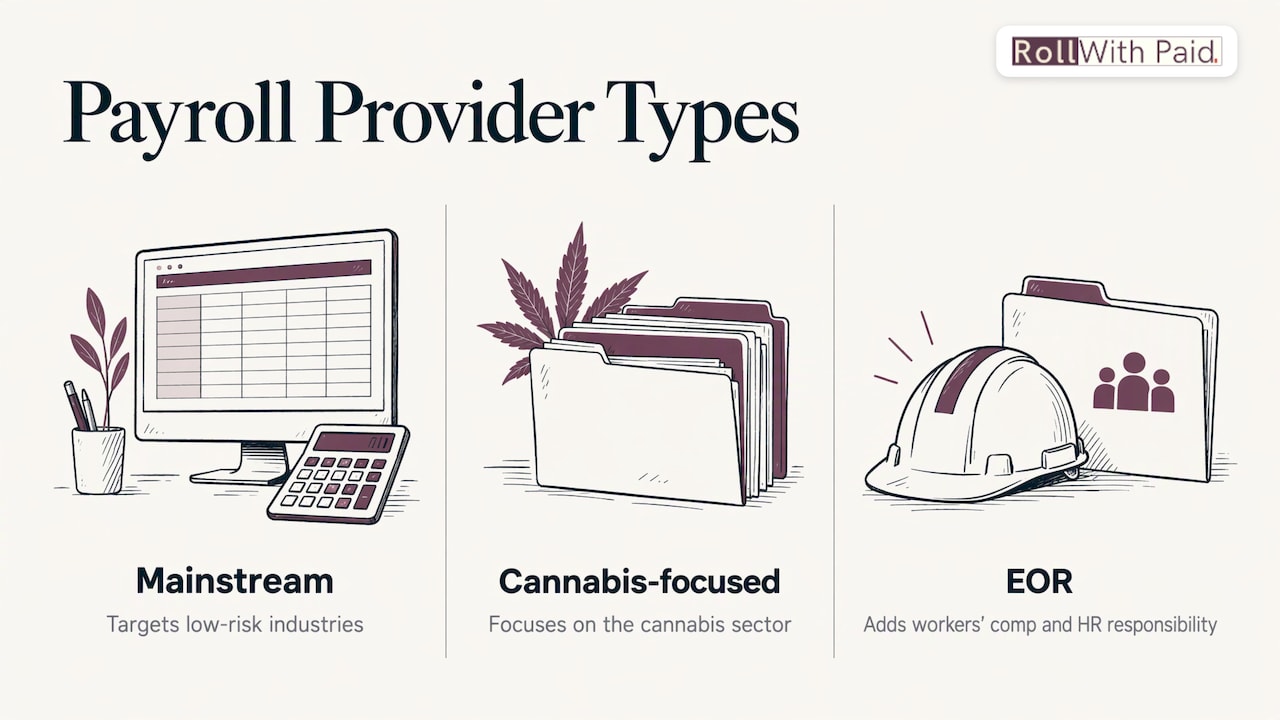
Mainstream payroll platforms such as Gusto, Paychex or ADP target low-risk industries. Cannabis-specific firms, including Greenleaf HR and Paragon Payroll, focus on the sector. An EOR adds workers’ comp and HR responsibility. Our side-by-side pages cover Greenleaf HR, Paragon Payroll and Clutch, each scored on eight compliance checks.
For a wider view, see our cannabis payroll overview, our human capital management guide and our CHRO guide. New rules and cases arrive in the Roll Call newsletter.
What does an owner’s perspective look like?
Most owners ask about price first. We think the better first question is who answers when something goes wrong.
A payroll error in cannabis is rarely only a payroll error. It touches workers’ compensation classification, state filings, 280E records and your standing with employees. That is why we built Roll With Paid around the Employer of Record model: payroll, HR compliance, onboarding and risk management sit together, so one team sees the whole picture.
We serve businesses that traditional payroll providers turn away. Our goal is simple: audit-ready records, filings on time, and an owner who can focus on the business. Our clients report zero late filings, and that is the standard we hold ourselves to.
Leah Kollross
Which Roll With Paid services answer these questions?
Roll With Paid combines Employer of Record, payroll execution, HR and compliance solutions, employee onboarding, multi-state hiring support and time and attendance tools for cannabis and other high-risk employers. Explore the full range on our services page or start at rollwithpaid.com.

Talk to us about your states, your headcount and your classification codes, and we will show how the EOR model covers each item on the checklist above.
FAQ
Do cannabis businesses need a special payroll provider?
Many mainstream providers decline or restrict cannabis clients, so a provider that accepts your license type in writing is essential. Cannabis employers also face 280E allocation, state-specific rules and higher-hazard classifications. A specialist handles these as routine work.
Can a payroll provider take over my IRS notices?
A provider can file and deposit for you, but the IRS recommends that you keep your own address of record so that you receive tax notices directly. You remain responsible for the taxes either way.
How long does it take to switch payroll providers?
Timing depends on the pay cycle and the quarter. Switching at the start of a quarter keeps the filings cleaner, because one provider reports the whole period. Ask the new provider for a written transition plan with dates for each state.
Is an Employer of Record the same as a PEO?
They overlap but are not identical. Both take on HR and payroll functions, and the way responsibility is shared differs by contract. Ask for a clear written split of duties for payroll taxes, workers’ compensation and HR compliance.
Sources
- Outsourcing payroll duties, Internal Revenue Service
- Third party payer arrangements: payroll service providers and reporting agents, Internal Revenue Service
- Medical and Recreational Marijuana Legalization Laws and Employment Claims, Federal Bar Association
- Workers’ Comp Audit Preparation: A Practical Checklist
Recommended
- Cannabis Payroll: Avoid 280E Exposure
- Cannabis Payroll: 8 Compliance Checks
- High Risk Cannabis Payroll
- Cannabis Industry Payroll: Rules, Risks and Provider Models
Roll With Paid. is not a law firm and does not provide legal advice. This article summarizes Minnesota law along with other states and jurisdictions law and is for general information only. Before changing a policy, consult employment counsel or contact DLI Labor Standards at 651-284-5075.