
Native American Heritage Month: History, Meaning and Workplace Practice
Native American Heritage Month is observed every November in the United States to honor the cultures, histories and contributions of Native Americans. Congress first designated November as National American Indian Heritage Month in 1990 (Pub. L. 101-343), and Presidents have proclaimed the month each year since. Native American Heritage Day falls on the Friday after Thanksgiving, which is November 27 in 2026.
TL;DR
- Native American Heritage Month runs November 1 to 30. Pub. L. 101-343 created it in 1990.
- Native American Heritage Day is the Friday after Thanksgiving, set by Pub. L. 111-33 in 2009. In 2026 it is November 27.
- The Bureau of Indian Affairs (BIA) 2026 theme is “250 Years and Beyond: Building a Culture of Service in Indian Country.”
- Employers observe the month best by naming specific tribes, featuring contemporary Native voices and keeping the work going after November.
- For cannabis and other regulated employers, tribal sovereignty, compacts and compliance make the month a working reality, not only a calendar entry.
Table of Contents
- What is Native American Heritage Month?
- When is Native American Heritage Day in 2026?
- How did Native American Heritage Month begin?
- What does Native American Heritage Month recognize?
- What is the 2026 theme for Native American Heritage Month?
- How should employers observe Native American Heritage Month respectfully?
- Why does Native American Heritage Month matter to cannabis employers?
- Does Native American Heritage Month apply to hospitality, construction and other high-risk employers?
- How does Roll With Paid. support tribal and high-risk employers?
- What is our perspective on observing the month?
- FAQ
- Sources
What is Native American Heritage Month?
Native American Heritage Month is the November observance that celebrates the contributions and achievements of Native Americans. The Congressional Research Service fact sheet also calls it National American Indian Heritage Month. Both names appear in federal materials.
The U.S. Courts educational page says the month calls attention to the culture, traditions and achievements of the nation’s original inhabitants and their descendants. Several federal agencies run a shared site for the month. They are the Library of Congress, National Archives, National Endowment for the Humanities, National Gallery of Art, National Park Service, Smithsonian Institution and U.S. Holocaust Memorial Museum. That collaborative site states that these agencies join in paying tribute to Native ancestry and traditions.
When is Native American Heritage Day in 2026?
Native American Heritage Day is Friday, November 27, 2026. It always falls on the Friday after Thanksgiving. Congress set that date in Pub. L. 111-33, the Native American Heritage Day Act of 2009, signed on June 26, 2009.
The text of Public Law 111-33 says the designation underscores the government-to-government relationship between the United States and Native American governments. Section 3 encourages programs, ceremonies and activities on the history and present status of tribal governments, Native cultures, traditions and languages.
The Heritage Day sits inside the month, so the same observance covers both. Thanksgiving falls on November 26 in 2026, and Heritage Day follows the next morning.
How did Native American Heritage Month begin?
The month grew out of a century of advocacy, and Congress made it official in 1990. The Library of Congress guide to the month’s history lays out the sequence:
- 1986: Pub. L. 99-471 authorized President Reagan to proclaim November 23 to 30 as American Indian Week.
- 1987 to 1989: Congress designated a different American Indian week each year.
- 1990: Pub. L. 101-343 authorized November as National American Indian Heritage Month.
Congress chose November because it concluded the traditional harvest season and was generally a time of thanksgiving and celebration for American Indians. Presidents issued annual proclamations from 1995 to 2008, and have designated the month each year since 2009 as National Native American Heritage Month.
Who campaigned for a national day before 1990?
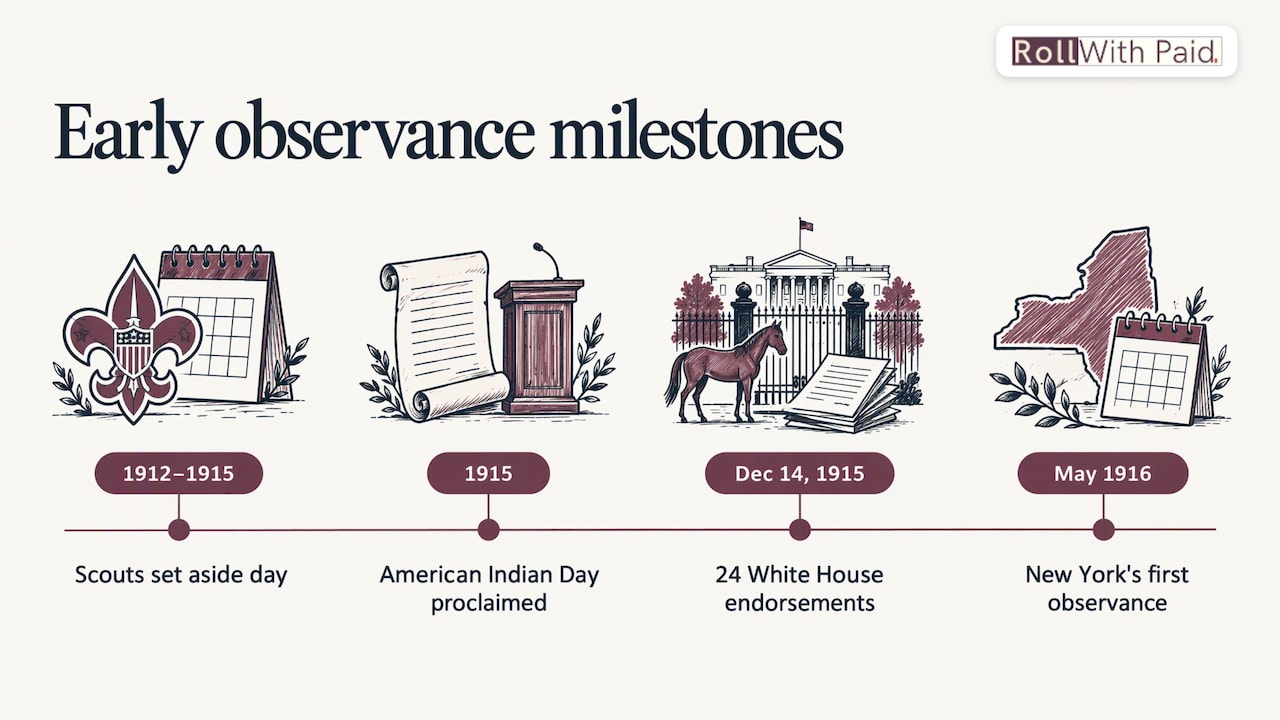
The Bureau of Indian Affairs history page credits Dr. Arthur Caswell Parker, a Seneca and director of the Rochester Museum. He persuaded the Boy Scouts of America to set aside a day for the “First Americans” from 1912 to 1915. In 1915 Rev. Sherman Coolidge, an Arapaho minister, proclaimed the second Saturday of each May as American Indian Day.
The official Native American Heritage Month site adds that Red Fox James, a Blackfoot man, rode horseback from state to state. On December 14, 1915, he presented the endorsements of 24 state governments at the White House. The first state American Indian Day was declared in New York in May 1916.
Who sponsored the 1990 resolution?
The U.S. Senate history page says Senator Daniel Inouye of Hawaii and Delegate Eni Faleomavaega of American Samoa introduced the 1990 joint resolution (H.J. Res. 577). In 2008, Congress amended the commemorative language to include Alaska Natives.
What does Native American Heritage Month recognize?
The month recognizes both historical contributions and living cultures. Public Law 111-33 finds that Native Americans have made distinct and significant contributions in agriculture, medicine, music, language and art. It also names them as inventors, entrepreneurs, spiritual leaders and scholars.
The same law notes that Native Americans have served with valor in the nation’s military actions from the Revolutionary War to the present. In most of those actions, more Native Americans per capita served in the Armed Forces than any other group of Americans.
The North Carolina American Indian Heritage Commission makes a point employers should hear. Its 2026 toolkit says Native Nations are older than U.S. customs and governments and still operate with their own laws and values. Highlighting contemporary Native history and culture helps people see it as alive, not as a closed chapter.
What is the 2026 theme for Native American Heritage Month?
The BIA’s 2026 theme is “250 Years and Beyond: Building a Culture of Service in Indian Country.” The BIA’s month page says the theme highlights work to secure justice for missing and murdered Indigenous people, create economic development and improve the probate process.
Economic development is the part most relevant to business owners. Tribal governments are employers, regulators and licensors, and many operate enterprises that run payroll across state and tribal lines.
Which November dates does the BIA highlight in 2026?
The BIA lists these observances for 2026:
| Date | Observance |
|---|---|
| November 7 | National Bison Day |
| November 11 | Veterans Day, noting 31,000 American Indian and Alaska Native service members on active duty |
| November 15 | Rock Your Mocs Day |
| November 18 | A Celebration of Indigenous Cuisine |
| November 19 | Red Shawl Day, honoring missing and murdered Indigenous people |
| November 26 | Thanksgiving Day |
| November 27 | Native American Heritage Day |
Rock Your Mocs began in 2011. It is a grassroots movement in which participants wear moccasins, or a Turquoise Ribbon or apparel if their tribe did not wear moccasins. The BIA says the hashtag #RockYourMocs is used to inspire cultural pride and show individual tribal identity.
How should employers observe Native American Heritage Month respectfully?
Employers observe the month well by being specific, current and consistent. The North Carolina American Indian Heritage Commission’s 2026 toolkit gives six guidelines that translate directly to the workplace:
- Name the specific tribe when you refer to people, and ask about individual preferences.
- Recognize that tribes differ. Not all tribes lived in teepees or wore headdresses.
- Teach triumphs and traumas together.
- Treat oral history as more than “legends” or “folklore.”
- Highlight contemporary Native history and culture.
- Keep it year-round. The National Park Service frames Indigenous heritage as present in every county and every national park, with learning resources available beyond November.
The Minnesota Department of Health adds guidance on tone in its American Indian culture toolkit. Never refer to Native people only in the past tense. Do not bring up traumas unexpectedly. Make space for Indigenous people to be heard, and compensate them fairly for their time.
That last point matters for employers. A guest speaker, a cultural consultant or a Native-owned caterer is working for you, and the work should be paid and documented like any other engagement.
What do Red Shawl Day and Rock Your Mocs ask of a workplace?
Red Shawl Day honors missing and murdered Indigenous people. The BIA encourages people to wear red, which symbolizes the loss of sacred life blood through violence, and to use #RedShawlWeek on social media. Rock Your Mocs invites staff to wear moccasins or tribal apparel. Both are voluntary. Neither should be required of any employee, and no manager should single out a Native employee to explain or represent a community.
Why does Native American Heritage Month matter to cannabis employers?
Tribal sovereignty shapes how cannabis businesses in many states hire, license and pay people. Tribal nations are governments, and in some states they hold their own cannabis authority alongside state regulators. Our own pages cover this ground in detail: Native American cannabis business and payroll, what NCAI’s resolution means for tribal cannabis employers, and Minnesota cannabis compacts in practice.
A heritage month post is a fair place to start, but the stronger practice is a standing relationship. Our Tribal Relations page is where we collect that work. Employers who want to follow tribal news year-round can use our list of Native American news sources. Our newsletter, Roll Call, carries regulatory updates for operators.
What does this look like for a dispensary?
A dispensary near tribal land may have Native employees, Native customers and tribal government partners. Observing the month there means featuring Native-owned brands and voices, scheduling flexibly around ceremonies and events, and keeping staff records clean enough that a regulator or compact partner can review them at any time.
What does this look like for a cultivation facility?
A cultivation facility has seasonal hiring, mixed job classifications and heavy documentation. Heritage Month is a natural moment to review how roles are classified and how new hires are onboarded, because misclassification is a payroll problem in any month. Congress chose November for this observance because it concluded the traditional harvest season, a rhythm cultivators know well.
What does this look like for a multi-state operator?
A multi-state operator faces a different rulebook in each state, and tribal jurisdictions add another layer. A single observance calendar helps, but the larger task is consistent policy documentation across every location. Our guide to audit-ready multi-state cannabis payroll and our write-up on PTO versus sick leave rules across states cover the compliance side.
Does Native American Heritage Month apply to hospitality, construction and other high-risk employers?
Yes. The month applies to every employer, and it matters most where workforces are diverse, seasonal and fast-moving. Restaurants, bars and event venues often serve as community gathering places. Construction and trades employers frequently work on or near tribal land and hire tribal members.
The practical steps are the same as for cannabis: name specific tribes, pay Native vendors and speakers fairly, and keep documentation current. For a view of how trades employers handle HR and payroll risk, see our construction and trades case study. For the wider picture of people management, our human capital management guide and CHRO guide are the pillar pages for this topic.
How does Roll With Paid. support tribal and high-risk employers?
We specialize in payroll and HR for high-risk industries, particularly cannabis businesses. Our services include Employer of Record, payroll execution, HR and compliance solutions, seamless employee onboarding, multi-state hiring support and time and attendance tools. Our model is designed to keep clients audit-ready, and our clients’ record includes zero late filings.
When payroll and HR administration are handled for you, your team has time to take part in November events, host Native vendors and build relationships that last past the month. You can see how this plays out in our case studies, review our services, or start at Roll With Paid..
For questions on how rates work, our pricing page explains the service rate and the optional HR retainer.
What is our perspective on observing the month?
Heritage Month works when it is a commitment, not a post. In our work with cannabis operators, the employers who earn trust with tribal partners are the ones whose paperwork is in order, whose workers are classified correctly and whose filings are never late.
That is why we built our Employer of Record model around audit readiness. When payroll, onboarding and compliance are handled properly, an owner can spend November on what the month is for: learning, listening and building relationships.
We encourage every operator to pair a November observance with a year-round practice. Name tribes specifically, pay Native speakers and vendors fairly, and keep your documentation ready for review.
Jennifer Williams
FAQ
Is Native American Heritage Month the same as Indigenous Peoples’ Day?
No. Native American Heritage Month is a November observance created by Congress in 1990. Indigenous Peoples’ Day is a separate observance. The National Park Service invites the public to use either #IndigenousHeritageMonth or #NativeAmericanHeritageMonth when joining its November conversation.
Why is Native American Heritage Month in November?
Congress chose November because it concluded the traditional harvest season and was a time of thanksgiving and celebration for American Indians. The Library of Congress guide records that reasoning. The month became permanent through Pub. L. 101-343 in 1990.
What is the difference between Heritage Month and Heritage Day?
Heritage Month covers all of November. Heritage Day is a single day, the Friday after Thanksgiving, created by Pub. L. 111-33 in 2009. The Bureau of Indian Affairs said in 2009 that the day can be observed through programs, ceremonies and activities about tribal governments, traditions, languages and cultural legacy.
Where can employers find official resources?
Start with the multi-agency Native American Heritage Month site and the BIA’s month page. The Congressional Research Service fact sheet also lists the National Museum of the American Indian and nongovernmental groups such as the National Congress of American Indians.
Sources
- Native American Heritage Month: Fact Sheet, Congress.gov
- Native American Heritage Month, U.S. Courts
- Native American Heritage Month 2026, official collaborative site
- About Native American Heritage Month 2026
- Public Law 111-33, Native American Heritage Day Act of 2009
- History and Overview, Library of Congress
- Celebrating National Native American Heritage Month, U.S. Senate
- Celebrate Native American Heritage, Bureau of Indian Affairs
- Native American Heritage Month, Bureau of Indian Affairs
- Native American Heritage Day Today, Bureau of Indian Affairs
- National Native American Heritage Month: November 2026, U.S. Census Bureau
- American Indian Heritage Month Toolkit, North Carolina American Indian Heritage Commission
- American Indian Culture and Foods, Minnesota Department of Health
- Native American Heritage Month, National Park Service
Recommended
- Native American News Sources Employers Should Follow
- Tribal Relations for Agencies: Minnesota Cannabis Compacts in Practice
Roll With Paid. is not a law firm and does not provide legal advice. This article summarizes Minnesota law along with other states and jurisdictions law and is for general information only. Before changing a policy, consult employment counsel or contact DLI Labor Standards at 651-284-5075.