
Native American Cannabis Business: Opportunity and Payroll

A Native American cannabis business is one that a federally recognized tribe, a tribal enterprise or a tribal member owns and runs under tribal law, sometimes alongside a compact with a state. The opportunity is real: new revenue for tribal government, jobs on the reservation and a stake in a market that mainstream operators already compete for. The legal footing is also different from a state-licensed shop, and so are the payroll and HR duties that come with it. This guide covers how these businesses work, why the revenue case is strong, and what operators should have in place before the first employee is hired.
TL;DR
- Federally recognized tribes are distinct governments, so state cannabis law generally does not apply to them, with exceptions. Cannabis is still federally illegal.
- Roughly 85 tribes were involved in cannabis in some form as of December 2024, from regulation to retail.
- One analysis projects that tribes that enter early could reach hundreds of millions of dollars a year in new revenue, and $2 billion a year over time.
- Revenue only helps if the business is employer-compliant: correct worker classification, payroll tax filings, workers’ compensation and I-9s.
- An Employer of Record model can take much of that administrative and liability load off a new tribal operator.
Table of Contents
- What makes a cannabis business tribal
- The legal footing: sovereignty, federal law and compacts
- Do reservations sell cannabis?
- The benefits for tribes and the revenue opportunity
- Where tribal operators get tripped up on payroll and HR
- A practical launch checklist for tribal cannabis employers
- Our perspective
- How Roll With Paid supports high-risk and cannabis employers
- FAQ
- Sources
What makes a cannabis business tribal
Tribal sovereignty is the inherent authority of Indigenous tribes to govern themselves, make and enforce laws, and regulate affairs within tribal territory, as Vicente LLP explains. In practice that means a tribe can write its own cannabis code, set its own licensing rules and decide who may grow, test, process or sell.
Most tribal businesses are run through a tribal enterprise, an entity whose executives answer to the Tribal Council. According to UNLV’s 2025 report on tribes and cannabis, federally recognized tribes are distinct government entities and state law generally does not apply to them, though there are exceptions. The same report notes that questions of state, federal and tribal jurisdiction often call for legal and historical analysis, so no single answer fits every nation.
There are a few common ownership shapes:
- Tribally owned enterprise: the tribe itself owns the dispensary or cultivation site, and profits flow to tribal government.
- Tribal member licensing: the tribe licenses members to grow or sell and collects tax. Professor Ryan Stoa suggests in the Utah Law Review that this model can generate tax revenue while insulating the tribal government from direct participation in cannabis activity.
- Joint ventures and management agreements: a tribe partners with an outside operator for expertise or capital. These carry their own contract and employment questions.
Each tribe is free to craft its own approach, and the legal frameworks for tribal cannabis agriculture are still evolving, per the same Utah Law Review article. Two tribal operators in the same state can look quite different.
The legal footing: sovereignty, federal law and compacts
Sovereignty is not a shield from federal law. Cannabis remains illegal under the Controlled Substances Act. The Department of Justice’s 2015 policy statement reiterates that federal prosecutors keep the authority to enforce federal marijuana laws in Indian Country. Federal funding is affected too: as of 2022, tribal proposals involving marijuana were ineligible for the Bureau of Indian Affairs’ NABDI grant program.
Within that frame, tribes may develop their own cannabis laws and programs on their lands. To engage in commercial cannabis activity outside tribal territory, they generally negotiate compacts with states. Compacts are common but not legally required: the UNLV Cannabis Policy Institute notes that many tribes choose to operate solely within a sovereign regulatory market.
Minnesota offers a concrete example. The state and White Earth Nation finalized a compact that, according to MPR News, recognizes the tribe’s authority to regulate its cannabis businesses outside tribal lands, the first of its kind in the nation. The tribe’s cannabis enterprise, Waabigwan Mashkiki, said it planned up to eight dispensaries off tribal lands. If you work with Minnesota agencies or tribes, our overview of Minnesota cannabis compacts in practice shows how those agreements play out day to day.
Do reservations sell cannabis?
Yes. The Eastern Band of Cherokee Indians, for example, sells cannabis on its territory. Some tribes sell only on their own lands, some operate under compacts that extend to off-reservation locations, and some focus on cultivation, testing or processing instead of retail. As of December 2024, about 85 tribes were involved in cannabis operations nationwide, according to the Indigenous Cannabis Industry Association as reported by Tribal Business News.
The benefits for tribes and the revenue opportunity
The strongest case for tribal cannabis is economic self-determination: a revenue stream that the tribe controls and can reinvest at home.
Funding for government services. The Las Vegas Paiute Tribe, for example, uses cannabis revenue for governmental services, including healthcare for children and elders. Vicente LLP likewise observes that sovereignty gives tribes a significant opportunity to generate revenue for community services, provided they navigate market competition and outside regulatory pressure.
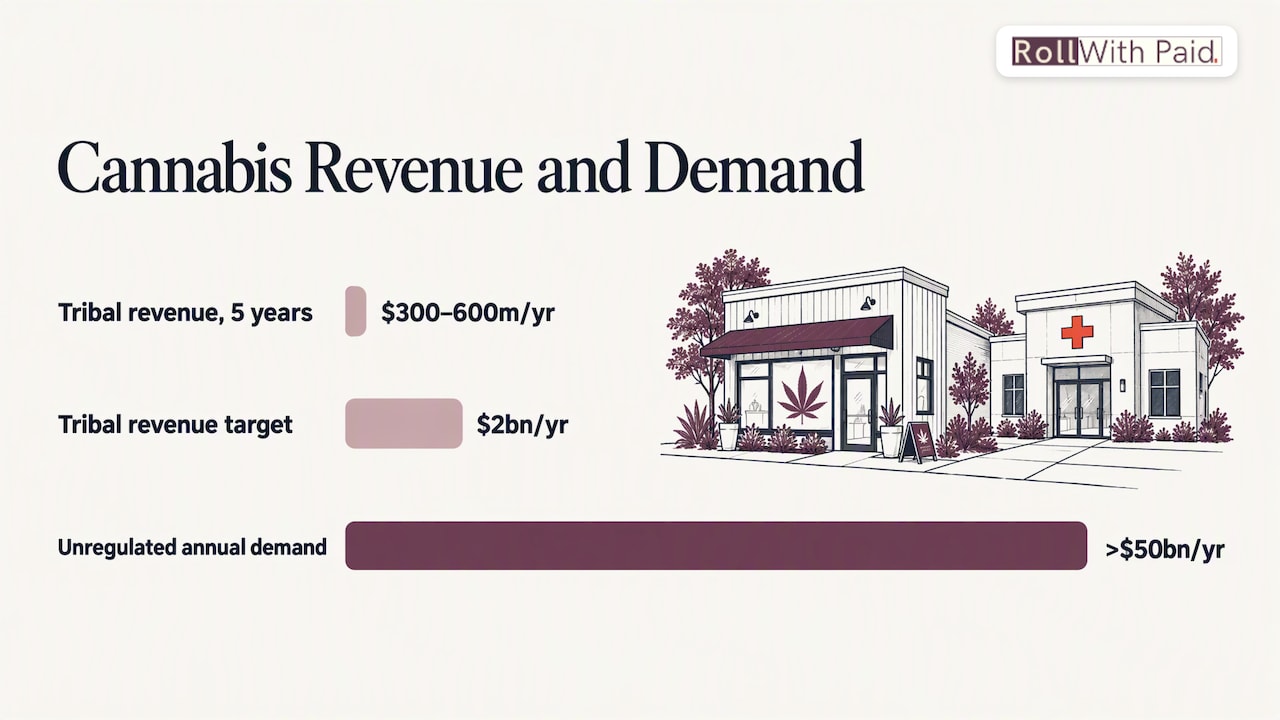
A large addressable market. HedgeRow Analysis estimates that tribes moving “deliberately and early” could see $300 million to $600 million in annual cannabis revenue within five years, building toward $2 billion a year, as Marijuana Moment reported. The firm points to more than $50 billion in annual consumer demand still met by unregulated products. Treat these as projections, not guarantees, but they show why so many nations are building plans.
More than one revenue stream. Cannabis is not only a storefront. A tribe can earn from several layers of the supply chain:
- Retail dispensaries on and, under a compact, off tribal land
- Cultivation and processing facilities
- Testing laboratories and compliance services
- Licensing and tax revenue from tribal members’ businesses
- Ancillary businesses such as packaging, security, delivery and hospitality
Jobs and skills on the reservation. Each of those layers hires people: budtenders, cultivators, trimmers, managers, drivers, lab technicians. For many communities these are the first local, year-round positions with benefits in a growth industry. That is also where payroll and HR quality starts to matter.
Where tribal operators get tripped up on payroll and HR
Revenue is only half of the picture. A cannabis employer, tribal or not, deals with an uneven set of rules, and mainstream payroll providers often will not serve the industry at all. Here are the areas to check before launch.
Worker classification and workers’ compensation
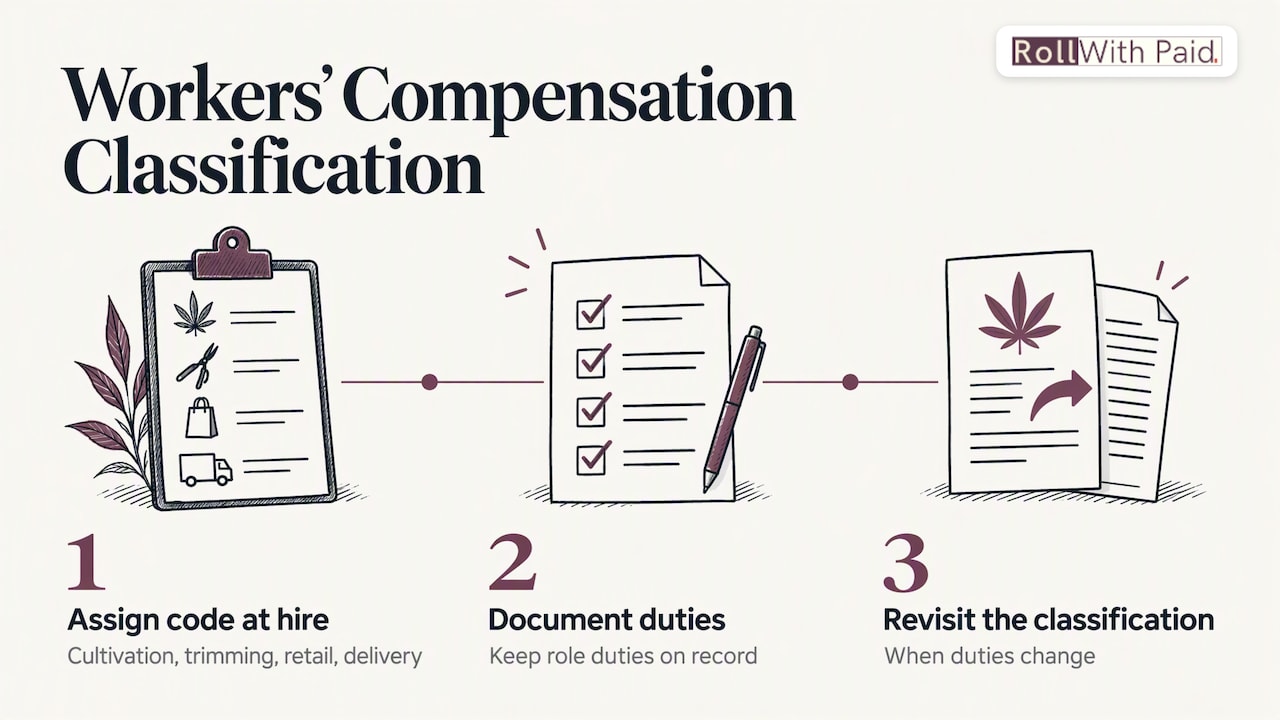
Misclassification is one of the costliest early mistakes. Cultivation, trimming, retail and delivery roles carry different risk classifications, and workers’ compensation premiums follow the classification code. Putting a trimmer in a clerical code to save on premium creates exposure at audit. Get the code right at hire, document the duties, and revisit it when a role changes.
Payroll taxes and cost accounting
For federal tax purposes, payroll taxes and workers’ compensation are among the costs the IRS lists as direct production costs and inventory costs under IRC §471-11. How a cannabis business allocates payroll between production and non-production roles therefore matters at tax time, and it is why clean job-level payroll records pay off. The IRS Advisory Council has also previously flagged the legal and ethical complexity tax practitioners face when preparing returns for cannabis businesses. If you are mapping out your own tax reporting for cannabis businesses, begin with a preparer who understands the industry and bring them payroll data that reconciles.
Tribal status can change which employment taxes and which agencies apply to particular workers and entities. That depends on the tribe, the entity structure and the employee, so confirm it with a tax professional experienced in tribal employment before you set up filings. Do not assume a rule that holds for one nation applies to yours.
Federal exposure on top of tribal law
Because marijuana stays illegal under federal law, even on tribal land, payroll and banking arrangements carry added scrutiny. Providers that avoid cannabis clients entirely may freeze accounts or drop a client with little warning. Our guide to five payroll mistakes cannabis businesses cannot afford lists the patterns we see most often, and our cannabis HR compliance calendar tracks the federal deadlines and enforcement trends that fall on employers.
I-9s, onboarding and policies
Every new hire needs a properly completed Form I-9 and the right state new-hire reporting. A fast-growing tribal enterprise often hires dozens of people at once before opening, and paperwork errors compound at that volume. Build a standard onboarding packet, train a named person to review I-9s, and keep a written handbook that covers drug-free workplace language, safety, scheduling and discipline. In Minnesota, for example, our new hire reporting checklist walks through the filing and the penalty range for missing it.
Multi-state and off-reservation expansion
A compact that lets a tribe sell off tribal lands also brings in state rules for wages, sick leave, new-hire reporting and unemployment insurance wherever your employees work. Each location can add a different set of filings. Before you open a second site across a state line, read our audit-ready multi-state cannabis payroll guide and compare your leave policies using our PTO versus sick leave breakdown.
A practical launch checklist for tribal cannabis employers
Use this list as a starting point with your counsel and your tribal council or board:
- Confirm the governing framework. Tribal cannabis code, any state compact and the federal position, in writing.
- Define the employer entity. Know which entity is the employer of record for tax and insurance purposes, and who signs.
- Map every role to a classification code. Cultivation, retail, security, management and delivery, each with documented duties.
- Secure workers’ compensation before day one. Confirm the carrier knows the operation is cannabis.
- Set a payroll calendar. Deposit schedules, quarterly wage detail, year-end forms and any state or tribal reports.
- Standardize onboarding. I-9 verification, new-hire reporting, handbook acknowledgment and training records.
- Choose time and attendance tools. Accurate time records protect you in wage disputes and audits.
- Keep an audit file. Policies, signed forms, classification rationale and filing confirmations in one place.
- Review before each new site. Treat every new state or location as a new compliance project.
Our HR compliance tips for dispensaries and cultivations expand on several of these steps.
Our perspective
Tribal nations are building cannabis businesses the way they build any enterprise: to fund services, create jobs and keep decisions close to home. The ambition is sound. What we see too often is that the payroll and HR side is treated as an afterthought until a late filing, a classification dispute or a dropped provider forces the issue.
We built Roll With Paid for the employers that traditional payroll companies turn away. Our Employer of Record model is designed to take on payroll execution, workers’ compensation, benefits administration and HR compliance, so owners and enterprise managers can concentrate on cultivation, retail and community goals. Our track record includes zero late filings for our clients.
For a tribal operator opening several roles at once, a managed structure means audit-ready records from the first paycheck, consistent onboarding and one team answerable for the details. The money a tribe earns from cannabis should reach healthcare, housing and elders, not penalties and rework.
Leah Kollross
How Roll With Paid supports high-risk and cannabis employers
We provide payroll execution, HR and compliance solutions, employee onboarding, multi-state hiring support, time and attendance tools and an Employer of Record model built for cannabis and other high-risk industries. If you operate in or alongside tribal markets, our Tribal Relations page is a good place to start.
We price by gross payroll, worker classification code and headcount, with an optional flat-rate HR retainer. See how our pricing works or start with our services overview to talk through your launch.
FAQ
Can Native American tribes legally grow and sell cannabis?
Tribes may develop their own laws and programs for cannabis on their lands, but cannabis remains illegal under the federal Controlled Substances Act. The 2015 DOJ policy statement confirms federal prosecutors keep enforcement authority in Indian Country. Each tribe should work with experienced counsel on its specific approach.
Do Indian reservations sell cannabis?
Many do. The Eastern Band of Cherokee Indians sells cannabis on its territory, and roughly 85 tribes were involved in cannabis operations at the end of 2024, from regulation to retail. Rules differ by tribe and by state, so a reservation shop in one state may operate very differently from another.
Does a tribe need a compact with the state?
Not always. Compacts are generally used for commercial activity outside tribal territory, and the UNLV Cannabis Policy Institute notes many tribes operate solely within their own sovereign market. Minnesota’s compact with White Earth Nation is an example of an agreement that allows off-reservation dispensaries.
How much revenue could tribes earn from cannabis?
HedgeRow Analysis projects $300 million to $600 million a year within five years for tribes that move early, growing toward $2 billion annually. These are estimates, and actual results depend on location, market competition and the legal framework each tribe adopts.
What payroll issues should a new tribal cannabis employer watch?
Start with worker classification, workers’ compensation coverage, payroll tax deposits and filings, I-9 verification and new-hire reporting. Confirm with a tax professional how tribal status affects the specific taxes that apply to your entity and employees.
Sources
- Examining Tribes and Tribal Cannabis, UNLV (2025)
- Native American Tribal Sovereignty and the Cannabis Industry, Vicente LLP
- Tribal Cannabis Agriculture Law, Utah Law Review (2023)
- Policy Statement Regarding Marijuana Issues in Indian Country, U.S. Department of Justice (2015)
- NABDI Frequently Asked Questions, Bureau of Indian Affairs (2022)
- 2026 National Cannabis Report, UNLV Cannabis Policy Institute
- Tribal cannabis dispensaries to open across Minnesota, MPR News
- Twenty-Nine Palms Band opens 3rd cannabis dispensary, Tribal Business News
- Las Vegas Paiute Tribe looks at cannabis expansion, KNPR
- Entering the marijuana market provides Native American tribes with opportunity for $2 billion a year, Marijuana Moment
- Cannabis Reporting, Retail Medical and Illegal, IRS (2022)
- IRS Guidance Coming for Practitioners Preparing Returns for Marijuana Retailers, IRS (2014)
- Accounting and Compliance Services: 2026 Business Guide
Recommended
- Cannabis Payroll: Avoid 280E Exposure: Roll With Paid vs Greenleaf HR
- Before Your First Paycheck: Audit Ready Multi-State Cannabis Payroll
- Avoid a Payroll Freeze: Roll With Paid vs. Paychex for Cannabis
- Avoid 280E Risk: Roll With Paid vs Paragon for Cannabis Employers
Roll With Paid. is not a law firm and does not provide legal advice. This article summarizes Minnesota law as of August 2026 and is general information only. Tip arrangements are fact-specific; before changing a policy, consult employment counsel or contact DLI Labor Standards at 651-284-5075.