
Native American News Sources Employers Should Follow
If you run a business that touches Indian Country, whether through a tribal compact, a tribal workforce or a cannabis license in a state that shares territory with Tribal Nations, the most reliable Native American news sources are Native News Online, ICT, Indianz.com and the regional and tribal papers listed in the NativeWeb directory. Read them for governance, budget and regulatory news, not only for culture. This guide explains what each outlet does well and how to use them, then walks through a live example from this week: the Navajo Nation’s payroll delays.
TL;DR
- Start with three national outlets: Native News Online, ICT and Indianz.com. Add a regional or tribal paper for each nation you work with.
- Governance and finance stories (budgets, controllers, court rulings, new systems) are the ones that change payroll and compliance for employers.
- The Navajo Nation’s October 2026 payroll problems trace back to employee data, tight file-release timelines and a rocky system transition. Any employer can learn from them.
- Build a short weekly routine: scan headlines, flag anything touching money, authority or compacts, and tell your payroll and HR owner.
- Cannabis operators in Minnesota should track compact news closely, because it shapes where and how tribal and state-licensed businesses operate.
Table of Contents
- Why employers should read Native American news at all
- The core list: where to read
- Case study: the Navajo Nation payroll delays
- Five payroll lessons any employer can take from it
- Our perspective
- How to build a simple news routine
- Where we can help
- FAQ
- Sources
Why employers should read Native American news at all
Most people who search for Native American news sources are students, researchers or readers looking for community coverage. That is a good reason to read. There is a second audience that gets less attention: owners, controllers and HR leads whose operations intersect with tribal governments and tribal enterprises.
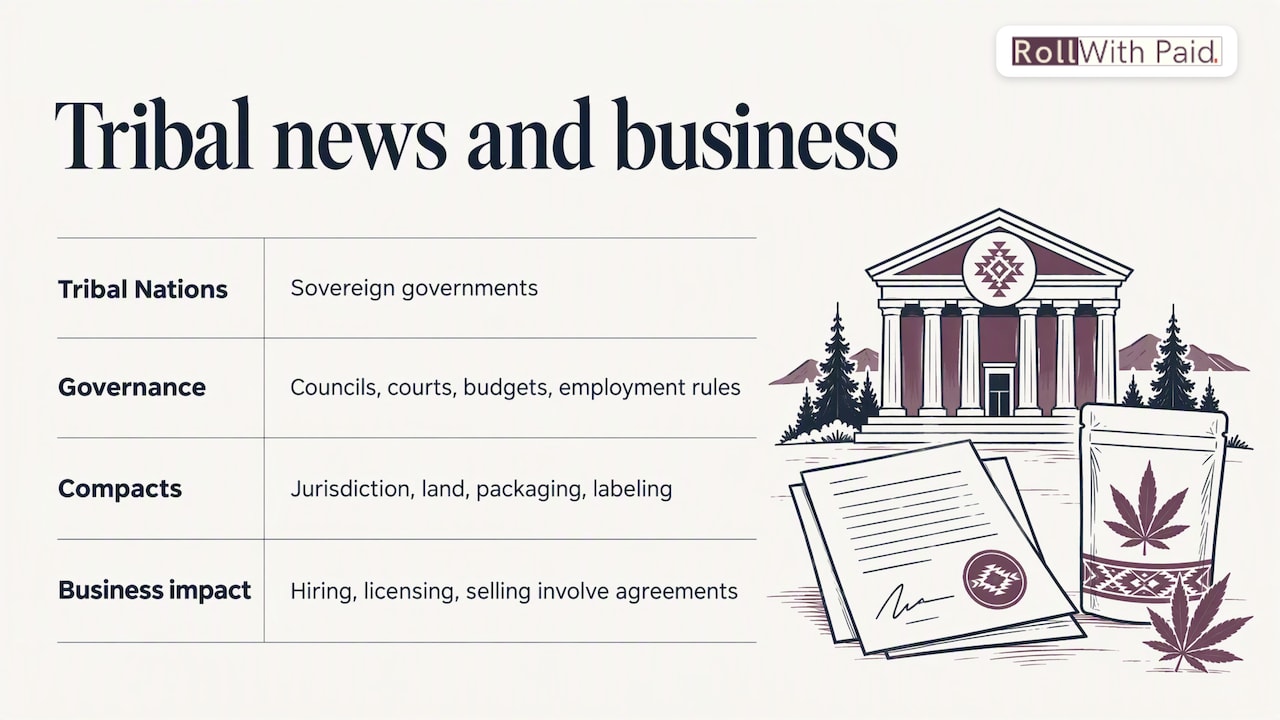
Tribal Nations are sovereign governments. They have their own councils, courts, budgets and employment rules, and those structures change over time. A dispute over who controls the budget, a new financial system, or a compact between a tribe and a state can all alter how money moves and who has authority to approve it. None of that shows up in a generic business newsletter.
For cannabis employers the stakes are concrete. Minnesota’s Office of Cannabis Management explains that cannabis compacts and cooperative agreements address jurisdictional questions between the state and Tribal Nations, including how tribal cannabis businesses operate off tribally regulated land and the packaging and labeling rules that apply to products sold into the state market. If you hire, license or sell in that environment, the news about those agreements is operating information.
The core list: where to read
The sources below come up repeatedly in university library guides and in what Google ranks for this topic. We have grouped them by what they do best.
| Source | Best for | Why an employer would read it |
|---|---|---|
| Native News Online | National coverage with a strong sovereignty and finance desk | Reports on tribal budgets, councils, courts and administrative systems, including the Navajo payroll story discussed below |
| ICT | Nonprofit, multimedia Indigenous news for national and global audiences | Broad policy and political coverage, useful for context on federal and state action |
| Indianz.com | Daily Indian Country news and information | Fast aggregation of federal policy, litigation and legislative updates |
| NativeWeb newspaper directory | Finding tribal and regional papers by nation and location | Lets you locate the paper that covers the specific nation you work with |
| Wikipedia’s list of Indigenous newspapers | Historical and current titles across North America | A starting point when you need a paper from a particular region or era |
NativeWeb’s own resource page describes Native News Online, Indianz.com and ICT (formerly Indian Country Today) as consistent sources on governance, finance and regulatory changes across tribal nations, which is why they anchor this list.
National outlets versus local papers
National outlets are good for patterns. Local and tribal papers are good for specifics: the council session that has not reached a national feed, the new hire policy, the announcement from a tribal department. If you work with one nation, subscribe to its paper or its official announcements page. The Navajo Nation, for example, posts its own memos and press releases, and several of the most useful facts in this article come from those primary documents rather than from news coverage.
Primary documents beat summaries
When a story involves money, go one step further and read the underlying memo, report or court decision. The Navajo Nation Office of the Controller’s fall report to the Council and the October payroll memo to employees say more about how payroll actually broke than any headline can. We link to them below.
Case study: the Navajo Nation payroll delays
Native News Online reported on October 21, 2026 that the 25th Navajo Nation Council is demanding accountability over payroll delays and the new financial management system. Delegates raised concerns about delayed direct deposits, incorrect deductions, short payments and discrepancies in leave balances.
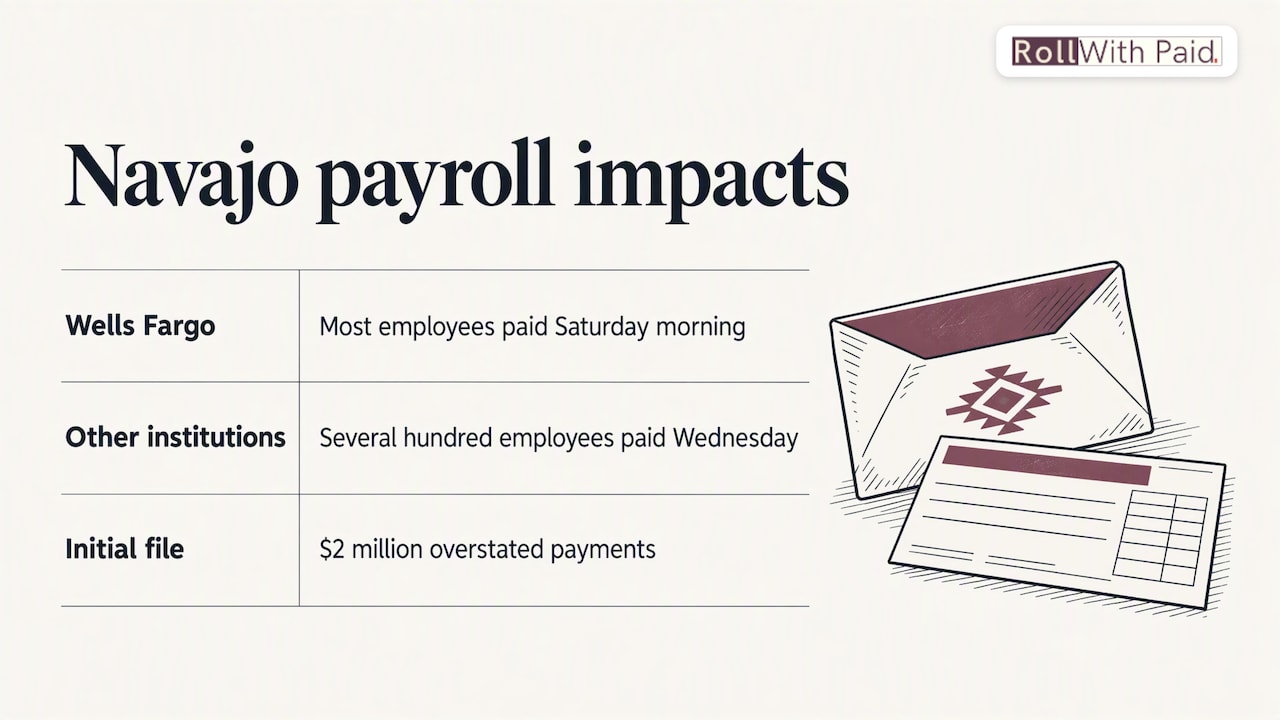
The reporting also shows how uneven the impact was. According to the same article, the payroll file went out in time for most employees who bank with Wells Fargo to receive deposits on Saturday morning, while several hundred employees who use other financial institutions saw deposits arrive Wednesday. One initial payroll file was reported to include $2 million in overstated payments traced to timesheet errors.
We are not commenting on the Nation’s internal politics, and nothing here is a criticism of its employees, many of whom were simply waiting to be paid. The story is useful because it is a clear, public, well-documented example of problems that every employer with more than a handful of people eventually faces.
Background: a big system, a long runway
The Nation announced its $31 million enterprise resource planning system in November 2024 as a way to replace older, patchwork systems with centralized data. That is a sound goal. Payroll built on disconnected tools is slow and error-prone, and an audit-ready process needs one reliable source of truth.
But a new system does not remove the work. It moves it. The Nation’s own March 2026 release on parallel payroll testing with Dayforce noted that roughly 1,500 time punches were missing from the system during the transition, a reminder that incomplete entry by staff and supervisors directly limits how well payroll can be tested and validated.
What the controller said went wrong
Gallup Today covered the controller’s explanation to the Council in a report titled what went wrong with payroll on the new financial system. One change it describes: payroll files will now be released earlier. Moving the release date one to two days ahead gives staff time to check exceptions and fix them before any funds are triggered for deposit.
The employee-facing side is just as instructive. In an October 14, 2026 memo, the Controller and the Division of Human Resources asked all employees to report payroll discrepancies through a defined process. The broader lesson in that memo and the surrounding coverage is that discrepancies often come from stale employee-level data, such as tax withholdings, direct deposit details and dependent information, rather than from the software alone.
Governance matters to payroll too
Payroll does not run in a vacuum. In August 2026, Native News Online reported that a Navajo court affirmed the Council’s authority in a dispute over the budget and the controller. Whatever your view of the dispute, the practical point for vendors and HR partners is that authority over financial personnel and approvals can sit in different branches of a tribal government. If you do not know who approves what, a disagreement upstream can slow things downstream.
Five payroll lessons any employer can take from it
The Navajo Nation is a government with a very large workforce, so the scale differs from a dispensary or a grow. The mechanics do not.
- Treat employee data as a recurring task, not a one-time setup. Ask staff to verify withholdings, direct deposit information and dependents before a pay cycle, not after a short check. Small errors multiply when they run through automation.
- Run parallel payroll before you cut over. Reconcile the old process against the new output line by line. This is the phase where errors are cheapest to find.
- Move your file release earlier. One to two extra days of lead time lets you catch exceptions before money moves. Late-week deadlines turn every problem into a fire drill.
- Enforce time entry and approval. Missing punches and unapproved timesheets are among the most common causes of both underpayment and overpayment. Set a firm cutoff and an owner for approvals.
- Plan for the bank, not just the software. Deposits to different institutions can arrive on different schedules. Tell employees what to expect, and check your timing against your bank’s cutoffs.
A quick pre-payroll checklist
- Time entries complete and approved by the cutoff
- New hires, terminations and pay changes entered and reviewed
- Employee profile reminders sent (withholding, bank, dependents)
- Exception report reviewed by someone other than the preparer
- File released with a buffer before the deposit date
- A named person and channel for employees to report discrepancies
Our perspective
We work with cannabis and other high-risk employers, and we see a version of the Navajo story more often than people admit. A company switches systems, or grows into a second state, and payroll quietly becomes the place where every unresolved data problem surfaces at once. The software gets blamed. Usually the cause is upstream: a classification that was never reviewed, a time record nobody approved, a bank detail that was never refreshed.
That is why we do not treat payroll as a standalone task. For a dispensary or cultivation facility, payroll touches workers’ compensation classification, I-9 verification, multi-state rules and, for plant-touching businesses, tax questions like 280E. A late filing or a misclassified worker is not just an annoyance. It is a liability. Our approach is built around keeping those pieces consistent so that a pay cycle is predictable and the records are audit-ready.
We also think Native American news belongs in the routine of any operator in Minnesota or a neighboring state. Tribal-state agreements, tribal enterprises and tribal governments are part of the market. If you understand who has authority and what is changing, you hire, license and contract with fewer surprises. If you want to see how we think about that landscape, our tribal relations page and our piece on Minnesota cannabis compacts in practice are good places to start.
— Leah Kollross
How to build a simple news routine
You do not need an hour a day. Ten minutes twice a week is enough if you set it up well.
- Pick your anchors. Bookmark Native News Online, ICT and Indianz.com. Add the paper or official announcement page for each tribal nation you contract with or hire near.
- Search for the money words. Scan for budget, controller, compact, payroll, audit, tax and enforcement. Skip the rest unless you want it.
- Read one primary document a month. A council report, a court order or an agency memo. You will understand the stories around it far better.
- Write down what changes your operations. If a story affects approvals, deadlines or licensing, send a two-line note to whoever runs payroll and HR.
- Check dates. Rules and systems shift quickly. A 2020 roundup of news sites is a fine starting point, but confirm that every outlet is still active before you depend on it.
Where we can help
If your payroll problems look more like a pattern than a one-off, our payroll software problem page explains why a tool alone rarely fixes them. For businesses that want payroll, workers’ compensation and HR compliance handled together, we offer Employer of Record, payroll execution and HR and compliance services built for cannabis and other high-risk industries. Pricing depends on gross payroll, worker classification codes and headcount, and there is an optional flat-rate HR retainer. You can see how it works on our pricing page.
If you operate in more than one state, our guide to audit-ready multi-state cannabis payroll covers what to settle before the first paycheck. Minnesota employers may also want our new hire reporting checklist.
FAQ
What is the best single source for Native American news?
For most business readers, Native News Online is the strongest single starting point because its sovereignty and finance coverage includes budgets, councils, courts and administrative systems. Pair it with ICT and Indianz.com for wider national coverage. If you work with one specific nation, add that nation’s own paper or announcements page.
Are Native American news sources only useful for tribal governments?
No. They are useful to any employer or vendor that hires on or near tribal land, contracts with tribal enterprises, or operates under state-tribal agreements. Cannabis businesses in Minnesota are a clear example, since compacts address how tribal cannabis operations and the state market interact.
What caused the Navajo Nation payroll delays?
The reporting points to several overlapping factors during a transition to a new Dayforce-based system: timesheet errors, missing time entries, stale employee data and tight file-release timing. The Controller’s office has said payroll files will now be released earlier to leave time for corrections. The Council is still asking for greater accountability, so details may change as more reports come out.
How can a small employer avoid a similar payroll problem?
Start with data hygiene and timing. Ask employees to verify their own profile information before each cycle, enforce time approval cutoffs, review an exception report, and release the file with a buffer. If you are changing systems, run parallel payroll first and compare results line by line.
Sources
- Navajo Nation Council Raises Concerns Over Payroll Delays, New Financial Management System, Native News Online
- Navajo Nation controller tells the Council what went wrong with payroll, Gallup Today
- Payroll discrepancy reporting memo, Navajo Nation Office of the Controller
- Dayforce payroll parallel testing release, Navajo Nation, March 2026
- Navajo Nation Modernizes with $31 Million Enterprise Resource Planning System, Native News Online
- Navajo Court Affirms Council Authority in Dispute Over Budget, Controller, Native News Online
- Compacts and Cooperative Agreements, Minnesota Office of Cannabis Management
- NativeWeb Resources: Newspapers, Native and Indigenous
- List of Indigenous newspapers in North America, Wikipedia
- Native News Online
- ICT
Recommended
Roll With Paid. is not a law firm and does not provide legal advice. This article summarizes Minnesota law as of August 2026 and is general information only. Tip arrangements are fact-specific; before changing a policy, consult employment counsel or contact DLI Labor Standards at 651-284-5075.