
GreenState Media: Leah Kollross on the Hemp Ban and Payroll Risk

A media mention is more than a logo on a press page. At its best, it carries a subject that matters to your industry in front of people who need it. That is why we want to thank GreenState for its October 15, 2026 piece, The hemp ban’s hidden toll on cannabis workers. It brings attention to a problem that rarely makes headlines: what a regulatory shock does to the people on the payroll and to the payroll provider that sits between them and their paychecks.
This page explains what the article raises, why payroll is the quiet pressure point in a hemp or cannabis business, and what operators should be checking this month.
TL;DR
- GreenState’s reporting highlights that payroll is a banking-risk issue for cannabis and hemp operators, not just an administrative task.
- Payroll providers can end service on very short notice when their banks flag exposure, which leaves employees unpaid and owners scrambling.
- Layoffs tied to the hemp redefinition can trigger federal WARN Act notice duties for covered employers, and the clock starts when thresholds are hit, not on the ban date.
- Ask your provider now what it knows about your products, whether its bank is comfortable with them, and what happens to your payroll if the answer changes.
- Thank you to GreenState for driving awareness of an issue that touches thousands of workers.
Table of Contents
- Why we are grateful to GreenState
- What the article means for payroll
- The WARN Act question hemp employers cannot ignore
- A short checklist for the next 30 days
- Our perspective
- What to look for in a payroll partner for high-risk work
- How Roll With Paid. can help
- Why media coverage like this matters to operators
- FAQ
- Sources
Why we are grateful to GreenState
Most coverage of the federal hemp redefinition has followed products, retailers and lawmakers. Those are fair subjects. But a business is also a group of people who expect to be paid on time, and the machinery that pays them is easy to ignore until it stops.
GreenState contributor, and Roll With Paid. founder, Leah Kollross, framed payroll as a banking-risk vector in her article. Payroll moves through the banking system, so gaps in how a company is classified or how it operates can lead a provider to end service with little warning. That framing is accurate, and it is the part of the story owners most often discover too late.
Thank you, GreenState, for putting worker pay inside the conversation about the hemp ban. Awareness is the first step toward preparation, and preparation is cheaper than a crisis.
What the article means for payroll
The core point is simple and uncomfortable: your payroll provider is a third party with its own bank, its own risk appetite and its own right to walk away.
In the cannabis and hemp space, providers monitor their banking partners for what is often called cannabis exposure. According to GreenState’s reporting, many providers drop clients on short notice, sometimes with only two days of warning, when a bank flags potential risk. The same piece advises operators to ask their provider whether it understands the products they sell and whether its banking institution is comfortable with that risk.
Those two questions are worth printing and taping to your desk. A vendor that answers vaguely is telling you something.
Why a payroll freeze hurts more than most vendor problems
If a marketing agency leaves, you lose some campaigns. If a payroll provider leaves with two days of notice, you face these problems at once:
- Employees miss a paycheck, which can create wage-payment liability under state law.
- Tax deposits and filings that the provider handled may lapse. Federal deposits follow fixed schedules, and the IRS notes that monthly depositors must deposit by the 15th of the following month, while semiweekly depositors follow Wednesday and Friday deadlines. Missing them can bring failure-to-deposit penalties.
- Records, time data and onboarding paperwork may be stranded in a system you can no longer access.
- Trust with your team erodes quickly, and in a tight labor market that is hard to rebuild.
None of this requires a bad actor. It only requires a bank deciding that your industry or product mix is outside its comfort zone.
The WARN Act question hemp employers cannot ignore
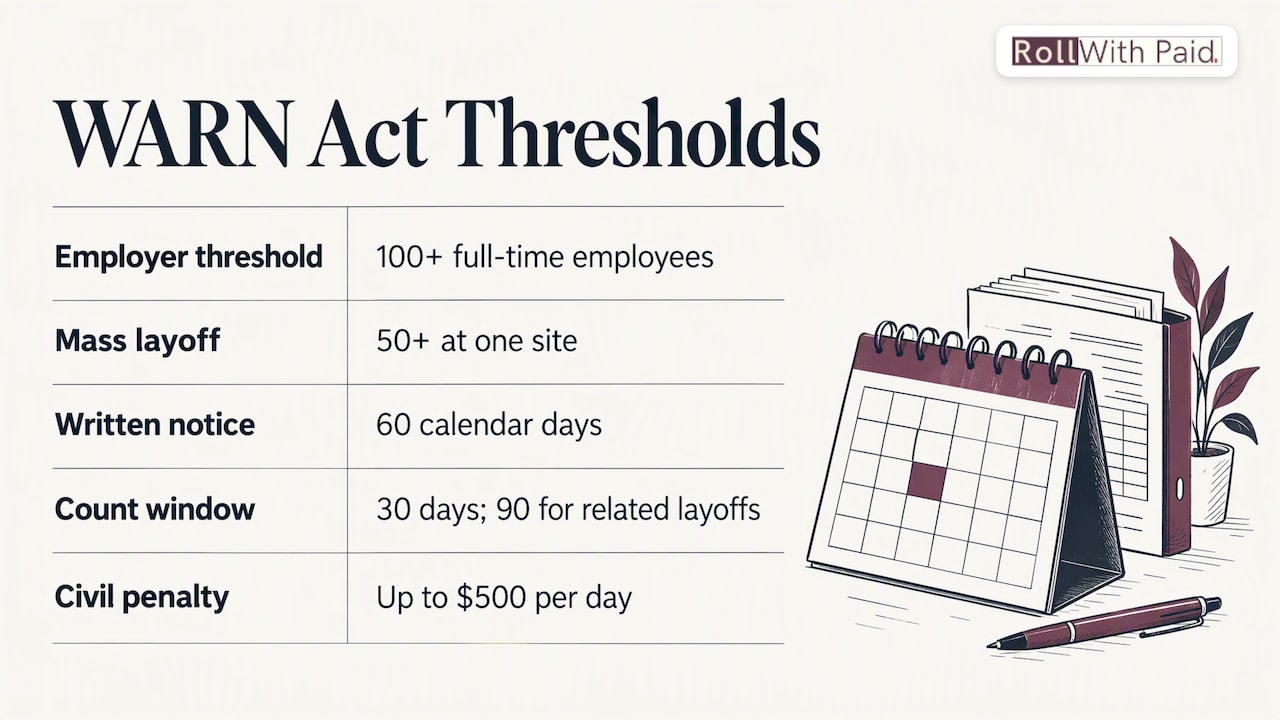
The hemp redefinition adds a second payroll-adjacent risk: layoffs. Under the federal WARN Act, employers with 100 or more full-time employees must give 60 calendar days of written notice before a plant closing or mass layoff, and a mass layoff generally means 50 or more employees losing work at a single site. Missing the notice can mean liability for back pay and benefits for up to 60 days, plus civil penalties of up to $500 per day, according to the Department of Labor.
Two details trip people up.
The count is rolling. As Shay Gilmore Law explains, job losses are counted across a rolling 30-day window, or 90 days for certain related layoffs, so cuts made earlier in 2026 can count toward a threshold. Notice is triggered by the threshold being hit, not by the ban date itself.
The dates have moved. The federal effective date was originally November 12, 2026. A later spending law changed the timing, and MJBizDaily reports the ban now lands December 11, with hemp firms planning mass layoffs facing back pay and class action risk if they miss the 60-day notice. Sixty days before December 11 falls in mid-October, so a covered employer that has not yet given notice should speak with employment counsel immediately. We are a payroll and HR provider, not a law firm, and this is a question for your attorney.
If your company is under the WARN thresholds, state mini-WARN laws or contractual notice obligations may still apply. That is another reason to ask counsel, not guess.
A short checklist for the next 30 days
Whether you run a hemp-derived products shop, a dispensary or a cultivation facility, these steps are practical and do not require a crisis to justify.
- Ask your payroll provider two direct questions. Do you know exactly what we sell? Is your bank comfortable with it? Get the answer in writing.
- Find out your provider’s termination terms. What notice does the contract require, and what happens to your data and filings if service ends?
- Map your headcount by site. Count full-time employees and any layoffs in the past 90 days, then bring that map to counsel.
- Confirm your pay schedule against state law. GreenState has warned about a hidden HR trap: some jurisdictions require weekly pay for dispensary staff, and a vendor’s biweekly default creates immediate back-pay liability.
- Name an owner for each compliance task. Break tracking, final pay, I-9s and filings should each have one person responsible. GreenState’s 4/20 HR piece notes that shared responsibility often turns into no accountability, and that wage problems surface weeks later in audits or reconciliation.
- Export your records. Keep current copies of payroll registers, time data, tax filings and employee files that you control.
- Document decisions. If you change schedules, classifications or staffing, write down who decided what and when.
Where banking and operations meet
Payroll is one banking relationship among several. Card acceptance and online payments carry the same kind of scrutiny, and operators who sell online may want to understand payment processing built for high-risk businesses before a decline or hold forces the issue. The principle is the same across all of them: know who your financial partners are and what they are comfortable with.
Our perspective
We built Roll With Paid. for the businesses that traditional payroll providers turn away, so this issue is personal to us. We see the same pattern repeatedly: owners choose a generic vendor because the sign-up is easy, and nobody asks what happens when that vendor’s bank changes its mind.
Here is how we think about it.
Payroll is a compliance function first. Running the payroll is the easy part. The harder part is classification, state-specific pay rules, quarterly wage detail, filings and records that hold up when someone asks for them. An audit-ready process is built in advance, not assembled the week an auditor calls.
Risk should be shared on paper. Our Employer of Record model is designed so that responsibility for payroll execution, compliance and workers’ compensation is spelled out instead of assumed. If you want to understand how that works for high-risk employers, our guide to Employer of Record for high-risk industries is a good start, and we also explain what an Employer of Record means for your benefits.
Reassurance comes from process. We would rather an owner feel mildly annoyed by a thorough onboarding than blindsided by a missed filing. Our clients have seen zero late filings, and that comes from boring discipline, not heroics.
The fix is a conversation, not a panic. Hemp and cannabis operators are used to regulatory change. A calm review of your payroll setup, your provider’s terms and your pay schedules is usually enough to find the weak points while there is still time to fix them.
— Leah Kollross
What to look for in a payroll partner for high-risk work
Whatever provider you use, test it against these criteria.
| Question | Why it matters |
|---|---|
| Does the provider knowingly serve your industry? | Providers that learn about your business after onboarding are the ones that drop clients later. |
| Can it explain its banking position? | The bank is the real gatekeeper, so a clear answer signals transparency. |
| What are the notice and transition terms? | Two days of warning is not a transition plan. |
| Does it handle state-specific pay rules? | Generic defaults cause back-pay liability. |
| Who owns multi-state compliance? | Each state adds its own filings, wage rules and registration steps. |
| Can you retrieve your records any time? | Access to your own data keeps you independent. |
If you operate in more than one state, our walkthrough on audit-ready multi-state cannabis payroll covers what to settle before the first paycheck goes out. If you are weighing common vendor risks, five payroll mistakes cannabis businesses cannot afford is a quick read, and our comparison on avoiding a payroll freeze with a generic provider shows how the questions above play out in practice.
How Roll With Paid. can help
We provide payroll execution, HR and compliance solutions, onboarding, multi-state hiring support, time and attendance tools and Employer of Record services for cannabis and other high-risk businesses. Fees are based on gross payroll, with an optional flat-rate HR retainer, and rates vary by worker classification code and headcount. You can review how that works on our pricing page, or start with our capabilities to see the full list of services.
If you are reading GreenState’s article and wondering whether your own payroll setup would survive a bank’s change of heart, that is exactly the conversation we like to have.
Why media coverage like this matters to operators
The phrase media mention usually brings to mind brand monitoring: tracking who said what about your company, across news, social and broadcast. Hootsuite describes media monitoring as tracking brand mentions, conversations and sentiment across channels. For high-risk industries there is an additional layer, because influencer and product coverage can raise disclosure questions. The FTC expects material connections such as paid partnerships or free products to be disclosed clearly, so cannabis brands should review their own mentions with that in mind.
There is a second kind of mention that matters just as much: coverage that educates the industry. GreenState’s reporting is that kind. It does not sell anything. It tells operators where the risk sits, so they can do something about it before it arrives.
That is also why we recommend that owners read the trade press closely. Regulatory change moves quickly, and the practical consequences for payroll tend to show up in articles like this one before they show up in vendor emails.
FAQ
Can a payroll provider really end service with two days of notice?
According to GreenState’s reporting, yes: some providers drop cannabis and hemp clients on short notice, sometimes two days, when their banking partners flag risk. Review your service agreement for notice terms, and ask your provider directly how its bank views your products.
Does the WARN Act apply to my hemp business?
It depends on size and facts. Generally it covers employers with 100 or more full-time employees and requires 60 days of written notice before a plant closing or mass layoff, per the Department of Labor. Because rolling windows and state laws can change the answer, talk to an employment attorney before making layoff decisions.
What is the first thing to check in my payroll setup?
Start with your pay schedule. If your state requires a specific frequency for certain employees and your system defaults to something else, you may already have back-pay exposure. Then confirm who owns each compliance task in your company.
How does an Employer of Record help in a high-risk industry?
An Employer of Record takes on defined payroll, compliance and workers’ compensation responsibilities under a service agreement, which reduces the administrative and legal burden on you. The specifics depend on the contract, so read the responsibility split closely before signing.
Sources
- The hemp ban’s hidden toll on cannabis workers, GreenState
- The hidden trap sinking cannabis shops everywhere, GreenState
- 4/20 will make you money, one mistake can wipe it out, GreenState
- Employment Law Guide: Notices for Plant Closings and Mass Layoffs, U.S. Department of Labor
- Hemp Employers: 60 Days to Avoid WARN Back Pay Before Nov. 12, 2026
- The Hemp Ban’s Real WARN Deadline, Shay Gilmore Law
- What hemp THC operators are forgetting ahead of the federal ban, MJBizDaily
- Topic no. 757, Forms 941 and 944 deposit requirements, IRS
- Media Monitoring Software and Real-Time Alerts, Hootsuite
Recommended
- Federal Hemp Ban: 0.4 mg Cap Could Put Workers at Risk
- Cannabis Payroll: Avoid 280E Exposure: Roll With Paid vs Greenleaf HR
- Four Week Switch for Cannabis Employers: Roll With Paid vs Green Leaf
- Bylines and Advocacy in GreenState Media for Cannabis Readers
Roll With Paid. is not a law firm and does not provide legal advice. This article summarizes Minnesota law as of August 2026 and is general information only. Tip arrangements are fact-specific; before changing a policy, consult employment counsel or contact DLI Labor Standards at 651-284-5075.