
Before Your First Paycheck: Audit Ready Multi-State Cannabis Payroll

Yes — cannabis employers can run payroll across multiple U.S. states, but doing so creates state tax and labor obligations, known as nexus, that you must register for before the first payroll run. The moment an employee performs work in a new state, that state can require withholding registration, and your immediate next step is simple: identify exactly where your people work, then register there before Rollwithpaid or any payroll system processes a check for them.
TL;DR:
- Employers must register for state withholding and unemployment accounts before paying employees who work in new states, regardless of physical presence or remote work.
- Accurate tracking of employee work locations is essential to avoid misfiling taxes, and automation systems should be used to handle jurisdiction-specific rules and changes.
- Discovering missed registration requires immediate action to register, back-calculate taxes owed, and amend filings to avoid penalties or audit issues.
- Cannabis industry-specific payroll issues include banking restrictions, 280E tax limitations, and varied worker classifications, which impact compliance and costs across states.
- Prioritizing compliance fundamentals before expanding into new states reduces errors, costs, and delays, especially by addressing nexus and registration upfront.
Table of Contents
- What State Registrations Does Multi-State Cannabis Payroll Require?
- How Do You Prevent Payroll Errors Across State Lines?
- What Happens When You Discover a Missed Registration?
- Why Cannabis-Specific Payroll Expertise Changes the Outcome
- How Does Employee Classification Change by State?
- Where Cannabis Operators Get Multi-State Payroll Wrong
- Get Multi-State Cannabis Payroll Set Up Right the First Time
- Sources
- FAQ
What State Registrations Does Multi-State Cannabis Payroll Require?
Nexus is the legal trigger that turns a single-state cannabis operator into a multi-state payroll employer. It’s created the moment someone performs work in a state, not necessarily when you open a facility there. A remote budtender, a traveling compliance manager, or even a commuting cultivation employee can create nexus the same way opening a second dispensary does.
Once nexus exists, you generally need three things in place before that employee’s first paycheck:
- A state withholding tax account, so you can remit income tax correctly.
- A State Unemployment Tax Act (SUTA) account, since nearly every state requires this once you have covered employment there.
- Local tax registrations where cities or counties layer on their own withholding, which several jurisdictions do.
Withholding rules hinge on where the work happens, not where the paycheck gets mailed. In most cases, the work state governs withholding. Residence state matters when reciprocity agreements exist between two neighboring states, which requires the employee to file a specific exemption certificate rather than assuming the agreement applies automatically.
Layer cannabis-specific wage rules on top of standard multi-state complexity. Minimum wage floors, mandatory paid sick leave accrual, and payroll frequency requirements (weekly versus biweekly) all vary by state, and cannabis employers in states like Minnesota face additional licensing and labor documentation on top of the baseline rules.
Pro Tip: Register for withholding and SUTA before you run payroll, not after. Retroactive registration in most states still requires back filings, and some assess penalties calculated per pay period you missed, not just once.
How Do You Prevent Payroll Errors Across State Lines?
Split-state work is where most multi-state payroll mistakes start. An employee who lives in one state and works in another, or who splits hours between two facilities, needs a payroll system that tracks location down to the pay period, not just the hire date.
Build these controls into onboarding and ongoing operations:
- Capture both addresses at onboarding. Record where an employee lives and where they actually perform work, since these can differ and both matter for tax purposes.
- Set alerts for address changes. A move mid-year should trigger an HR review, not sit unnoticed until W-2 season.
- Run quarterly confirmations. A simple portal prompt asking employees to confirm their work location catches drift before it becomes a filing problem.
- Integrate time and attendance with payroll. Systems that map hours worked to specific jurisdictions handle split-week calculations automatically and leave an audit trail for every location change.
- Subscribe to legislative tracking. Payroll platforms with built-in compliance alerts catch state rule changes before they cause a missed filing.
Automation should handle jurisdiction calculation, filing reminders, and routine local tax support. Manual review still belongs in the loop for edge cases: a new hire in a state you’ve never operated in, or an employee who changes work location mid-quarter.
There’s a real trade-off here, too. Restricting remote work to states where you’re already registered cuts your compliance workload, but it also shrinks your hiring pool in an industry that already competes hard for experienced compliance and cultivation talent.
What Happens When You Discover a Missed Registration?
Finding a gap in your multi-state cannabis payroll setup is uncomfortable, but the fix follows a fairly standard sequence. Move fast, and the exposure stays manageable.
- Pin down the date of change. Identify exactly when the employee started working in the unregistered state.
- Register immediately. Get the withholding and SUTA accounts open in that state as soon as the gap is confirmed.
- Calculate back taxes owed. Work with payroll or tax counsel to determine what should have been withheld since the trigger date.
- Remit and correct reporting. File amended returns and, if needed, issue corrected W-2s to the affected employee.
- Preserve your documentation. Keep time logs, address-change history, and payroll run records. These support you if the state audits or questions the correction later.
For anything beyond a simple one-employee fix, bring in tax counsel or an Employer of Record. Our payroll mistakes guide covers the errors that trigger these situations most often.
Why Cannabis-Specific Payroll Expertise Changes the Outcome
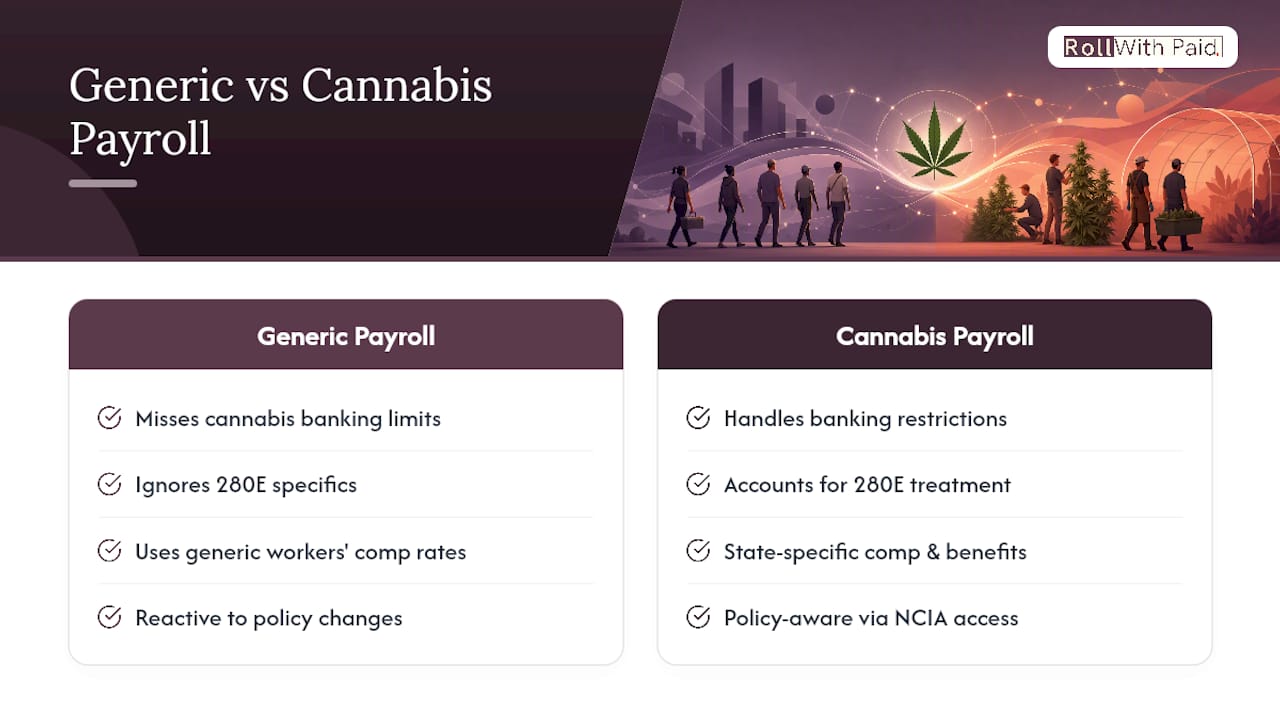
Multi-state cannabis payroll isn’t generic payroll with an extra state code. It carries banking restrictions, 280E tax treatment, and workers’ comp rates that shift meaningfully from state to state. Weekly benefit maximums and rate structures differ across all 50 states, which means a cultivation employer budgeting for expansion into a second or third state needs those numbers before signing a lease, not after an injury claim arrives.
Rollwithpaid’s founder, Leah Kollross, sits on the NCIA HR committee, where main street cannabis operators and federal policy conversations meet directly. That seat matters because cannabis HR rules move faster than general payroll guidance can track, and being in the room where those rules get discussed means Rollwithpaid clients get policy-aware guidance rather than a repackaged generic payroll playbook.
Sitting on the NCIA HR committee means hearing where state and federal cannabis employment policy is headed before it shows up in a compliance bulletin. That’s the difference between reacting to a new rule and being ready for it.
An Employer of Record model, audit-ready processes, I-9 support, and workers’ comp handling exist specifically to address the gaps generic payroll providers miss in high-risk industries. Learn more about how the Employer of Record model works for cannabis operators managing exposure across several states.
How Does Employee Classification Change by State?
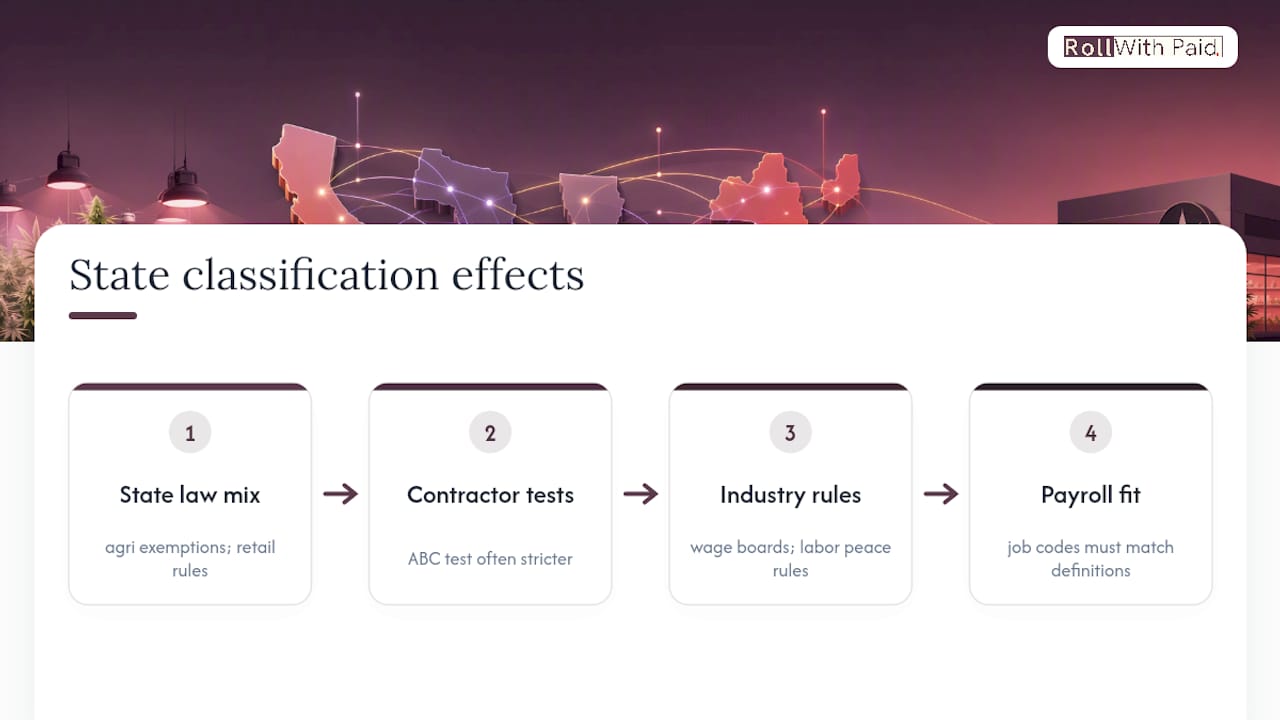
Cannabis employee classification isn’t uniform across state lines, and getting it wrong has direct payroll consequences. Some states treat cultivation and processing roles under agricultural labor exemptions that affect overtime eligibility. Others classify dispensary retail staff under standard retail wage rules with no special carve-out at all.
The independent contractor question adds another layer. Several states apply an “ABC test” for worker classification that is far stricter than the federal standard, meaning a trimmer or budtender you classify as a contractor in one state might legally need to be an employee in another. Misclassification exposure compounds when you’re running payroll in a state with aggressive labor enforcement, since back pay, penalties, and unpaid payroll taxes can stack up fast once a state agency reviews your workforce.
Cannabis-specific wage board rules also vary. A handful of states have considered or enacted cannabis-industry wage boards or labor peace agreement requirements tied to licensing, meaning your payroll obligations can be linked directly to your ability to keep operating. Job codes matter here too: how you classify a role in your payroll system needs to match how that state defines the role for wage and hour purposes, not just how your org chart labels it.
Our HR compliance guide for dispensaries and cultivators breaks down classification nuances by role type in more detail.
Where Cannabis Operators Get Multi-State Payroll Wrong
Most guidance on multi-state payroll treats every industry the same, and that’s precisely where it fails cannabis operators. The conventional advice says “register, withhold, file, repeat.” It rarely mentions that cannabis banking restrictions mean some payroll providers won’t touch your account at all, or that 280E limits which payroll-adjacent costs you can even deduct while you’re trying to stay compliant everywhere else.
Here’s what I’ve seen matter more than vendor selection: knowing your employees’ actual work locations, cold, before you expand into a new state. Operators who treat multi-state hiring as a recruiting decision first and a payroll decision second are the ones who end up filing corrected W-2s eighteen months later.
Prioritize the registration and withholding setup before you post a single remote job listing in a new state. Everything else, including which system you use to automate filings, is a solvable problem once that foundation is right. The mistake isn’t picking the wrong software. It’s skipping the nexus question entirely.
— Leah
Get Multi-State Cannabis Payroll Set Up Right the First Time
Rollwithpaid is the alternative to piecing together a payroll setup from generic software and hoping your cannabis-specific obligations don’t slip through the cracks. Where standard payroll providers stop at basic tax filing, Rollwithpaid handles state registration support, automated withholding across jurisdictions, Employer of Record options for states where you don’t want to establish a direct entity, workers’ comp management, and audit-ready recordkeeping built for high-risk industries.

Before a consultation, gather a list of employees by state, your gross payroll figures, pay frequency, job codes, and any existing remote-work policies. This information is needed to map your current exposure and close gaps fast. Start by reviewing Rollwithpaid’s home page or Employer of Record solutions for high-risk industries to see how the setup fits your current footprint, then reach out to scope your specific states.
Sources
- State nexus and payroll: when hiring remote creates tax obligations — Warp
- Building high-impact teams in the cannabis industry — Huntscanlon
- 2026 Workers’ Comp Weekly Benefit Rates — All 50 States + DC — WorkersCompEstimator
FAQ
Is Multi-State Cannabis Payroll Legal to Run In-House?
Yes, running multi-state cannabis payroll in-house is legal, but you must register for withholding and SUTA in every state where employees perform work before processing their pay.
What Triggers Nexus for Cannabis Payroll Purposes?
Nexus is triggered when an employee performs work in a state, whether that’s a remote hire, a commuting worker, or staff at a physical facility, and it obligates you to register for state payroll accounts there.
How Fast Do I Need to Register After Hiring in a New State?
Register for state withholding and SUTA accounts before running the employee’s first paycheck; most states expect registration ahead of the first payroll, not after.
What Should I Do If I Find a Missed State Registration?
Identify the date the employee’s work location changed, register immediately, calculate and remit back taxes, then correct any affected reporting like amended returns or W-2s.
Does Employee Classification Change Across States for Cannabis Workers?
Yes, states apply different tests for contractor versus employee status and different wage rules for cultivation, processing, and retail roles, so the same job title can carry different payroll obligations by state.
Recommended
- 5 Payroll Mistakes Cannabis Businesses Can’t Afford
- 280E and Payroll: What Cannabis Employers Need to Understand
- I-9 and E-Verify: A Compliance Guide for Cannabis Employers
Roll With Paid. is not a law firm and does not provide legal advice. This article summarizes Minnesota law as of August 2026 and is general information only. Tip arrangements are fact-specific; before changing a policy, consult employment counsel or contact DLI Labor Standards at 651-284-5075.