
Hemp Employers: 60 Days to Avoid WARN Back Pay Before Nov. 12, 2026

Yes, covered hemp employers generally must give 60 calendar days’ written notice before a qualifying plant closing or mass layoff under the WARN Act. When those cuts trace back to the federal hemp redefinition, the notice clock runs backward from that regulatory date, not from your shutdown date, so the real deadline lands weeks before the ban itself takes hold.
TL;DR:
- Employers must back-date WARN notices 60 days from the hemp ban’s effective date or shutdown event, not from the actual layoff date.
- Business size and headcount must be checked at least against federal and state thresholds, which can differ and affect compliance.
- Layoffs tied to the hemp redefinition typically do not qualify as unforeseeable circumstances, so early notice is the safer course.
- Missing the WARN deadline can result in significant liabilities, including back pay, civil penalties, and class action suits.
- Acting now with legal and payroll support minimizes financial exposure and ensures timely, compliant notices.
Table of Contents
- Quick Checklist: What to Confirm Before You Act
- How to Calculate WARN Coverage for Your Hemp Operation
- When You Might Give Less Than 60 Days (and Why That’s Risky Here)
- State-Level Traps That Can Catch You Off Guard
- What You Face If You Miss the Notice Deadline
- What to Do This Week to Avoid WARN Liability
- How Specialized Payroll Support Reduces WARN Exposure
- Why We Think Employers Should Assume WARN Applies and Move Early
- How Roll With Paid Can Help You Move Fast on WARN Compliance
- FAQ
- Sources
Quick Checklist: What to Confirm Before You Act
Before anything else, run the numbers. Confirm whether your business meets WARN’s 100-employee coverage threshold and whether your planned reductions meet the plant-closing or mass-layoff tests. If they do, back-date 60 calendar days from your planned shutdown or from the hemp redefinition’s effective date, whichever applies to your situation, and consult Office Locations – Calil Law for specialized state-specific WARN counsel. If that math puts you inside the 60-day window right now, notice needs to go out immediately, not after you finish internal deliberations.
- Check employer size and site-level headcount against WARN thresholds.
- Back-date 60 days from your operative trigger date and flag it on the calendar today.
- Identify which state dislocated worker unit and local officials need copies.
- Preserve payroll records, meeting notes, and board decisions tied to the layoff timeline.
- Loop in counsel or a payroll and HR partner familiar with high-risk industries before you finalize anything.
This isn’t a one-person job. Payroll, HR, and legal all touch different pieces of the notice requirement, and a gap in any one of them can undercut your compliance position later. If you operate across state lines, add a parallel check against each state’s own notice law, since several set a lower bar than the federal rule.
How to Calculate WARN Coverage for Your Hemp Operation
WARN coverage hinges on two tests, and getting the math right matters more than getting it fast.
- Plant closing test: a shutdown that causes job loss for 50 or more employees at a single site during any 30-day period triggers notice, regardless of total site size.
- Mass layoff test: notice is required when 50 or more employees lose their jobs and that number is at least 33% of the active workforce at that site, or when 500 or more employees are affected regardless of percentage, under the same DOL thresholds.
- Who counts: employees with less than six months of tenure are generally excluded from the headcount, while part-time hours can still factor into the 4,000-hour aggregate test used to confirm mass-layoff status.
- Rolling windows: WARN regulations require you to look both 30 and 90 days forward and backward, so staggered cuts across a quarter can aggregate into coverage even if no single round looks large enough on its own.
Say a cultivation site employs 160 workers and lays off 55 in one month: that alone meets the plant-closing test. If instead 40 are cut in week one and 15 more in week six, the 90-day aggregation rule still pulls those together into a single covered event.
When You Might Give Less Than 60 Days (and Why That’s Risky Here)
Two narrow exceptions exist: unforeseeable business circumstances and the faltering company exception. Courts accept these only when the triggering event was genuinely unpredictable, a sudden contract cancellation, a natural disaster, or something no reasonably prudent employer could have planned around.
- The federal hemp redefinition has a known, publicly announced effective date, which weakens any unforeseeable-circumstances defense for ban-driven layoffs.
- A full-year transition period before the rule takes hold makes it harder to argue the outcome was a surprise, according to DOL guidance on these exceptions.
- Temporary layoffs or furloughs that were initially expected to last under six months but later get extended can trigger notice obligations retroactively once that six-month mark is crossed.
If your layoffs are tied to the redefinition, plan as though no exception will hold up, because that’s the safer and more defensible position.
State-Level Traps That Can Catch You Off Guard
Federal WARN is a floor, not a ceiling, and several states set tighter rules. California is the clearest example: Cal-WARN applies at a lower employer threshold of 75 employees rather than the federal 100, and it counts part-time workers toward that total where federal law might not.
- California also added mandatory notice content requirements in 2026 that go beyond the federal minimum.
- Rolling aggregation under state law can push a site over threshold sooner than the federal count would suggest, especially if you’ve already trimmed staff earlier in 2025 or 2026.
- Run your headcount test against both federal and any applicable state law now, not after notices go out, since a federal-only check can still leave you exposed under state rules.
For multi-state hemp operations, that gap between federal and state thresholds is where most compliance surprises happen.
What You Face If You Miss the Notice Deadline
Missing the 60-day window isn’t a paperwork slip. It creates direct financial exposure.
Employers who violate WARN can owe back pay and benefits for each day of the violation, up to 60 days, plus civil penalties and potential attorney’s fees. That liability compounds quickly across a workforce of any meaningful size.
- Back pay and benefits liability runs for each violation day, capped at 60 days per affected employee.
- Civil penalties under 29 U.S.C. § 2104(a) can apply on top of back pay.
- Affected employees may bring class actions, and courts can award attorney’s fees to a prevailing plaintiff group.
- Industry reporting on hemp sector layoffs flags this exact risk for operators who treat the ban date, rather than the notice deadline, as their trigger point.
Estimate your exposure early. Knowing the rough dollar range helps you decide whether a fast, compliant notice now is cheaper than defending a missed one later, and it almost always is.
What to Do This Week to Avoid WARN Liability
Treat this as a sequence, not a list of options to pick from.
- Run site-by-site headcount math against both the plant-closing and mass-layoff tests.
- Model your planned cuts and back-date the 60-day window from whichever trigger date applies, shutdown or regulatory effective date.
- Prepare and deliver written notices to affected employees, the state dislocated worker unit, and local government officials, and keep delivery records.
- Document the business judgment behind the timeline, including board minutes and internal memos.
- Bring in counsel or a payroll and HR partner experienced in high-risk industries before notices go out, not after a problem surfaces.
Notice content matters as much as timing: include the expected date of the first layoff, whether it’s permanent or temporary, and contact information for someone who can answer employee questions. Our HR compliance guidance for dispensaries and cultivators covers related recordkeeping habits worth adopting alongside this process.
Pro Tip: Keep a dated payroll snapshot from the exact day you made the layoff decision. It becomes your strongest evidence if a notice timeline ever gets challenged.
How Specialized Payroll Support Reduces WARN Exposure
We built our services around the compliance demands of high-risk industries, and headcount audits tied to events like a WARN trigger are exactly where that focus pays off. We handle accurate headcount snapshots across multiple sites, coordinate state filings alongside federal notice, manage notice distribution logs, and set up payroll holdbacks when back-pay exposure is a live possibility.
- Multi-state headcount reconciliation so federal and state thresholds get checked together, not separately.
- Timely filing support tied to the actual 60-day deadline rather than the more visible ban date.
- Payroll holdback structuring to cover potential back-pay liability without disrupting ongoing operations.
Pro Tip: Ask any payroll partner how they’d document your headcount on the exact day you’re deciding layoffs. If they can’t answer specifically, that’s a gap worth closing before you need it.
Why We Think Employers Should Assume WARN Applies and Move Early
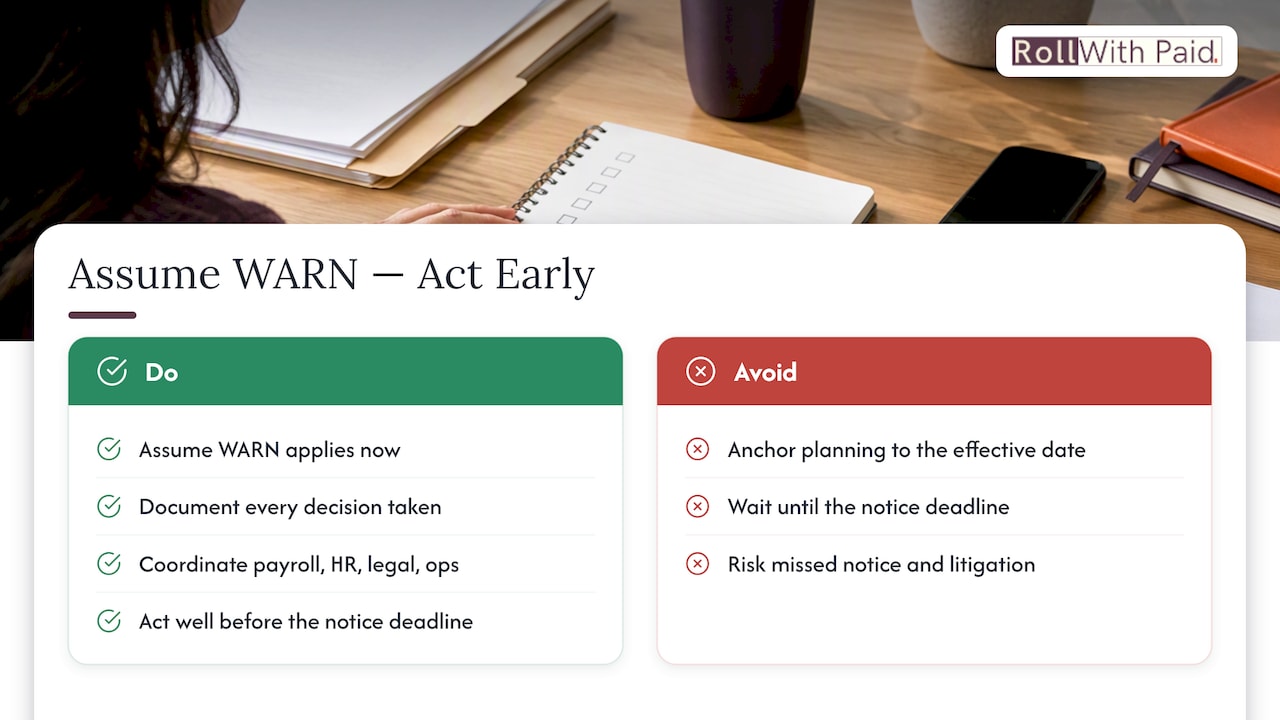
Our honest read: too many hemp employers are still anchoring their planning to the ban’s effective date instead of the notice deadline that sits weeks ahead of it. That’s backward, and it’s the single most common mistake we see building toward real liability.
The safer posture is to assume coverage applies, document every decision as you go, and get payroll, HR, legal, and operations talking to each other now. Acting early costs far less than litigating a missed notice later.
— Leah
How Roll With Paid Can Help You Move Fast on WARN Compliance
Getting a WARN notice right under time pressure is harder alone. We offer Employer of Record services, payroll execution, and HR and compliance support built specifically for cannabis and hemp operators who can’t afford a timing mistake.

- Headcount audits that check both federal and state thresholds in one pass.
- Multi-state filing assistance so notices reach every required state and local office on time.
- Payroll holdback setup to manage back-pay exposure without disrupting day-to-day operations.
If you’re staring down a layoff decision tied to the hemp redefinition, reach out through our pricing page to schedule a headcount snapshot review before your 60-day window closes.
This article is general information, not a substitute for advice from a qualified lawyer. Consult a qualified legal professional about your own circumstances before acting on anything here.
FAQ
Is Hemp Going to Be Illegal in 2026?
The federal hemp redefinition takes effect November 12, 2026, which will reclassify many hemp-derived cannabinoid products rather than banning hemp outright, according to congressional research on the statutory change. Whether a specific product remains legal depends on how it falls under the new definition, so check the rule’s text against your own product line.
How Much Notice Is Given for Layoffs?
Covered employers under WARN must generally give 60 calendar days’ written notice before a qualifying plant closing or mass layoff, per DOL regulations. Some states, including California, add their own notice requirements on top of the federal rule.
What Is the 60 Day Rule for Layoffs?
The 60-day rule requires covered employers to notify affected employees, the state dislocated worker unit, and local government officials at least 60 calendar days before a qualifying plant closing or mass layoff. When a layoff is tied to a known event like a regulatory deadline, that 60-day clock runs backward from the event date, as legal analysis of the hemp ban deadline explains.
Is the Hemp Loophole Being Closed?
The federal government has moved to narrow the statutory definition of hemp through FY2026 appropriations legislation, with changes effective November 12, 2026, according to the Congressional Research Service. The practical effect on specific products depends on how each one is classified under the revised definition.
Sources
- Worker Adjustment and Retraining Notification (WARN) — DOL
- WARN FAQs — DOL ELAWS
- The Hemp Ban’s Real WARN Deadline Is Sept. 13 — Shay Aaron Gilmore
- The other deadline hemp operators need to remember ahead of the federal ban — MJBizDaily
Recommended
- 280E and Payroll: What Cannabis Employers Need to Understand
- Your Rights as a Cannabis Worker in Minnesota
- I-9 and E-Verify: A Compliance Guide for Cannabis Employers
Roll With Paid. is not a law firm and does not provide legal advice. This article summarizes Minnesota law as of August 2026 and is general information only. Tip arrangements are fact-specific; before changing a policy, consult employment counsel or contact DLI Labor Standards at 651-284-5075.