
What NCAI’s Resolution Means for Tribal Cannabis Employers
NCAI Resolution PSC-26-048 asks the U.S. Department of Justice (DOJ) to start formal Tribal consultation on cannabis rescheduling, because the DOJ order did not address Tribally regulated cannabis. A resolution is a request, not law, so it changes nothing about your tax, payroll or licensing duties today. Tribal cannabis employers should keep running compliant payroll and HR now, and track the consultation outcome.
TL;DR
- The National Congress of American Indians (NCAI) adopted Resolution PSC-26-048 at its 83rd Annual Convention & Marketplace and sent it with a letter to Attorney General Todd Blanche requesting consultation.
- The DOJ’s 2026 Schedule III order covers FDA-approved products and products under a qualifying state medical marijuana license. It does not name Tribally licensed cannabis.
- The resolution is advocacy. Federal employment taxes, wage rules and workers’ compensation duties stay exactly as they are.
- Tribal enterprises remain separate entities for federal employment tax purposes, so payroll filings must stay clean whatever happens with rescheduling.
- Employers who keep records audit-ready now will be positioned to use any federal relief that reaches Tribal programs.
Table of Contents
- What does NCAI Resolution PSC-26-048 ask the Department of Justice to do?
- Is the NCAI resolution legally binding on the federal government?
- What did the DOJ’s rescheduling order actually cover?
- Why are Tribally licensed cannabis businesses left out of the order?
- Does a Tribal-state compact change the picture?
- What stays the same for Tribal cannabis employers payroll today?
- Which federal proposals could reach Tribal cannabis next?
- What are the common challenges Tribal cannabis employers face?
- How does a Tribal enterprise compare payroll options?
- What use cases show the resolution in practice?
- How should HR and finance teams prepare for a consultation outcome?
- What is our view as a Tribal payroll and HR partner?
- How can Roll With Paid. support Tribal cannabis employers?
- FAQ
- Sources
What does NCAI Resolution PSC-26-048 ask the Department of Justice to do?
NCAI Resolution PSC-26-048 urges the DOJ to consult with Tribal Nations on what cannabis rescheduling means for Tribally regulated cannabis products. NCAI adopted it at its 83rd Annual Convention & Marketplace, according to Native News Online’s November 8, 2026 briefing.
NCAI says the DOJ order addressed certain FDA-approved and state-regulated medical cannabis products but left out products regulated by Tribal Nations. It argues that federal policy must respect the sovereignty of Tribes that choose to regulate cannabis within their territories. NCAI forwarded the resolution, with a formal letter, to the Attorney General.
The coverage describes a call for consultation. It does not describe a new federal rule, a deadline for DOJ or a change to any Tribal license.
Is the NCAI resolution legally binding on the federal government?
No. NCAI Resolution PSC-26-048 is a policy position adopted by a membership organization of Tribal governments. It asks the DOJ to act. It does not bind the DOJ, the Drug Enforcement Administration (DEA) or the IRS.
Its value is practical. It puts the Tribal position on the record, ties it to sovereignty and consultation, and gives Tribal leaders a document to cite in meetings with federal officials. For an employer, the useful reading is this: the resolution signals where Tribal policy advocacy is heading, but your operating obligations are set by existing law, your Tribal code and any compact.
What did the DOJ’s rescheduling order actually cover?
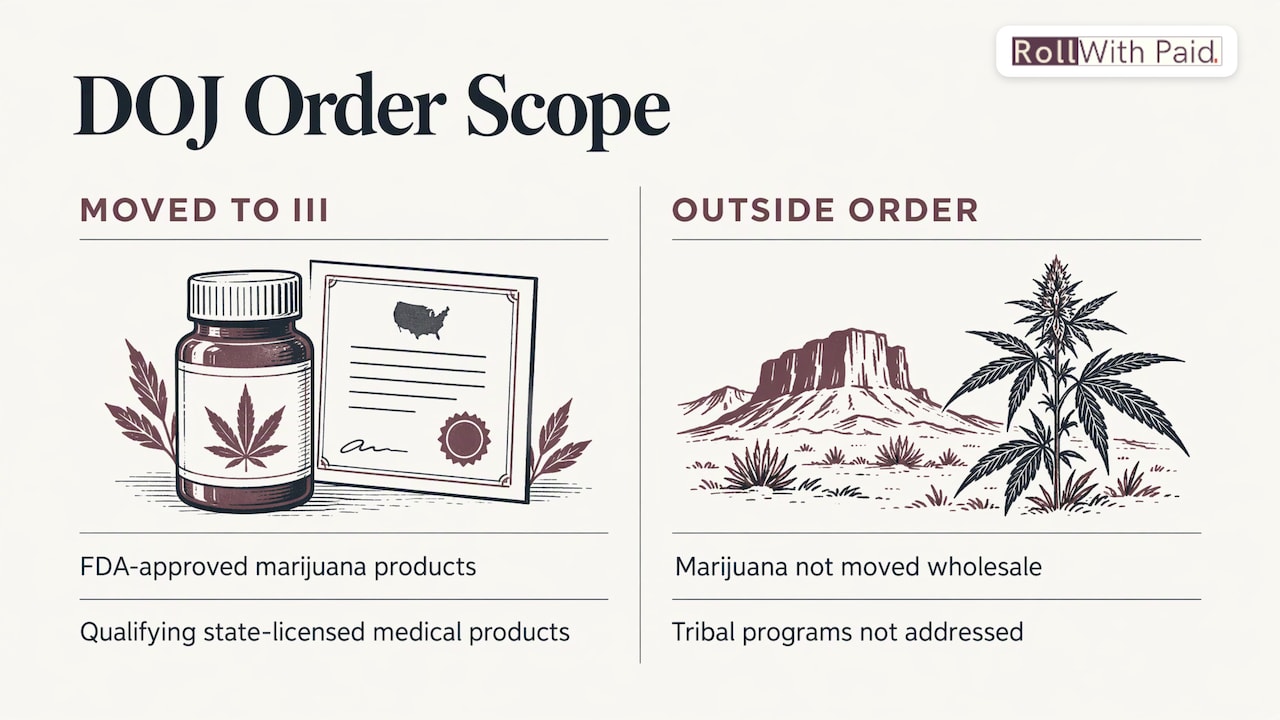
The DOJ’s Final Order, AG Order No. 6754-2026, moved only two categories to Schedule III: FDA-approved marijuana products and products subject to a qualifying state-issued medical marijuana license. It was published at 91 Fed. Reg. 22,714 on April 28, 2026, and was effective April 22, 2026. It also created an expedited registration process under 21 C.F.R. Part 1301 for state-licensed entities. These details appear in the D.C. Circuit petition for review, Case No. 26-1136.
The order is not a full move of marijuana to Schedule III. The UNLV Cannabis Policy Institute’s 2026 National Cannabis Report states that qualifying state medical marijuana licensees will no longer be subject to Internal Revenue Code Section 280E, and notes that the order did not address Tribal programs.
Section 280E is the tax rule that bars businesses trafficking in Schedule I or II substances from deducting ordinary expenses. Its removal matters to your margins and to how payroll costs are treated. Our 280E and payroll guide explains how the rule touches labor costs.
Why are Tribally licensed cannabis businesses left out of the order?
The order’s relief is tied to state licensing. Its second category depends on a qualifying state-issued medical marijuana license, and its registration pathway is built for state-licensed entities. A business licensed only under a Tribal code does not fit that wording. That gap is what NCAI’s resolution targets.
The gap exists inside a larger structure. A 2025 academic review of marijuana policy and Tribal communities explains that federal policy preempts state and Tribal marijuana laws, that the federal government may choose to enforce the Controlled Substances Act, and that many states lack a formal policy allowing Tribes into statewide cannabis markets. Congress also keeps authority to legislate on Tribal issues.
The CDC’s public health law resource page notes that some Tribes run lucrative cannabis programs while others face strong resistance from state and federal drug enforcement agencies.
Does a Tribal-state compact change the picture?
A compact gives a Tribal cannabis program a documented structure with a state, and it is the closest thing to a state-license pathway for many Tribal enterprises. Compacts do not by themselves resolve federal scheduling questions.
Washington is one example. According to the academic review above, 22 federally recognized Tribes there have signed compacts to grow, process or distribute cannabis, using tax revenue sharing to secure inclusion in the state program.
Minnesota’s model is documented too. The White Earth Nation compact with the Minnesota Office of Cannabis Management has the state provide a civil regulatory framework and the Tribe legalize cannabis on Tribally Regulated Land under its own civil system. It authorizes cross-jurisdiction transactions and expressly disclaims any waiver of the Tribe’s sovereign immunity. Our Minnesota compacts in practice page covers how these arrangements work day to day.
What stays the same for Tribal cannabis employers payroll today?
Federal employment tax duties stay the same. The IRS final regulations published December 16, 2025 provide that entities wholly owned by Tribes and organized under Tribal law are generally not separate entities for federal tax purposes, but are recognized as separate entities for federal employment and certain excise tax purposes. Tribes generally remain subject to federal employment taxes, including FICA, FUTA and income tax withholding, subject to applicable exceptions. The text is in the Federal Register notice.
In plain terms, your Tribal cannabis enterprise still files payroll taxes, issues W-2s and keeps I-9 records. Whether a particular worker or wage falls under an exception depends on the facts, so confirm exceptions with a tax adviser before you rely on them.
Three areas deserve attention while rescheduling plays out:
- Worker classification. Misclassifying budtenders, trimmers or drivers as contractors creates tax and workers’ compensation exposure.
- Workers’ compensation. Cultivation and processing are classed as higher-risk work, and premiums depend on classification codes and headcount.
- Multi-jurisdiction payroll. Employees who live off-reservation or work across state lines can trigger state withholding and filing duties.
Our cannabis industry payroll guide and five costly payroll mistakes go deeper on these.
Which federal proposals could reach Tribal cannabis next?
Congress is weighing several bills. The NCCI 2026 Legislative and Regulatory Trends Report lists S 3576 (a Commission on the Federal Regulation of Cannabis), HR 9471/S 4942 and S 5049 (insurer protections for doing business with cannabis businesses) and S 5022 (decriminalize and deschedule cannabis). It also reports that Executive Order 14370 on December 18, 2025 directed the Attorney General to complete rescheduling to Schedule III, and that DOJ and DEA began an expedited hearing on broader rescheduling after the April 2026 order.
A Congressional Research Service report on Section 280E notes that a couple of proposals would carve out an exception for marijuana businesses operating in compliance with state and Tribal laws. That language is the one Tribal leaders will watch, because it names Tribal law alongside state law.
Insurance access matters for employers because workers’ compensation and liability coverage depend on carriers willing to write the business. When a claim arrives, knowing the difference between defend versus indemnify obligations shapes what you send to a carrier.
What are the common challenges Tribal cannabis employers face?
The same few problems come up across Tribal and non-Tribal cannabis payrolls:
- Providers that decline the account. Many traditional payroll companies turn away cannabis and other high-risk employers.
- Late or inconsistent filings. Quarterly wage detail and new-hire reports fall behind when HR is stretched. Minnesota fines for late new-hire reports are covered in our new-hire reporting checklist.
- Mixed workforces. Tribal members, non-member employees and seasonal staff may be treated differently for some purposes, so records must show the basis for each treatment.
- Policy gaps. Drug-free workplace, safety and incident policies are often written for a different industry.
An employer of record (EOR) model addresses several of these at once. In an EOR arrangement the provider becomes the employer for payroll, tax filing, workers’ compensation and compliance duties, while the business directs the daily work. Our explainer on employer of record for high-risk industries lays out the model.
How does a Tribal enterprise compare payroll options?
Tribal enterprises generally choose among three routes. The comparison below uses criteria that matter to cannabis employers.
| Criterion | Mainstream payroll software | Cannabis-focused payroll provider | Roll With Paid. EOR model |
|---|---|---|---|
| Accepts cannabis and high-risk accounts | Often declines | Yes | Yes, built for these industries |
| Workers’ compensation handled with payroll | Separate vendor | Varies | Part of the Employer of Record model |
| Multi-state hiring support | Limited | Varies | Multi-State Hiring Support offered |
| HR policy documentation | Not included | Varies | HR & Compliance Solutions offered |
| Tribal relations practice | No | Rarely | Yes, Roll With Paid. is a Tribal entity |
For side-by-side detail on named providers, see our comparisons with Paragon Payroll, Greenleaf HR and hybrid payroll.
What use cases show the resolution in practice?
These scenarios are illustrations, not client accounts.
A Tribal dispensary under a state compact. The compact authorizes sales, but federal Schedule III relief follows state medical licensing. The employer keeps payroll tax filings and records clean so the business can document compliance if relief extends to Tribal programs.
A Tribal cultivation facility without a compact. The program operates under Tribal code only. The employer’s priority is workers’ compensation classification and I-9 files, because those are the records any future review would examine first.
A multi-state Indigenous-owned operator. The company holds Tribal and state licenses in different places. Payroll must follow each jurisdiction’s withholding and new-hire rules. Our multi-state cannabis payroll page addresses this.
How should HR and finance teams prepare for a consultation outcome?
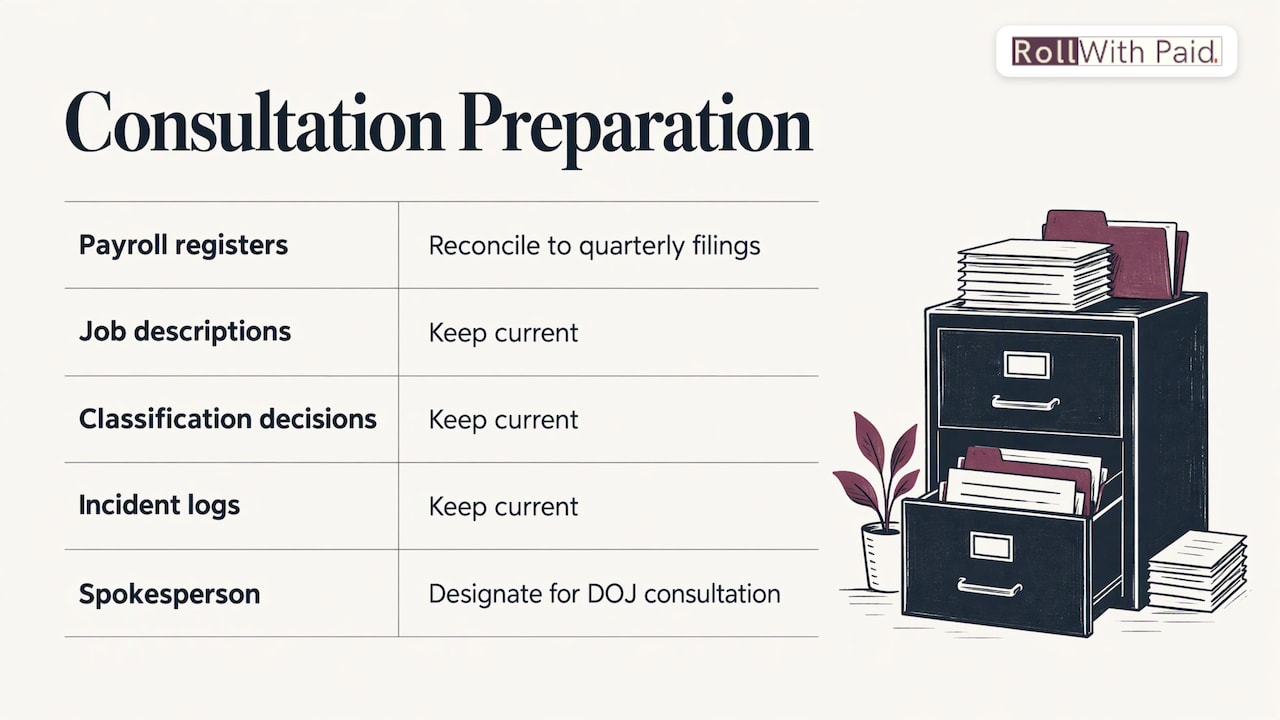
Prepare by keeping documentation consistent, because every plausible outcome rewards it. Finance teams should keep payroll registers reconcilable to quarterly filings. HR teams should keep job descriptions, classification decisions and incident logs current. Leaders should decide who speaks for the enterprise if the DOJ opens consultation sessions.
Integrations matter here. Payroll, time and attendance and HR document storage work best when they share one employee record, so hours worked flow into payroll without re-keying. Our reviews of HR document management and incident reporting tools show what to look for. The 2026 cannabis HR calendar tracks IRS, OSHA and DEA dates through the year.
For wider context, see our guides to human capital management and the CHRO pillar guide, and subscribe to the Roll Call newsletter for regulatory updates.
What is our view as a Tribal payroll and HR partner?
Rescheduling headlines move fast, and Tribal enterprises are often the last to learn whether they are covered. We read the resolution as a signal to build compliance that does not depend on the outcome.
Roll With Paid. is a Minnesota-based company and a woman-owned entity managed by Jennifer Williams, a proud member of the Sisseton-Wahpeton Oyate, and we run a dedicated Tribal relations practice. That shapes how we work with Tribal leaders: sovereignty comes first, and payroll, workers’ compensation and HR documentation are built to stand up to review under any rule.
An Employer of Record model takes filings, classification and workers’ compensation off an owner’s desk, so leadership can spend its time on consultation, licensing and growth. Our goal is zero late filings and files that are audit-ready on any day.
Leah Kollross
How can Roll With Paid. support Tribal cannabis employers?
Roll With Paid. provides Employer of Record, Payroll Execution, HR & Compliance Solutions, onboarding, Multi-State Hiring Support and Time & Attendance Tools for cannabis and other high-risk businesses. Our Tribal relations practice and our page on Native American cannabis business and payroll describe how we work with Tribal enterprises. Pricing is based on gross payroll, with an optional flat-rate HR retainer; see the pricing page or our services overview.
To talk through your enterprise’s payroll and HR setup, start at rollwithpaid.com.
FAQ
Does Resolution PSC-26-048 give Tribal cannabis businesses Schedule III treatment?
No. The resolution asks the DOJ to consult Tribes about rescheduling. The existing order covers FDA-approved products and products under a qualifying state medical marijuana license. Tribal programs were not addressed.
Do Tribal cannabis employers still owe federal payroll taxes?
Yes. Under the IRS final regulations of December 2025, wholly owned Tribal entities are recognized as separate entities for federal employment tax purposes. Tribes generally remain subject to FICA, FUTA and income tax withholding, subject to exceptions. Confirm any exception with a tax professional.
Who should Tribal leaders contact about DOJ consultation?
NCAI sent the resolution and a formal letter to Attorney General Todd Blanche requesting consultation. Tribal leaders should coordinate through their Tribal governments and NCAI, and follow DOJ announcements on any consultation sessions.
Can an Employer of Record work for a Tribal cannabis enterprise?
Roll With Paid. offers Employer of Record services for cannabis and other high-risk businesses, and runs a dedicated Tribal relations practice. The EOR model covers payroll execution, compliance and workers’ compensation support.
Sources
- Native News Weekly (November 8, 2026): D.C. Briefs, Native News Online
- D.C. Circuit petition for review, Case No. 26-1136
- 2026 National Cannabis Report, UNLV Cannabis Policy Institute
- Marijuana policy and tribal communities in the United States, PMC
- Marijuana Legalization in Indian Country: Selected Resources, CDC
- Cannabis Compact Between the White Earth Nation and Minnesota OCM
- IRS final regulations, Federal Register, December 16, 2025
- 2026 Legislative and Regulatory Trends Report, NCCI
- The Application of Internal Revenue Code Section 280E, Congressional Research Service
Recommended
- Native American Cannabis Business: Opportunity and Payroll
- Leah Kollross: Why Operator Evidence Matters as an NCIA HRC Member
- Tribal Relations for Agencies: Minnesota Cannabis Compacts in Practice
Roll With Paid. is not a law firm and does not provide legal advice. This article summarizes Minnesota law along with other states and jurisdictions law and is for general information only. Before changing a policy, consult employment counsel or contact DLI Labor Standards at 651-284-5075.