
Minnesota Pay Stub Requirements: What Employers Must Include

Minnesota employers must give every employee a written or electronic earnings statement (pay stub) at the end of each pay period, and the statement must carry 12 listed items under Minnesota Statutes § 181.032. Copies must be kept for three years. A separate written wage notice is also required at the start of employment.
TL;DR
- Minnesota Statutes § 181.032 requires an earnings statement every pay period, on paper or electronically.
- The statement must show the employee’s name, pay rate and basis, hours, gross pay, deductions, net pay, pay period end date and employer details.
- Employers must keep copies of earnings statements for three years under Minn. Stat. § 177.30.
- A signed written wage notice is due at hire, and written notice of changes is due before they take effect.
- Recordkeeping failures can bring fines of up to $1,000 per failure, and $5,000 for a repeated failure.
Table of Contents
- What must a Minnesota pay stub include?
- When must employers issue pay stubs, and can they be electronic?
- How long must Minnesota employers keep pay stubs?
- What is the Minnesota wage notice employers must give at hire?
- What changed in Minnesota pay stub law recently?
- What penalties do Minnesota employers face for pay stub violations?
- How do these rules play out in cannabis, hospitality and trades?
- What is the difference between a pay stub, a wage notice and payroll records?
- What do payroll software and employer of record models change?
- What does an audit-ready pay stub process look like for us?
- How can Roll With Paid handle Minnesota pay stubs and wage notices?
- What else do Minnesota employers ask about pay stubs?
- Sources
What must a Minnesota pay stub include?
A Minnesota pay stub must include 12 items under Minn. Stat. § 181.032(b). The Minnesota Department of Labor and Industry (DLI) enforces the rule. Its own summary pages condense the list to 10 lines, so some payroll checklists show 10 and the statute text shows 12. The statute text controls.
The statute requires:
- The employee’s name.
- The rate or rates of pay and the basis of pay: hour, shift, day, week, salary, piece, commission or another method.
- Any meal or lodging allowances claimed.
- Total hours worked, unless the employee is exempt from Minnesota Statutes chapter 177 (the state’s wage and hour chapter).
- Total gross pay.
- A list of deductions.
- Any amount deducted under § 268B.14 subdivision 3 (the state paid leave premium), and the employer-paid amount under subdivision 1.
- Net pay after deductions.
- The date the pay period ends.
- The employer’s legal name and operating name.
- The physical address of the main office or principal place of business, plus a mailing address if different.
- The employer’s telephone number.
The DLI explains the purpose in a June 2021 bulletin: when employees review stubs regularly, missing wages, hours or wrong deductions surface early, when they are easier to correct.
How do the 12 items differ by pay type?
The basis of pay line changes what the stub must show. The table below compares common worker types in cannabis, restaurants, bars and construction.
| Worker type | Basis of pay shown | Hours line |
|---|---|---|
| Hourly budtender or server | Hour | Required |
| Salaried manager | Salary | Required unless exempt from chapter 177 |
| Commissioned sales rep | Commission, plus any base rate | Required unless exempt |
| Piece-rate trimmer or harvest worker | Piece | Required; piece counts are also a recordkeeping item |
| Tipped bartender | Hour | Required |
The statute names piece, commission and shift as valid bases. A stub that lists only a dollar amount, with no basis, fails item 2.
When must employers issue pay stubs, and can they be electronic?
Minnesota employers must issue the earnings statement at the end of each pay period, in writing or electronically, under § 181.032(a). Electronic delivery is allowed with conditions.
When an employer delivers stubs electronically, § 181.032 requires three things:
- Employees can access an employer-owned computer during regular working hours to review and print statements.
- Statements stay available for review or printing for three years.
- If an employee gives at least 24 hours’ notice that they prefer paper, the employer must provide written statements on an ongoing basis (§ 181.032©).
The computer access rule matters most for workplaces without desks: grow rooms, dispensary floors, job sites and kitchens. A portal alone does not satisfy the statute if the employee has no employer-owned device to use.
Paper versus electronic stubs compared
| Factor | Paper stub | Electronic stub |
|---|---|---|
| Statutory basis | § 181.032(a), written form | § 181.032(a), electronic means |
| Employee access | Handed over each pay period | Employer-owned computer access during working hours |
| Retention | Three years from issuance | Available for review or printing for three years |
| Employee can switch | Not applicable | Employee can demand paper with 24 hours’ notice |
How long must Minnesota employers keep pay stubs?
Minnesota employers must keep earnings statements for three years from the date issued. The DLI’s earnings statement guidance states this, and the payment for hours worked page notes it took effect August 1, 2024.
Minn. Stat. § 177.30 sets the location rule. Records stay on the premises where the employee works, or must be producible within 72 hours if kept elsewhere. For state-funded public works projects, the three years run from final payment.
The DLI recordkeeping guidance lists 10 records per employee. They include:
- Name, address and occupation.
- Pay rate and the amount paid each period.
- Daily hours with start and end times.
- Pieces completed, for piece-rate pay.
- Copies of earnings statements.
- Meal-credit records.
- Proof of age for minors.
- A list of personnel policies with dates.
- The signed employee notice and any written changes.
- Biweekly certified payroll reports on state-funded public works.
Tax records follow a different clock. The Minnesota Department of Revenue’s 2025 withholding instructions direct employers to keep employment tax records, including W-2s, 1099s and payroll records, for at least four years. An employer that keeps everything four years satisfies both rules.
What is the Minnesota wage notice employers must give at hire?
Every Minnesota employer must give each employee a written notice at the start of employment and keep a signed copy. The DLI employee wage notice page sets out the rule. The notice must include a multilingual statement that employees may request it in another language.
The notice is the “wage theft notice” some employers search for. It comes from the 2019 wage theft law. The DLI’s employer guidance calls written notice of employment status, wages, hours and benefits both good business practice and a legal requirement.
Who needs a wage notice?
All employees, including seasonal ones. The DLI wage theft Q&A says a seasonal worker rehired for the next season needs a new notice at the start of that season. That matters for cultivation harvest crews and seasonal patio staff.
What about changes after hire?
Written changes must reach the employee before the change takes effect. A raise, a pay basis switch from hourly to piece rate, or a new pay date all count. Minneapolis employers may face additional city requirements, per the DLI page. Our guide to Minneapolis minimum wage payroll steps covers the local layer.
Do other notice rules apply to specific employers?
Yes. The DLI employer guidance names migrant worker recruiters (Minn. Stat. §§ 181.85 to 181.91), meatpacking employers (§ 179.86) and employers of 10 or more non-farm, non-casual employees with written agreement rules (§§ 181.55 to 181.57). Most cannabis, restaurant and trades employers fall outside these categories.
For the full statute context, see our overview of the Minnesota Wage Theft Prevention Act.
What changed in Minnesota pay stub law recently?
The amendment history of § 181.032 lists changes in 2019, 2023 and 2024, per the 2026 statute text. The 2019 changes brought the detailed recordkeeping and wage theft rules, including the basis of pay on the stub. The 2024 change set the three-year retention requirement, effective August 1, 2024.
The statute also now ties to paid leave premiums. Item 7 on the stub refers to § 268B.14, the Minnesota paid leave premium. Employers that run payroll through software built before paid leave launched should confirm the stub template shows both the employee deduction and the employer-paid amount. Our page on Minnesota paid leave employer obligations covers the payroll side, and our sick and safe time payroll guide covers leave tracking.
What penalties do Minnesota employers face for pay stub violations?
The DLI commissioner can fine an employer up to $1,000 for each failure to maintain required records, and up to $5,000 for each repeated failure, under Minn. Stat. § 177.30©. The commissioner weighs the business’s size and the violation’s gravity.
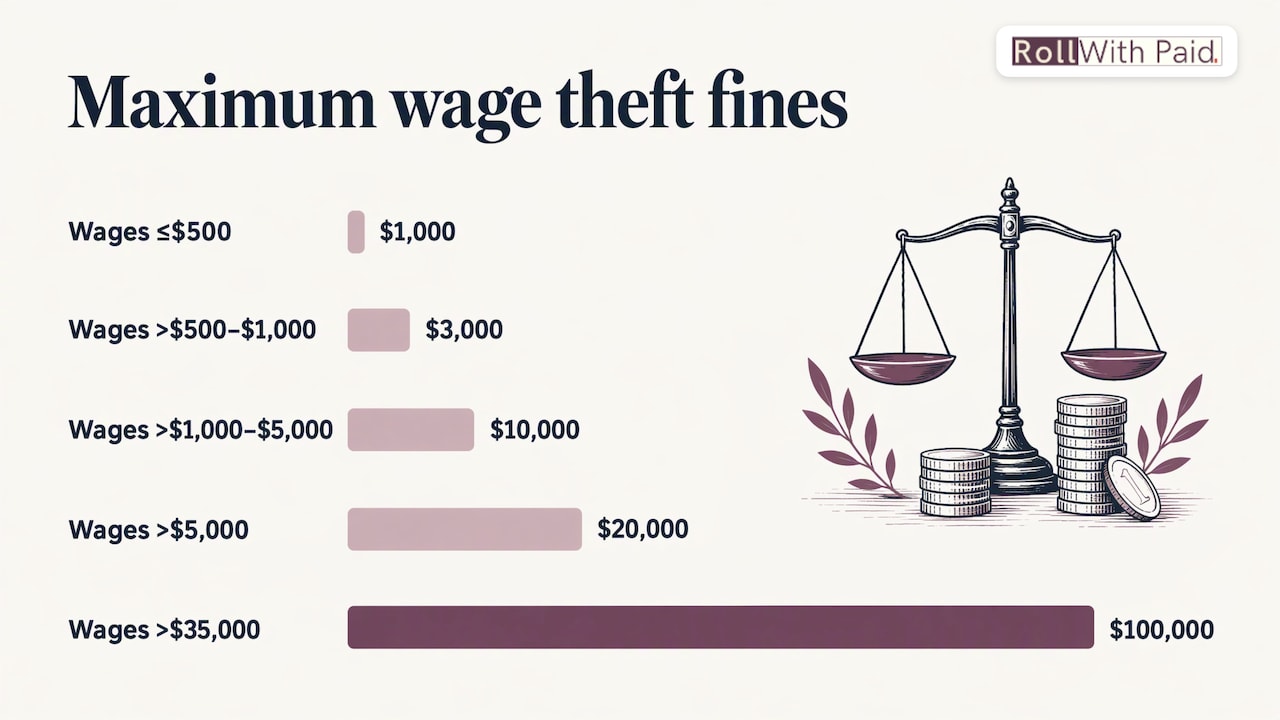
The larger exposure is wage theft. The Associated General Contractors’ April 2023 wage theft guide summarizes Minnesota’s criminal tiers by value of wages taken:
| Wages stolen | Maximum penalty |
|---|---|
| $500 or less | 90 days and/or $1,000 |
| Over $500 to $1,000 | 1 year and/or $3,000 |
| Over $1,000 to $5,000 | 5 years and/or $10,000 |
| Over $5,000 | 10 years and/or $20,000 |
| Over $35,000 | 20 years and/or $100,000 |
Values can be added together within any six-month period. A payroll error repeated on every stub can therefore climb a tier. A stub that omits hours or shows the wrong rate is also the document an employee will hand to the DLI. Our guide to reporting a payroll or wage issue in Minnesota shows what that path looks like from the employee’s side.
How do these rules play out in cannabis, hospitality and trades?
The stub rules apply to every Minnesota employer, but each industry trips on different lines. These are common scenarios, not client case reports.
A dispensary with budtenders and managers
The floor staff are hourly and the managers are salaried. Both need a stub, but the hours line is required for the hourly group and for salaried staff unless they are exempt from chapter 177. A template built for one pay type often drops the basis of pay line for the other. Cannabis workers also have specific workplace rights, covered in our page on rights as a cannabis worker in Minnesota.
A cultivation facility with piece-rate trimming
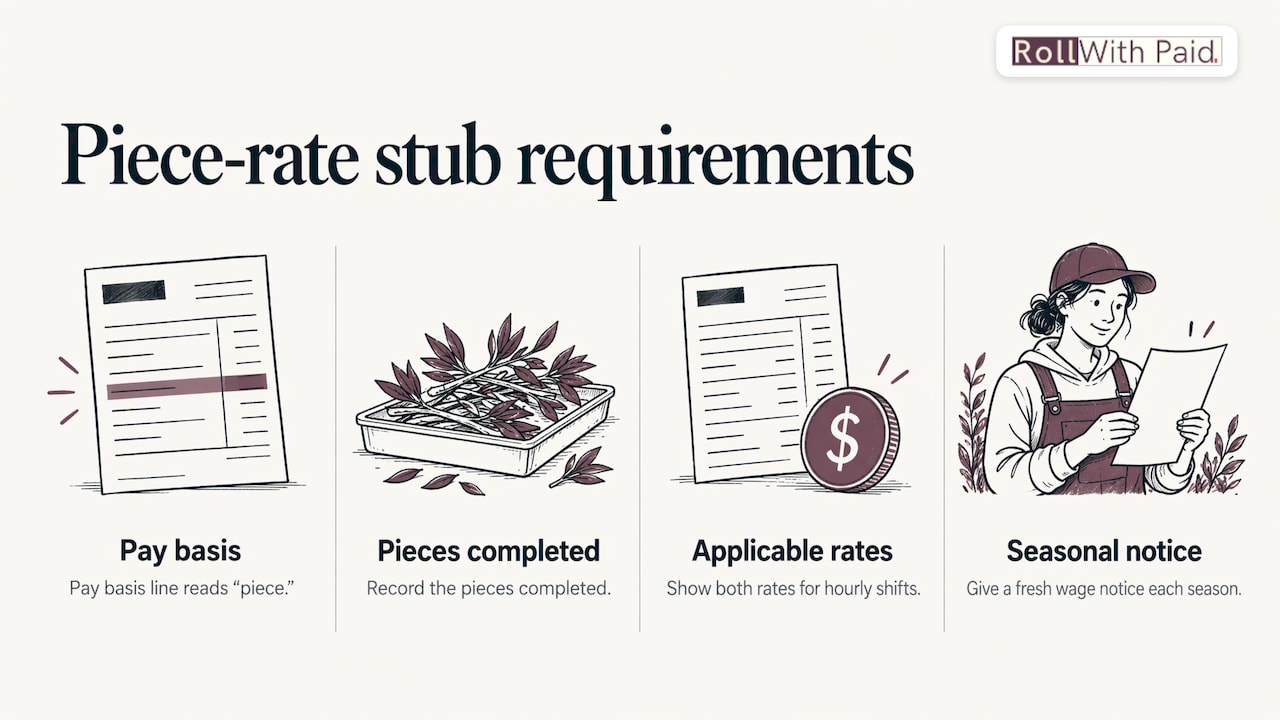
Piece-rate pay needs a basis of pay line reading “piece,” and the DLI recordkeeping list separately requires pieces completed. If trimmers also work hourly shifts, the stub must show both rates. Seasonal harvest hires need a fresh wage notice each season.
A restaurant or bar with tipped and shift pay
Bartenders and servers often work mixed shifts at different rates. Item 2 requires every rate on the stub. Meal allowances claimed against wages, common in restaurants, must appear under item 3.
A construction or trades employer
Trades crews may move between private jobs and state-funded public works. Public works adds biweekly certified payroll reports and a retention clock that starts at final payment. Our construction and trades case study shows how this kind of payroll is handled.
A multi-state operator
A stub template that works in one state may omit Minnesota’s paid leave lines or employer address items. Operators hiring across state lines should map each state’s statement rules before the first paycheck. Our guide on audit-ready multi-state cannabis payroll covers that groundwork. Minnesota’s new-hire reporting rules also apply at hire; see the new hire reporting checklist.
What is the difference between a pay stub, a wage notice and payroll records?
Three documents, three jobs. They are easy to confuse, and the same audit can ask for all of them.
| Document | When | Governing rule | Retention |
|---|---|---|---|
| Earnings statement (pay stub) | Every pay period | Minn. Stat. § 181.032 | Three years from issuance |
| Wage notice | At hire; written changes before they take effect | DLI employee notice rules | Signed copy kept with payroll records |
| Payroll records | Ongoing | Minn. Stat. § 177.30 | Three years; four years for tax records |
A stub proves what was paid. The wage notice proves what was promised. The records prove the hours. When the three disagree, the employee’s version usually wins in a dispute. For a plain-language look at what employees see on each line, read our pay stub deduction explainer.
What do payroll software and employer of record models change?
Payroll software can generate the stub, but it does not decide the basis of pay, supply the legal name, or maintain the signed wage notice. Those inputs come from the employer. We cover that gap on our payroll software problem page.
An employer of record (EOR) arrangement shifts payroll execution and compliance administration to a provider. Our guide to employer of record for high-risk industries explains the model. Because the EOR becomes the payroll employer, items 10 to 12 on the stub (legal name, address, phone) need to be set up deliberately, not assumed. That is a configuration point to settle before the first pay run.
What does an audit-ready pay stub process look like for us?
We have watched compliance questions in high-risk industries arrive the same way: not as a big legal event, but as one pay stub with one missing line.
Our view is that the stub is the cheapest compliance document an employer produces and the one most often handed to a regulator. That is why we treat it as a system, not a template. Payroll execution, the signed wage notice, onboarding and record retention should all point to the same facts.
Cannabis and other high-risk employers are often turned away by traditional payroll providers. We built Roll With Paid around those employers. Our Employer of Record model carries payroll and HR compliance work, and our clients’ filings have gone out with zero late filings. We want a business owner to be able to say that any stub, from any period, would pass inspection.
For ongoing Minnesota compliance updates, we publish our newsletter, Roll Call.
Leah Kollross
How can Roll With Paid handle Minnesota pay stubs and wage notices?
We run payroll and HR compliance for cannabis businesses and other high-risk employers. Our services include Payroll Execution, Employer of Record, HR & Compliance Solutions, Seamless Employee Onboarding, Multi-State Hiring Support and Time & Attendance Tools. Onboarding is where the wage notice starts, and time and attendance data is what fills the hours line on each stub.
Pricing is a monthly service fee based on gross payroll, with an optional flat-rate HR retainer. Rates vary by worker classification code and headcount. See our pricing page or talk to us through rollwithpaid.com.
If you are comparing providers, we have written side by side pages on Roll With Paid vs Paragon Payroll and Roll With Paid vs Greenleaf HR.
What else do Minnesota employers ask about pay stubs?
Does a salaried employee need a Minnesota pay stub?
Yes. Every employee gets an earnings statement. Salaried employees’ stubs must show the salary basis and gross pay. The total hours line is required unless the employee is exempt from Minnesota Statutes chapter 177, per § 181.032(b).
Can an employer refuse to give a paper stub?
Not after the employee asks. Under § 181.032©, an employee who gives at least 24 hours’ notice that they prefer written statements must receive them on an ongoing basis. The employer cannot require portal-only access in that case.
Does a former employee still have a right to the stub?
The employer must keep copies for three years, including for former employees, because the records are available for DLI inspection. Final pay timing is a separate rule. See our guide to final paycheck laws in Minnesota.
Where should records be stored for a DLI request?
On the premises where the employee works, or somewhere that lets the employer produce them within 72 hours, under Minn. Stat. § 177.30. Employers with several sites should confirm each location can meet that window.
Does a holiday or premium pay rate change the stub?
Yes. Any rate paid must appear as a rate of pay, with its basis. Our page on Minnesota holiday pay for employers covers the premium rate rule for nursing homes.
Sources
- Minnesota Statutes 2026, § 181.032 (PDF)
- Minnesota Statutes 2026, § 181.032 (web)
- Minnesota Statutes 2025, § 177.30
- DLI: Employee wage notice
- DLI: Wage theft questions and answers
- DLI: Guidance for employers on Minnesota’s new wage theft law
- DLI: Minnesota’s labor standards recordkeeping laws
- DLI: Minnesota earnings statement laws
- DLI: Payment for hours worked
- DLI bulletin: Pay stub requirements, June 2021
- Minnesota Department of Revenue: 2025 Withholding Tax Instructions and Tables
- AGC Wage Theft Guide, April 2023
Recommended
- Understanding Your Pay Stub: Every Deduction Explained
- MN Wage Theft Prevention Act: What Employers Need to Know
- Final Paycheck Laws in Minnesota: Deadlines for Employers
- Minnesota Paid Leave: Employer Obligations After Launch
Roll With Paid. is not a law firm and does not provide legal advice. This article summarizes Minnesota law along with other states and jurisdictions law and is for general information only. Before changing a policy, consult employment counsel or contact DLI Labor Standards at 651-284-5075.