
Final Paycheck Laws in Minnesota: Deadlines for Employers
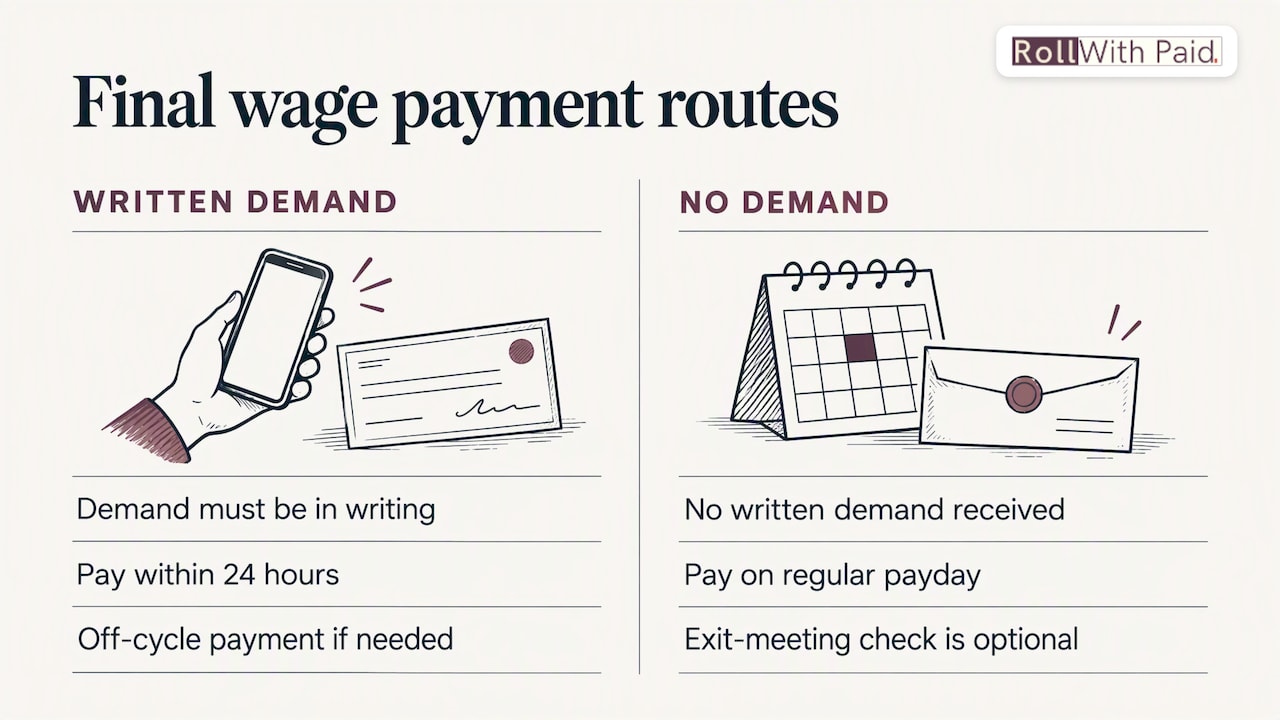
Minnesota has two different clocks for a final paycheck, and which one applies depends on how the job ended. If you fire or lay off an employee, wages are due within 24 hours of their written demand. If an employee quits, wages are due by the first regularly scheduled payday after the last day, with limited exceptions. Miss either deadline and you can owe the wages plus a daily penalty.
This guide is written for the owner or operator who has to get the last check right: what is due, when, what you can and cannot deduct, and how to build a separation routine so it never turns into a claim. It applies to every Minnesota employer, and we point out where cannabis operations, with their high turnover and tight compliance margins, need extra care.
TL;DR
- Fired or laid off: earned, unpaid wages are due within 24 hours after the employee’s written demand. Without a demand, they are generally paid on the next regular payday.
- Quit or resigned: wages are due by the first regularly scheduled payday after the final day, and never later than 20 calendar days after separation.
- Penalty for being late: unpaid wages plus a penalty equal to the employee’s average daily earnings for each day in default, up to 15 days.
- PTO and vacation: payout follows your written policy, and any benefit that becomes payable is due within 30 days.
- Deductions: do not net out a claimed debt, such as a missing till amount or unreturned equipment, from the last check without meeting the statute’s strict conditions.
Table of Contents
- Two deadlines, depending on how employment ended
- When you terminate an employee
- When an employee quits
- What counts as final pay
- Vacation, PTO, and sick time at separation
- Deductions from the last check
- What happens if you pay late
- Termination notices and records
- A separation checklist for payroll
- Our perspective: where final pay goes wrong in cannabis
- Getting separation payroll off your plate
- Related obligations to review
- FAQ
- Sources
Two deadlines, depending on how employment ended
Minnesota splits final pay across two statutes. Section 181.13 covers employees who are discharged, and section 181.14 covers employees who quit or resign. Treating them as one rule is the most common mistake we see, and it leads to either paying too early (and sometimes incorrectly) or paying too late.
| Situation | Statute | When final wages are due |
|---|---|---|
| Employee fired, discharged, or laid off | Minn. Stat. 181.13 | Within 24 hours after the employee’s written demand; otherwise generally on the regular payday |
| Employee quits or resigns | Minn. Stat. 181.14 | By the first regularly scheduled payday after the final day, unless a collective bargaining agreement says otherwise |
| Employee entrusted with employer money or property | Minnesota DLI guidance | Up to 10 additional calendar days after separation to audit accounts |
| Public employer needing governing-board approval | Minn. Stat. 181.13 | The 24-hour period starts at the first regular or special board meeting after discharge |
The audit window in row three comes from the Department of Labor and Industry’s wages and overtime FAQs. It is narrow. It fits a cashier or a manager who handled deposits, not every employee who held a key.
When you terminate an employee
The statute says wages earned and unpaid at discharge are due upon the employee’s demand, and the employer is in default if it has not paid within 24 hours after that demand. The Department of Labor and Industry (DLI) says the same thing on its employment termination page: a terminated employee’s paycheck must be paid within 24 hours of the employee’s demand for wages.
Three details matter in practice.
The demand must be in writing. Section 181.13 requires a written demand, and DLI’s February 2024 wage and hour bulletin tells employees to put it in writing. The demand does not need to state the exact amount owed. A short email saying “please pay my final wages” is enough to start your 24 hours. Treat any written message that asks for the money as a demand, including a text or an email sent to a manager rather than to payroll.
Without a demand, the regular payday applies. DLI’s wage claim page explains that, absent a demand, a terminated employee’s wages are generally paid on the regularly scheduled payday. Many employers still hand over the check at the exit meeting. That is a reasonable practice if the hours are final and verified, but it is a choice, not a rule, and rushing an estimate is how final checks end up wrong.
The clock runs in hours, not business days. A demand sent Friday afternoon can come due Saturday afternoon. If your payroll runs on a weekly cutoff, you need a way to cut an off-cycle check or direct deposit quickly. That is a systems question as much as a legal one, which we come back to below.
When an employee quits
For resignations, section 181.14 requires payment in full by the first regularly scheduled payday following the employee’s final day. The statute also says wages are “earned and unpaid” if the employee was not paid for all time worked at the regular rate or at the rate required by law, whichever is greater. So a final check that applies a lower rate than a local ordinance requires is still short.
There is a timing safeguard. Under the same statute, if the first payday falls fewer than five calendar days after the final day, you may wait until the second regular payday. In no case can payment come later than 20 calendar days after separation. An employee covered by a collective bargaining agreement may be subject to a different provision.
A worked example
Say you pay biweekly on Fridays, and an employee gives notice and works their last shift on Wednesday.
- Their final day is Wednesday. The next payday is Friday, two calendar days later.
- Because that payday is fewer than five calendar days after the final day, you may pay on the following payday instead, two weeks later.
- That second payday is 16 calendar days after separation, inside the 20-day ceiling, so it works.
If instead the final day is the Sunday after a payday, the next payday is five days out or more, and the first-payday rule applies. We recommend paying on the first payday whenever the hours are known. Waiting costs you goodwill and gains you almost nothing.
What counts as final pay
Final wages are everything the employee earned and has not yet been paid: regular hours, overtime, commissions earned, and any pay owed at a higher legal rate. For a dispensary or cultivation team, that usually means checking the following before you release the check:
- Hours through the last clock-out, including any off-the-clock closing or trimming time that the time records show
- Overtime for the final pay period, calculated on the correct regular rate
- Earned commissions or documented production bonuses
- Any tip or tip-pool amounts your policy distributes through payroll
- Reimbursable expenses the employee submitted (mileage, for example; see our guide on Minnesota mileage reimbursement for how to keep those from becoming taxable wage errors)
Because Minnesota treats underpayment of any of these as unpaid wages, an incomplete last check can trigger the same penalty exposure as a late one.
Vacation, PTO, and sick time at separation
Minnesota does not have a blanket statute that says every employer must pay out unused vacation. DLI states that vacation, sick leave, and severance benefits are governed by company policy and are payable within 30 days after they become due. If a benefit is not paid, the employee can pursue it in conciliation court under Minnesota Statutes section 181.74.
That puts the weight on your written policy. Employers are also required to give written notice at the start of employment describing paid vacation, sick time, or other PTO accruals and the terms of use, according to DLI’s guidance on the wage theft law. If your handbook says unused PTO is paid out at separation, pay it. If it says it is forfeited, make sure the employee received that notice in writing, and that the policy is applied the same way to everyone.
Two cautions:
- Keep PTO and earned sick and safe time (ESST) separate in your records. They are different obligations with different rules, and mixing them is how policies drift. Our ESST payroll steps walk through the distinction, and our PTO vs. sick leave article covers the multi-state view.
- Do not improvise. A manager who tells a departing budtender, “we’ll cash out your PTO,” has just created a promise you may have to honor.
Deductions from the last check
Separation is when employers are most tempted to net out a debt: an unreturned key card, a missing till amount, a damaged tool, an uniform deposit. Minnesota restricts this. Section 181.79 bars deductions from wages for lost or stolen property, damage, or other claimed indebtedness unless specific conditions are met, and any deduction is limited by the garnishment rules.
The practical rule: if you are not certain the deduction meets the statute, pay the full wages on time and pursue the debt separately. A deduction that fails the statute can leave you with a wage violation on top of the original loss. Our overview of the Minnesota Wage Theft Prevention Act explains how broadly the state now treats wage underpayment.
What happens if you pay late
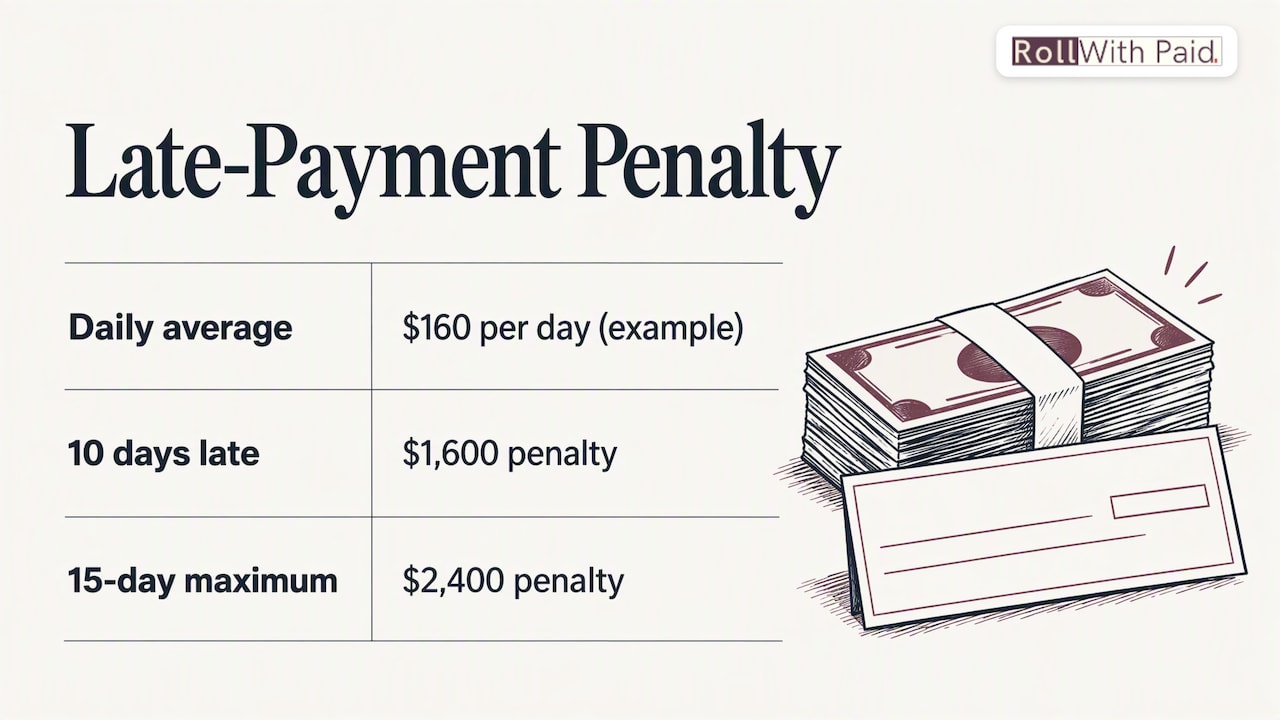
Under section 181.13, a discharged employee may recover the unpaid wages plus a penalty equal to their average daily earnings for each day the employer is in default, up to 15 days. The employee can seek payment directly. Employees are directed to DLI Labor Standards, at 651-284-5075 or dli.laborstandards@state.mn.us, with the employer’s information, wage details, last workday, and the date of their demand if one applies.
Here is what that penalty looks like on a real payroll. An employee who averaged $160 per day and waited 10 days past the deadline could claim the unpaid wages plus 10 days of penalty, or $1,600. At the 15-day maximum, the penalty is $2,400, whatever the size of the original shortfall. That is a high price for a missing check of a few hundred dollars. (The $160 average is an illustration, not a figure from the statute.)
If an employee has contacted you about a payroll problem, or you want to understand what the other side of a claim looks like, see our walkthrough on how to report a payroll or wage issue in Minnesota.
Termination notices and records
People also ask whether Minnesota requires a termination letter. Our reading of DLI’s termination page is that it addresses a notice of separation and the reason for termination as separate topics, so check that page for the current notice requirements before you write your template. Whatever the notice rules, we recommend a standard separation packet that records:
- The date and manner of separation (fired, laid off, resigned)
- The employee’s last day worked and the date final wages were paid
- Any written wage demand and the time it was received
- The PTO or benefit treatment applied, with a reference to the policy
- Return of company property, handled separately from pay
Dated records are your evidence if a claim arrives months later.
A separation checklist for payroll
Use this in order, every time:
- Classify the separation. Discharge, layoff, or resignation? This decides the clock.
- Log any written demand with the date and time received. A discharged employee’s 24 hours start there.
- Reconcile hours against time records through the final clock-out.
- Calculate the correct rate, including local minimum wage ordinances; for Minneapolis, see our minimum wage payroll steps.
- Apply your PTO policy exactly as written and confirm the 30-day window for any benefit that becomes due.
- Skip deductions unless you have confirmed they comply with section 181.79.
- Pay by the deadline and keep proof of delivery.
- Complete the file and store it with your other personnel and payroll records.
Our perspective: where final pay goes wrong in cannabis
We work with employers other payroll companies often avoid, and the pattern in final-pay problems is consistent. It is rarely bad intent. It is a workflow that was built for a stable team and then handed a high-turnover workforce.
Dispensaries and cultivations lose people fast: seasonal trimmers, part-time budtenders, shift leads who move to a competitor down the road. Each departure creates the 24-hour problem if the employee asks in writing, and many operators run payroll through a bundled tool or an in-house spreadsheet that cannot cut an off-cycle check quickly. When the demand lands on a Friday, the penalty clock starts running while the owner is on the floor.
There is a second problem that is specific to this industry. Cannabis employers are held to a high documentation standard because their books are examined closely, so a late filing or a bad classification stands out. A final check that is wrong in one state can be wrong in the same way in three, which is why multi-state operators need one process, not one per state.
Our view is simple. Final pay should be a routine step of payroll execution, not an emergency. That means tracked separation dates, a single place where written demands are logged, off-cycle runs that take minutes, and PTO treatment that matches the handbook every time. Under our Employer of Record model we run payroll and HR compliance together, so the person who knows a separation happened is the same person who knows what the policy says and what the deadline is. We have not had a late filing for our clients, and we build that same discipline into every separation.
— Leah Kollross
Getting separation payroll off your plate
If your team is small and turnover is constant, the safest improvement is to stop treating final pay as a manual task. Roll With Paid handles payroll execution, HR and compliance support, onboarding, and time and attendance tools for cannabis and other high-risk employers, with an Employer of Record option that moves much of the administrative and liability burden off you. Pricing is based on gross payroll and worker classification, with an optional HR retainer, and you can see how it is structured on our pricing page. To learn how the model works, visit Roll With Paid or read about Employer of Record for high-risk industries.
Related obligations to review
Final pay rarely stands alone. Employees leaving also touch other rules worth checking at the same time:
- Paid leave rules now in effect, covered in our guide to Minnesota paid leave employer obligations
- Holiday pay owed in certain settings, such as the nursing home 1.5x rule
- Cannabis worker rights that employees may raise at exit, summarized in Your Rights as a Cannabis Worker in Minnesota
- Replacement hires, which trigger new hire reporting within the required window
FAQ
How long does my employer have to give me my final paycheck in Minnesota?
It depends on how you left. If you were fired or laid off, your employer must pay within 24 hours after your written demand, and generally on the regular payday if you do not demand. If you quit, payment is due by the first regularly scheduled payday after your last day, subject to the five-day and 20-day limits in section 181.14.
Does Minnesota require PTO payout upon termination?
Not by a blanket rule. DLI says vacation, sick leave, and severance benefits are governed by company policy, and benefits are payable within 30 days after they become due. Check your handbook and your written PTO notice.
Does the employee have to ask in writing?
For a discharged employee, yes: section 181.13 requires the wage demand to be in writing, though it does not have to state the exact amount owed. Employers should treat any written request for the money, including an email or text, as a demand.
What penalty does an employer face for a late final paycheck?
The employee can recover the unpaid wages plus a penalty equal to average daily earnings for each day in default, up to 15 days. Employees can also contact DLI Labor Standards to start a wage claim.
Can an employer deduct unreturned property from the final check?
Only if the deduction meets the conditions in section 181.79, which restricts deductions for lost, stolen, or damaged property and other claimed debts. When in doubt, pay the full wages on time and handle the debt separately, ideally after talking with an employment attorney.
Sources
- Minnesota Statutes 181.13, discharged employees
- Minnesota Statutes 181.14, employees who quit or resign
- Minnesota Statutes 181.79, wage deductions
- DLI: Employment termination
- DLI: Wage claim
- DLI Wage and Hour Bulletin: When are employees owed their last paycheck?
- DLI: Wages and overtime FAQs
- DLI: Guidance for employees on Minnesota’s wage theft law
Recommended
- How to Report a Payroll or Wage Issue in Minnesota (Step by Step)
- Employers: 5 Payroll Steps to Comply With Minnesota Paid Family Leave
- Avoid ESST Audits in 2026: Minnesota Sick and Safe Time Payroll Steps
- MN Wage Theft Prevention Act: What Employers Need to Know
Roll With Paid. is not a law firm and does not provide legal advice. This article summarizes Minnesota law as of August 2026 and is general information only. Tip arrangements are fact-specific; before changing a policy, consult employment counsel or contact DLI Labor Standards at 651-284-5075.