
Avoid $25 to $500 Fines: Minnesota New Hire Reporting Checklist

Yes, Minnesota law and federal law both require you to report new and rehired employees within 20 calendar days of their start date. The fastest path is the Minnesota New Hire Reporting Center’s online portal, which generates a printable confirmation the moment you submit. If you’ve missed recent hires, report anyone brought on recently and keep every confirmation on file.
TL;DR:
- Employers must report new hires within 20 days of employment using the Minnesota New Hire Reporting Center or a compliant form, ensuring all required fields are filled.
- Accurate reporting relies on correct employer FEIN, legal name, mailing address, employee’s full name, address, and Social Security number, with optional birth date.
- Reporting can be submitted via online portal, electronic file, payroll vendor, or mail/fax, with confirmation kept as proof of compliance, especially in audits.
- Missed deadlines may lead to penalties of $25 per employee for intentional noncompliance or $500 per employee in conspiracy cases, emphasizing the need for proper documentation.
- Rehires after a 60-day or longer break must be reported, while reporting independent contractors is optional but should be consistent if chosen, and multistate employers can centralize filings or report separately.
Table of Contents
- What Information Does Minnesota New Hire Reporting Require?
- How Do You Actually Submit a New Hire Report in Minnesota?
- When Does the 20-Day Clock Start, and What Counts as Late?
- What Happens If You Miss the Deadline?
- How Do You Handle Rehires, Temp Staff, and Contractors?
- Do Multistate Employers Report Differently in Minnesota?
- What Does a Reliable New-Hire Reporting Workflow Look Like?
- The Real Cost of Treating New Hire Reporting as an Afterthought
- Get Help Keeping New Hire Filings On Time
- Sources
- FAQ
What Information Does Minnesota New Hire Reporting Require?
A rejected report almost always traces back to a missing field, not a missed deadline. Before you touch the portal, gather two sets of information: your business details and the employee’s.
On the employer side, you need your Federal Employer Identification Number (FEIN), your legal business name, and a mailing address the state can use for income withholding orders if a child support case arises. On the employee side, you need the person’s full legal name (first, middle, last), current mailing address, Social Security number, and date of hire. Date of birth is optional, though some employers include it to avoid confusion with common names.
Many small employers still submit a W-4 as their new-hire report instead of using a dedicated form. That works, but only if you fill in boxes 8 and 10, the employer name/address and the date of hire. Skip those two boxes and the Minnesota New Hire Reporting Center has no way to process the form, which means your “on-time” filing sits incomplete until someone catches the error.
- FEIN and employer legal name
- Employer mailing address for withholding orders
- Employee’s full name, address, and Social Security number
- Date of hire (birth date optional)
- W-4 boxes 8 and 10 completed if using that form as your report
How Do You Actually Submit a New Hire Report in Minnesota?
You have four real options, and the right one depends on your headcount and your systems.
- Online portal. Register once at the Minnesota New Hire Reporting Center, then report each new hire through a session form. The portal, upgraded on July 1, 2024, now issues automated printable confirmations and ad hoc confirmation lookups, so you never have to wonder whether a report actually went through.
- Electronic file or SFTP. Employers with higher hire volume can build and transmit files according to the center’s file layout specs. Note that the SFTP hostname changed after the 2024 upgrade, so if you’re using an old connection string that’s been sitting untouched in a script, it will fail silently until someone checks the logs.
- Payroll vendor. Many payroll providers report new hires as part of their service, but don’t assume this without confirming it. Ask your vendor directly whether they file on your behalf, how often, and whether they retain proof of submission you can request.
- Mail, fax, or W-4. If you don’t have internet access, you can mail or fax a completed W-4 with the employer boxes filled in, using the contact details in the Minnesota Department of Revenue’s new employer guide.
Pro Tip: Whichever method you use, save or print the confirmation the same day you file. If your business is ever audited or a dispute arises over a missed report, that confirmation is your best evidence you complied on time.
When Does the 20-Day Clock Start, and What Counts as Late?
The clock starts on the date of hire or rehire, not the date you process payroll or run onboarding paperwork. Under Minnesota Statute 142A.29, you have 20 calendar days from that date to submit your report, and weekends count.
If you hire someone on the 5th of the month, your deadline lands on the 25th, no exceptions for pay cycles that don’t align. Employers who file electronically or magnetically get one piece of flexibility: you can submit in two monthly batches, as long as the transmissions are spaced no less than 12 days and no more than 16 days apart. That spacing rule matters if you’re batching new hires around payroll runs. Miss it, and your “twice a month” filing schedule technically falls out of compliance even if every individual report would have been on time filed alone.
What Happens If You Miss the Deadline?
Minnesota’s civil penalty structure escalates with intent, not just with lateness. A first violation typically triggers a written notice rather than an immediate fine, giving you a chance to correct course. Repeat violations are where the cost shows up.
Under Minnesota Statute 142A.29, an employer who intentionally fails to report an employee after a written notice faces a civil penalty of $25 per unreported employee. If the failure stems from a conspiracy between employer and employee to avoid reporting, such as knowingly leaving someone off the books, the penalty jumps to $500 per employee.
- $25 per employee for intentional noncompliance after written notice
- $500 per employee where reporting is skipped as part of an employer-employee conspiracy
- Documentation (confirmations, vendor filing records) is your primary defense if a report is disputed
The state’s enforcement approach leans on documentation. If you can produce a printable confirmation or a vendor’s filing log showing a report went out on time, you have a real answer to any inquiry. Employers who can’t produce anything are the ones who end up negotiating penalties instead of disputing them.
How Do You Handle Rehires, Temp Staff, and Contractors?
Not every returning worker or nontraditional hire triggers a fresh report, but the rules differ by category, and guessing wrong in either direction creates problems.
- Rehires: Report an employee who returns after a separation, generally treated as a qualifying break once it’s been roughly 60 days or more, according to Minnesota New Hire Reporting Center FAQs.
- Temporary staffing agencies: The agency, not the client business, is responsible for reporting its placements, and a new report is generally needed each time a worker starts a new assignment period.
- Independent contractors: Reporting is optional under Minnesota’s program, but the choice belongs to you as the payer, and once you decide to report contractors consistently, keep doing so to avoid gaps that look inconsistent in an audit.
- Substitute teachers and poll workers: These roles typically require only a single report at the start of the relevant period (school year or election cycle) rather than a new filing for every assignment.
Do Multistate Employers Report Differently in Minnesota?
If you have employees working in more than one state, you get a choice. You can report each employee to the state where they physically work, filing separately in each jurisdiction, or you can elect to send all new-hire reports to a single state electronically and notify the federal Office of Child Support Services of that election, per ACF guidance on employer responsibilities.
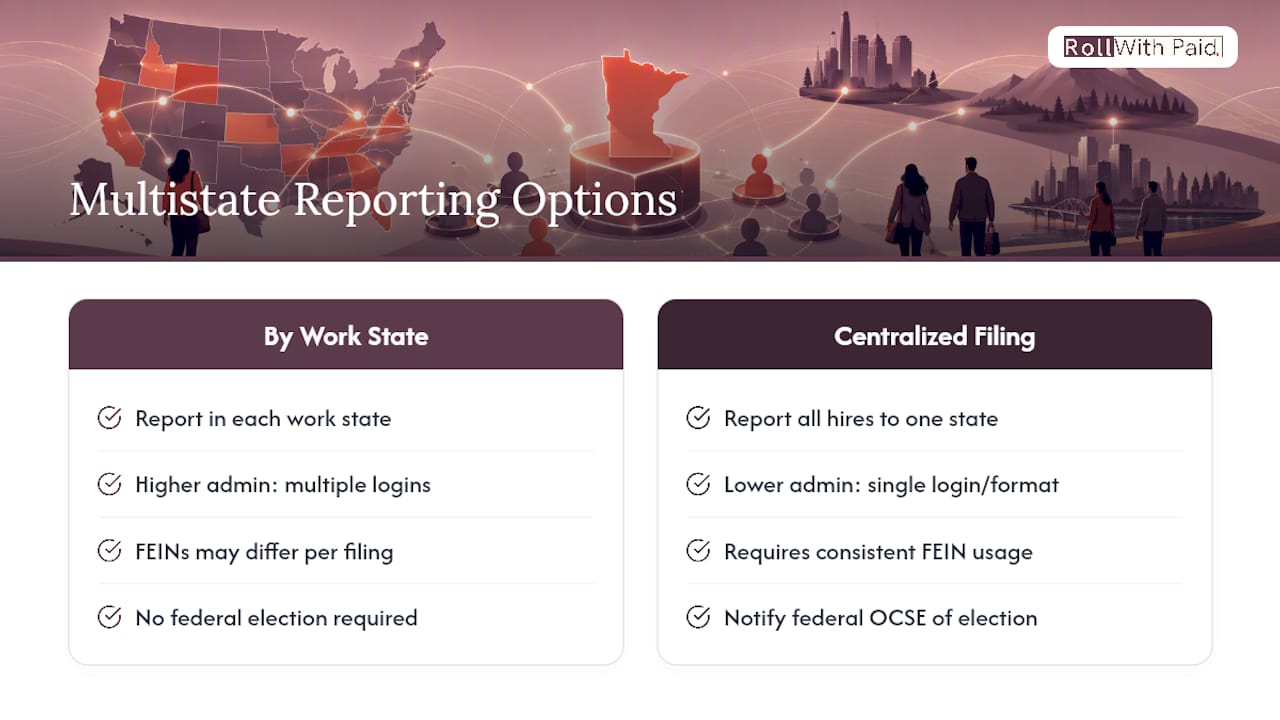
Centralized reporting cuts down on the administrative juggling of multiple state logins and formats, but it only works cleanly if your FEIN usage is consistent across payroll exports. Duplicate or mismatched FEINs across state systems create the exact kind of confusion centralized reporting was supposed to eliminate. If you’re weighing this option, it pairs naturally with a broader look at how Employer of Record services handle multistate payroll and filings on your behalf.
What Does a Reliable New-Hire Reporting Workflow Look Like?
A workflow only works if it survives turnover on your HR team, so keep it simple enough that anyone can follow it without guessing.
- Collect data at the offer or onboarding stage: name, address, SSN, hire date, and your FEIN and business address already on file.
- Choose your method: portal, SFTP file, payroll vendor, or mail/fax, based on your volume and systems.
- Submit within the 20-day window, ideally within the first week of employment while the paperwork is fresh.
- Download or print the confirmation immediately after submission.
- Archive the confirmation in the employee’s HR file, not just in your email inbox.
Most rejected reports fail for the same handful of reasons: an unreadable W-4 scan with blank employer boxes, a typo in the FEIN, or a missing Social Security number. A single onboarding checklist, paired with the archive step above, eliminates nearly all of them.
Pro Tip: If your payroll vendor claims to file new-hire reports automatically, ask for a monthly report proving it. “We handle that” isn’t documentation, and documentation is what protects you if the state ever asks.
The Real Cost of Treating New Hire Reporting as an Afterthought
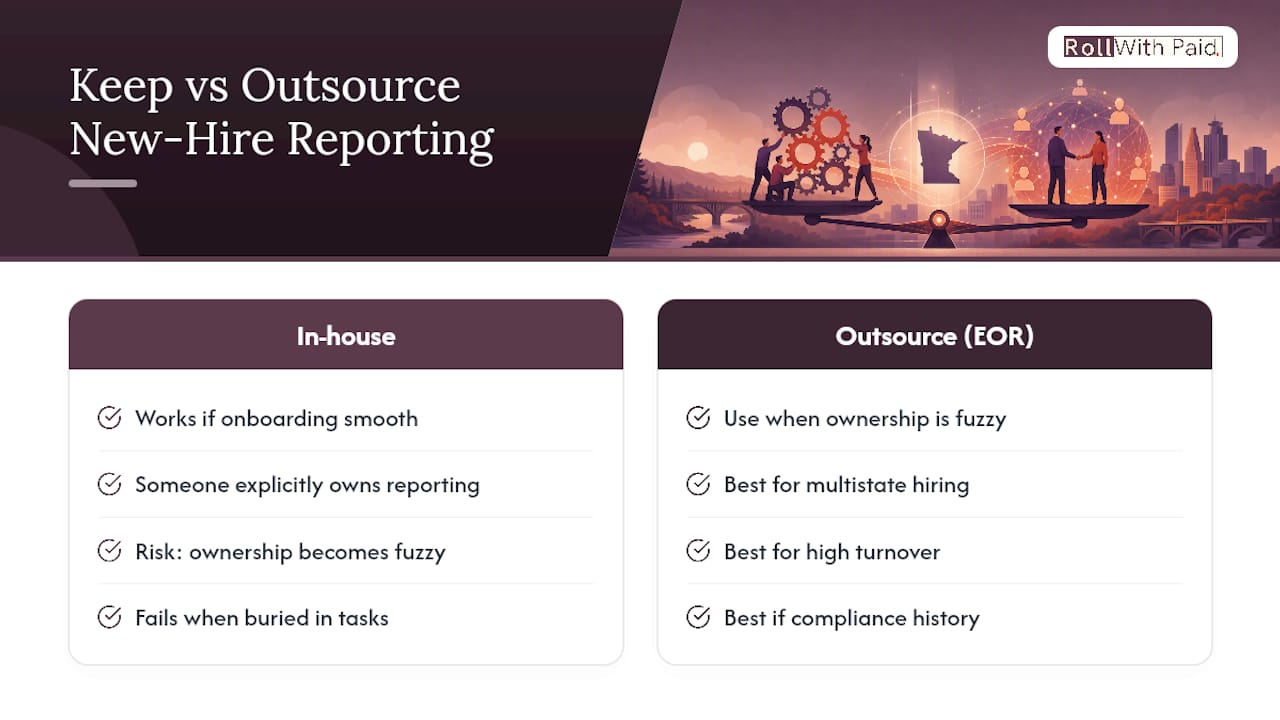
Most employers don’t miss the 20-day deadline out of carelessness. They miss it because reporting sits at the bottom of a stack of onboarding tasks, competing with I-9s, benefits enrollment, and payroll setup, and nobody owns it specifically. That’s the actual failure point, not ignorance of the law.
For high-risk industries like cannabis, where regulatory scrutiny is already elevated, a missed new-hire report is the kind of small administrative gap that turns into a bigger question during an audit. Employers considering Employer of Record support should weigh it seriously once they’re managing multistate hiring, high turnover, or a compliance history that leaves no room for another notice letter. If your onboarding process runs smoothly and someone owns reporting explicitly, keeping it in-house works fine. The moment that ownership becomes fuzzy is the moment outsourcing starts paying for itself.
— Leah
Get Help Keeping New Hire Filings On Time
There are services that simplify new-hire filings, handling new-hire reporting as a built-in step of onboarding rather than an afterthought.

If you’re evaluating whether to keep reporting in-house or hand it off, ask any potential partner three questions: do they file within the 20-day window as standard practice, do they provide proof of filing you can keep in your own records, and do they understand the specific compliance pressure that comes with operating in a high-risk industry like cannabis. Rollwithpaid’s Employer of Record services are built around exactly those three points, alongside multi-state payroll, I-9 support, and regulatory filings. If new-hire reporting has ever slipped through the cracks on your team, reach out to Rollwithpaid and get onboarding handled by people who treat compliance as the job, not a side task.
Sources
- Minnesota Statutes, Section 142A.29
- Minnesota New Hire Reporting Center – Home
- ACF – Employer responsibilities: new-hire reporting
- New Employer Guide | Minnesota Department of Revenue
FAQ
What Is Minnesota New Hire Reporting?
It’s the legal requirement for employers to report newly hired and rehired employees to the state within 20 calendar days, mandated by Minnesota Statute 142A.29 and federal PRWORA.
What Forms Are Required for New Employees in Minnesota?
You can submit a dedicated new-hire report through the Minnesota New Hire Reporting Center portal, or use a completed W-4 with employer boxes 8 and 10 filled in if you’re reporting by mail or fax.
Who Is Responsible for New Hire Reporting?
The hiring employer is responsible, including temporary staffing agencies for their own placements; payroll vendors may handle filing, but you should confirm and document that they actually do it.
What Happens If I Report a New Hire Late in Minnesota?
A first violation typically results in a written notice, but repeat intentional noncompliance carries a $25 per-employee civil penalty, rising to $500 per employee for conspiracy-based violations.
Do I Need to Report Rehired Employees or Independent Contractors?
Report rehired employees who return after a qualifying break of roughly 60 days or more; reporting independent contractors is optional and left to your discretion as the payer.
Recommended
- MN Wage Theft Prevention Act: What Employers Need to Know
- How to Report a Payroll or Wage Issue in Minnesota (Step by Step)
- Minnesota Paid Leave: Employer Obligations After Launch
- Understanding Your Pay Stub: Every Deduction Explained
Roll With Paid. is not a law firm and does not provide legal advice. This article summarizes Minnesota law as of August 2026 and is general information only. Tip arrangements are fact-specific; before changing a policy, consult employment counsel or contact DLI Labor Standards at 651-284-5075.