
Cannabis Benefits in the Workplace: What the Evidence Shows
The honest answer to “does cannabis have benefits at work?” is: a few, in specific settings, and with limits employers cannot ignore. A 2026 study in the Journal of Workplace Behavioral Health links medical cannabis decriminalization to fewer health-related absences. Other research ties frequent use and cannabis use disorder to more missed work. Both findings are real, and a sound workplace policy accounts for both.
This guide separates what the data supports from what it does not, then explains what it means for owners and operators, with a focus on Minnesota. We wrote it for cannabis employers, who face the same legal duties as every other employer, plus a few of their own.
TL;DR
- A 2026 study associates medical cannabis decriminalization with a 6.9% lower likelihood of health-related absences, strongest in physically demanding jobs. It is an association, not proof that cannabis use caused it.
- Use before or during work is linked to worse task performance. Off-work use was not significantly related to performance in the research we reviewed.
- Legal use does not remove your right to prohibit on-duty impairment, but it does add duties: written policies, behavior-based impairment checks and ADA accommodation talks.
- Cannabis employers are not exempt. The EEOC has pursued marijuana businesses for failing to accommodate employees with disabilities.
- Minnesota law is more protective of off-duty use than many states, so check your policy against current rules.
Table of Contents
- What the research says about the benefits
- The other side: where cannabis hurts workplace performance
- Safety-sensitive roles are different
- Minnesota: what employers need to know
- Why a positive test is not proof of impairment
- The ADA still applies, even in the cannabis industry
- CBD is not a safe workaround
- Perspective: what we tell cannabis employers
- A policy checklist for cannabis employers
- Where Roll With Paid fits
- FAQ
- Sources
What the research says about the benefits
The absenteeism finding
The strongest recent benefit claim comes from the study reported by GreenState in August 2026. Researchers analyzed more than 20 million Current Population Survey responses from 1990 to 2025. They found that medical cannabis decriminalization was associated with a 6.9% reduction in the likelihood of health-related workplace absences. The effect was largest in physically demanding occupations such as manufacturing and construction.
The proposed explanation is better symptom management, particularly for chronic pain. Two caveats matter here. Individual cannabis use was not measured, so the study shows a pattern across places and years, not what happens to a given employee. And the economist quoted in the coverage, Patryk Babiarz, stresses that the result is not a blanket endorsement of cannabis use at work. Roles involving driving or heavy machinery are a different conversation.
What that could mean for your payroll
Absences cost money twice: once in lost production and again in scheduling, overtime and coverage. If medical access helps some workers manage pain well enough to stay on the job, the gain shows up in attendance. For a cultivation facility with trimmers, harvest crews and packaging staff on their feet all day, that is a plausible mechanism. We would still treat it as a hypothesis worth watching, not a line item in a budget.
Other benefits people cite
Search results for this topic are full of claims about pain relief, better sleep and reduced fatigue for workers who use cannabis off the clock. Some patients do hold demanding jobs and perform them well. A GreenState perspective piece makes the point that certain patients may consume cannabis and still complete their job. The research on workplace outcomes, though, is thinner than the marketing. Treat individual testimonials as stories, not data.
The other side: where cannabis hurts workplace performance
A responsible article on benefits has to include the costs. A study of U.S. full-time employees in 2021 and 2022 found a dose-response pattern: the more severe a person’s cannabis use disorder, the more workdays they skipped. Severe CUD carried an adjusted incident rate ratio of 2.87 for skipped days.
Timing matters as well. The same research notes that using cannabis before or during work is negatively associated with task performance and raises counterproductive work behaviors, while off-work use was not significantly related to performance in a study of when cannabis is used relative to its impact.
That distinction between on-duty and off-duty is the backbone of every defensible policy. It is also the line the law draws.
| Question | What the evidence suggests | What it means for employers |
|---|---|---|
| Does legal medical access reduce absences? | Association with a 6.9% lower likelihood of health-related absences | Promising, but not measured at the individual level |
| Does heavy use or CUD raise absenteeism? | Yes, with a dose-response pattern | Support and EAP referrals beat reflexive termination |
| Does use before or during work affect performance? | Negative association with task performance | Prohibit on-duty use and impairment in writing |
| Does off-work use affect performance? | No significant relationship in the study cited | Focus on behavior, not lifestyle |
Safety-sensitive roles are different
Benefits discussions often skip this: some jobs leave no room for risk. The joint guidance from the American Association of Occupational Health Nurses and the American College of Occupational and Environmental Medicine recommends closely monitoring marijuana use among employees in safety-sensitive positions, and notes the difficulty employers face reconciling state medical marijuana laws with federal rules.
In a cannabis business, safety-sensitive work includes forklift and equipment operation, extraction, delivery driving and anything involving armed security. Cultivation and production carry their own hazards. OSHA’s Local Emphasis Program directive names unguarded machinery, flammable liquids in extraction, and occupational asthma or dermatitis from cannabis dust and allergens as common hazards. Impairment layered on top of those risks is where a tolerable policy gap becomes an injury. Owners weighing cannabis compliance and regulatory costs for cultivation should count these exposures in, because inspections and claims tend to arrive together.
Minnesota: what employers need to know
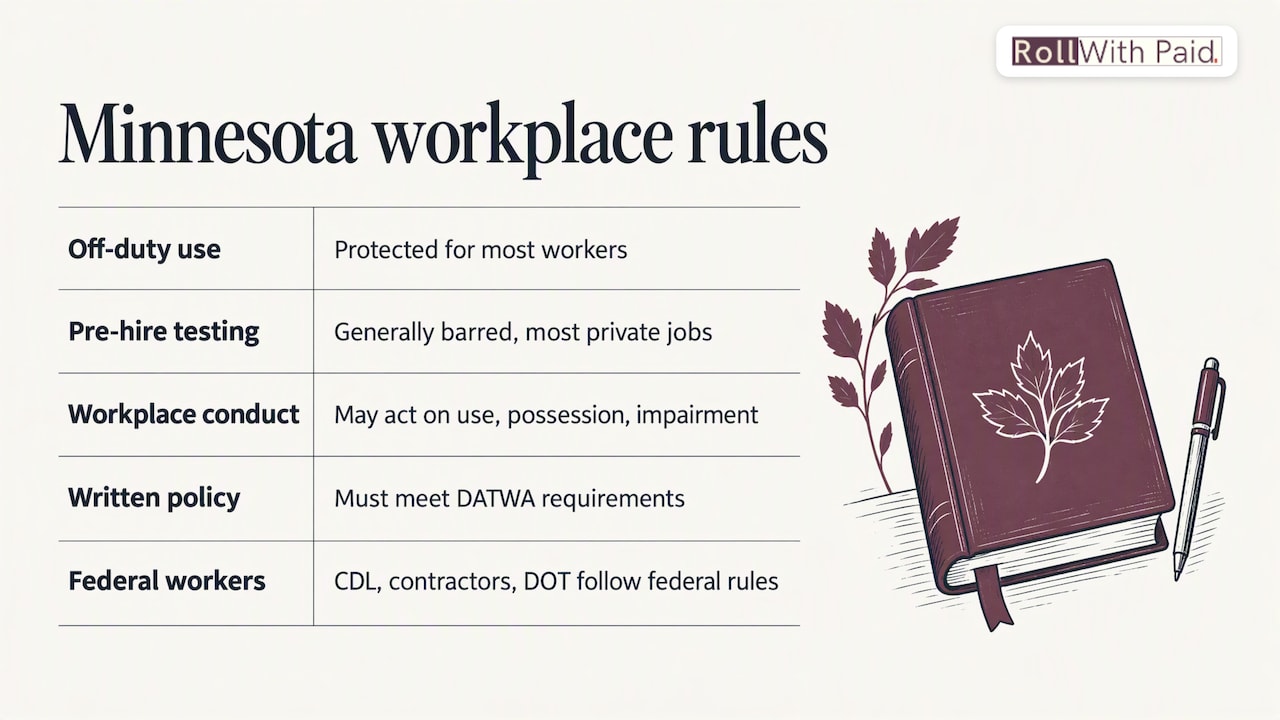
Minnesota’s rules matter because they shift the default. According to one Minnesota cannabis employment summary, the state amended the Consumable Products Act in August 2023 so that most workers are protected from discipline for off-duty, off-premises cannabis use, and pre-employment cannabis testing is generally prohibited for most private-sector jobs. The same summary says employers can still act on use during working hours, possession on premises, and on-the-job impairment. Those prohibitions must sit in a written policy that meets the state’s drug and alcohol testing statute (DATWA) requirements. It also notes that CDL holders, federal contractors and DOT-regulated workers fall under federal rules instead.
That is a secondary summary, not legal advice. Before you change a drug testing policy, have a Minnesota employment attorney review it against the current statute. Rules change, and exceptions for safety-sensitive positions are where most mistakes happen.
Also check the paperwork around new hires. A late filing is its own penalty, and our Minnesota new hire reporting checklist walks through the fines you can avoid.
Why a positive test is not proof of impairment
The most common legal error we see described in HR circles is treating a positive THC result as evidence of current impairment. Tests that detect inactive metabolites tell you about past exposure, not how someone is functioning on the floor. The occupational health guidance cited above recommends moving from relying only on positive tests toward behavior-based impairment training for supervisors.
A workable approach looks like this:
- Train supervisors to document observable signs: slurred speech, unsteady movement, missed steps in a process, unusual drowsiness.
- Use two observers where possible and write notes the same shift.
- Offer a reasonable-suspicion process that includes removing the employee from safety-sensitive tasks and arranging safe transportation home.
- Test only where your policy and state law allow, and apply it consistently.
- Keep records that link each action to documented behavior.
This is also where risk transfer enters. Reviewing employers liability coverage with your insurance advisor helps you understand what a claim arising from an on-the-job incident would and would not cover, and what documentation your carrier will expect.
The ADA still applies, even in the cannabis industry
Owners sometimes assume that a cannabis employer can skip the usual accommodation process. Federal regulators say otherwise. In October 2024, a Colorado marijuana retailer with seven stores agreed to pay $95,000 to settle an EEOC disability and retaliation case. In September 2025, the EEOC sued a Tampa medical marijuana treatment center alleging it failed to provide a reasonable accommodation and then fired an employee with a disability.
The lesson is procedural. When an employee asks for an accommodation tied to a disability, even one treated with medical marijuana, you engage in the interactive process before you consider termination. Write down the request, the options you discussed and the outcome. Skipping that step is a common and costly pitfall, and it applies to you regardless of what you sell.
CBD is not a safe workaround
Employees who want the benefits without the positive test often reach for CBD. It is not a reliable shortcut. At a 2020 federal advisory board meeting, researchers reported no evidence that pure CBD converts to THC in the 18 participants studied. But CBD containing 3.7 milligrams of delta-9-THC produced some positive results. Product labels are inconsistent, so workers who are subject to drug testing are generally advised to avoid CBD products.
For context, the 2018 Farm Bill removed hemp from the Controlled Substances Act’s definition of marijuana, but it did not erase the THC limit or the drug-free workplace rules that sit around it. Your policy should name CBD explicitly, so no one can say they were not told.
Perspective: what we tell cannabis employers
We work with dispensaries, cultivation facilities and multi-state operators, so we hear this question from both directions. Owners ask whether they should loosen policies because they sell the product. Employees ask why their employer, of all employers, enforces rules at all.
Our answer is that a cannabis business has less room for error, not more. You operate under heavy scrutiny from tax authorities, OSHA, the EEOC and state regulators. A policy that reads like a mission statement and is enforced by mood will fail all four.
The studies on absenteeism are interesting, and we would welcome more of them. But a six percent association across millions of survey responses does not tell you how your harvest crew is doing on a Thursday. What protects you is a clear written line between on-duty impairment and off-duty consumption, supervisors trained to document behavior, and an accommodation process you follow every time. Payroll and HR administration should make that easy, not add another quarterly fire drill.
— Leah Kollross
A policy checklist for cannabis employers
Use this as a starting point and have counsel review it.
- Define terms. Separate on-duty impairment, on-premises possession and off-duty consumption.
- Name the roles. List safety-sensitive positions and the federal or DOT rules that apply to them.
- Cover every product. Include THC, CBD, edibles, vapes and employee discounts or product samples.
- Describe testing. State when you test, how, and who decides, in line with Minnesota law if you operate there.
- Build the accommodation path. Assign one person to handle ADA requests and document the interactive process.
- Train supervisors. Teach behavioral indicators, not guesses.
- Sign and store. Collect acknowledgments and keep them with personnel records. For multi-state teams, handbook tooling helps keep versions straight.
- Check I-9s and onboarding. Our I-9 and E-Verify guide for cannabis employers covers the paperwork that audits examine first.
For more operational detail, see our HR compliance tips for dispensaries and cultivations and the cannabis HR calendar for IRS, OSHA and DEA dates.
Where Roll With Paid fits
Policies only work if the back office backs them up. Roll With Paid. provides payroll execution, HR and compliance solutions, onboarding, time and attendance tools and an Employer of Record model built for cannabis and other high-risk industries, where traditional payroll providers often decline to work. Our focus is audit-ready processes and personalized support, so owners spend less time on administration. To see how fees are structured, visit our pricing page, or start from our homepage to review the full list of services.
FAQ
Does cannabis use have any benefits at work?
There is some evidence at the population level. A 2026 study associates medical cannabis decriminalization with fewer health-related absences, especially in physically demanding jobs. That does not show that using cannabis improves any one employee’s performance, and use before or during work is linked to worse task performance.
Are you allowed to use CBD at work?
That depends on your employer’s written policy and the nature of your job. Because some CBD products contain unlabeled THC that can trigger a positive test, workers subject to drug testing are generally advised to avoid them. If your job is safety-sensitive or federally regulated, ask HR before using any CBD product.
Can an employer in Minnesota fire someone for cannabis use?
It depends on when and where the use happens and on the role. One Minnesota summary says most workers are protected for off-duty, off-premises use, while employers can still act on on-duty use, on-premises possession and impairment. Have an employment attorney check your specific policy.
Does a medical marijuana card require an employer to accommodate use?
Not automatically. The ADA still requires an interactive process when an employee requests a reasonable accommodation for a disability, and the EEOC has pursued cannabis employers that skipped it. That process does not oblige you to allow use or impairment on the job.
Sources
- Legal weed may have an unexpected workplace benefit, GreenState
- When should your boss care if you smoke weed? GreenState
- Cannabis Use, Use Disorder, and Workplace Absenteeism in the U.S., 2021-2022
- Altered States or Much to Do About Nothing? Cannabis timing and performance
- Marijuana in the Workplace: Joint Guidance Statement, AAOHN and ACOEM
- OSHA Local Emphasis Program directive
- Can Your Employer Fire You for Using Cannabis in Minnesota?
- EEOC: Nature’s Herbs & Wellness Center to pay $95,000
- EEOC sues Fluent Servicing for disability discrimination
- SAMHSA DTAB September 2020 open session transcript
- SAMHSA memo on hemp products and the 2018 Farm Bill
Recommended
- Marijuana Moment on Payroll Risk: What Cannabis Employers Should Do
- Cannabis HR Calendar 2026: IRS Deadlines, OSHA Scrutiny, DEA Changes
- Your Rights as a Cannabis Worker in Minnesota
- Cannabis Payroll: Avoid 280E Exposure: Roll With Paid vs Greenleaf HR
Roll With Paid. is not a law firm and does not provide legal advice. This article summarizes Minnesota law as of August 2026 and is general information only. Tip arrangements are fact-specific; before changing a policy, consult employment counsel or contact DLI Labor Standards at 651-284-5075.