
Workers’ Comp Rates for Cannabis Businesses: 2026 Guide
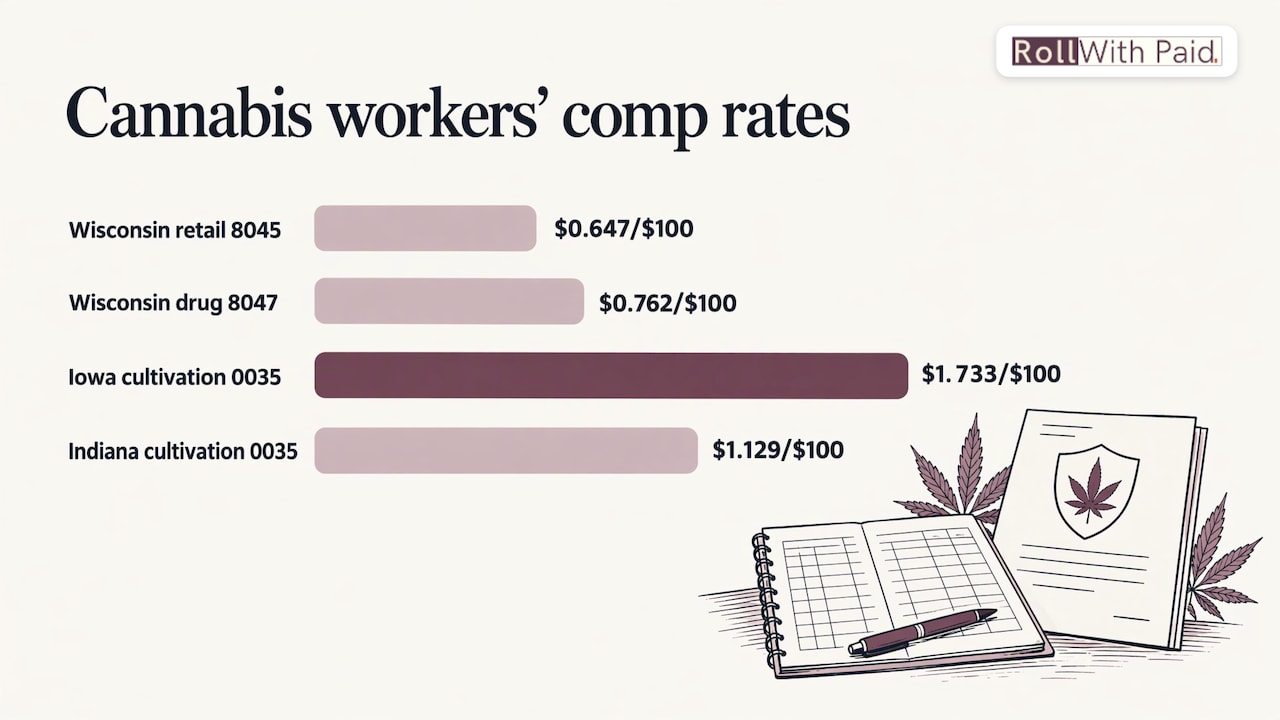
Cannabis workers’ compensation rates depend on the state and the class code, not on the plant. Wisconsin’s filed rate for cannabis dispensaries (class 8045) is $0.647 per $100 of payroll effective October 1, 2026. NCCI’s filings for cultivation (class 0035) in Iowa and Indiana proposed $1.733 and $1.129 per $100 for 2026.
Your premium is that rate multiplied by your payroll, then adjusted by your claims history. We built our Employer of Record model at Roll With Paid. for operators who need that math to hold up at audit.
TL;DR
- Workers’ comp rates are set per $100 of payroll for each class code. Dispensary, cultivation, manufacturing and testing roles carry different rates.
- Wisconsin’s 2026 dispensary rate is $0.647 per $100. Proposed 2026 cultivation rates are $1.729 lower in Indiana ($1.129) than… see the table below for the exact figures by state.
- The premium you are quoted is an estimate. The carrier trues it up at audit against actual payroll by class code.
- Misclassified or poorly split payroll is the most common reason a cannabis premium changes after the policy year ends.
- Our Employer of Record model is built to keep payroll, classification and workers’ comp aligned and audit-ready.
Table of Contents
- What are typical workers’ comp rates for cannabis businesses?
- How do insurers classify dispensary, cultivation and manufacturing jobs?
- How is a cannabis workers’ comp premium calculated?
- Who pays the premium, and what happens at audit?
- What rate changes have affected cannabis workers’ comp recently?
- What are the most common workers’ comp problems for cannabis employers?
- How do the main cannabis operation types compare on workers’ comp?
- How can cannabis employers keep workers’ comp costs under control?
- How does Roll With Paid. handle workers’ comp for cannabis businesses?
- FAQ
- Sources
What are typical workers’ comp rates for cannabis businesses?
Cannabis workers’ comp rates range from under $1 to more than $1.70 per $100 of payroll in the filings we reviewed, depending on state and class. The rate is a price per $100 of covered payroll. A rate of $1.00 on $500,000 of payroll produces $5,000 of base premium.
The published figures below come from rate bureaus and state filings. Rates are re-filed on a schedule, usually annually, so read each figure as the filing for its period.
| State | Class | Operation | Rate per $100 payroll | Period |
|---|---|---|---|---|
| Wisconsin | 8045 | Retail store, cannabis/dispensary | $0.647 | Effective October 1, 2026 |
| Wisconsin | 8047 | Drug store | $0.762 | Effective October 1, 2026 |
| Iowa | 0035 | Cultivation | $1.733 (minimum premium $351) | Proposed effective January 1, 2026 |
| Indiana | 0035 | Cultivation | $1.129 (minimum premium $516) | Proposed effective January 1, 2026 |
Three things move these numbers. Regulators approve overall rate-level changes: Wisconsin’s was a 1.97% decrease, the 11th consecutive annual decrease. Iowa’s filing proposed an average change of -2.5%. Indiana’s proposed -5.8% to the overall voluntary and assigned risk rate level. Your class code sets the starting point. Your own loss history sets the rest.
The filed rate is a benchmark for the class, not your quote. Compare your own policy and audit statement against your state’s current filing.
How do insurers classify dispensary, cultivation and manufacturing jobs?
Insurers classify cannabis work by what the employee physically does. Cultivation, processing, retail, testing and distribution each map to a different class code.
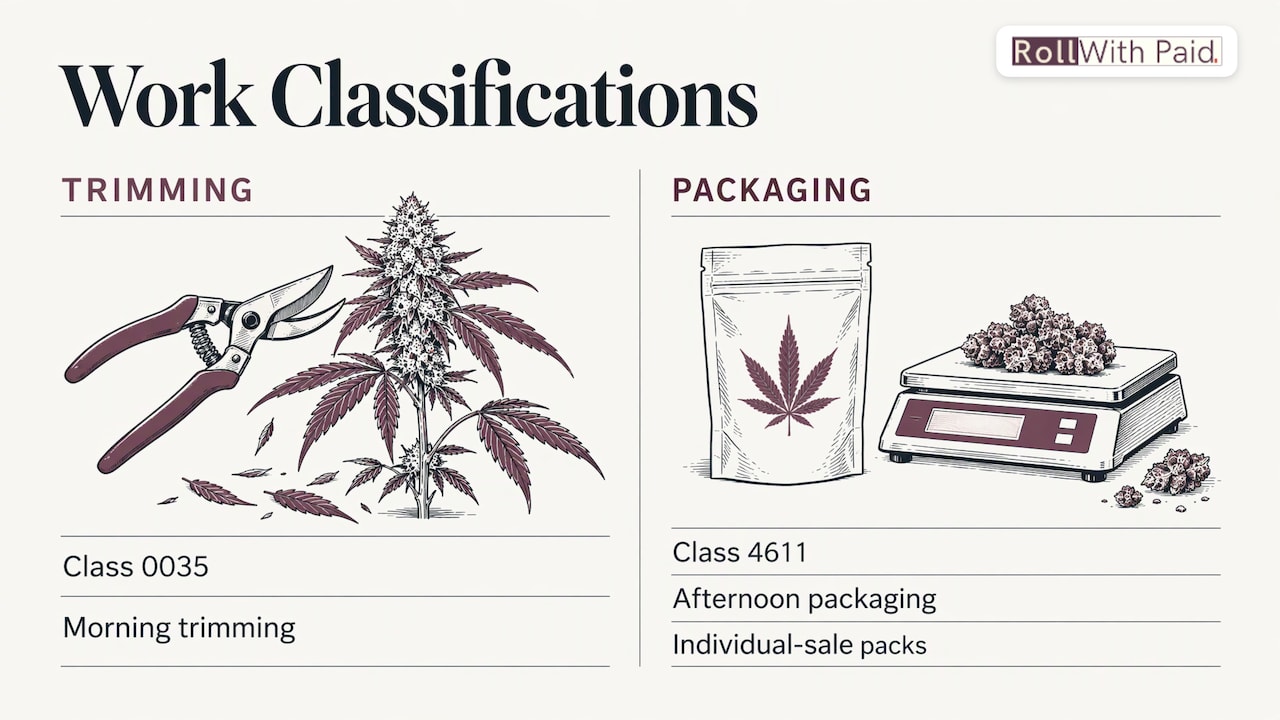
California’s rating bureau, the WCIRB, publishes the clearest map. Under its guidance, cultivation is assigned to Classification 0035, trimming without packaging stays in 0035, and trimming plus packaging for individual sale moves to 4611. The same WCIRB page assigns:
- Pre-rolls, extracts, concentrates, CBD products and oil extraction to 4611
- Non-baked edibles to 6504
- Baked goods sold primarily to retail to 2003, and primarily to wholesale to 2004
- Infused beverages to 2163
- Testing labs to 4511
- Retail dispensaries and cannabis delivery sales companies to 8017(1)
- Wholesale distribution of purchased, prepackaged products to 8018
These are California assignments. Other states use NCCI or independent bureau manuals, and the code numbers and wording differ, as the Wisconsin 8045 dispensary class shows. For a closer look at how code choices play out in the field, see our guide to getting workers’ comp classification codes right. Investors tracking how these class-code assignments touch listed cannabis operators can follow cannabis class code assignments alongside company filings.
Why does the split between cultivation and packaging matter?
A grow that also packages for individual sale can cross from 0035 into 4611 under the WCIRB’s guidance. Those are different classes with different rates. A single employee who trims in the morning and packages in the afternoon is the classic overlap, and the payroll has to show where the hours went.
How is a cannabis workers’ comp premium calculated?
A premium equals payroll divided by 100, times the class rate, adjusted by an experience modification. The experience mod is a multiplier that compares your losses to those of similar businesses.
Worked example, using the Wisconsin dispensary rate of $0.647:
- Annual payroll in class 8045: $500,000.
- Payroll per $100: 5,000 units.
- Base premium: 5,000 x $0.647 = $3,235.
- Experience mod of 1.00 leaves the premium at $3,235. A mod of 0.90 lowers it to about $2,912. A mod of 1.20 raises it to $3,882.
For a cultivation operation with the same payroll at Iowa’s proposed 0035 rate, the base premium is 5,000 x $1.733 = $8,665. At Indiana’s proposed rate it is 5,000 x $1.129 = $5,645. Same payroll, same plant, a very different bill.
Who qualifies for an experience mod?
Only employers whose premium passes a state threshold are experience rated. In California, the WCIRB looks at three years of payroll and losses for qualifying employers. The California Department of Insurance’s March 20, 2026 notice proposed raising the eligibility threshold from $10,800 to $11,700 of annual premium, proposed effective September 1, 2026. Small cannabis employers below the threshold pay standard rates until their premium grows.
Who pays the premium, and what happens at audit?
The employer pays the workers’ comp premium, and the carrier reconciles it at audit. The premium you pay at policy start is an estimate based on projected payroll.
The Michigan Workers’ Compensation Placement Facility manual states that final earned premium is determined on actual payroll, not estimated payroll, and that the carrier may examine original payroll records. Other states’ manuals follow the same principle.
For a cannabis employer, the audit is where three problems surface:
- Payroll not kept by class code. If trimmers, packagers and budtenders sit in one bucket, the auditor assigns the higher-rated code.
- Split roles without documentation. Overlapping duties need time records that support the split.
- Uninsured subcontractors. Their payroll can be charged back to your policy.
Our 5 payroll mistakes cannabis businesses cannot afford covers the payroll side of these errors.
What rate changes have affected cannabis workers’ comp recently?
Rates have been trending down in the filings above, but class-level changes still vary. Wisconsin’s October 1, 2026 filing is a 1.97% overall decrease. Iowa’s January 1, 2026 proposal is -2.5%. Indiana’s is -5.8% on the overall rate level.
Indiana’s filing also proposes carrying rates to three decimal places for every class code. The filing expects the change to be premium-neutral overall. The practical effect is that class-level movements can be more precise year to year, which makes it more important that your payroll sits in the right class.
A falling state average does not guarantee a falling premium. Your payroll mix, your mod and your audit result decide what you pay.
What are the most common workers’ comp problems for cannabis employers?
The problems below are the recurring patterns in cannabis payroll and workers’ comp. They are illustrative scenarios, not client records.
Use case 1: the single-location dispensary. A dispensary with budtenders, a manager and a delivery driver needs the retail class for in-store staff and may need different treatment for drivers. The rate difference between roles is the reason payroll must be tracked by job, not by location. See cannabis dispensary payroll and cannabis delivery payroll.
Use case 2: the vertically integrated operator. A company that grows, processes and sells touches several classes at once. Each entity’s payroll must be reported against the correct code, and shared employees need documented time splits.
Use case 3: the multi-state operator. Each state sets its own rate, class wording and filing schedule, so one policy structure does not carry across borders. Our guide to audit-ready multi-state cannabis payroll walks through the payroll setup.
How do the main cannabis operation types compare on workers’ comp?
Operation type changes the class, the exposure and the audit questions. This comparison uses the WCIRB assignments and the filed rates above.
| Operation | Typical class (California) | What the auditor looks for |
|---|---|---|
| Cultivation | 0035 | Trimming vs. packaging hours |
| Extraction and pre-rolls | 4611 | Separation from retail payroll |
| Edibles and beverages | 6504, 2003, 2004, 2163 | Retail vs. wholesale sales mix |
| Testing lab | 4511 | Lab vs. office duties |
| Dispensary | 8017(1) | Delivery and in-store roles |
| Distribution | 8018 | Prepackaged vs. processed product |
How can cannabis employers keep workers’ comp costs under control?
Cost control starts with correct classification and clean payroll records. Both are payroll tasks before they are insurance tasks.
- Keep payroll by class code and by pay period.
- Document split roles with time records.
- Collect proof of coverage from every subcontractor.
- Report only the base portion of overtime where your state rates it that way, and confirm this in your state’s manual.
- Review each quote and audit against your state’s live rate filing.
We designed our Employer of Record model to reduce workers’ compensation costs and legal liability while keeping clients audit-ready. For the wider framework, see our Chief Human Resources Officer guide and human capital management pillar. For regular updates, subscribe to the Roll With Paid. newsletter.
Our perspective on cannabis workers’ comp
Most cannabis employers do not have a rate problem. They have a records problem. The rate bureau publishes the price per $100, and the audit measures whether your payroll proves which class each employee belongs in.
We specialize in high-risk and cannabis industries, including businesses that traditional payroll providers turn away. Our Employer of Record model brings payroll execution, HR compliance and workers’ compensation under one roof. Our clients’ focus is zero late filings and audit-ready records, so the number on the premium notice matches the work actually done.
When payroll, classification and coverage are handled together, a role change or a new hire does not become a surprise at audit. That is the standard we hold ourselves to.
Leah Kollross
How does Roll With Paid. handle workers’ comp for cannabis businesses?
We provide Employer of Record services, payroll execution, HR and compliance solutions, multi-state hiring support and time and attendance tools for cannabis and other high-risk businesses. Our fees are monthly and based on gross payroll, with an optional flat-rate HR retainer. Rates vary by worker classification code and headcount. Details are on our pricing page.
To see everything we offer, visit our services page. To see how we compare on workers’ comp exposure, read Avoid Workers’ Comp Hits.
FAQ
What is the average workers’ comp rate for a cannabis dispensary?
It depends on the state. Wisconsin’s filed class 8045 dispensary rate is $0.647 per $100 of payroll effective October 1, 2026. California assigns dispensaries to class 8017(1). Your state’s rate bureau publishes the current rate for your class.
Does cultivation cost more to insure than retail?
In the filings reviewed here, yes. Iowa’s proposed 2026 class 0035 rate is $1.733 per $100, and Indiana’s is $1.129. Wisconsin’s dispensary rate is $0.647. Different states and periods are compared, so check your own state’s filing.
Can the premium change after I buy the policy?
Yes. The premium starts as an estimate and is finalized at audit on actual payroll. Keeping payroll by class code and documenting split roles are the best ways to keep the audit result close to the estimate.
Do small cannabis employers get an experience mod?
Only above a state threshold. California’s threshold was $10,800 of annual premium, with a proposed increase to $11,700 in a March 2026 notice. Below it, you pay standard rates.
Sources
- Wisconsin Workers’ Compensation Rates by Class Code (2026)
- Classifications Applicable to Cannabis Industry Operations, WCIRB
- Iowa Insurance Division, NCCI advisory rates filing
- Indiana NCCI rate filing, effective January 1, 2026
- California Department of Insurance, rating rules public notice, March 20, 2026
- Michigan Workers’ Compensation Placement Facility manual
Recommended
- Workers’ Comp Classification Codes: Getting Them Right
- Avoid Workers’ Comp Hits: Roll With Paid vs. KayaPush for Cannabis
- Cannabis HR Calendar 2026: IRS Deadlines, OSHA Scrutiny, DEA Changes
- 6 Questions to Spot Top Workers’ Comp Insurers for Small Businesses
Roll With Paid. is not a law firm and does not provide legal advice. This article summarizes Minnesota law along with other states and jurisdictions law and is for general information only. Before changing a policy, consult employment counsel or contact DLI Labor Standards at 651-284-5075.