
Minnesota Supplemental Withholding: 2026 Bonus Tax Rate
If you pay a bonus separately from regular wages in Minnesota, withhold state income tax at a flat 6.25%. Minnesota Revenue’s 2026 withholding instructions say to multiply the supplemental payment by 0.0625, regardless of the employee’s allowances. When the bonus rides along on a regular paycheck, you have a choice of method, and the choice depends on how you list the payment in your payroll records.
This guide covers which payments count as supplemental wages, how to calculate the withholding both ways, how Minnesota differs from federal bonus withholding, and the mistakes that tend to show up in audits. It is written for employers and operators, including cannabis dispensaries and cultivations, where seasonal bonuses, retention pay and overtime make supplemental pay routine.
TL;DR
- Minnesota’s supplemental withholding rate is 6.25% for payments made separately from regular wages, with no adjustment for allowances.
- If a bonus is paid with regular wages and listed separately, you may use Method 1 (combine and use the tables) or Method 2 (tables for regular wages, 6.25% on the bonus). If it is not listed separately, Method 1 is required.
- Federal withholding is a separate calculation: the IRS flat rate is 22%, rising to 37% on supplemental wages above $1 million in a calendar year.
- The “40% bonus tax” is a myth. Withholding is a prepayment, and the employee’s real tax is settled on their return.
Table of Contents
- What counts as supplemental wages in Minnesota
- The Minnesota rate: 6.25%
- Paid with regular wages: Method 1 or Method 2
- Minnesota versus federal bonus withholding
- Are bonuses taxed at 40%?
- Your responsibilities as a Minnesota employer
- A bonus payroll checklist
- Our perspective: bonuses are where good payroll teams slip
- How Roll With Paid handles supplemental pay
- FAQ
- Sources
What counts as supplemental wages in Minnesota
Supplemental wages are payments made to an employee in addition to regular wages. Minnesota Revenue’s supplemental payments page lists examples: vacation pay and accumulated sick leave, overtime, back pay, severance, bonuses, commissions, awards, prizes and nondeductible moving expenses.
The state rule is consistent with that list. Minnesota Rule 8092.0700 defines supplemental wages to include bonuses, commissions and overtime, whether they are paid for the same period as regular wages, for a different period, or without regard to any particular period.
Two practical points follow from that:
- Overtime is on the list. Many employers treat overtime as ordinary pay because it appears on the same check. If it is paid in the same payroll as regular wages, it is aggregated with them (more on that below). If you cut it as a separate payment, it is a supplemental payment.
- Wages are not only cash. Minnesota Revenue’s definition of wages covers money and nonmoney compensation, including goods, lodging, food, clothing or services, to the extent withholding rules reach them. A gift card or employee perk can create a withholding obligation.
Payments that are reimbursements for actual business costs are a different category. Mileage reimbursements, for example, can turn into taxable wages when handled incorrectly, which we cover in our guide to Minnesota mileage reimbursement and 2026 rates.
The Minnesota rate: 6.25%
The rate in the 2026 instructions is 6.25% (0.0625) for supplemental payments made separately from regular wages. The same rate has appeared in prior years’ guidance, for example in EY’s summary of the 2020 tables, so it is not a number that changes with each tax year’s table release. Still, confirm it against the current instructions each January when the new tables are published.
A quick example. You pay a dispensary shift lead a $1,200 retention bonus in a standalone payment:
| Step | Calculation | Result |
|---|---|---|
| Minnesota withholding | $1,200 × 0.0625 | $75.00 |
| Federal income tax withholding (flat method) | $1,200 × 22% | $264.00 |
The employee’s filing status, W-4MN allowances and regular pay level do not change the $75.00. That simplicity is the main reason many employers prefer to issue bonuses on a separate check or a separate payroll run.
Paid with regular wages: Method 1 or Method 2
Things get more interesting when the bonus is paid on the same payday as regular wages. The 2026 instructions distinguish two cases.
When the bonus is listed separately
If your payroll records identify the supplemental payment separately from the regular wages, you may choose either:
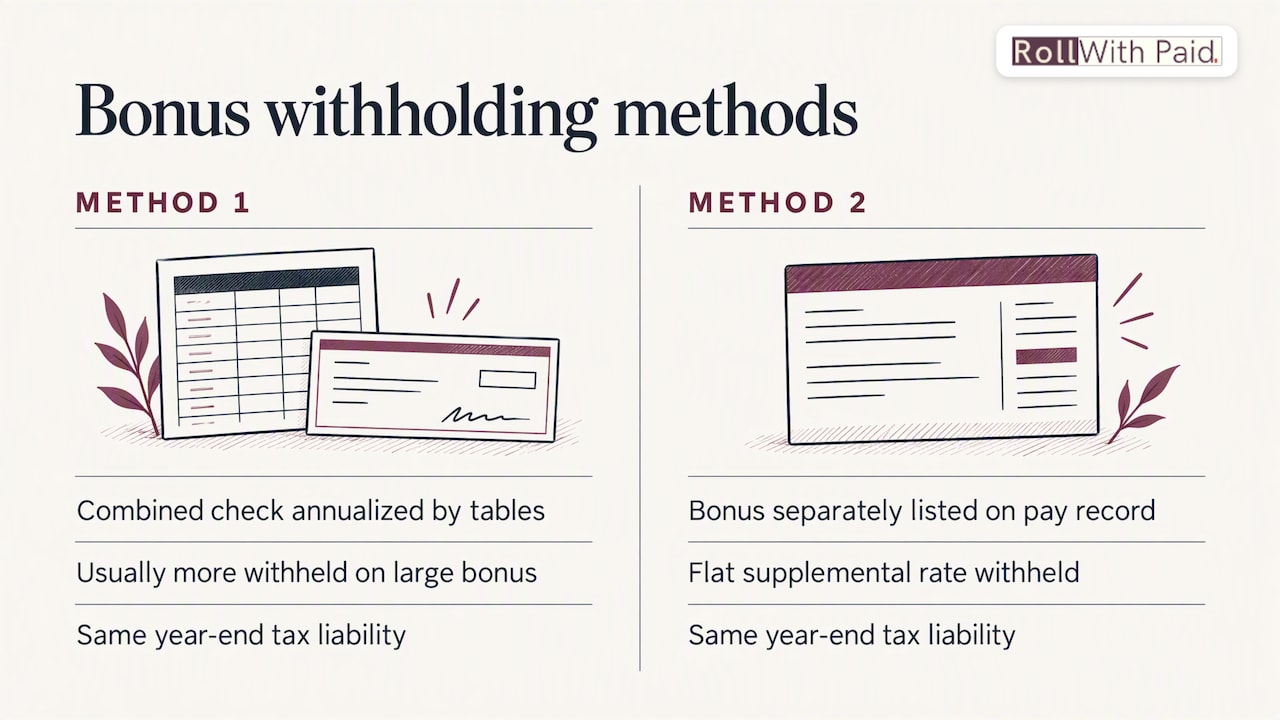
- Method 1: combine the regular and supplemental payments and withhold using the Minnesota tables for the combined amount.
- Method 2: calculate withholding on the regular wages using the tables, then withhold 6.25% of the supplemental amount.
Minnesota Revenue confirms on its supplemental payments page that either method is allowed when the two are paid together and listed separately in the payroll records.
When the bonus is not listed separately
If the payments are not separately listed, Method 1 is required. This is the rule behind Rule 8092.0700: supplemental wages paid at the same time as regular wages are aggregated with the wages for that payroll period, and withholding is figured as though the total were a single payment.
Which method gives which result?
Method 1 usually withholds more on a large bonus, because the combined paycheck is annualized by the tables and pushed into a higher bracket for that period. Method 2 holds the bonus at 6.25%. Neither one changes what the employee owes at year end. They only change how much is prepaid with each check.
To see the difference, set up a worked comparison in your payroll system before you run a large bonus batch. Run the same employee through both methods and compare. If your system lets you flag a payment as “supplemental,” make sure that flag is what produces the separate listing on the pay record, since that listing is what keeps Method 2 available.
Minnesota versus federal bonus withholding
Minnesota follows federal guidelines on what counts as a supplemental payment and points employers to IRS Publication 15-A for federal withholding guidance. The rates, however, are entirely separate. The IRS states in Publication 15 (2026) that the withholding rate on supplemental wages remains 22%, and 37% once supplemental wages paid to an employee during the calendar year exceed $1 million.
| Minnesota | Federal | |
|---|---|---|
| Flat rate on separate supplemental payment | 6.25% | 22% |
| Higher rate for very large supplemental pay | Not applicable | 37% above $1 million in the calendar year |
| Allowances matter for flat-rate payments? | No | No |
| Alternative when paid with regular wages | Method 1 or Method 2 | Aggregate or identified-separately methods |
A practical consequence: on that $1,200 bonus, total income tax withheld under the flat methods is $339.00 ($75.00 state plus $264.00 federal), before payroll taxes such as Social Security and Medicare. That is the number that makes employees feel their bonus was taxed at a punishing rate. It leads to the next question.
Are bonuses taxed at 40%?
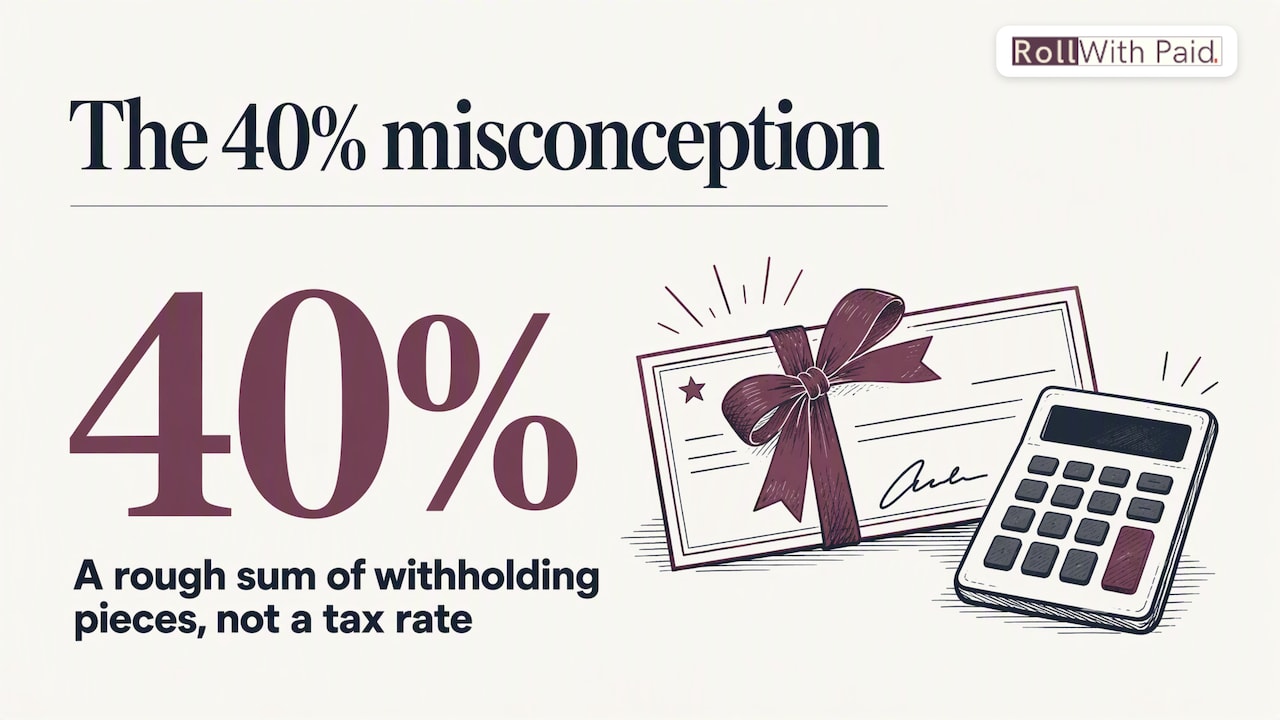
No. The 40% figure is a rough sum of withholding pieces, not a tax rate. It comes from adding the 22% federal flat rate, state withholding, and payroll taxes, and then treating the total as a rate on the bonus.
For income tax purposes, a bonus is ordinary wage income. As Prudential’s 2026 explainer puts it, how a bonus is taxed and how tax is withheld from it are two different ideas. The employee’s actual liability is figured on their return at their normal marginal rates. If the flat withholding was higher than their real rate, they get the difference back as a refund or lower balance due. If it was lower (common for higher earners), they may owe more at filing.
It is worth giving employees that explanation when you announce a bonus. A short line on the notice (“federal and Minnesota income tax will be withheld at flat supplemental rates, which may differ from your final tax”) prevents a flood of pay-stub questions. Our walkthrough of every deduction on a pay stub is a good thing to hand to staff who want to see where each dollar went.
Your responsibilities as a Minnesota employer
Supplemental wages are not a special regime with lighter duties. The same withholding framework applies. According to the 2026 instructions, you must:
- Determine Minnesota withholding when wages are paid, using the correct method for the type of payment.
- Use Form W-4MN information and the Minnesota tables or formula where they apply.
- Withhold the tax and remit it to Minnesota Revenue.
- Report wages and withholding through the required payroll filings.
Minnesota Revenue generally requires withholding when federal withholding is required, subject to exceptions such as reciprocity and allocation rules. The statutory authority is Minnesota Statutes section 290.92, which incorporates federal wage concepts for withholding.
Nonresidents and former residents
Residency can change the answer. Minnesota Revenue’s guidance on nonresidents working in Minnesota says wages are subject to Minnesota withholding if the employee earned them while a Minnesota resident but received them while a nonresident. That matters for severance, deferred bonuses and commissions paid after an employee moves. For employees who live in a reciprocity state, check the exemption rules before you stop or start withholding.
Voluntary withholding
When Minnesota withholding is not otherwise required, an individual may ask you to withhold. Per Minnesota Revenue’s voluntary withholding page, you may agree, and you may use the 6.25% supplemental rate or an amount specified on Form W-4 or W-4MN. It is optional for you, so decide on a consistent policy rather than agreeing case by case.
A bonus payroll checklist
Before you release a bonus run, work through these:
- Classify the payment. Is it a bonus, commission, overtime, back pay, severance or a noncash award? All of them are supplemental, but noncash awards need a value attached.
- Decide on timing. Separate payment means a flat 6.25%. Same-day payment means choosing Method 1 or 2, and only if the bonus is listed separately.
- Check the pay record. The bonus must appear as its own line to keep Method 2 available.
- Verify residency. Confirm the employee’s state of residence and work location, especially for remote or multi-state staff.
- Run federal and state together. Flat rates differ, and the $1 million federal threshold is tracked per employee across the calendar year.
- Reconcile deposits. Make sure the extra withholding is included in your next Minnesota deposit and in your quarterly and year-end reports.
- Document it. Keep the bonus approval, calculation method and date in the employee file.
Bonuses also interact with other Minnesota payroll obligations. If you hire new staff to cover seasonal demand, review the Minnesota new hire reporting checklist. If you are building out leave programs, our overview of Minnesota paid leave employer obligations covers a related set of payroll mechanics.
Our perspective: bonuses are where good payroll teams slip
We work with employers in cannabis and other high-risk industries, where the staff are often paid with a mix of hourly wages, overtime, shift incentives and holiday bonuses. In our experience, supplemental withholding errors rarely come from not knowing the rate. They come from process: a manager approves a spot bonus, someone keys it into the system as an adjustment to regular pay, and the separate listing that allows Method 2 never gets created. Nobody notices until an employee asks why their check was smaller than expected, or until a notice arrives.
The second pattern is inconsistency. One pay cycle uses Method 1, the next uses Method 2, and nobody can explain why. Minnesota permits either when the conditions are met, but an auditor will want to see a documented, repeatable practice. We recommend choosing a default method, writing it into your payroll procedures, and applying it uniformly.
For operators in cannabis, where banking, taxation and licensing already demand audit-ready records, bonus withholding is one more place where clean documentation pays off. Our approach is to make sure each supplemental payment is classified, calculated and recorded the same way every time, so that a filing is a review of work already done rather than a quarterly fire drill.
— Leah Kollross
How Roll With Paid handles supplemental pay
We run payroll and HR compliance for businesses that traditional providers often turn away, including dispensaries, cultivations and multi-state cannabis operators. Supplemental wage handling is part of payroll execution: classification, withholding method, filings and records. If you operate in more than one state, our guide to audit-ready multi-state cannabis payroll shows how we approach the differences between jurisdictions.

Our Employer of Record, payroll and HR services are priced as a monthly service fee based on gross payroll, with an optional flat-rate HR retainer. Rates vary by worker classification code and headcount, so see our pricing page for how it works, or explore our payroll and HR services to see what is included.
FAQ
What is the Minnesota supplemental tax rate?
It is 6.25% for supplemental payments made separately from regular wages, per Minnesota Revenue’s 2026 withholding instructions. You multiply the payment by 0.0625, and allowances do not change the result. Check the current instructions each January in case the guidance changes.
What is the bonus tax rate in Minnesota if I pay it with a regular paycheck?
If the bonus is listed separately on the pay record, you can use Method 1 (combine and use the tables) or Method 2 (tables for regular wages, 6.25% on the bonus). If it is not listed separately, you must use Method 1. The result under Method 1 is usually higher withholding on a big bonus.
Do employees have to pay federal tax on bonuses at a different rate?
Federal withholding on a separate supplemental payment is a flat 22%, or 37% on supplemental wages above $1 million in a calendar year, according to IRS Publication 15. That is withholding, not the final tax. The employee’s actual federal liability is settled on their return.
Does Minnesota withhold on overtime and commissions the same way?
Yes, Minnesota Revenue lists overtime and commissions as supplemental payments alongside bonuses, back pay and severance. Overtime paid in the same payroll as regular wages is aggregated with those wages. Overtime or commissions paid as a separate payment are subject to the 6.25% rate.
Can I withhold Minnesota tax for an employee who is not required to have it withheld?
Yes, if the employee asks and you agree. Minnesota Revenue allows you to use the 6.25% supplemental rate or the amount specified on the employee’s Form W-4 or W-4MN. It is voluntary on your side, so set a consistent policy.
Sources
- 2026 Minnesota Withholding Tax Instructions and Tables
- Supplemental Payments, Minnesota Department of Revenue
- Minnesota Rule 8092.0700
- Definition of Wages, Minnesota Department of Revenue
- Nonresidents Working in Minnesota
- Voluntary Withholding, Minnesota Department of Revenue
- Minnesota Statutes section 290.92
- IRS Publication 15 (2026), Employer’s Tax Guide
- EY Tax News: Minnesota Form W-4MN and 2020 withholding tables
- Prudential: How bonuses are taxed, 2026 withholding rules
Recommended
- Avoid Taxable Wage Errors: Minnesota Mileage Reimbursement and 2026 Rates
- $16.37 Minneapolis Minimum Wage 2026: Payroll Steps Employers Must Take
- Understanding Your Pay Stub: Every Deduction Explained
- Minnesota Paid Leave: Employer Obligations After Launch
Roll With Paid. is not a law firm and does not provide legal advice. This article summarizes Minnesota law as of August 2026 and is general information only. Tip arrangements are fact-specific; before changing a policy, consult employment counsel or contact DLI Labor Standards at 651-284-5075.