
Roll With Paid vs. Minnesota Cannabis Services: Which Fits?

Roll With Paid is an outsourced payroll, HR and Employer of Record (EOR) provider built for cannabis and other high-risk businesses. Minnesota Cannabis Services (MCS) documents a different model in its own hiring: an in-house HR department that runs payroll coordination, compliance training and employee files. If you operate one or two Minnesota locations and do not want to build that department, Roll With Paid is the better fit.
TL;DR
- Roll With Paid supplies payroll execution, HR and compliance support, onboarding, time and attendance tools and an Employer of Record model for cannabis operators.
- MCS’s 2025 job postings describe HR as an internal function: systems, training, investigations, benefits and payroll coordination.
- An in-house team means you hire, train and supervise the people who carry that work. An EOR model moves much of that administration to the provider.
- Minnesota’s Office of Cannabis Management (OCM) sets payroll record rules for grantees, so time records and paystubs matter in either model.
- Roll With Paid prices by gross payroll, worker classification code and headcount. Pricing is not published, so ask for a quote.
Table of Contents
- What is the difference between Roll With Paid and Minnesota Cannabis Services?
- What does Roll With Paid provide to cannabis employers?
- How do the two models compare side by side?
- Which model fits a dispensary, a cultivator or a multi-state operator?
- What does Minnesota require for payroll records?
- Who counts as a true party of interest under Minnesota law?
- What costs should you verify before signing with an HR provider?
- What is the difference between an EOR and a PEO for cannabis?
- What common problems do cannabis employers face with payroll and HR?
- Which tools pair best with an outsourced payroll and HR provider?
- Where do these models apply beyond cannabis?
- Our perspective: why outsourcing wins for most operators
- Ready to compare a quote?
- FAQ
- Sources
What is the difference between Roll With Paid and Minnesota Cannabis Services?
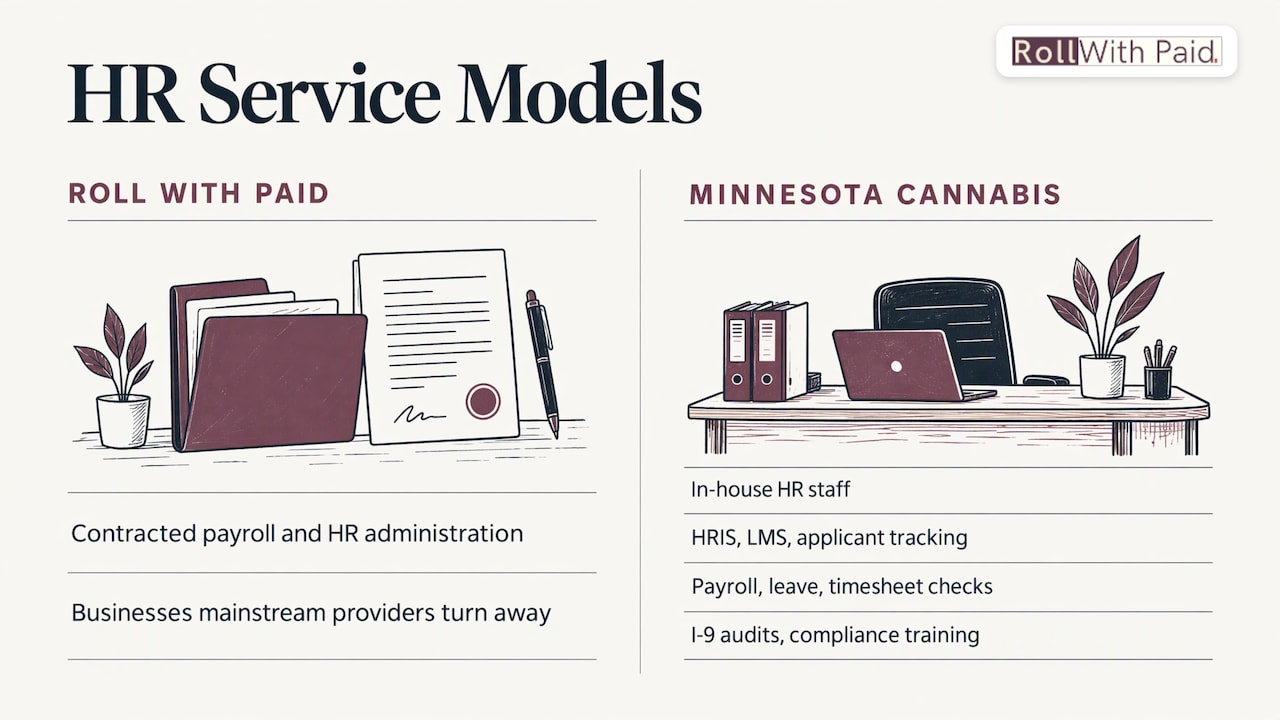
Roll With Paid sells a service: payroll and HR administration for businesses that mainstream providers often turn away. Minnesota Cannabis Services, based on its 2025 postings, shows HR run inside the company by hired staff. The two are not the same kind of option. One is a vendor you contract with. The other is a staffing model you build.
MCS’s Human Resources Manager posting lists HRIS, learning-management and applicant-tracking systems, payroll verification, time-off and sick-leave accuracy checks, timesheet and schedule oversight, I-9 audits and compliance training tracking. Its Director of Human Resources posting adds employee files, background checks, investigations, disciplinary processes, benefits administration and coordination with payroll and finance.
That is a full HR department. It treats HR as an operating function, not just a payroll run. For a multi-state operator with the scale to staff it, that can work. For a single dispensary or a cultivation facility with a lean office, each of those tasks becomes a salary, a software license and a training burden.
What does Roll With Paid provide to cannabis employers?
Roll With Paid provides payroll execution, HR and compliance solutions, employee onboarding, multi-state hiring support and time and attendance tools. It also provides Employer of Record services, I-9 support, regulatory filings, benefits administration, workers’ compensation and policy documentation. The service is built for dispensaries, cultivators and other high-risk businesses.
The EOR model is the core difference. Under an EOR arrangement, the provider takes on employer administration, including payroll filings and workers’ compensation placement, so your team is not assembling that work from separate vendors. Our approach is designed to keep clients audit-ready, and our clients have recorded zero late filings. For a deeper look at the model, see our guide to Employer of Record for high-risk industries.
Onboarding is part of the service. We build seamless employee onboarding around the paperwork cannabis employers get audited on, including I-9s, and we support hiring across multiple states.
How do the two models compare side by side?
The table compares Roll With Paid’s outsourced model with the in-house HR function that MCS’s 2025 postings document. It covers what each approach puts on your plate.
| Need | Roll With Paid (outsourced EOR) | In-house HR function (as documented by MCS postings) |
|---|---|---|
| Payroll processing | Payroll execution handled by the provider | Payroll verified and coordinated by HR with finance |
| I-9 handling | I-9 support included | I-9 audits run by HR staff |
| Time and attendance | Time and attendance tools offered | Timesheet and schedule oversight by HR |
| Benefits | Benefits administration offered | Benefits administration by HR leadership |
| Workers’ compensation | Part of the EOR model | Managed within the company |
| Multi-state hiring | Multi-state hiring support offered | HR monitors rules in each operating state |
| Systems | Provider’s tools | HRIS, learning and applicant-tracking systems administered in-house |
| Startup effort | Onboarding by the provider | Hire, train and equip a team |
The in-house column is not wrong. It is expensive to build and slow to stand up. The outsourced column replaces that build with a monthly service agreement.
Which model fits a dispensary, a cultivator or a multi-state operator?
Dispensaries and cultivators with one or two sites usually fit the outsourced model, while large multi-state operators with a dedicated HR leadership budget may keep more in-house. Fit depends on headcount, number of states and how much compliance work already sits with one person.
Single-location dispensaries
A dispensary owner often handles scheduling, inventory compliance and payroll in the same week. Retail staff are mostly hourly, so overtime accuracy drives risk. Our dispensary overtime rules guide explains what cannabis employers must pay. Accurate time records also matter for overtime exposure: a FLSA overtime guide for HR teams covers the financial risk of weak records.
An outsourced provider fits this operator because the owner gets payroll execution and compliance without hiring an HR manager.
Cultivation facilities
Cultivators carry mixed job types: trimmers, grow technicians, drivers and managers. Each class can carry a different workers’ compensation code, and rates vary by classification code. Misclassification is the quiet risk. Our cannabis cultivator payroll guide covers rules, taxes and provider models for this group.
An EOR model fits because it centralizes classification and workers’ compensation with a provider that works in this industry.
Multi-state operators
MCS’s posting lists Washington, Oregon, Minnesota, Puerto Rico, Florida and Iowa among the regions its HR monitors. That scope shows why multi-state employers need systematic coverage: each state has its own employment and cannabis rules.
Roll With Paid offers multi-state payroll and multi-state hiring support, so an operator can add a state without building a new HR desk there. Operators large enough to staff a director-level HR team can still use an outsourced provider for payroll execution and filings.
Delivery and ancillary operations
Delivery drivers add mileage, shift and insurance questions. Our cannabis delivery payroll guide covers rules, risks and setup.
What does Minnesota require for payroll records?
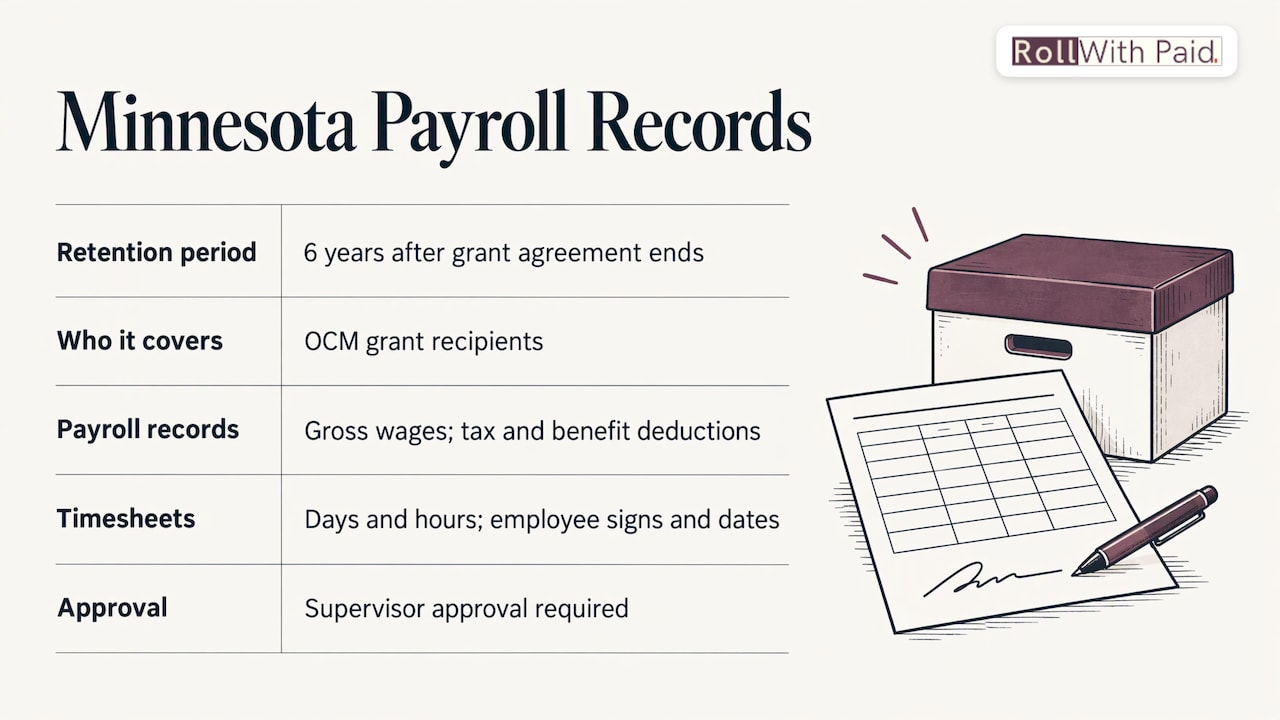
Minnesota’s OCM requires grantees to keep payroll books and records and make them available to the state for six years after the end of the grant agreement, according to the OCM Grantee Manual (August 4, 2025). The manual applies to grant recipients, so check whether your business holds an OCM grant before treating it as a rule for your site.
The same manual says documentation such as timesheets, paystubs and payroll reports must show gross wages and tax and benefit deductions. Timesheets must show days and hours, be signed and dated by the employee and be approved by a supervisor.
Those rules point to one operating habit: build clean time records from the first shift. Our time and attendance tools are built to support it, and our guide to biometric time clocks explains what owners should look for.
Who counts as a true party of interest under Minnesota law?
Minnesota Statutes section 342.185 excludes an employee paid a salary or hourly rate from the definition of a true party of interest if the employee has no ownership interest or control, per the Minnesota Statutes 2025 text. It also excludes certain written sales commissions capped at 10% of sales for a commission period.
The practical point for pay design: an hourly or salaried employee with no ownership or control stays outside that definition. A commission plan needs to be written and stay within the 10% cap to qualify. Have counsel review any bonus or profit-share plan before you roll it out.
What costs should you verify before signing with an HR provider?
Roll With Paid bills a monthly service fee based on gross payroll, with an optional flat-rate HR retainer. Rates vary by worker classification code and headcount. We do not publish a price, so the pricing page is the place to start a quote.
Whatever provider you evaluate, line up the same items before you compare:
- Fee basis: percent of gross payroll, per-employee charge or flat retainer.
- Classification codes assigned to each job title, since they drive workers’ compensation cost.
- What the monthly fee includes: filings, I-9 support, onboarding, time tools, benefits administration.
- Who signs and files regulatory documents.
- Contract term and how you move your payroll data in.
For an in-house build, add salaries for an HR manager and director, HRIS and learning-management licenses, background-check costs and the time you spend supervising the team. Those are the line items MCS’s own postings imply.
What is the difference between an EOR and a PEO for cannabis?
An Employer of Record becomes the employer for payroll, tax filing and workers’ compensation purposes, while a PEO shares employer responsibilities with you as co-employer. In both cases, you still direct daily work, set schedules and run the floor.
Roll With Paid uses the EOR model to reduce legal liability and workers’ compensation costs for clients. For a side-by-side with another cannabis HR provider, see Roll With Paid vs. Greenleaf HR. For a payroll-processor comparison, see Clutch vs. Roll With Paid.
A general-purpose accounting firm can handle tax work, and payroll and tax support from a CPA covers filings and planning. A cannabis-specific EOR goes further because it carries the employer-side compliance work that the industry makes harder.
What common problems do cannabis employers face with payroll and HR?
Cannabis employers most often run into five problems: misclassified workers, weak time records, late filings, scattered HR documents and rejected applications from mainstream payroll vendors. Each one has a practical fix.
- Misclassification. A job title that does not match its classification code distorts workers’ compensation premium. Review titles against duties once a year.
- Time records. Edited or unsigned timesheets weaken your position in an audit. Capture time at the source.
- Late filings. Missed quarterly deadlines create penalties. Assign one accountable owner for the calendar.
- HR documents. Policies, I-9s and training records sit in different places. Our guide to HR document management compares tools with a managed HR partner.
- Payroll software. General software was not built for 280E exposure or cannabis banking realities. See our payroll software problem page and our guide to avoiding 280E exposure.
Our 5 payroll mistakes cannabis businesses cannot afford goes through the costliest ones in more detail.
Which tools pair best with an outsourced payroll and HR provider?
The tools that pair best are the ones that feed clean data into payroll: a time clock with approvals, PTO tracking, incident reporting and leave tracking. Pick tools that export hours in a payroll-ready format so no one retypes them.
Our comparison guides cover PTO tracking software, incident reporting software, FMLA tracking software and the cannabis HRIS options. Roll With Paid also offers its own time and attendance tools, so the hours that feed payroll come from one place.
Where do these models apply beyond cannabis?
The same logic applies to other regulated and high-risk employers. Restaurants, bars and other hospitality venues run tipped and shift-based payroll with heavy overtime exposure. Construction and trades carry high workers’ compensation classifications and field crews. Our construction and trades case study shows how an EOR model handles that environment.
In every one of these industries, the question is the same: do you build HR and payroll compliance as a department, or contract it to a provider that works in the sector every day?
Our perspective: why outsourcing wins for most operators
A payroll error in cannabis does not stay a payroll error. It becomes a tax question, an insurance question and sometimes a licensing question. That is why we built Roll With Paid around the businesses other providers turned away.
An in-house HR department is a reasonable choice when you have the headcount and the budget to staff a director, a manager and the systems they use. Most dispensaries and cultivation facilities do not. They need the same I-9 support, filings, onboarding and workers’ compensation handling, without building a department around it.
Our Employer of Record model is designed to take that administration off your desk and keep you audit-ready. Our clients have had zero late filings. You keep running the business, and we run the paperwork behind it.
Leah Kollross
Ready to compare a quote?
If you want payroll execution, HR compliance, onboarding and workers’ compensation handled by one provider, Roll With Paid can scope it by gross payroll, classification codes and headcount.
Start on our pricing page or see everything we offer on rollwithpaid.com. For regular updates on payroll and compliance for regulated industries, subscribe to the Roll Call newsletter.
FAQ
Is Minnesota Cannabis Services a payroll provider?
Based on its 2025 job postings, MCS describes HR, payroll coordination and compliance as work done by its own staff. Those postings do not present a payroll service for outside businesses. If you need a provider to run payroll for your company, Roll With Paid offers that service.
Does an Employer of Record remove my compliance duties?
No. You still direct daily work and keep accurate time records. An EOR takes on employer administration such as payroll execution, filings and workers’ compensation, so fewer tasks depend on one person in your office.
How long should I keep payroll records in Minnesota?
Minnesota’s OCM Grantee Manual requires grantees to keep payroll books and records for six years from the end of the grant agreement. If you hold an OCM grant, build that retention period into your document system.
What does Roll With Paid cost?
We bill a monthly fee based on gross payroll, with an optional flat-rate HR retainer. Rates vary by worker classification code and headcount, and no price is published. Request a quote through the pricing page.
Sources
- OCM Grantee Manual, August 4, 2025
- Minnesota Statutes 2025, Section 342.185
- Minnesota Cannabis Services
- FLSA Overtime Rules for Employers
- Payroll services overview
Recommended
- Roll With Paid vs Würk
- Roll With Paid vs Green Leaf Business Solutions
- Roll With Paid vs Paragon Payroll
- Roll With Paid vs Gusto
Roll With Paid. is not a law firm and does not provide legal advice. This article summarizes Minnesota law along with other states and jurisdictions law and is for general information only. Before changing a policy, consult employment counsel or contact DLI Labor Standards at 651-284-5075.