
How Minnesota Dispensaries Actually Pay Their People

Minnesota dispensaries pay employees through regular payroll: an hourly wage, tips on top, and a written earnings statement every pay period. Banking limits tied to federal law decide how that money moves, so many operators rely on specialized payroll and Employer of Record support. Roll With Paid. runs payroll and HR for cannabis employers, so the pay routine, the records and the tax exposure sit with people who work in this industry every day.
TL;DR
- Minnesota dispensary pay is usually an hourly wage plus tips. One public Minnesota retail posting lists $15 per hour plus tips.
- Federal law makes many banks unwilling to offer electronic payroll services to cannabis businesses, so payroll mechanics differ from a typical retailer.
- Minnesota employers must give a written earnings statement each pay period and keep wage records for at least three years.
- Section 280E limits what a cannabis retailer can deduct, which raises the cost of every payroll mistake.
- A cannabis-specialized payroll partner or Employer of Record model keeps pay, filings and records in one audit-ready system.
Table of Contents
- How do Minnesota dispensaries pay their employees?
- What do Minnesota budtenders earn in wages and tips?
- Why do banking limits change how dispensaries run payroll?
- Can a Minnesota dispensary pay employees in cash?
- How do tips work on a dispensary paycheck?
- How does Section 280E affect dispensary payroll?
- What screening applies before a Minnesota dispensary hires someone?
- Which payroll setup fits a Minnesota dispensary?
- What payroll situations do Minnesota cannabis operators run into?
- What questions do owners ask before changing payroll?
- What mistakes cost dispensaries the most?
- Perspective
- Ready to take payroll off your plate?
- FAQ
- Sources
How do Minnesota dispensaries pay their employees?
Minnesota dispensaries pay employees as W-2 staff on a regular payroll cycle, with an hourly wage, tips where the store allows them, and a written statement of what was paid. The pay itself looks like any retail job. The system behind it does not.
A typical budtender, inventory associate or shift lead is paid per hour. Managers may be salaried. Each pay period, the employer must provide an earnings statement showing gross pay, deductions and net pay, according to the Minnesota Department of Labor and Industry.
The same page says employers must keep required wage-and-hour records for at least three years. In a licensed cannabis business those records matter twice: once for wage law, and again when a regulator, auditor or tax examiner wants proof that labor costs were paid correctly.
Pay frequency, payroll cards, direct deposit and final pay all sit on top of this base. The owner’s job is to choose a method, apply it the same way to every employee and document it.
What do Minnesota budtenders earn in wages and tips?
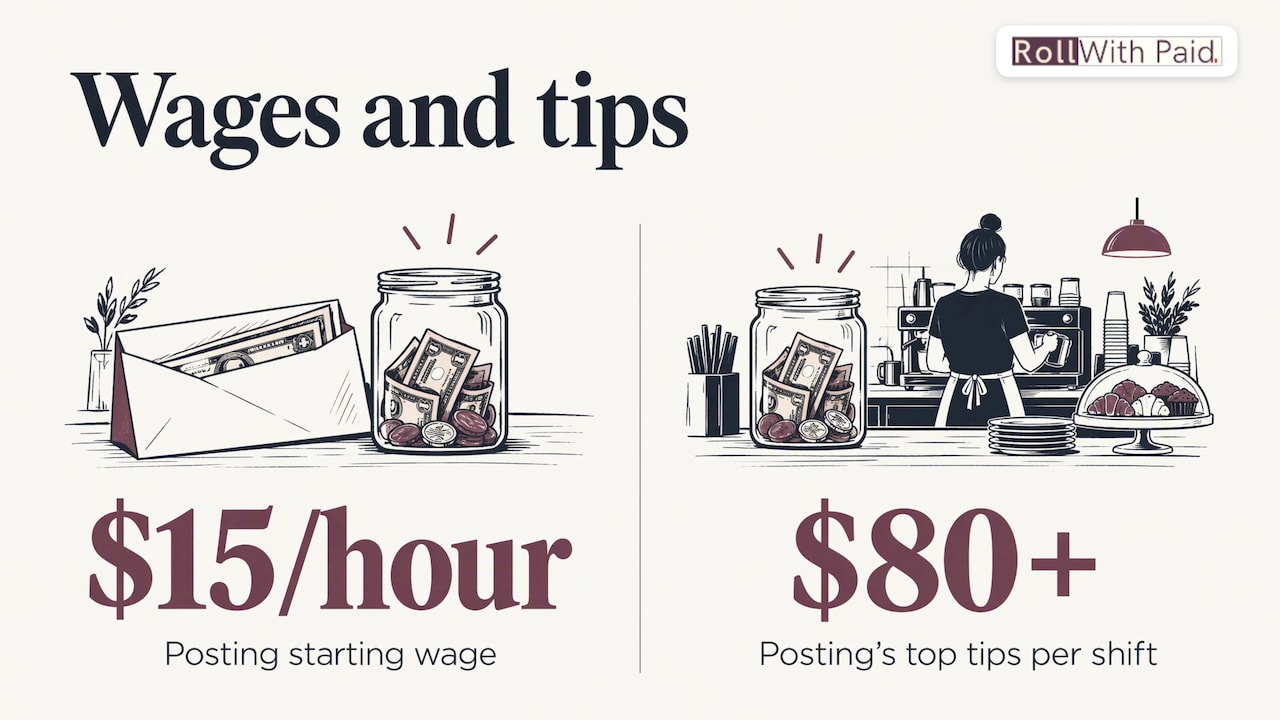
A public Minnesota Cannabis Services retail associate posting lists a starting rate of $15 per hour plus tips. The same job posting says top performers may earn $80 or more in tips per shift.
That is one employer’s posting, not a statewide average. Wages vary by store, city, role and experience. What the posting shows is the structure most dispensary workers recognize: a base wage that pays the bills and tips that vary with traffic, shift and customer relationships.
For workers comparing offers, converting an hourly rate into a monthly figure makes the comparison clearer. A monthly wage calculator turns any hourly rate into a monthly amount, and a US paycheck calculator estimates take-home pay after withholding.
For employers, the wage is only part of the cost. Payroll taxes, workers’ compensation and overtime all follow the wage. Our guide to dispensary overtime rules covers what cannabis employers must pay when shifts run long, such as on launch weekends and holiday rushes.
Why do banking limits change how dispensaries run payroll?
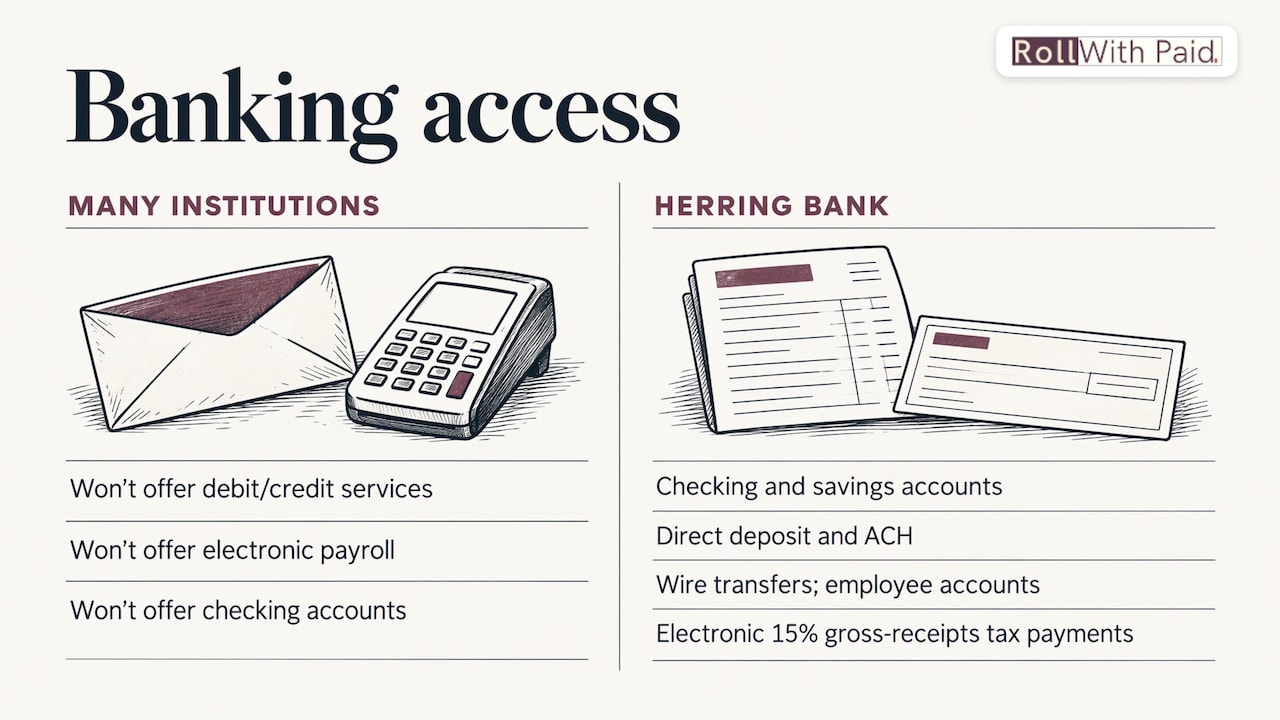
Banking limits change dispensary payroll because marijuana remains illegal under federal law. A Congressional Research Service report, Financial Services for Marijuana Businesses, says many financial institutions will not provide state-authorized marijuana businesses with common products. These include debit or credit card payment services, electronic payroll services and checking accounts.
The same report says this pushes some businesses to operate exclusively in cash, which raises public-safety and tax-collection concerns. Payroll is where that pressure lands on employees: they still need a reliable paycheck, a pay stub and correct withholding.
The picture is not uniform. Herring Bank states that it offers licensed Minnesota cannabis businesses checking and savings accounts, direct deposit, ACH payments, wire transfers, employee accounts and electronic tax payments, including the 15% cannabis gross receipts tax. Its services follow FinCEN Bank Secrecy Act and anti-money-laundering guidance while Congress considers the SAFE Banking Act.
So a Minnesota operator may have a banking relationship that supports direct deposit, or may have a limited one. Either way, the payroll process has to produce clean records. A payroll partner that works with cannabis clients handles that routine every pay cycle, which is the reason many dispensary owners hand it off.
Can a Minnesota dispensary pay employees in cash?
Cash handling is a reality of the industry, but a cash payment does not remove any payroll duty. The employer still owes a written earnings statement for the pay period, and the employer still keeps wage records for at least three years, per the Minnesota DLI.
The risk with cash payroll is not the cash. It is the paper trail. When pay is handed over without a matching record, three problems follow:
- The employee cannot prove what they earned, which creates wage disputes.
- The owner cannot show an auditor that taxes were withheld and deposited.
- Tips and base wages blur together, which makes the numbers harder to defend.
Our article on the Minnesota Wage Theft Prevention Act explains why documentation of pay terms matters to employers in this state.
How do tips work on a dispensary paycheck?
Tips on a dispensary paycheck should be recorded in the payroll system like every other form of pay, so the employee’s earnings record reflects the full picture. A tip jar that is emptied into a pocket at closing leaves no record at all.
Three habits keep tips clean:
- Decide whether tips are pooled or individual, and write the policy down.
- Record tips per shift, not per month.
- Run recorded tips through payroll so the earnings statement matches what the employee actually received.
Digital tipping is changing how this works in other hospitality settings. For background on how tip reporting is moving to digital point-of-sale systems, see this overview of digital tipping taxes.
How does Section 280E affect dispensary payroll?
Section 280E of the federal tax code bars deductions and credits for expenses tied to trafficking in controlled substances. According to an IRS publication, marijuana retailers can deduct only the cost of goods sold.
For payroll, that means a retail dispensary’s labor cost is treated very differently from a restaurant’s or a clothing store’s. How each position is classified, and what the business can treat as part of cost of goods sold, becomes a real question. The same IRS document says tax treatment of other expenses depends on whether they are part of cultivating or selling, or a subsidiary trade or business.
This is why a late filing or a misclassified worker costs a cannabis business more than it would cost a typical employer. Our explainer on 280E and payroll walks through what cannabis employers need to understand, and your tax professional should confirm how it applies to your entity.
What screening applies before a Minnesota dispensary hires someone?
Minnesota law allows the Office of Cannabis Management to require a criminal history check of prospective cannabis workers. Under Minn. Stat. 342.15, upon request by the office, a prospective worker submits a consent form, fingerprints and the required fees. The fingerprints may be exchanged with the FBI for a national check.
That is the legal screening. Employers may add their own standards, such as references, availability or product knowledge, and those are business decisions, not state requirements.
Once a hire clears, the employer still has onboarding paperwork to complete. In Minnesota that includes reporting new hires, and our new hire reporting checklist covers the fines employers face when it is missed.
Which payroll setup fits a Minnesota dispensary?
A cannabis-specialized payroll partner or Employer of Record fits most dispensaries best, because it combines pay processing, compliance and records in one place. The other common setups each leave a gap.
| Setup | Who runs payroll | Where it tends to break |
|---|---|---|
| Roll With Paid. Employer of Record and payroll execution | A team that works with cannabis and other high-risk employers | Built for audit-ready records, filings and workers’ compensation |
| Mainstream payroll software | The owner or a manager | Banking limits and classification questions land back on the owner |
| In-house payroll with spreadsheets | The owner or office manager | Missed filings, thin records, no backup when the one person who knows the process is out |
| Cash payroll with no system | The owner | No earnings statements, weak tax records, wage-dispute exposure |
We built our approach for businesses that traditional payroll providers turn away. Our Employer of Record model is designed to reduce legal liability and workers’ compensation costs, and our clients have seen zero late filings. If you want to compare us with other named options, see how Roll With Paid. compares with Paragon Payroll or with Greenleaf HR. For a deeper look at the model, read Employer of Record for high-risk industries.
What payroll situations do Minnesota cannabis operators run into?
Three situations come up again and again for operators. Each one is a use case for specialized payroll support.
A new single-store dispensary opening its doors
A new store has to hire, onboard and pay a full team within weeks. The workload is I-9 verification, new hire reporting, policy documents and a first payroll that has to be right. Our onboarding service is designed for exactly that window, so the owner can focus on the opening.
A multi-state operator adding Minnesota
An operator already running payroll in other states faces different wage rules, different filings and different regulators in Minnesota. One process copied across states is the usual source of errors. Our multi-state cannabis payroll guide covers what to settle before the first paycheck, and our multi-state hiring support is built for this expansion.
A cultivation or processing facility with mixed roles
Cultivation staff, trimmers, drivers and retail employees often sit under one owner, with different job duties and different cost treatment. Classification has to follow the real work. Delivery and transport roles add their own payroll questions, covered in our guides on cannabis delivery payroll and cannabis transporter payroll.
What questions do owners ask before changing payroll?
Owners tend to ask the same practical questions. Here are the common ones, with direct answers.
Will my employees still get a normal paycheck and pay stub?
Yes. Minnesota requires an earnings statement each pay period, and a well-run payroll process produces one every time.
Do I need a bank account that supports direct deposit first?
Not always. Banking access varies, and the CRS report notes many institutions decline electronic payroll services for cannabis businesses. Payroll support is designed to work within those limits.
Can time tracking connect to payroll?
Yes. We offer time and attendance tools, so hours flow into payroll rather than being retyped by hand.
Who is responsible for filings?
The employer is always legally responsible for its payroll obligations. Our payroll execution service handles the filings so they are done on time.
What mistakes cost dispensaries the most?
The most expensive payroll mistakes are late filings, misclassified workers, missing records and unrecorded tips. Each one is small on the day it happens and large when it surfaces in an audit.
Our article on five payroll mistakes cannabis businesses cannot afford goes through them in detail. For the broader picture, see our guides to cannabis dispensary payroll and cannabis industry payroll.
Perspective
Dispensary payroll is two things wearing one name: paying people, and proving you paid them correctly. Most operators get the first part right and discover the second part during an audit.
We built Roll With Paid. for employers in high-risk industries, cannabis first, because the usual payroll product assumes a normal bank, a normal tax position and a normal risk profile. A dispensary has none of those. Our Employer of Record model and audit-ready processes are designed so the paperwork exists before anyone asks for it.
The goal is a quiet payroll: on time, documented and consistent, so owners can spend their energy on the store, the team and growth.
Leah Kollross
Ready to take payroll off your plate?
Roll With Paid. provides Employer of Record, payroll execution, HR and compliance solutions, onboarding, multi-state hiring support and time and attendance tools for cannabis and other high-risk employers. Pricing depends on your service rate and an optional HR retainer; see our pricing page or start from the Roll With Paid. home page.

For regular updates on payroll and compliance in regulated industries, subscribe to our Roll Call newsletter.
FAQ
How often do Minnesota dispensaries pay employees?
Pay frequency is set by the employer and applied consistently, with an earnings statement for every pay period. Many dispensaries choose a biweekly or semimonthly schedule. Whatever the schedule, write it into your pay policy and keep the records for at least three years.
Do Minnesota dispensary workers get paid in cash?
Some cash use is part of the industry because of banking limits, but wages are still payroll. The employer owes a written earnings statement and must keep wage records. Direct deposit is available where the operator has a bank that supports it.
What disqualifies you from working at a Minnesota dispensary?
The state can require a criminal history records check of prospective cannabis workers, including fingerprints, under Minn. Stat. 342.15. Individual employers may add their own hiring standards beyond that.
Why do dispensaries have trouble with payroll?
Federal law leaves many banks unwilling to offer electronic payroll services to cannabis businesses, and Section 280E limits deductions. Together these make clean records and correct classification more important than at other retailers.
Sources
- Minnesota Department of Labor and Industry: Payment for hours worked
- Job posting: Budtender, Retail Associate, Minnesota Cannabis Services
- Congressional Research Service: Financial Services for Marijuana Businesses
- Herring Bank: Minnesota Cannabis Banking
- IRS: Guidance for practitioners preparing returns for marijuana retailers
- Minnesota Statutes 342.15
- Monthly Wage Calculator
- US Paycheck Calculator
- Digital tipping taxes overview
Recommended
- Your Rights as a Cannabis Worker in Minnesota
- Cannabis Dispensary Payroll: Rules, Risks and Providers
- Dispensary Overtime Rules: What Cannabis Employers Must Pay
- 5 Payroll Mistakes Cannabis Businesses Can’t Afford
Roll With Paid. is not a law firm and does not provide legal advice. This article summarizes Minnesota law along with other states and jurisdictions law and is for general information only. Before changing a policy, consult employment counsel or contact DLI Labor Standards at 651-284-5075.