
Cannabis Payroll: 8 Compliance Checks, Clutch vs. Roll With Paid

For cannabis and other high-risk operators, the safest path is a compliance-first, Employer of Record style partner rather than a bare-bones payroll processor. That structure keeps audit-ready filings, I-9 verification, and multi-state wage rules in one accountable relationship instead of scattered across spreadsheets and part-time help. We built our services at Roll With Paid around exactly that job, so operators spend less time defending their payroll and more time running their business.
TL;DR:
- A payroll processor files taxes but leaves legal employer liability with you; a PEO shares duties by contract, while an EOR assumes broader filing responsibility.
- Complete employment verification on time; retain forms until three years after hire or one year after termination, whichever is later; delegation does not shift liability.
- Track wage, overtime, and new hire reporting rules by each employee’s work state; headquarters rules do not govern workers elsewhere.
- Before signing, request written verification procedures, a sample audit report with identifying details removed, proof of recent timely filings, and contract clauses assigning liability.
- Accurate job codes and wage records help insurers base workers’ compensation premiums on actual duties; miscoding can raise costs or expose coverage gaps.
Table of Contents
- What EOR, PEO and payroll provider models actually mean for cannabis operators
- Practical compliance checklist: I-9, filings, state rules, record retention
- How to vet and choose a payroll/EOR partner for cannabis and high-risk operations
- How Roll With Paid maps to these needs
- Impact of payroll provider choice on workers’ compensation and insurance costs
- Client onboarding and employee onboarding processes differences between Clutch and Roll With Paid
- Case studies or customer testimonials highlighting compliance success and audit readiness
- Support and responsiveness levels for managing complex state and federal regulations in cannabis payroll
- Integration capabilities with time & attendance and HR software tailored for high-risk industries
- Detailed comparison of risk management and legal compliance features specific to cannabis payroll
- Typical pricing/timing shapes and what affects cost
- Author perspective: why a compliance-first specialist matters
- Next steps: get a pricing estimate from Roll With Paid
- FAQ
- Sources
What EOR, PEO and payroll provider models actually mean for cannabis operators
Vendors throw around “payroll,” “PEO,” and “EOR” as if they were interchangeable. They are not, and the differences change who holds legal responsibility when something goes wrong.
A payroll processor calculates wages, withholds taxes, and files returns, but your business stays the legal employer of record. A PEO creates co-employment: the PEO and your company share employer responsibilities under a joint contract, which can centralize benefits and HR support but also means liability is split in ways that are not always clear until a dispute arises. An Employer of Record goes further. The EOR becomes the legal employer for tax and compliance purposes, assuming responsibility for filings, tax deposits, and much of the documentation burden, while you retain control over day-to-day work direction.
Each model handles tax reporting and liability differently:
- A payroll processor files on your behalf but leaves you exposed if forms are wrong or late.
- A PEO shares liability contractually, though the exact split depends on the agreement’s language.
- An EOR generally assumes employer-level liability for payroll tax compliance and reporting accuracy.
Before signing anything, ask who on the vendor’s staff actually provides HR advice and whether that person’s guidance is backed by professional credentials or liability coverage. Marketing language about being “cannabis-friendly” does not answer that question. Many operators end up combining services, using a payroll processor for execution while contracting a separate HR consultant or EOR for compliance oversight, because no single vendor covers every need equally well.
Practical compliance checklist: I-9, filings, state rules, record retention
Audit readiness is not a feeling, it is a checklist, and most of it starts with documentation the federal government already requires.
- Complete Section 2 of Form I-9 within the legally required timeframe after the employee’s hire date, using an employer or authorized representative.
- Review original documents in person or through a compliant remote-examination process, confirming they reasonably appear genuine and relate to the person presenting them, per the USCIS I-9 instructions.
- Retain completed I-9 forms for the legally specified retention period after employment ends, as detailed in USCIS retention guidance.
- Verify that any authorized representative used for remote verification understands employer liability still rests with you, a point the USCIS I-9 central page reinforces for anyone delegating this step.
- File state new-hire reports for every employee in every state where you have workers, since reporting deadlines and formats differ by jurisdiction.
- Track multi-state wage and overtime rules separately rather than applying your headquarters state’s rules everywhere, since wage law is enforced by the work location, not the company address.
- Confirm tax deposits are made on schedule and returns are filed with no gaps, since a pattern of late deposits is one of the first things an auditor flags.
- Document every payroll correction with a dated explanation, not just a revised number, so an auditor can see the reasoning behind a change.
One of the most consistent sources of audit exposure is the I-9 form itself: federal guidance requires employers to record document titles, issuing authorities, and document numbers, then attest under penalty of perjury that review was done correctly. Missing a single field, or missing the three-day window, is enough to trigger a correction notice.
Audit-ready payroll means filings happen on time, deposits clear without exception, and every correction is traceable. That standard is achievable, but it requires a system built for it from the start rather than retrofitted after a notice arrives.
How to vet and choose a payroll/EOR partner for cannabis and high-risk operations
Not every vendor that claims cannabis experience has actually built compliance processes around it. A short, pointed evaluation saves you from finding out the hard way.
Weigh candidates on these axes:
- Compliance rigor: Do they document every filing and correction, or just promise accuracy?
- EOR liability acceptance: Will they contractually accept employer-level liability, or just coordinate paperwork?
- Multi-state experience: Can they name the states where they currently manage payroll and new-hire reporting?
- Onboarding speed: How long does it take from signed agreement to first compliant payroll run?
- Pricing transparency: Is the fee structure tied to gross payroll and headcount in writing, with no vague add-ons?
- Staff credentials: Who on their team handles HR questions, and what is their background?
Before signing, ask for their I-9 completion process in writing, a sample audit report with identifying details removed, proof of recent on-time filings, and the actual liability clauses from a sample service agreement. A vendor who hesitates to share any of these is telling you something.
Pro Tip: Ask a prospective vendor to walk through what happens the week a state audit notice arrives, not just what happens during normal operations.
Watch for scripted support that cannot answer a specific compliance question, vague language around who “owns” liability, and pricing that is quoted differently depending on who you ask. An EOR model is usually the better fit when you need clean employment documentation for lender underwriting, when you are adding benefits administration, or when you are hiring across multiple states at once.
How Roll With Paid maps to these needs
Everything on that checklist maps directly to a service we built, not a feature we bolted on afterward.
- Employer of Record: we assume employer-level responsibility for tax filings and compliance documentation, reducing the liability that sits on your business.
- Payroll Execution: wage calculations, deposits, and returns run on a documented schedule so nothing slips.
- HR & Compliance Solutions: our I-9 and E-Verify guidance is built specifically for cannabis employers navigating federal verification rules inside a state-legal, federally unrecognized industry.
- Multi-State Hiring Support: we track new-hire reporting and wage rules by work location, not by headquarters address, which matters for operators expanding into new states.
- Seamless Employee Onboarding: new hires move through verification and payroll setup without the gaps that create audit exposure later.
We built our processes around being audit-ready by default, and our track record includes zero late filings for the clients we serve. If you are vetting us alongside any other partner, ask the same questions you would ask anyone else: our onboarding timeline from signed agreement to first payroll run, a sample of how we document I-9 verification, and how we handle authorized representative duties when remote verification is needed. Our Employer of Record explainer walks through how that liability shift works in more detail.
Impact of payroll provider choice on workers’ compensation and insurance costs
The payroll partner you choose affects more than tax filings, it also shapes how your business is classified for workers’ compensation and what you pay in premiums. Misclassified job codes, whether by accident or through a vendor cutting corners, can inflate premiums or create coverage gaps that surface only after a claim is filed.
An EOR model that properly documents job classifications and wage data gives your workers’ compensation carrier accurate information from the start, which tends to keep premiums aligned with actual risk rather than a worst-case default. Carriers that insure high-risk and cannabis operations already price in industry risk, so clean documentation is one of the few variables you control once that baseline is set.
Proof of contractual liability coverage matters here too. As independent insurance guidance explains, employers’ liability coverage protects against claims that fall outside standard workers’ compensation, and a payroll partner who understands how that coverage interacts with their own liability acceptance is a better fit than one who treats insurance as someone else’s problem. We review classification codes against actual job duties as part of our payroll setup, because a miscoded position is one of the quieter ways premiums creep upward over time.
Client onboarding and employee onboarding processes differences between Clutch and Roll With Paid
Clutch operates as a comparison and review platform where businesses research and compare B2B service providers, including accounting and payroll firms, rather than delivering payroll or HR services directly. That means a search that starts with a Clutch listing typically ends with a conversation on the actual provider’s own onboarding process, not a payroll run managed by Clutch itself.
Our onboarding is built specifically around high-risk operators from the first call. We start with a compliance review of existing payroll records, flag any I-9 or wage-reporting gaps before they become audit findings, and set a defined timeline from signed agreement to first compliant payroll run. Employee-level onboarding follows the same discipline: new hires complete verification within the required window, documentation is logged immediately, and multi-state new-hire reports go out on the state’s own schedule rather than a generic one.
The practical difference for an operator comparing a review platform listing against a direct provider relationship is accountability. A listing can point you toward options, but it cannot accept liability for a missed filing or a mishandled I-9. That responsibility sits with whichever provider you ultimately sign with, which is why the onboarding conversation itself, not the research step, is where the real evaluation happens.
Case studies or customer testimonials highlighting compliance success and audit readiness
Audit readiness is easiest to understand through the pattern it produces over time: consistent on-time filings, documented corrections, and no scramble when a notice arrives. That pattern is the standard we hold ourselves to, and it is reflected in our record of zero late filings across the clients we serve.
A cannabis operator managing payroll in-house, or through a generic processor, often discovers gaps only when a state agency requests records, at which point missing documentation becomes a compliance finding rather than a quick fix. An operator working with an EOR built around audit-ready processes from day one has a different experience: when a request comes in, the records are already organized, dated, and complete, because that is how the process was designed to run.
This is also where lender relationships intersect with payroll. As guidance on business loan documentation points out, lenders often request clean payroll and wage records as part of underwriting, and employees benefit from the same accuracy when their own wage reporting needs to hold up for a mortgage or loan application. Transparent, correctly filed wage data is not just a compliance checkbox, it is documentation that follows your business and your employees into decisions well beyond payroll itself.
Support and responsiveness levels for managing complex state and federal regulations in cannabis payroll
Cannabis payroll sits at the intersection of federal rules that do not recognize the industry and state rules that regulate it closely, which means support responsiveness is not a convenience feature, it is a compliance necessity. A question about a new state’s wage reporting deadline or an unexpected I-9 document issue cannot wait for a multi-day ticket queue.
We built our support model around direct access to people who understand cannabis-specific compliance, not a general payroll help desk reading from a script. When a question touches on multi-state wage law, I-9 verification, or a state-specific new-hire reporting rule, the person answering it should be able to speak to that rule specifically, not redirect clients to a generic knowledge base article.
Responsiveness also matters most at the moments operators fear: a state audit notice, a workers’ compensation claim, or a sudden expansion into a new state. Our personalized support model is structured to be available at those moments, with staff who already understand your payroll history rather than starting from scratch. That continuity is part of what keeps a compliance question from turning into a compliance failure.
Integration capabilities with time & attendance and HR software tailored for high-risk industries
Payroll accuracy depends on clean data flowing in from time and attendance systems, and cannabis operators often run shift-based, multi-location workforces where manual timesheet entry is the point where errors start. A payroll partner that integrates directly with time and attendance tools reduces the gap between hours worked and hours paid, which matters both for wage compliance and for workers’ compensation classification accuracy.
The Time & Attendance Tools are built to connect with the payroll and HR compliance side of services, so hours worked flow into payroll runs without a manual re-entry step that introduces its own risk of error. That connection also supports the documentation trail auditors look for: a clear, time-stamped record of hours worked that matches what was paid and what was reported.
For operators managing employee handbooks and policy documentation across multiple states, having payroll, time tracking, and HR policy tools under one coordinated system, rather than three disconnected vendors, reduces the chance that a policy update in one system fails to reach the others. Our employee handbook resources address this same coordination challenge for multi-state employers building out policy documentation.
Detailed comparison of risk management and legal compliance features specific to cannabis payroll
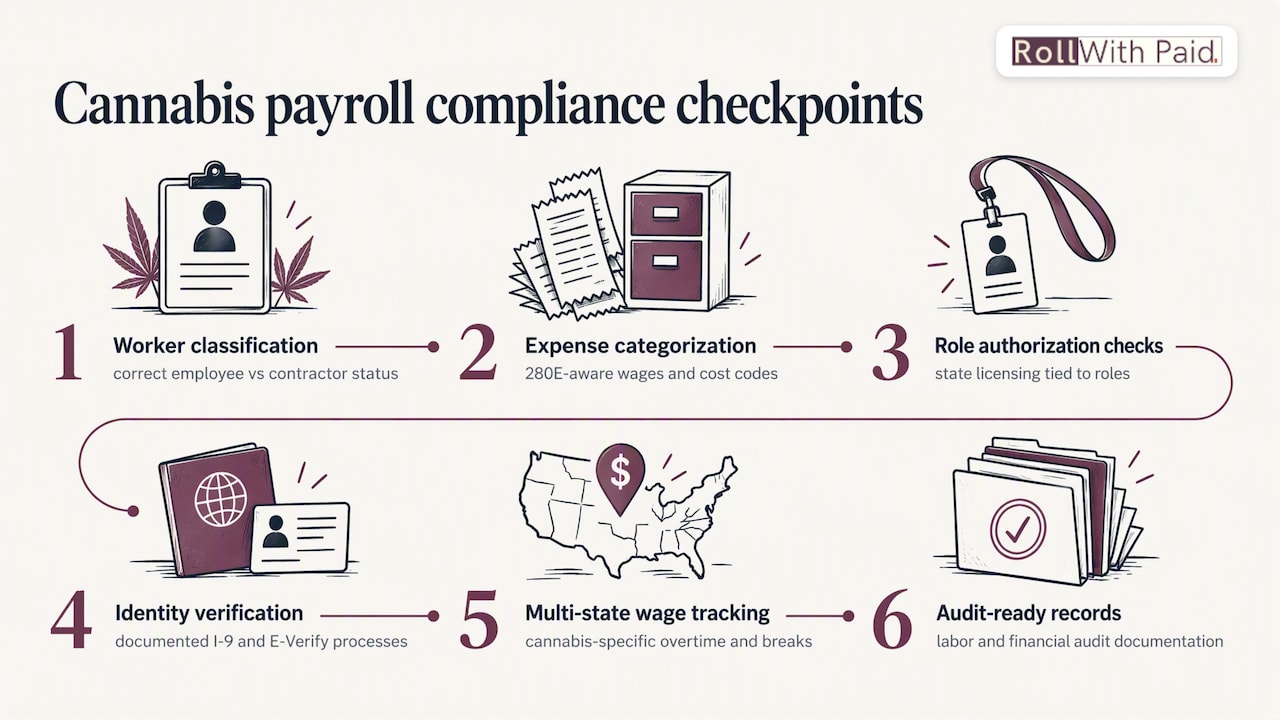
Cannabis payroll carries risk layers that mainstream payroll does not: federal banking restrictions, state-specific licensing requirements tied to employment, and the ever-present 280E tax exposure that shapes how wages and expenses get classified. A generic payroll provider built for retail or hospitality is not built to manage those layers.
Risk management for cannabis payroll starts with correct worker classification, since misclassifying an employee as a contractor creates both wage liability and workers’ compensation exposure. It extends to 280E-aware payroll structuring, where how wages and related costs are categorized affects tax exposure in ways unique to the industry. It also includes state-specific licensing checks tied to certain cannabis roles, something a payroll provider unfamiliar with the industry would not know to verify.
Legal compliance features that matter specifically here include documented I-9 and E-Verify processes built for an industry operating in a gray zone between federal and state law, multi-state wage tracking that accounts for cannabis-specific overtime and break rules where they exist, and audit-ready documentation that can stand up to both a labor department inquiry and a financial audit tied to licensing renewal. These are not generic HR features, they are the specific risk points that make cannabis payroll a distinct discipline rather than a variation on standard payroll.
Typical pricing/timing shapes and what affects cost
Payroll and HR compliance services for high-risk operators are typically priced as a monthly recurring fee based on gross payroll, sometimes paired with a flat-rate HR retainer for ongoing compliance support. Our own service rate and HR retainer options follow that same structure, with rates that vary by worker classification code and headcount rather than a flat number applied to every business.
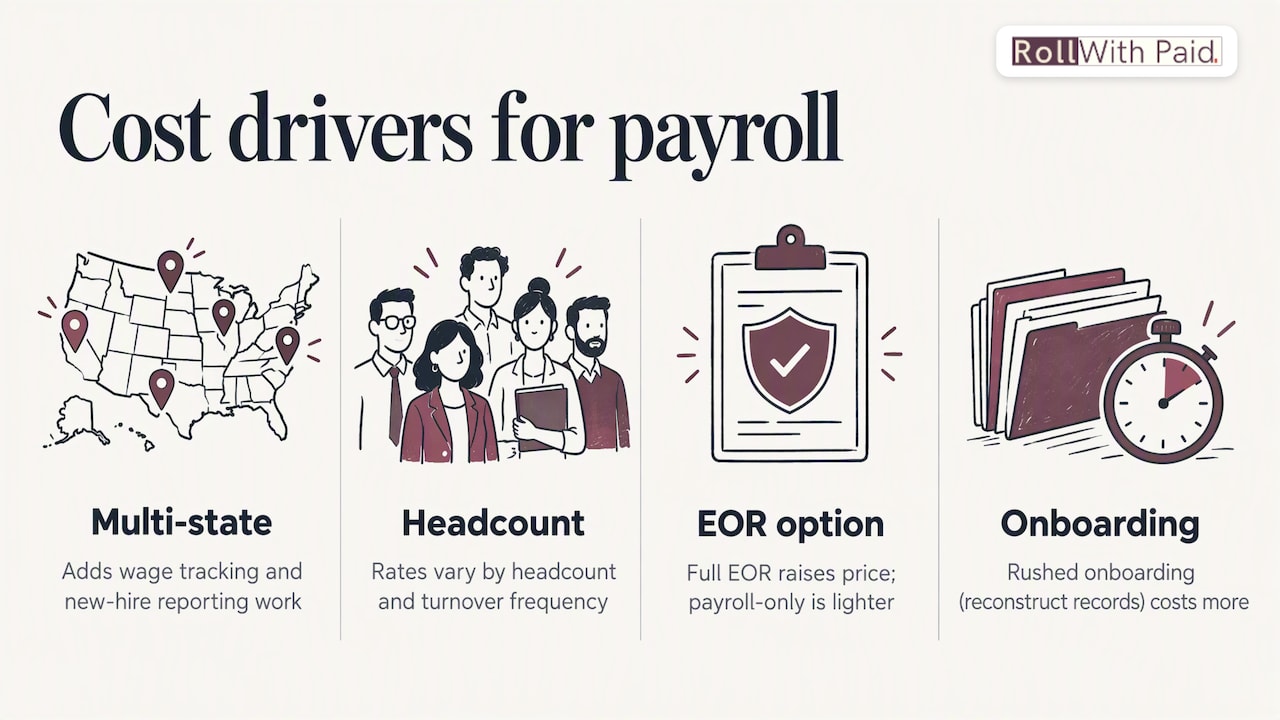
Several factors move the cost up or down: the number of states you operate in, since multi-state wage tracking and new-hire reporting take more work than a single-state payroll run; your headcount and how often it changes; whether you need full EOR liability assumption or a lighter payroll-execution-only arrangement; and whether benefits administration or a dedicated HR retainer is layered on top.
Timing shapes cost too. A rushed onboarding, where records need to be reconstructed after the fact, often costs more in staff time than a planned transition with documentation ready in advance. Operators considering a switch should ask any prospective vendor for a written rate structure tied to payroll volume and headcount, rather than a verbal estimate that may not hold once the agreement is signed. Exact pricing for our own services is available on request through a direct conversation, since worker classification codes and headcount vary enough between operators that a single published number would not reflect most clients’ actual cost.
Author perspective: why a compliance-first specialist matters
In our experience, the operators who struggle most at diligence or underwriting are not the ones with the messiest businesses, they are the ones with the messiest paperwork. A lender or auditor does not weigh intentions, only documentation. An operator with clean I-9 records and on-time filings clears underwriting faster than one with a stronger business but thin wage records. Outsourcing payroll does not mean giving up oversight: keep copies of your own filings, know your retention timelines, and treat your vendor as a partner in compliance, not a replacement for understanding it.
— Leah Kollross
Next steps: get a pricing estimate from Roll With Paid
If audit-ready payroll, I-9 compliance, and multi-state hiring support are what you need, our services at Roll With Paid are built around exactly that combination.

- Request our compliance checklist and a sample audit report format.
- Ask about our onboarding timeline from signed agreement to first payroll run.
- Get a pricing estimate based on your headcount and worker classification codes.
Reach out through our home page to start that conversation.
This article is general information, not a substitute for advice from a qualified lawyer. Consult a qualified legal professional about your own circumstances before acting on anything here.
FAQ
What is the difference between a PEO and an Employer of Record?
A PEO creates co-employment, where your business and the PEO share employer responsibilities under a joint contract. An Employer of Record becomes the legal employer for tax and compliance purposes, generally assuming more of the filing and documentation liability while you retain control over daily work direction.
How long do employers have to complete Form I-9 for a new hire?
Employers or their authorized representatives must complete Section 2 of Form I-9 within the federally mandated timeframe following the employee’s start date. Completed forms must then be retained for one year after employment ends or three years after the hire date, whichever is later.
Does hiring across multiple states change payroll compliance requirements?
Yes, each state sets its own new-hire reporting deadlines, wage rules, and in some cases overtime standards, so a company hiring in several states cannot apply one state’s rules everywhere. Payroll partners experienced in multi-state compliance track these requirements by work location rather than company headquarters.
How does payroll provider choice affect workers’ compensation costs?
Accurate job classification and wage reporting from your payroll provider help workers’ compensation carriers price premiums based on actual risk rather than default assumptions. Misclassified codes or inconsistent wage data can lead to inflated premiums or coverage gaps that surface during a claim.
What should I ask a payroll or EOR vendor before signing?
Ask for their written I-9 completion process, a sample audit report, proof of recent on-time filings, and the liability clauses from a sample service agreement. Our services at Roll With Paid are built to answer each of these directly, since audit-ready documentation is the standard we hold ourselves to.
Sources
- Instructions for Form I-9, Employment Eligibility Verification
- Employment Eligibility Verification | USCIS
Recommended
- Cannabis Payroll: Avoid 280E Exposure: Roll With Paid vs Greenleaf HR
- Avoid 280E Risk: Roll With Paid vs Paragon for Cannabis Employers
- High Risk Cannabis Payroll: Roll With Paid vs Würk and 4 Numbers
- Avoid a Payroll Freeze: Roll With Paid vs. Paychex for Cannabis
Roll With Paid. is not a law firm and does not provide legal advice. This article summarizes Minnesota law as of August 2026 and is general information only. Tip arrangements are fact-specific; before changing a policy, consult employment counsel or contact DLI Labor Standards at 651-284-5075.