
Cannabis Payroll: Avoid 280E Exposure: Roll With Paid vs Greenleaf HR

For most cannabis employers, an Employer of Record model is the better starting point because it consolidates compliance under one entity and shifts a portion of payroll tax exposure to a provider built for that risk. This article calls out Roll With Paid as the type of provider suited to that role. Along the way, we cover the legal differences between PEO, EOR, and payroll-only structures, how 280E complicates the decision, what full pricing actually looks like, and the exact questions to ask any vendor before you sign.
TL;DR:
Most cannabis businesses benefit from an Employer of Record model to reduce tax and compliance risks, especially when expanding across multiple states.
The choice between PEO, EOR, or payroll-only models critically impacts legal liability, with EOR offering the most direct employer responsibilities for payroll and taxes.
When evaluating vendors, cannabis employers should scrutinize payroll allocation reports for 280E compliance and demand concrete proof of licensing and financial stability.
Full costs, including state registration, benefits, and termination fees, are often hidden and should be included in a multi-year comparison before signing a contract.
Vendors with industry-specific experience, especially in high-risk sectors like cannabis, provide more reliable support and compliance, making due diligence essential.
Table of Contents
-
PEO, EOR, or Payroll-Only: What Each Model Does to Your Legal Status
-
Service Features: Roll With Paid Versus a Generalist Cannabis HR Provider
PEO, EOR, or Payroll-Only: What Each Model Does to Your Legal Status
The three models look similar from a sales pitch but create very different legal relationships once your tax filings are on the line.
A PEO arrangement creates co-employment: you and the provider share employer responsibilities, with the PEO typically handling payroll processing, benefits, and some HR functions while you retain day-to-day operational control. Under Treas. Reg. 31.3504-2, a PEO can be designated to perform certain employer acts, and the IRS treats PEOs that file under their own EIN as payors for wage-payment purposes. That designation determines who is on the hook when a filing goes wrong.
An Employer of Record goes a step further. The EOR becomes the W-2 employer of record for payroll and tax filing purposes, which means it absorbs most of the administrative and filing obligations rather than sharing them with you. According to one comparison of entity requirements for PEO and EOR arrangements, a PEO typically requires you to already have a US legal entity, while an EOR is generally used when a business lacks that entity or needs to hire across multiple states quickly. Roll With Paid describes how this applies specifically to cannabis and other high-risk sectors in its explainer on Employer of Record for high-risk industries.
A payroll-only or administrative services organization (ASO) model is the leanest option: the provider processes paychecks and files paperwork, but you remain the legal employer and keep the employment tax liability on your books.
-
PEO: shared employer status, co-employment risk, usually requires your own entity.
-
EOR: provider is the legal employer for payroll and tax purposes, good for fast or multi-state hiring.
-
Payroll-only: you retain full employer liability, provider just processes the numbers.
Certification matters here. A Certified PEO (CPEO) receives statutory protection under Section 3511 that can limit your successor liability for certain federal payroll taxes. Most PEOs are not certified, so a non-certified PEO leaves you exposed if the provider mishandles trust fund deposits, regardless of what the contract promises.
Why 280E and Cannabis Labor Rules Change the Vendor Math
Cannabis employers cannot treat this as a generic payroll decision because Section 280E of the federal tax code disallows ordinary business expense deductions for activities that touch the plant. That single rule reshapes how you should think about payroll allocation.
-
Payroll allocation affects your tax bill directly. Wages tied to cannabis-touching roles are generally non-deductible, while wages for genuinely separate management or ancillary services may not be, so how a provider codes and allocates labor costs has real financial consequences, not just administrative ones, as outlined in this 280E tax guide for cannabis businesses.
-
Workers’ compensation and insurance carry their own wrinkles. Cannabis remains a nonstandard risk class for many carriers, and whether the EOR or you hold the workers’ comp policy affects both your premium exposure and your claims history going forward.
-
State and local labor rules vary widely across cannabis markets. A dispensary chain hiring across several states needs a provider comfortable registering entities, filing state unemployment returns, and tracking local wage ordinances in each jurisdiction, not just running a national payroll batch.
-
Management-company structures need real substance. If you separate cannabis-touching payroll from non-cannabis services to reduce 280E exposure, the structure has to reflect arm’s-length pricing and genuine operational separation, not just a name on an invoice, per the same 280E guide. Roll With Paid’s own breakdown of 280E and payroll covers how this plays out in practice.
Pro Tip: Ask any provider to show you a sample payroll allocation report before you sign, not just a sales deck, so you can see how they actually code cannabis-touching versus non-cannabis wages.
Comparing Full Cost, Not Just the Quoted Rate
Fee structures across providers rarely match up line for line, which makes sticker-price comparisons close to useless.
PEOs typically price as a percentage of payroll or a flat per-employee-per-month fee, often bundled with benefits access. EOR pricing is usually per-employee-per-month plus pass-through costs for salary, taxes, and benefits administration, according to the PEO versus EOR cost comparison referenced earlier. Payroll-only providers tend to charge the lowest base fee but leave you covering entity setup, tax filings, and compliance work separately.
Before you sign anything, build a three-year comparison rather than a one-month quote:
-
Entity setup or registration costs in each state you operate.
-
Benefits administration fees and whether group rates are included or billed separately.
-
Ongoing admin or platform fees beyond the base payroll rate.
-
Exit or termination costs if you switch providers mid-contract.
A few hidden costs catch cannabis employers off guard specifically. Benefit lock-in clauses can penalize you for leaving before a plan year ends. Termination penalties buried in a PEO contract can turn a routine vendor switch into a costly one. And successor liability, along with a wage-base restart when you move employees to a new EIN, can quietly erase a year’s worth of state unemployment tax savings. Roll With Paid’s pricing page outlines its own rate structure for reference as you build this comparison.
Vetting a Provider Before You Sign Anything
Cannabis employers cannot afford to take a vendor’s compliance claims at face value, so due diligence has to be concrete and documented.
-
Request proof, not assurances. Ask for CPEO documentation if certification is claimed, recent audited financials, bonding information, and copies of state registrations in every jurisdiction where you operate.
-
Ask who controls the money and the filings. Find out whose EIN appears on Form 941, who has signing authority over payroll fund transfers, and who holds the workers’ compensation policy of record.
-
Read the exit clause first. Watch for auto-renewal terms without adequate notice windows, long minimum commitment periods, and vague language about who remains responsible for tax remittance during a transition.
-
Confirm cannabis-specific experience. Ask for references from other cannabis clients, sample 280E-aware payroll allocation reports, and copies of standard HR policies they have built for dispensaries or cultivation operations.
Pro Tip: Get the exit terms in writing before the onboarding terms. A provider that hesitates to spell out how termination works is telling you something about how the relationship will end.
Cannabis-specific HR advisories echo this caution, noting that PEO contracts can carry auto-renewal and benefit portability risks that are easy to miss during the sales process. Roll With Paid’s own list of payroll mistakes cannabis businesses can’t afford covers several of these blind spots in more detail.
Service Features: Roll With Paid Versus a Generalist Cannabis HR Provider
The core difference between Roll With Paid and a broader cannabis HR provider like Greenleaf HR comes down to how the service is structured around risk. Roll With Paid builds its offering around the Employer of Record model specifically, which means payroll execution, HR compliance, workers’ compensation coverage, and onboarding all run through one contractual relationship designed for high-risk industries. A generalist provider may offer similar categories of service but typically operates on a more traditional PEO or payroll-only chassis, which shifts more compliance responsibility back to you.
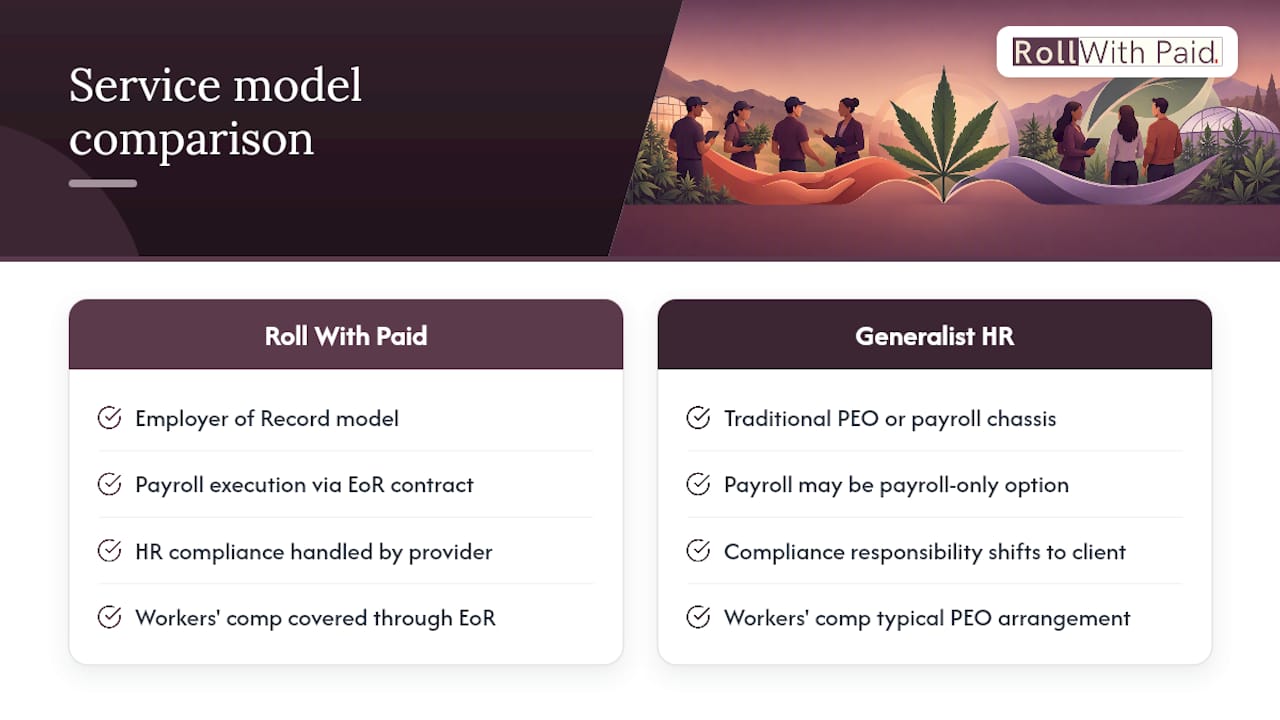
Multi-state hiring support is another point of separation. Roll With Paid positions its Multi-State Hiring Support as a dedicated service line for cannabis operators expanding across state lines, rather than a bolt-on feature. Time and attendance tracking, policy documentation, and I-9 support round out the service set, all built with the assumption that the client operates in a plant-touching or adjacent business. Where a generalist provider may treat cannabis as one vertical among many, the practical difference shows up in how payroll allocation and compliance documentation are handled day to day, not just in the marketing copy.
Support Responsiveness: What to Expect and What to Ask
Support quality is difficult to compare from the outside, since most providers do not publish response-time data. What you can compare is the support model itself.
Roll With Paid emphasizes personalized support as part of its onboarding and ongoing service, positioning itself against high-risk clients that traditional payroll providers often decline to work with in the first place. That specialization matters in cannabis, where a generic payroll help desk may not understand why a wage code needs to route through a management company for 280E purposes.
When comparing any two providers on support, ask for specifics rather than adjectives: Is there a named account contact or a ticket queue? What are the guaranteed response windows for payroll errors versus general questions? Can the provider walk you through a real compliance issue, such as a misclassified worker or a late state filing, and describe exactly how they resolved it for another client? A provider that cannot answer those questions concretely is asking you to take its responsiveness on faith.
Integration With Your Existing HRIS and Payroll Tools
Most cannabis operators already run some combination of point-of-sale, time tracking, and seed-to-sale compliance software before they ever look at a payroll provider, so integration compatibility matters more than it might in a lower-regulation industry.
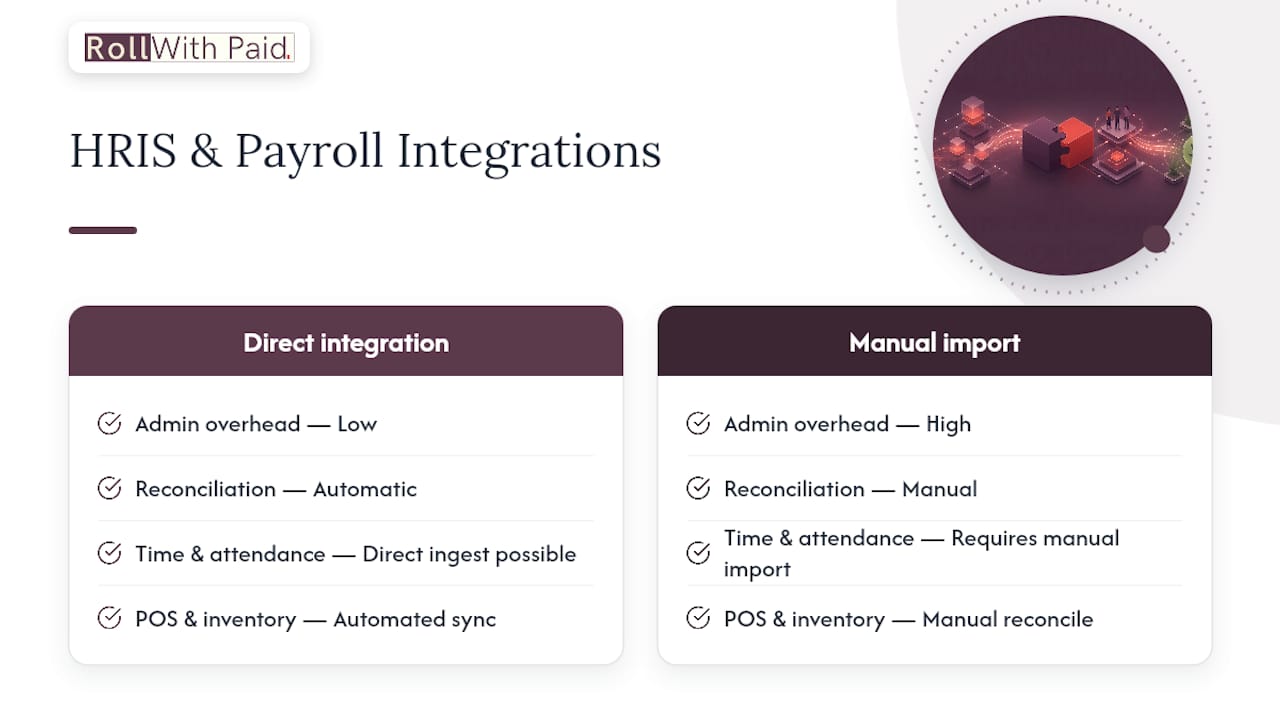
Ask any provider, including Roll With Paid, how their Time & Attendance Tools connect to your existing systems rather than requiring a full rip-and-replace. Some providers offer direct integrations with common time-tracking platforms; others rely on manual exports and imports, which adds administrative overhead every pay period. If you already use a dedicated time and attendance system such as Clock-Me’s GPS punch clock and geofencing tools, confirm whether the payroll provider can ingest that data directly or whether you will be reconciling two systems by hand.
The same question applies to your point-of-sale and inventory compliance software. A provider that cannot speak to how it handles data flow between systems is likely to leave you doing manual reconciliation work that erodes whatever time savings the service was supposed to deliver.
What Cannabis Operators Say About These Providers
Public reputation data for cannabis-specific payroll and HR providers is thinner than in mainstream industries, partly because many operators are cautious about publicizing vendor relationships in a federally gray market.
That makes direct outreach more useful than review aggregators when you are vetting a provider. Ask for references from cannabis clients specifically, not just general HR clients, since the compliance demands are different enough that generic satisfaction scores do not tell you much. A provider willing to connect you with an existing dispensary or cultivation client, and one that can speak to specific 280E-aware payroll handling, is giving you a more reliable signal than a star rating ever will.
Roll With Paid positions its specialization in high-risk industries as a core part of its pitch, which is worth weighing against a generalist provider’s broader but shallower cannabis experience.
Contract Length and How Much Flexibility You Actually Get
Contract terms vary more than most sales conversations let on, and the length of your commitment interacts directly with the exit risks covered earlier.
Some PEO and EOR agreements run month to month with a short notice period, while others lock you into annual terms with automatic renewal unless you cancel within a narrow window. Cannabis-specific HR advisories have flagged auto-renewal clauses and termination penalties as some of the most common ways operators get stuck longer than they intended.
Before comparing Roll With Paid or any other provider on price, ask directly: what is the minimum term, what notice period is required to exit, and what happens to employee records and benefit continuity if you switch providers mid-year. A provider confident in its service should have no trouble putting those terms in writing early in the sales process rather than burying them in an appendix.
How Long Onboarding Actually Takes
Onboarding timelines depend heavily on how many states you operate in and how many employees you are transitioning, so treat any flat “days to launch” promise with some skepticism.
Roll With Paid describes a streamlined onboarding process as part of its Employer of Record model, which is designed to get cannabis operators running payroll without the multi-week entity registration process a payroll-only model would require in each new state. For a single-location dispensary, that can mean a shorter runway than for a multi-state cultivation operation with dozens of employees across different wage and hour rules.
When comparing providers, ask for a realistic timeline based on your specific footprint rather than a generic estimate, and find out what documentation you need to gather on your end before the clock starts. The providers that give you a detailed onboarding checklist upfront are usually the ones that have done this enough times to know where cannabis-specific delays tend to happen.
Where the Received Wisdom on Payroll Vendors Falls Short
Most advice on choosing a payroll or HR provider treats the decision like picking a software vendor: compare features, compare price, pick the cheapest one that checks your boxes. That framework breaks down for cannabis employers, because the real risk is not a clunky dashboard. It is who is legally on the hook when a filing goes wrong or a worker is misclassified.
The providers that look most attractive on price are often payroll-only models that leave you holding full employment tax liability. That can be the right call for a well-capitalized operator with strong internal HR and legal support. It is a much riskier bet for a single-location dispensary without a compliance team.
An Employer of Record model is not automatically the right answer for every cannabis business, and a PEO can still make sense if you already have a strong internal HR function and simply need processing support. What matters more than the label on the contract is whether you actually run the due-diligence checklist before you sign, regardless of which model you choose.
— Leah
How Roll With Paid Can Support Your Payroll and HR Needs

Cannabis operators spend enough time managing regulatory risk on the plant side of the business without also carrying full payroll tax exposure. Roll With Paid’s Employer of Record model is built specifically to take that weight off your books while keeping you compliant across every state you operate in.
-
Employer of Record services that shift much of the payroll tax administration burden off your entity.
-
Payroll Execution built around 280E-aware wage allocation, not a generic payroll batch.
-
Seamless Employee Onboarding and Multi-State Hiring Support for operators expanding across state lines.
-
HR & Compliance Solutions and Time & Attendance Tools designed for high-risk industry requirements.
Roll With Paid reports zero late filings for clients on its platform, demonstrating a strong compliance record around cannabis and other high-risk sectors. If you are ready to compare real numbers, visit the pricing page or explore the full range of services to see what fits your operation.
Sources
-
Third-party payer arrangements and professional employer organizations (IRS)
-
Certified PEO vs Non-Certified PEO: Which Should You Choose? (PEO IQ)
-
The Complete 280E Tax Guide for Cannabis Businesses (2026) | Northstar Financial Advisory
FAQ
What is the main legal difference between a PEO and an EOR?
A PEO creates co-employment, where you and the provider share employer responsibilities and you typically need your own US legal entity, while an EOR becomes the legal employer of record for payroll and tax filing purposes. That distinction determines who files what and who is exposed if something goes wrong.
Does 280E affect how I should choose a payroll provider?
Yes, because how a provider allocates wages between cannabis-touching and non-cannabis roles affects which labor costs you can deduct under Section 280E. A provider without cannabis-specific payroll allocation experience can create tax exposure that a generic payroll company would never flag.
What does Roll With Paid charge for its services?
Roll With Paid’s service rate and HR retainer pricing are not published as a flat figure and are available directly on its pricing page. Rates vary based on worker classification and headcount, so a direct quote is the most reliable way to get an accurate figure.
Is a Certified PEO safer than a regular PEO for cannabis businesses?
A Certified PEO carries statutory protections under Section 3511 that can limit certain federal payroll tax successor liabilities, while a non-certified PEO does not carry that same protection. That said, certification alone does not replace full due diligence on financials, bonding, and state registrations.
How long does onboarding with an Employer of Record typically take?
Onboarding timelines depend on your headcount and how many states you operate in, since multi-state cannabis operators face more registration steps than a single-location business. Ask any provider, including Roll With Paid, for a timeline based on your specific footprint rather than a generic estimate.
Recommended
-
280E and Payroll: What Cannabis Employers Need to Understand
-
What Is an Employer of Record — and Why It Matters for Your Benefits
Roll With Paid. is not a law firm and does not provide legal advice. This article summarizes Minnesota law as of August 2026 and is general information only. Tip arrangements are fact-specific; before changing a policy, consult employment counsel or contact DLI Labor Standards at 651-284-5075.