
Best Cannabis HRIS in 2026: What to Compare Before You Buy

The best HRIS for a cannabis business is the one that will still be serving you after your first audit, your first 280E review and your first state expansion. Plenty of platforms look good in a demo. Fewer will keep your account open once they learn what you grow or sell. Below we compare the realistic options: cannabis-specific software, mainstream platforms that tolerate the industry, and a managed Employer of Record (EOR) model like ours at Roll With Paid. We also give you the criteria to judge any of them.
TL;DR
- Cannabis-specific HRIS tools (Evolve HCM, KayaPush) are built around 280E labor allocation, scheduling and state rules, so they usually fit single-state operators who want to run HR in-house.
- Mainstream platforms (Paychex, Paycor, BambooHR, Gusto) have strong software, but cannabis reviewers report sudden account terminations as a recurring risk.
- Software alone does not take on liability. If you want someone to carry filings, workers’ comp classification and compliance with you, an Employer of Record model is a different category of product.
- Judge every option on five things: willingness to serve cannabis long term, 280E-ready reporting, multi-state coverage, workers’ comp handling and the quality of human support.
Table of Contents
- What a cannabis HRIS has to do that a normal one doesn’t
- The main options at a glance
- Cannabis-specific HRIS platforms
- Mainstream platforms that serve cannabis
- Software versus a managed Employer of Record
- How Roll With Paid approaches it
- Our perspective: the HRIS is the smaller decision
- Comparison criteria that actually separate the options
- Which option fits which operator
- Working with us
- FAQ
- Sources
What a cannabis HRIS has to do that a normal one doesn’t
A standard HRIS stores employee records, runs payroll, tracks time and administers benefits. A cannabis HRIS has to do all of that and also hold up under pressures that other employers never face.
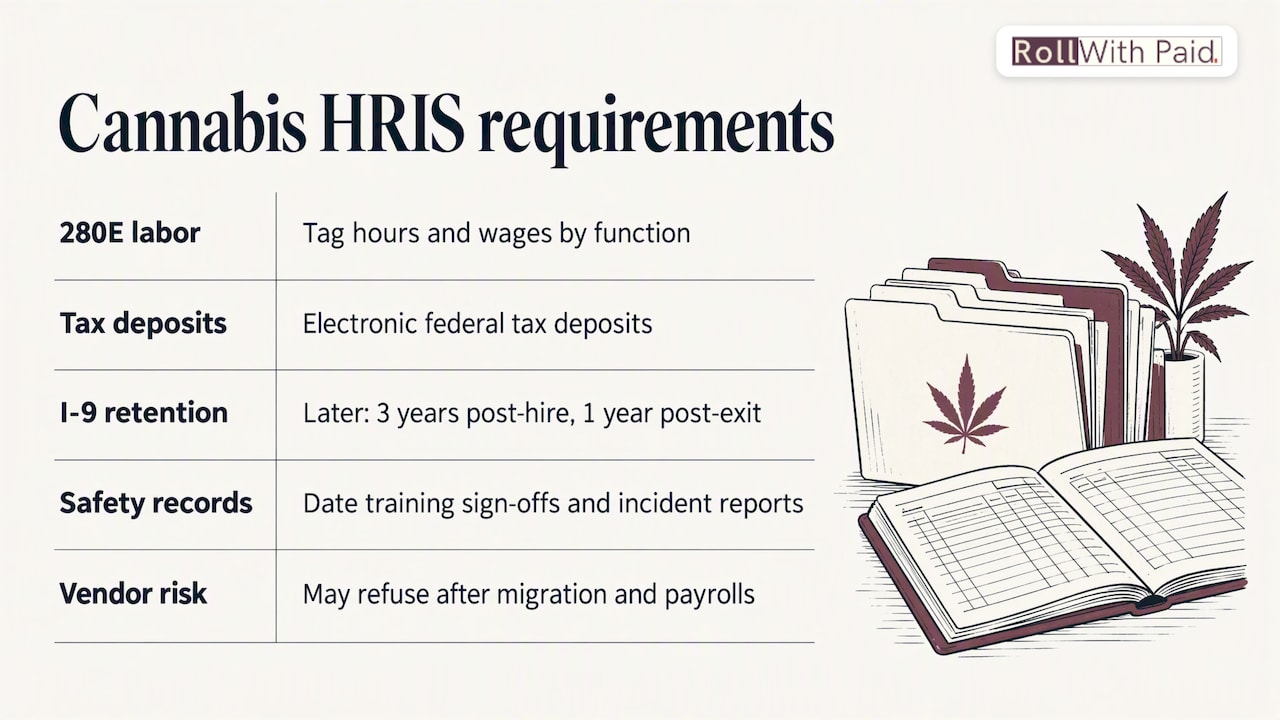
Labor allocation for 280E. Under Section 280E, plant-touching businesses cannot deduct most ordinary business expenses. As the National Taxpayer Advocate explains, cost of goods sold is the main route to a legitimate deduction, which makes it important to separate cultivation labor from general administrative work in payroll records. If your system cannot tag hours and wages by function, your accountant ends up rebuilding that split by hand every quarter. We cover the mechanics in 280E and payroll: what cannabis employers need to understand.
Reliable federal deposits. Employers must withhold and deposit federal income, Social Security and Medicare taxes, and the IRS requires electronic deposits. IRS Publication 15 notes that employers who fail to withhold, deposit or pay may face the trust fund recovery penalty, and that dishonored payments carry a penalty of $25 or 2% of the payment, whichever is greater.
I-9 discipline. Every employer must complete Form I-9 for each hire. The USCIS Handbook for Employers (M-274) is the reference, and retention runs three years after hire or one year after employment ends, whichever is later. High turnover in dispensaries makes this a steady source of paperwork errors.
Safety documentation. OSHA has a Local Emphasis Program for cannabis industries, and injury records and training logs are what inspectors ask for. An HRIS that stores training sign-offs and incident reports with dates is doing real defensive work.
A vendor that stays. This one is least visible on a feature list. HR managers in the industry say the most common frustration with standard platforms is that they refuse to work with cannabis, sometimes after you have already migrated your data and run several payrolls.
The main options at a glance
Published ratings for cannabis-friendly payroll software vary widely, from 6.2 to 9.1 out of 10 on review platforms, so treat any single score with caution. The table below sorts the options by the type of product, not by a made-up ranking.
| Option | Type | Best for | Watch for |
|---|---|---|---|
| Evolve HCM | Cannabis-specific HCM software | Small to mid-size operators who want an in-house HR tool with 280E features | You still run the system, file the paperwork and own the compliance outcome |
| KayaPush | Cannabis-focused payroll, HR, scheduling | Dispensaries that want scheduling and time tracking tied to payroll | Confirm multi-state depth and how support handles filings |
| Paychex, Paycor | Mainstream payroll and HR | Operators whose provider has explicitly approved their license type | Account stability if underwriting changes |
| BambooHR, Gusto | Mainstream HR or payroll | Strong employee experience, easy setup | Not built for 280E allocation or high-risk workers’ comp classes |
| Roll With Paid | Managed payroll, HR and Employer of Record | Owners who want compliance carried for them, not just software | Service model, so it replaces tools rather than adding one |
Cannabis-specific HRIS platforms
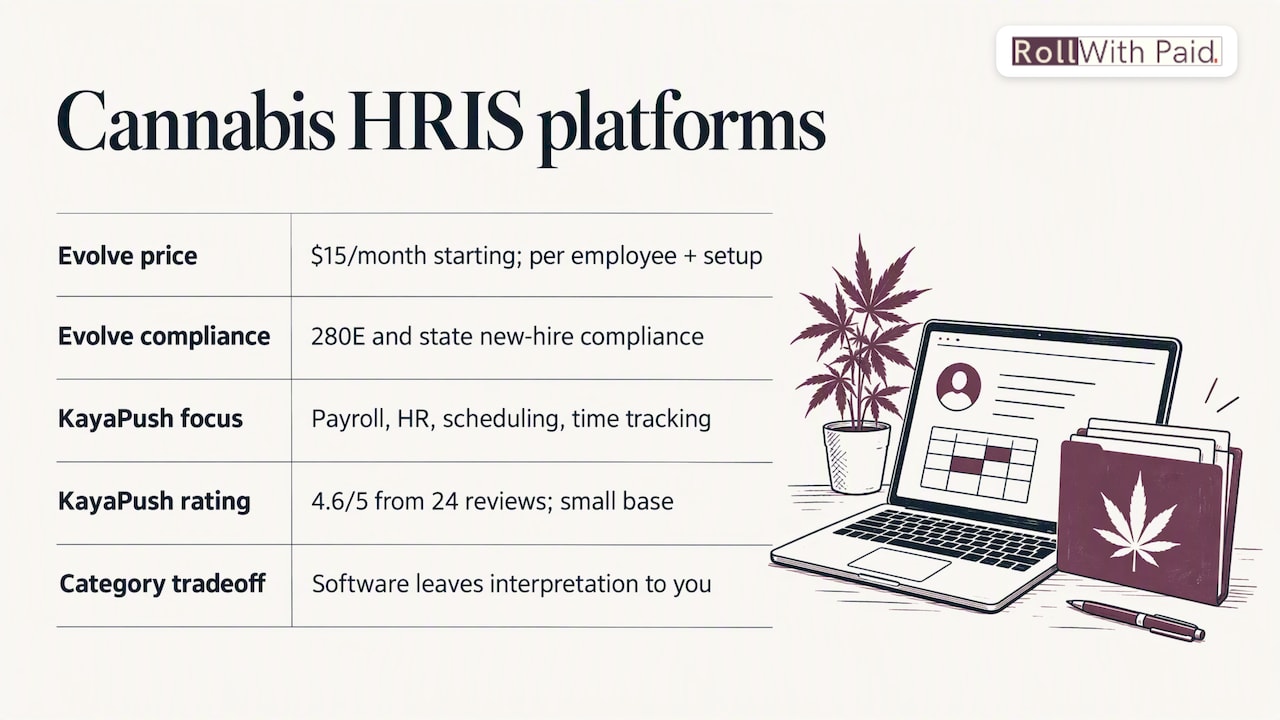
Evolve HCM describes itself as a SaaS HR and payroll product for small to mid-size cannabis employers. Its Software Advice listing names recruitment, onboarding, benefits management, performance management, time and labor with payroll and tax filing, plus 280E compliance and state-by-state new hire compliance. Pricing is shown as starting at $15.00 per month on that listing, with fees structured per employee per month plus a one-time implementation charge. Treat the starting figure as an entry point and ask for a full quote for your headcount.
KayaPush positions itself around payroll, HR, scheduling and time tracking for dispensaries. Its G2 profile shows a 4.6 out of 5 rating from 24 reviews at the time we checked. That is a small review base, so read the individual reviews for your state and store size.
The case for this category is obvious: the product was designed with your industry in mind, and the feature set matches your daily operations. The tradeoff is that a software tool leaves interpretation to you. If a worker is coded to the wrong class or a state registration is missed, the software processed what you entered.
Mainstream platforms that serve cannabis
Some general providers do take cannabis clients. A 2026 roundup of cannabis payroll tools lists Paychex, Paycor and Paper Trails alongside the specialists, and another 2026 comparison includes BambooHR, Rippling and Gusto, with Hybrid Payroll flagged as the cannabis-specific pick.
Be careful with the word “supports.” A provider may process your payroll today under an underwriting exception and still reserve the right to end the relationship. One HR manager’s review describes cannabis operators switching to cannabis-friendly providers after mainstream tools led to account terminations that halt operations. Before signing with a mainstream vendor, ask these questions in writing:
- Do you currently serve plant-touching cannabis businesses, or only ancillary ones?
- Under what conditions can you terminate, and with how much notice?
- Can the system tag labor by COGS and non-COGS function?
- Who files and who is liable if a deposit is late?
The answers to the fourth question separate software from service, and that is where the next category comes in.
Software versus a managed Employer of Record
An HRIS is a tool. You still need people to use it correctly, watch deadlines and respond when a state agency or insurer asks questions. Under an Employer of Record arrangement, a provider becomes the employer for payroll, tax filing, workers’ comp and certain HR functions, and you direct the daily work. We explain the structure in understanding Employer of Record for high-risk industries and in what an Employer of Record is and why it matters for your benefits.
The tradeoffs are plain:
- Software gives you control and a lower line item, but you carry the workload and the risk.
- EOR moves filings, classification and much of the compliance workload to a specialist, in exchange for a service fee based on payroll.
If your team has a seasoned HR director and a cannabis-literate bookkeeper, software may be all you need. If you are an owner who is also the HR department, a service is often the safer choice.
How Roll With Paid approaches it
We built Roll With Paid for high-risk industries, with cannabis at the center, including businesses that traditional payroll providers turn away. What we provide:
- Payroll execution with audit-ready processes
- HR and compliance solutions, including I-9 support, regulatory filings and policy documentation
- Employer of Record services that include workers’ compensation
- Employee onboarding built around your roles and states
- Multi-state hiring support
- Time and attendance tools
Our clients’ results include zero late filings, and we treat that as the standard our process is built to hold. Where tools like Evolve HCM sit on top of your own workflow, we run the workflow with you. For a side-by-side with specific providers, see our comparisons with Paychex, Paragon, Greenleaf HR and Hybrid Payroll.
Our perspective: the HRIS is the smaller decision
We talk with cannabis owners who have spent weeks comparing dashboards and almost no time asking who is responsible when a filing goes wrong. In our experience, the interface matters far less than three things.
First, whether the provider wants your business next year. Cannabis operators tell us the worst moment is a termination notice in the middle of a pay cycle, with employees expecting checks on Friday. Choose a partner whose core market is your market.
Second, how classification is handled. Workers’ compensation rates depend on the class code assigned to each role, and a misassigned code can inflate your premium or create audit exposure. We wrote about this in workers’ comp classification codes: getting them right. A good HRIS lets you record the code. A good partner checks that it is the right one.
Third, whether payroll and accounting tell the same story. Under 280E, a mismatch between labor records and the books is the kind of problem that surfaces during an exam, not before. Treat payroll as a risk-management function and the rest follows.
Software is a fine choice when you have the people to operate it. When you do not, buy the outcome, not the screen.
— Leah Kollross
Comparison criteria that actually separate the options
Use this checklist when you shortlist vendors. Score each from 0 to 2 and compare totals.
Industry commitment
Ask for a written statement that plant-touching cannabis is a supported customer type, and ask how many cannabis clients they serve. A vendor that hesitates is giving you an answer.
280E reporting
Can you tag hours and wages to functions, and export a report your CPA will accept? If the answer is “export to a spreadsheet,” you are doing the work.
Multi-state coverage
Every state has its own new hire reporting, wage rules and registration steps. Minnesota operators, for instance, have a specific new hire reporting checklist with penalties for missed filings. If you operate in more than one state, read our guide to audit-ready multi-state cannabis payroll before you pick a platform.
Workers’ comp and risk
Can the provider place coverage, or does insurance sit outside the system? Understanding what your policy covers beyond statutory workers’ comp also matters, and this overview of employers liability coverage is a useful primer to bring to your insurance conversation.
Documentation and incident handling
Training records, handbooks, I-9s and incident reports should live somewhere searchable. If you are weighing tools for this specifically, we compared HR document management options and incident reporting software for cannabis employers.
Skills and workforce planning
Larger operators sometimes want more than records: skills mapping, career pathways and succession planning. Platforms such as TalentJam’s capability intelligence for mid-market organizations sit in that adjacent workforce-planning space. They do not replace payroll compliance, but they can complement an HRIS once your basics are solid.
Total cost
Compare the full picture: per-employee fees, implementation, filing charges, workers’ comp premium and the hours your team spends. A low monthly software fee can cost more than a service once you count the time and the penalty risk.
Which option fits which operator
- Single-location dispensary, in-house HR lead: a cannabis-specific tool such as Evolve HCM or KayaPush is a reasonable shortlist.
- Cultivation or manufacturing with OSHA exposure and complex job classes: favor a provider that handles classification and safety documentation, not only timekeeping.
- Multi-state operator: prioritize state registrations, new hire reporting and consistent policy across jurisdictions. Managed service usually pays for itself here.
- Owner-operator with no HR staff: choose a service that carries filings and compliance, so you are not learning employment law at the same time you are running the store.
If you want a broader operating calendar, our 2026 cannabis HR compliance calendar maps the IRS, OSHA and federal scheduling pressure points. And if you are fixing existing problems, start with five payroll mistakes cannabis businesses can’t afford.
Working with us
Our payroll processing fees are a percentage of and based on gross payroll, with an optional monthly flat-rate HR retainer. Rates vary by worker classification code and headcount, so we do not publish a single number. You can see how pricing is structured on our pricing page, or start from Roll With Paid to talk through your states, headcount and current payroll setup. Onboarding is customized, and you get personalized support rather than a ticket queue.
FAQ
What is the best HRIS for a cannabis dispensary?
There is no single winner. Cannabis-specific tools like Evolve HCM and KayaPush suit dispensaries with in-house HR capacity, while a managed Employer of Record suits owners who want filings and compliance carried for them. Choose by industry commitment, 280E reporting and who bears liability, not by interface alone.
Can I use a mainstream HRIS like Paychex or BambooHR for a cannabis business?
Sometimes, but confirm in writing that your license type is supported and under what conditions the vendor can terminate. Industry reviewers describe sudden terminations as a common problem with standard platforms. Also check that the system can separate labor for 280E purposes.
Does an HRIS handle 280E compliance automatically?
No software makes 280E go away. A good system helps you tag labor by function so your accountant can support cost of goods sold deductions, but the classification decisions remain yours or your provider’s. Review them with a CPA experienced in cannabis.
What does a cannabis HRIS cost?
It varies. Evolve HCM lists a starting price of $15.00 per month on Software Advice, with per-employee billing and one-time implementation. Managed services like ours are priced as a percentage tied to gross payroll, with rates varying by classification code and headcount.
Sources
- Best Cannabis Business Payroll Software, StatPit
- UZIO review for cannabis businesses, TrustRadius
- National Taxpayer Advocate on marijuana-related business tax challenges
- IRS Publication 15 (2026)
- USCIS Handbook for Employers M-274
- OSHA CPL 24-04, Local Emphasis Program for Cannabis Industries
- Evolve HCM on Software Advice
- KayaPush on G2
- Best Payroll Software for Cannabis-Industry Businesses in 2026, StrategyDriven
Recommended
- Cannabis HR Calendar 2026: IRS Deadlines, OSHA Scrutiny, DEA Changes
- HR First Incident Reporting Software for Cannabis Employers
Roll With Paid. is not a law firm and does not provide legal advice. This article summarizes Minnesota law as of August 2026 and is general information only. Tip arrangements are fact-specific; before changing a policy, consult employment counsel or contact DLI Labor Standards at 651-284-5075.