
Protect Cannabis Payroll From 280E: Roll With Paid vs Hybrid Payroll

For most cannabis operators weighing payroll partners, we recommend Roll With Paid over a standard hybrid payroll setup like Hybrid Payroll because an Employer of Record model shifts real compliance weight off your shoulders. The reasoning comes down to specialization: audit-ready recordkeeping, 280E-aware payroll practices, and a structure built for high-risk industries rather than adapted to fit them. Below, we unpack the operational tradeoffs, the tax stakes, and how to vet any provider before you sign.
TL;DR:
- Most cannabis operators should choose an Employer of Record model like Roll With Paid to shift payroll compliance and reduce audit-related liabilities.
- An EOR handles payroll tax filings, workers’ compensation, unemployment accounts, and day-to-day HR responsibilities, unlike hybrid models where the business remains the legal employer.
- Proper documentation of production labor via real-time timesheets and job descriptions is essential for reducing 280E tax exposure, especially under an EOR that enforces discipline.
- The decision to switch providers should be carefully managed with documented data transfer, clear timing, and confirmation of filings to prevent reconciliation issues.
- Specialized EOR providers built around cannabis needs incorporate workflow habits that help maintain compliance in complex multi-state and high-risk environments.
Table of Contents
- How an Employer of Record Differs From Standard Payroll
- Why the Payroll Model You Pick Affects Your 280E Exposure
- A Checklist for Vetting Any Payroll Provider
- How to Transition Payroll Providers Without Creating Gaps
- Weighing the Tradeoffs: Paid Payroll vs. Hybrid Models
- Cash Flow and the Employee Experience Under Each Model
- Compliance Issues Beyond 280E That Cannabis Payroll Must Handle
- Technology Considerations When Comparing Payroll Systems
- Where Each Model Tends to Make Sense in Practice
- Why Specialization Changes the Risk Calculation
- How Roll With Paid Addresses This Checklist
- FAQ
- Sources
How an Employer of Record Differs From Standard Payroll
The distinction between an EOR and a standard or hybrid payroll arrangement comes down to who legally holds the employment relationship. Under a typical hybrid setup, like what Hybrid Payroll offers, your business stays the legal employer of record. You keep your Federal Employer Identification Number (FEIN) tied to every employee, and the payroll provider acts mainly as an administrative processor, cutting checks and filing forms on your instructions. Under an Employer of Record model, a specialized partner like Roll With Paid becomes the legal employer for payroll purposes, taking on responsibilities that would otherwise sit entirely with you.
That shift matters because several liabilities move with it:
- Payroll tax filing and deposits typically transfer to the EOR, which files under its own tax accounts.
- Workers’ compensation administration often moves to the EOR’s policy, which can reduce your direct claims exposure.
- Unemployment insurance accounts may shift to the provider, depending on the state and the arrangement’s structure.
- Day-to-day HR execution (onboarding paperwork, wage statements, benefits enrollment) generally becomes the EOR’s job, not yours.
What stays with you, regardless of model, is the underlying business risk: hiring decisions, workplace conduct, and strategic direction. Co-employment does not erase your role; it redistributes the paperwork and the regulatory contact points.
Here’s how the audit-notice question tends to play out in practice:
- A state agency flags a wage discrepancy or workers’ comp claim.
- Under standard payroll, the notice lands on your FEIN and your desk.
- Under an EOR arrangement, the notice often routes to the provider first, since filings were made under their accounts.
- The EOR coordinates a response using records it has maintained continuously, rather than reconstructing them after the fact.
Pro Tip: Ask any provider, EOR or otherwise, exactly whose FEIN appears on your quarterly wage filings before you sign anything.
For a deeper comparison of co-employment structures, our breakdown of what an Employer of Record does and why it matters covers the mechanics in more detail, and the third-party primer on EOR versus PEO models is a useful neutral reference if you want another angle on the distinction.
Why the Payroll Model You Pick Affects Your 280E Exposure
Section 280E disallows most ordinary business deductions for companies that traffic in a federally controlled substance, which still includes marijuana under current law. The IRS confirmed as recently as mid-2024 that marijuana remains a Schedule I substance and that 280E still applies until any rescheduling takes effect. The one meaningful offset is Cost of Goods Sold: properly calculated COGS reduces gross receipts even though it is not technically a “deduction” in the 280E sense, according to IRS guidance on business expenses.
That guidance draws a sharp line between payroll categories. Direct production labor, think trimmers, cultivators, and extraction technicians, can often be allocated to COGS when the time is properly documented. General administrative payroll, including most sales, marketing, and office staff wages, generally cannot. Employer-side payroll taxes like FICA, FUTA, and state unemployment are treated separately again, and benefits or workers’ comp premiums carry their own complicated treatment.
The documentation bar matters more than most operators expect. Auditors look for contemporaneous timesheets, production logs, and clear job descriptions tying hours to specific cultivation or production tasks, not a spreadsheet assembled the week before filing.
What auditors typically want to see:
- Real-time clock-in and clock-out records tied to specific production tasks.
- Written job descriptions that distinguish production labor from administrative work.
- Consistent labor allocation methodology applied the same way every pay period.
An EOR that builds these habits into onboarding, rather than treating them as a once-a-year scramble, reduces the friction when an audit notice eventually arrives. That structural discipline is a large part of why we point most cannabis operators toward a specialized partner over a generic hybrid setup. Our page on 280E and payroll walks through the recordkeeping side in more depth.
A Checklist for Vetting Any Payroll Provider
Before signing with any provider, EOR or hybrid, run through a short list of questions that exposes how the relationship actually works day to day.
- Who owns the FEIN on filings, and who receives notices from state agencies first? This determines your real audit exposure.
- Who controls the workers’ compensation policy, and who pays claims? Ask for the carrier name and policy structure, not just a confirmation that coverage exists.
- What documentation do you require for COGS labor allocation, and how is it captured? Timesheets and production logs should be built into the workflow, not bolted on later.
- What is your audit support process? Ask whether support is included or billed separately, and whether it covers correspondence, not just document handoff.
- Do you handle multi-state withholding and I-9 or E-Verify compliance? Cannabis operators expanding across state lines need this answered concretely, not in general terms.
- How is pricing structured: percentage of gross payroll, or flat retainer? Ask what triggers additional fees, especially around claims or audit support.
Pro Tip: If a provider hesitates to name their workers’ comp carrier or explain who fields an audit notice, treat that hesitation as your answer.
Watch for a few consistent red flags: vague answers about claims handling, no audit assistance beyond “we’ll send you the files,” and unclear insurance carriage that the provider can’t explain in plain terms. These gaps tend to surface three months into a relationship, not during the sales call.
How to Transition Payroll Providers Without Creating Gaps
Switching providers, or engaging an EOR for the first time, goes smoothly when you treat it as a documented project rather than a flip of a switch.
Before the switch, gather:
- Payroll history for at least the current and prior tax year.
- Confirmation of tax deposits already made for the current quarter.
- Workers’ compensation policy details and current experience modification rate.
- Worker classification codes for every role, especially production versus administrative staff.
Onboarding typically moves through a few milestones: data transfer and verification, a test payroll run to catch classification or withholding errors, the first live payroll cycle, and confirmation that filings landed correctly with the right agencies.
Timing matters. Avoid switching mid-quarter or right at year-end when possible; straddling a tax quarter between two providers’ filing systems creates reconciliation headaches that can take months to untangle.
Document the transition itself: retain the signed service agreement, any handoff memo from your prior provider, and dated records of the first several payroll runs. These documents become your evidence trail if questions arise later about who was responsible for what, when. Our list of common payroll mistakes cannabis businesses make covers several transition pitfalls worth reviewing first.
Weighing the Tradeoffs: Paid Payroll vs. Hybrid Models
A standard or hybrid payroll model, the kind many generalist providers offer, keeps you in direct control of employment decisions and often costs less on paper, since you’re paying for processing rather than assumed liability. That control comes with a cost: you retain the FEIN, the workers’ comp exposure, and the burden of building audit-ready labor records yourself.
An Employer of Record model trades some of that direct control for shared liability and built-in compliance infrastructure. You lose a degree of autonomy over how payroll mechanics run day to day, but you gain a partner whose own filings, policies, and recordkeeping are on the line alongside yours.
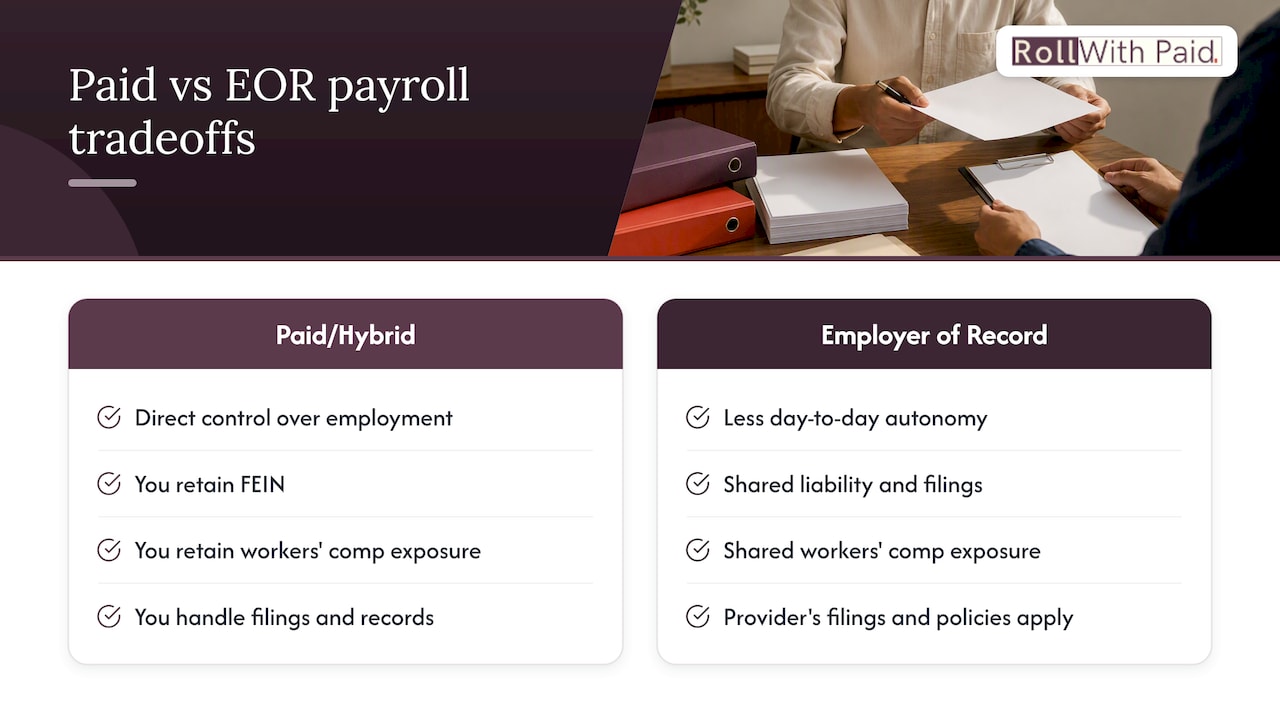
For a cannabis operator, the calculus tends to tilt toward the EOR model specifically because the downside of getting payroll wrong, a 280E audit, a misclassified worker, a lapsed workers’ comp filing, is disproportionately severe compared to other industries. A hybrid approach can work for operators with strong in-house HR expertise and the bandwidth to maintain contemporaneous production logs themselves. For everyone else, the administrative burden of doing it right without specialized support is easy to underestimate until an audit notice arrives.
Cash Flow and the Employee Experience Under Each Model
Payroll model choice affects more than compliance paperwork; it shows up in your cash flow planning and in what your employees actually experience each pay period.
Under a percentage-of-payroll pricing structure, common with EOR arrangements, your payroll cost scales directly with headcount and wage growth, which makes budgeting more predictable as you expand into new states or add shifts. A flat retainer model, more common with traditional hybrid processors, can feel cheaper at low headcounts but less predictable as you scale, since service tiers or add-on fees often kick in once you cross certain thresholds.
For employees, the difference is often invisible day to day, paychecks still arrive, but it shows up in the margins: how quickly a benefits question gets answered, how smoothly a new hire’s paperwork moves, and how consistently withholding gets calculated across multiple states if your workforce spans more than one. A provider with dedicated cannabis experience tends to handle these edge cases, like unusual shift differentials in cultivation facilities, with fewer errors than a generalist processor encountering them for the first time.
Compliance Issues Beyond 280E That Cannabis Payroll Must Handle
Section 280E dominates the conversation, but it is far from the only compliance layer cannabis payroll has to manage. Multi-state operations face a patchwork of state-specific wage and hour rules, some of which were written without cannabis in mind and require careful interpretation for cultivation and production shifts.
I-9 verification and E-Verify requirements carry extra weight in an industry where federal and state law diverge, and getting worker eligibility documentation wrong compounds other regulatory exposure. Workers’ compensation rating for cannabis-specific job classifications, trimmer, cultivator, extraction technician, often falls outside standard insurance codes, which means misclassification can distort premium calculations and claims handling. Tribal land operations add another layer of jurisdictional complexity that most generalist payroll providers have never encountered. Each of these issues demands payroll infrastructure built around cannabis operations specifically, not a generic system retrofitted after the fact.
Technology Considerations When Comparing Payroll Systems
The technology stack behind your payroll choice determines how much manual reconciliation you do every pay period. A standard hybrid system often integrates with mainstream time and attendance tools that were not designed with COGS labor allocation in mind, which means someone on your team has to manually tag hours to production categories after the fact.
A payroll system built for cannabis operators should capture production versus administrative labor at the point of entry, not as a downstream correction. That matters for 280E substantiation, since contemporaneous tagging is far more defensible in an audit than a reconstructed spreadsheet. Integration with state-specific withholding tables, multi-state filing systems, and benefits administration platforms also varies widely between providers; a system that handles one state cleanly may require manual workarounds the moment you open a second location. When evaluating any provider’s technology, ask specifically how labor categorization happens: automatically at clock-in, or manually after the fact.
Where Each Model Tends to Make Sense in Practice
A single-location dispensary with a small, stable staff and an owner comfortable handling HR administration personally might reasonably choose a hybrid payroll model, accepting the extra recordkeeping work in exchange for lower monthly fees and direct control.
A multi-state cultivation operation with dozens of production employees, shifting harvest schedules, and exposure to several state tax authorities faces a different calculation entirely. The volume of contemporaneous labor documentation required for defensible COGS allocation, combined with multi-state withholding and workers’ comp complexity, makes the administrative burden of a hybrid model difficult to sustain without dedicated internal HR staff.
A growing dispensary chain expanding into a second or third state often sits in between: outgrowing a simple hybrid setup but not yet large enough to justify building an internal compliance team. This is typically where the EOR model’s value becomes clearest, shifting the filing burden and the recordkeeping discipline onto a partner that specializes in exactly this transition point.
Why Specialization Changes the Risk Calculation
Cannabis payroll is not a generalist’s side project. The stakes around 280E, multi-state licensing, and workers’ comp classification punish shortcuts that would be minor inconveniences in most other industries. A provider that treats cannabis as its core focus, rather than an exception to its standard playbook, tends to build recordkeeping habits into the workflow instead of bolting them on after an audit notice arrives.
That specialization is the single factor we weigh most heavily when comparing providers for operators in this space. For readers who want to go deeper on how an EOR model is built around high-risk industries specifically, our guide to Employer of Record structures for high-risk businesses is a useful next stop.
— Leah
How Roll With Paid Addresses This Checklist
We built our service around the exact questions this article walks through, focusing on cannabis and other high-risk industries rather than treating them as an edge case. Our model handles payroll execution, HR and compliance work, and onboarding with recordkeeping discipline suited for 280E audits.

What that looks like in practice:
- Employer of Record coverage that includes payroll tax filing, workers’ comp administration, and FEIN-level responsibilities.
- Payroll practices designed to address 280E considerations during onboarding.
- Multi-state hiring support and time and attendance tools suited to cultivation and dispensary shift patterns.
- Consistent on-time filings, underscoring the audit-readiness emphasized in client relationships.
If you are weighing whether an EOR model fits your operation, visit our pricing page to see how our service rate and HR retainer options line up with your headcount, or reach out through Rollwithpaid to talk through your current setup.
This article is general information, not a substitute for advice from a qualified financial advisor. Consult a qualified financial professional about your own circumstances before acting on anything here.
FAQ
What is the difference between an EOR and standard payroll?
An Employer of Record becomes the legal employer for payroll purposes, taking on tax filings and often workers’ comp administration, while standard payroll keeps your business as the legal employer with the provider handling processing only. The shift changes who holds liability and who receives agency notices first.
Does Section 280E apply to all cannabis business expenses?
Section 280E disallows most ordinary deductions for businesses trafficking in a federally controlled substance, and the IRS confirmed in 2024 that this still applies to marijuana businesses. Properly calculated Cost of Goods Sold remains the main avenue for reducing gross receipts, which is why labor allocation documentation matters so much.
Can payroll records help with COGS allocation under 280E?
Yes. Direct production labor, like cultivation or extraction work, can often be allocated to COGS when supported by contemporaneous timesheets and job descriptions, according to IRS business expense guidance. Administrative and sales payroll generally cannot be allocated this way.
How much does Roll With Paid cost?
Pricing is based on a service rate tied to gross payroll, with an optional HR retainer for additional support, and exact figures are available by request through our pricing page. Rates vary by worker classification and headcount, so we quote them individually rather than publishing a flat number.
How long does it take to switch payroll providers?
Timelines vary by operator, but a typical transition includes data transfer, a test payroll run, and a first live cycle before filings are fully confirmed with the right agencies. Avoiding a switch mid-quarter or at year-end tends to reduce reconciliation problems significantly.
Sources
Recommended
- 280E and Payroll: What Cannabis Employers Need to Understand
- 5 Payroll Mistakes Cannabis Businesses Can’t Afford
- I-9 and E-Verify: A Compliance Guide for Cannabis Employers
Roll With Paid. is not a law firm and does not provide legal advice. This article summarizes Minnesota law as of August 2026 and is general information only. Tip arrangements are fact-specific; before changing a policy, consult employment counsel or contact DLI Labor Standards at 651-284-5075.