
Minnesota Holiday Pay for Employers: 1.5× Nursing Home Rule
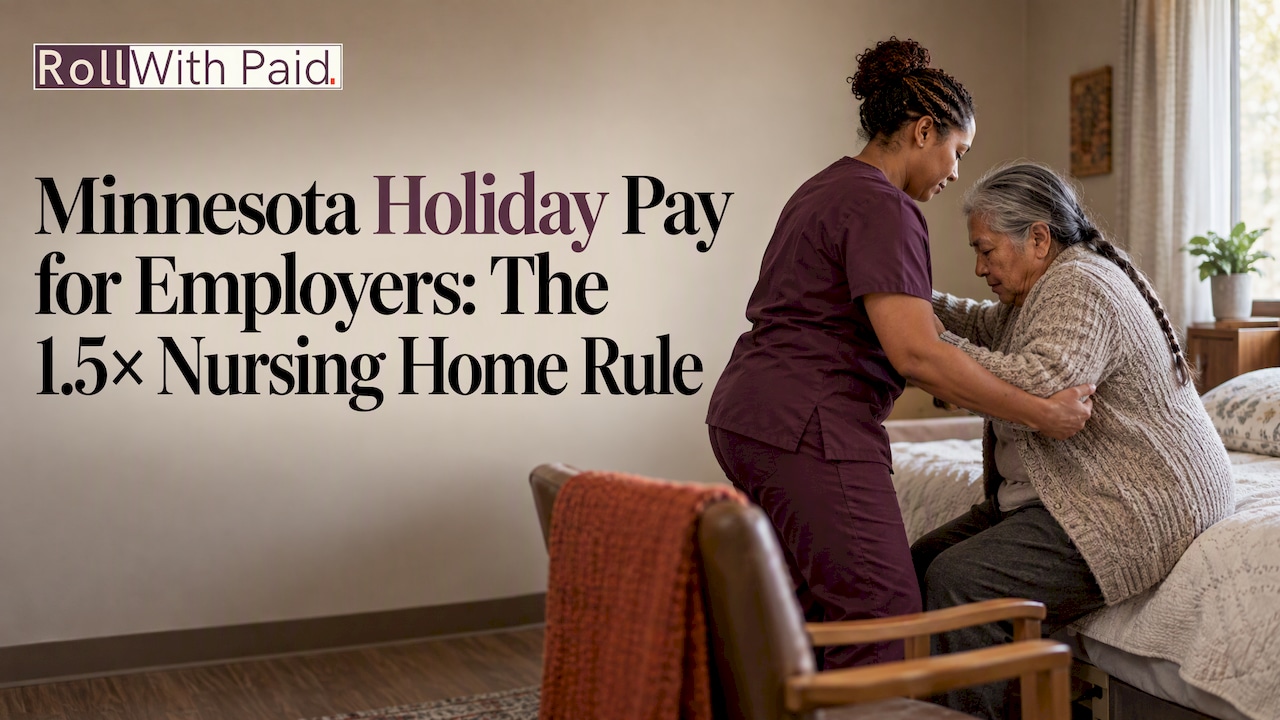
Minnesota law does not require private employers to offer paid holidays or pay extra for working one, with one notable exception: nursing home workers, who must receive at least time-and-a-half on 11 specific state holidays. Separately, Minnesota Paid Leave and earned sick and safe time (ESST) create their own obligations starting in 2026, but neither one amounts to a general holiday-pay mandate.
TL;DR:
- Covered nursing home workers must receive at least 1.5 times their regular rate for hours worked midnight to midnight on any of 11 state holidays.
- Nursing homes may substitute up to four holidays with majority worker agreement, documented and retained for three years; some administrative and supervisory roles are excluded.
- Written holiday promises in handbooks, offer letters, or union agreements become enforceable; define eligibility and calculations, and check whether collective agreements set different terms.
- For overtime, only hours actually worked count: an employee who works 32 hours and receives eight holiday hours has worked 32, not 40.
- Minnesota Paid Leave began January 1, 2026, with premiums due April 30; ESST accrues one hour per 30 worked, up to at least 48 annually.
Table of Contents
- What Minnesota Law Says About Holiday Pay in the Private Sector
- Sector Exception: Nursing Home Worker Holiday-Pay Rules
- Minnesota Paid Leave and ESST: Separate From Holiday Pay
- Paying Employees Who Work on a Holiday: Rules and Overtime Interaction
- Practical Payroll and Policy Steps for Minnesota Employers
- Why Clear Holiday-Pay Policies Matter for High-Risk Employers
- How We Help Minnesota Employers Manage Holiday Pay, ESST, and Paid Leave
- FAQ
- Sources
What Minnesota Law Says About Holiday Pay in the Private Sector
If you run a business in Minnesota and have never offered holiday pay, you are not out of compliance. According to the Minnesota Department of Labor and Industry’s wage and overtime guidance, holiday pay is voluntary for private employers. There is no state statute that forces you to close on New Year’s Day, pay time-and-a-half on Thanksgiving, or give workers Labor Day off with pay.
That surprises people because Minnesota does have a defined list of state holidays. Those dates exist for public-business observance purposes, not as a private-sector pay mandate. A state holiday on the calendar and a paid day off at your company are two things wearing one name, and conflating them is where a lot of confusion starts.
Here is where it gets binding, though: once you write a holiday-pay promise into an employee handbook, offer letter, or collective bargaining agreement, that promise becomes enforceable. DLI guidance on wage disputes points to exactly this kind of documentation when resolving claims, which means a vague or inconsistent handbook clause can create liability you never intended.
Key points to keep straight:
- Private employers decide independently whether to offer paid holidays or holiday premiums.
- A written policy, contract, or union agreement turns a voluntary benefit into a binding obligation.
- Ambiguous eligibility or calculation language is the most common source of holiday-pay disputes.
- Collective bargaining agreements can set holiday terms that override your standard handbook policy for union employees.
If you offer holiday pay for competitive reasons, which many employers do, write the eligibility rules and calculation formula in plain language before you publish them.
Sector Exception: Nursing Home Worker Holiday-Pay Rules
Nursing homes are the clear carve-out to Minnesota’s voluntary approach. Under the Nursing Home Workforce Standards Board (NHWSB) rules, covered nursing home workers who work on any of the 11 state holidays must be paid at least time-and-a-half for every hour worked during that holiday period, effective January 1, 2025. A holiday period runs midnight to midnight on the calendar date.

At least 1.5 times the regular rate is the floor nursing homes must pay for holiday hours worked, a standard set specifically for this sector and not required anywhere else in Minnesota’s private economy, according to DLI’s NHWSB holiday-pay guidance.
The 11 statutory holidays, defined in Minnesota Statutes §645.44, are:
- New Year’s Day
- Martin Luther King Jr. Day
- Washington’s and Lincoln’s Birthday (Presidents’ Day)
- Memorial Day
- Juneteenth
- Independence Day
- Labor Day
- Indigenous Peoples’ Day
- Veterans Day
- Thanksgiving Day
- Christmas Day
Nursing homes can substitute up to four of these holidays for alternate days, but only if a majority of affected workers agree, and that agreement needs to be documented and retained for three years. The rules also carry posting and recordkeeping obligations, so facilities need to keep holiday-pay notices visible and accessible, the same way other wage postings are maintained. If you operate a facility that falls under NHWSB jurisdiction, check your current roles against the statute’s definition of covered nursing home worker, since some administrative and supervisory positions are excluded.
Minnesota Paid Leave and ESST: Separate From Holiday Pay
A lot of employers assume that once Minnesota Paid Leave and earned sick and safe time are in place, holiday pay is somehow covered too. It is not. These are distinct programs addressing different situations, and neither one creates a holiday-pay requirement.
Minnesota Paid Leave became available on January 1, 2026. First premium remittances are due April 30, 2026.
Earned sick and safe time works differently. Employees accrue one hour of ESST for every 30 hours worked, up to at least 48 hours per year, and ESST must be paid at the employee’s base rate when used. Some cities, including Minneapolis and St. Paul, maintain their own sick-and-safe-time ordinances, so employers there need to apply whichever standard is more generous to the worker.
| Program | What it covers | Key figure |
|---|---|---|
| Minnesota Paid Leave | Family and medical leave insurance | 0.88% premium rate, effective January 1, 2026 |
| Earned Sick and Safe Time | Accrued paid sick and safe leave | 1 hour per 30 worked, up to 48 hours minimum |
| Nursing home holiday pay | Holiday premium for covered workers | At least 1.5x pay on 11 state holidays |
PTO can satisfy your ESST obligation, but once you designate PTO hours to meet ESST, those hours pick up ESST’s protections, including notice rules and anti-retaliation provisions, even when an employee is using the time for an ordinary vacation day. Our guide to avoiding ESST audits walks through the payroll mechanics in more detail, and our breakdown of employer obligations after Paid Leave’s launch covers the reporting timeline step by step.
Paying Employees Who Work on a Holiday: Rules and Overtime Interaction
Outside the nursing home exception, any holiday premium you pay is a product of your own policy or contract, not a legal mandate. You decide the rate, the eligibility rules, and whether it applies to part-time staff.
One detail trips up payroll teams constantly: holiday pay does not count as hours worked for overtime purposes. According to Minnesota’s overtime guidance, overtime is calculated on actual hours worked in a seven-day workweek. If an employee works 32 hours and receives eight hours of holiday pay, that employee has worked 32 hours for overtime purposes, not 40.
A few practical points:
- Holiday premiums are voluntary and governed entirely by your written policy.
- Paid holiday hours never count toward the 40-hour overtime threshold.
- Exempt employees generally receive their full salary regardless of holiday closures, and adding a holiday premium on top requires careful handling so it doesn’t jeopardize salary-basis status.
- Pay-period calculations should treat holiday pay as a separate line item from regular wages, not blended into the hourly rate.
Pro Tip: Build a distinct pay code for holiday premiums in your payroll system so audits and year-end reconciliations don’t require manually separating holiday hours from regular hours worked.
Practical Payroll and Policy Steps for Minnesota Employers
Whether you offer holiday pay or not, the paperwork around your decision matters more than the decision itself. A documented, consistently applied policy is what protects you if a dispute arises.
- Define your holidays and eligibility rules in writing, including whether part-time or newly hired employees qualify.
- Set your premium rate formula, if you choose to pay one, and state clearly how it interacts with PTO or ESST.
- Build dedicated payroll codes for holiday premiums so they are excluded from overtime calculations automatically.
- Map out your Paid Leave premium reporting timeline, with the first remittance due April 30, 2026, and confirm your payroll system can handle the deduction split.
- Keep NHWSB-related postings and holiday-pay records on file if you operate a covered nursing home, including documentation of any majority-agreement holiday substitutions.
- Run a test payroll cycle before any policy change takes effect, and document every decision in case DLI or an employee later asks for the rationale.
Pro Tip: If you operate across multiple states, run a side-by-side comparison of each state’s holiday-pay, ESST, and overtime rules before finalizing a single company-wide handbook; one template rarely fits every jurisdiction cleanly. For a deeper look at handbook structure across states, our employee handbook software comparison breaks down what each tier typically covers.
Employers managing workers’ compensation exposure alongside holiday premiums may also find it useful to review workers’ compensation insurance options from Daly & Alexander, since holiday and overtime pay structures factor into total labor-cost calculations insurers consider.
Why Clear Holiday-Pay Policies Matter for High-Risk Employers
Cannabis operators and other high-risk employers face a sharper version of every compliance question in this article, because regulators and auditors tend to scrutinize these businesses more closely. A clear, written holiday-pay policy does more than satisfy a legal technicality. It reduces scheduling friction during the highest-demand retail days of the year, and it gives new hires a concrete reason to stay when competing operators offer vague or inconsistent terms.
Some Minnesota cannabis and cultivation employers have struggled with exactly this gap: a verbal promise of holiday pay that nobody wrote down, followed by a dispute nobody expected. Documenting your policy, storing your NHWSB notices if applicable, and keeping Paid Leave and ESST reporting on a fixed calendar are the practical habits that keep audits short instead of long.
— Leah Kollross
How We Help Minnesota Employers Manage Holiday Pay, ESST, and Paid Leave
Running payroll for a cannabis business or another high-risk operation in Minnesota means tracking NHWSB rules, Paid Leave premiums, and ESST accrual at the same time, often across multiple locations. Our Employer of Record and payroll execution services are designed to handle this kind of complexity, aiming to ensure timely filings for our clients.
- Payroll Execution with dedicated holiday-pay and overtime pay codes built in
- Employer of Record coverage that absorbs multi-state compliance risk
- HR & Compliance Solutions for handbook language, ESST policy design, and Paid Leave reporting
- Multi-State Hiring Support for operators expanding beyond Minnesota
If you want a second set of eyes on your current holiday-pay policy or Paid Leave setup, visit our pricing page or explore what an Employer of Record model covers for your business.
This article is general information, not a substitute for advice from a qualified lawyer. Consult a qualified legal professional about your own circumstances before acting on anything here.
FAQ
What are the legal holidays in Minnesota?
Minnesota recognizes 11 state holidays under Minnesota Statutes §645.44, including New Year’s Day, Memorial Day, Juneteenth, Independence Day, Labor Day, Indigenous Peoples’ Day, Veterans Day, Thanksgiving, and Christmas. This list governs public-business observance and sets the holidays referenced in the nursing home holiday-pay rules, but it does not itself require private employers to provide paid time off.
What is holiday pay versus PTO?
Holiday pay is a premium or wage paid specifically for working on, or being off for, a designated holiday, while PTO is a broader bank of hours employees can use for vacation, illness, or personal time. In Minnesota, neither is required for most private employers, though PTO can be designated to satisfy ESST accrual requirements if structured correctly, as explained in our PTO versus sick leave guide.
What are the new leave policies in Minnesota for 2026?
Minnesota Paid Leave launched January 1, 2026, as a paid family-and-medical-leave insurance program funded by an initial 0.88% premium, with employers’ first remittances due April 30, 2026. This program runs alongside existing earned sick and safe time requirements and does not replace or expand any holiday-pay obligation.
Can my employer deny my Minnesota Paid Leave?
Employers generally cannot deny an eligible employee’s request for Minnesota Paid Leave once the program’s eligibility and notice requirements are met, according to Paid Leave program guidance. Specific denial grounds, such as incomplete documentation or notice failures, are outlined in the program’s official materials, so employees and employers should review the current rules for their exact situation.
Sources
- Wages and overtime FAQs | Minnesota Department of Labor and Industry
- Paid Leave: common questions | Minnesota Paid Leave
- Minnesota Statutes §645.44 — Holidays
Recommended
- Avoid ESST Audits in 2026: Minnesota Sick and Safe Time Payroll Steps
- Employers: 5 Payroll Steps to Comply With Minnesota Paid Family Leave
- Minnesota Paid Leave: Employer Obligations After Launch
- $16.37 Minneapolis Minimum Wage 2026: Payroll Steps Employers Must Take
Roll With Paid. is not a law firm and does not provide legal advice. This article summarizes Minnesota law as of August 2026 and is general information only. Tip arrangements are fact-specific; before changing a policy, consult employment counsel or contact DLI Labor Standards at 651-284-5075.