
Avoid ESST Audits in 2026: Minnesota Sick and Safe Time Payroll Steps
Minnesota requires covered employees to earn paid sick and safe time at a rate of one hour per 30 hours worked, with a required minimum annual accrual and a maximum accrual cap carrying over from year to year. Employers must track balances, notify employees in writing, and report available and used hours on every pay stub. Miss any of those three pieces and you’re exposed, regardless of how well you handle the accrual math itself.
TL;DR:
- Minnesota employers must track and report employee ESST balances every pay period, or risk audit findings, regardless of accrual methods.
- ESST is available to employees expected to work at least 80 hours annually, with accrual starting at hire, even if schedules fluctuate later.
- Employers should choose between per-pay-period accrual or frontloading, ensuring compliance with notice and documentation rules during method changes.
- Use of ESST is broader than typical sick leave, covering personal illness, family care, domestic abuse, and public health emergencies, with specific notice requirements.
- Local ordinances in Minneapolis and St. Paul may require applying the more generous rules, often best managed by standardizing policies across all worksites.
Table of Contents
- What Is Minnesota Sick and Safe Time?
- Who Qualifies for Minnesota Sick and Safe Time?
- How Much Sick and Safe Time Do Minnesota Employees Earn?
- What Can Minnesota Employees Use Sick and Safe Time For?
- What Are Employers Required to Do Under Minnesota Sick and Safe Time?
- Do Minneapolis and St. Paul Have Different Sick and Safe Time Rules?
- Compliance Checklist: What Should Payroll Teams Do Right Now?
- Where Minnesota Employers Actually Get Tripped Up
- How Roll With Paid Keeps ESST Compliance Off Your Plate
- Where to Verify Minnesota Sick and Safe Time Rules
- Sources
- FAQ
What Is Minnesota Sick and Safe Time?
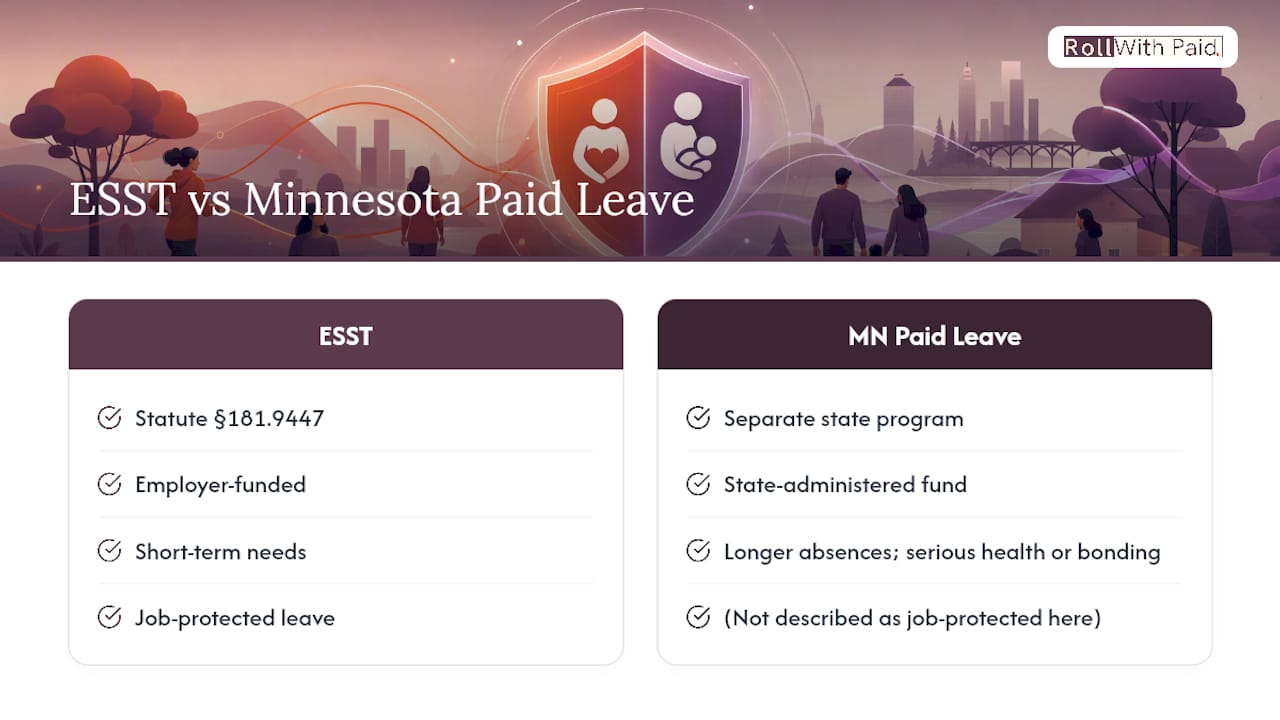
Minnesota earned sick and safe time, commonly shortened to ESST, is a paid leave benefit written into Minnesota Statutes §181.9447. The law entitles eligible workers to earn paid leave for their own illness, a family member’s care, domestic abuse situations, and certain public health closures. It is not the same thing as Minnesota Paid Leave, the state’s separate paid family and medical leave program, and it is not satisfied by a generic PTO bucket unless that PTO meets ESST’s specific accrual, notice, and usage rules.
Two programs, two purposes, one easy point of confusion for payroll teams juggling both. ESST is job-protected, employer-funded leave for short-term needs. Minnesota Paid Leave, by contrast, runs through a state-administered fund for longer absences tied to serious health conditions or bonding. The Minnesota Department of Labor and Industry (DLI) is the primary regulator for ESST, and the statute itself remains the controlling legal text. Any employer building a policy should start with both, not with a template borrowed from another state.
Who Qualifies for Minnesota Sick and Safe Time?
Coverage attaches to any employee anticipated to work at least 80 hours in a year in Minnesota, part-time and full-time alike. Independent contractors fall outside the law, along with a narrow set of other excluded categories such as certain seasonal and federal workers.
The “anticipated” language matters more than employers realize. DLI’s adopted rules require a good-faith evaluation of a new hire’s expected hours and work location at the start of employment, not a wait-and-see approach. Document that evaluation when you make it. If a seasonal or on-call worker’s schedule later balloons past 80 hours, accrual should already be running from day one of employment, since ESST begins accruing at hire, not at the 80-hour mark.
How Much Sick and Safe Time Do Minnesota Employees Earn?
The accrual formula is simple on paper: one hour of ESST for every 30 hours worked, with minimum required and maximum accrual limits per year. An employee working a full-time schedule earns a corresponding amount of ESST, above the minimum but below the maximum.
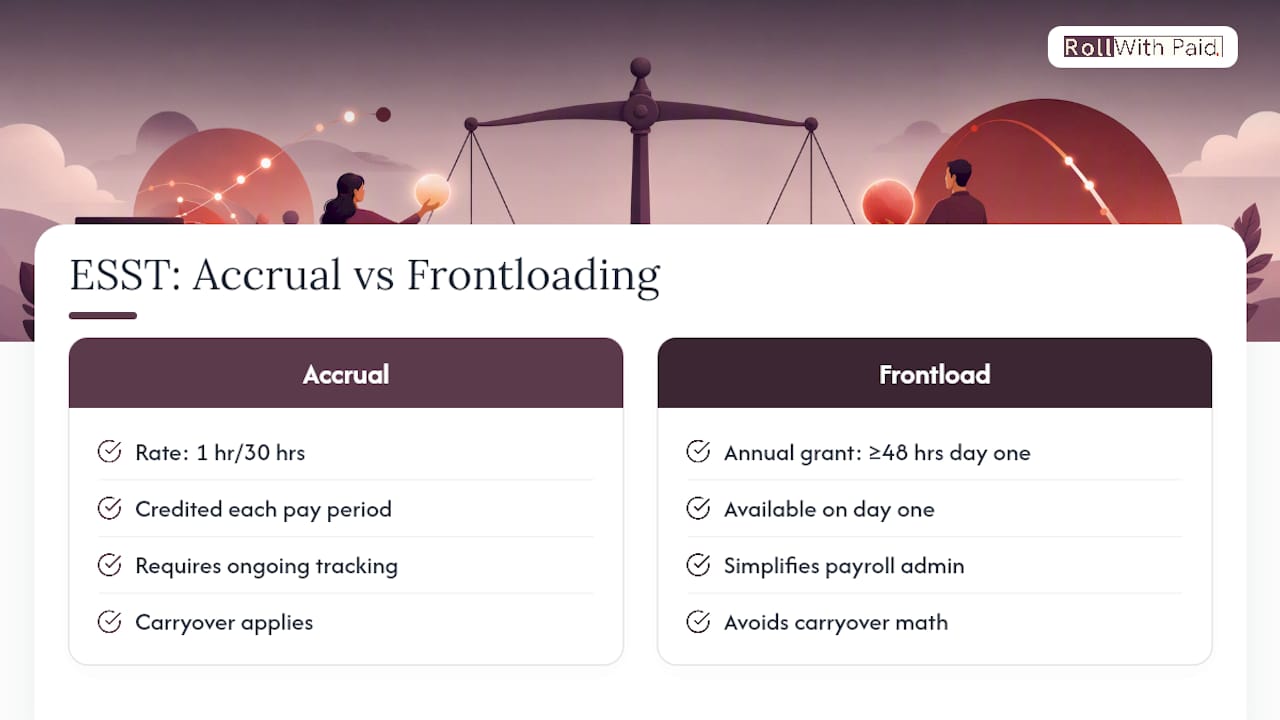
Employers have two paths for meeting this obligation. The accrual method credits hours as they’re earned, pay period by pay period, and requires ongoing tracking. The frontloading method grants the full annual amount, at least 48 hours, on day one of the accrual year, which sidesteps carryover math entirely and simplifies payroll administration considerably. Both are valid under DLI’s adopted rules, but switching between them mid-year triggers notice obligations to affected employees, and the timing of that switch matters for compliance.
Whichever method you choose, ESST needs to be credited and made available by the end of each pay period; a payroll system that posts regular wages weekly but reconciles leave balances monthly creates a gap that shows up fast in an audit. Rehired employees returning within 180 days generally get previously accrued, unused ESST reinstated, so frontloaded plans need clear documentation of what happens to a departing employee’s balance.
What Can Minnesota Employees Use Sick and Safe Time For?
The statute lists specific qualifying reasons, and the list is broader than most handbooks capture. Employees can use ESST for their own illness or preventive care, for the care of a family member, for domestic abuse, sexual assault, or stalking situations affecting the employee or a family member, and for closures related to weather emergencies or public health orders. During a declared public emergency involving a communicable disease, additional usage rules apply for exposure and quarantine situations.
Notice obligations split into two tracks. Foreseeable leave, like a scheduled medical appointment, can require up to seven days’ advance notice under a written policy. Unforeseeable leave, like a sudden fever, only requires notice as soon as practicable. Employers may request reasonable documentation, but only after an absence exceeding three consecutive scheduled workdays, and that documentation cannot demand a specific diagnosis. Usage increments follow the employer’s normal payroll increments, and ESST hours must be paid at the employee’s regular rate.
What Are Employers Required to Do Under Minnesota Sick and Safe Time?
Compliance is a paperwork discipline as much as a payroll one. Employers must give every employee written notice of their ESST rights at hire, using DLI’s uniform notice or an equivalent, translated into an employee’s primary language when that translation is reasonably available. That same policy needs to live in the employee handbook, and a physical or digital notice needs to be posted where employees can see it.
Every pay stub, or an accessible electronic system, needs to show available and used ESST hours as of the end of each pay period, a requirement confirmed in DLI’s FAQ guidance. Skipping this line item is one of the more common findings in payroll audits, largely because it requires syncing leave accrual to the same cadence as wage posting rather than treating it as a separate, occasional update.
Employers also need to retain accurate records of hours worked and ESST taken, keep medical or personal documentation confidential and separate from general personnel files, and never retaliate against an employee for requesting or using ESST. Enforcement runs through DLI complaints, which can result in back pay, damages, and civil penalties, and employees retain the right to pursue a private civil suit. Employers unsure how to structure a complaint response can review the step-by-step process for reporting a payroll or wage issue in Minnesota.
Do Minneapolis and St. Paul Have Different Sick and Safe Time Rules?
Yes. Minneapolis and St. Paul both operate their own sick and safe time ordinances, and where a local rule is more generous than the state standard, employers must follow the local one. Differences often show up in accrual caps, covered employer size thresholds, or usage details rather than the core one-hour-per-30-hours formula.
The operating principle is straightforward: apply whichever standard, state or local, gives the employee more. For a workforce split across city and non-city worksites, that usually means tracking by employee location rather than applying one blanket policy. Many employers with any Minneapolis or St. Paul headcount find it simpler to apply the more generous local standard company-wide rather than run two parallel policies.
Compliance Checklist: What Should Payroll Teams Do Right Now?
Getting ESST right is less about understanding the law and more about building it into the payroll calendar you already run. A practical rollout looks like this:
- Pick an accrual method. Decide between per-pay-period accrual and frontloading, and set a consistent accrual year (calendar year, anniversary date, or fiscal year).
- Document and post your policy. Write ESST into the handbook, distribute the uniform written notice at hire, translate it where needed, and post it physically or digitally.
- Configure payroll to match pay periods. Credit ESST hours at the same cadence as regular wages, and expose a running balance on pay stubs or an employee portal.
- Train managers on notice and documentation. Make sure supervisors know the seven-day foreseeable-leave window and the three-consecutive-day documentation threshold, so they don’t ask for a doctor’s note on day one.
- Reconcile local ordinance differences. Flag any Minneapolis or St. Paul employees and confirm which standard, state or local, applies to each worksite.
- Build an audit cadence. Review balances, documentation requests, and notice compliance quarterly, not just at year-end.
Pro Tip: If your payroll platform can’t show an ESST balance on the same pay stub as gross wages, that’s the gap auditors find first. Fix the sync before you fix the policy language.
Where Minnesota Employers Actually Get Tripped Up
I’ve watched high-risk employers, cannabis operators especially, treat ESST as a policy document problem when it’s really a payroll configuration problem. The mistake shows up in three familiar patterns: accrual calculated on a payroll cycle that doesn’t match the hours-worked data, pay stubs that quietly omit the balance line DLI requires, and documentation requests fired off on day one of an absence instead of after the three-day threshold the statute sets.
None of these are complicated fixes in isolation. They become compliance liabilities when a business is already managing tighter margins and heavier regulatory scrutiny than most industries face. Roll With Paid works inside exactly that pressure, building payroll and HR systems for cannabis and other high-risk employers where a missed pay-stub line isn’t a minor oversight, it’s an audit finding. Employers can review related guidance on HR compliance for dispensaries and cultivation operations for industry-specific detail.
— Leah
How Roll With Paid Keeps ESST Compliance Off Your Plate
Some providers offer solutions to help employers manage ESST compliance across payroll software, handbook updates, and city ordinance research. Managing compliance in-house can lead to accrual errors and missing pay-stub balances.
As an Employer of Record, Roll With Paid handles payroll administration, pay-stub ESST reporting, uniform notice distribution and translation, and ongoing recordkeeping, so accrual syncs to your actual pay periods instead of a manual spreadsheet update. That structure also extends to broader benefits planning, including how ESST fits alongside programs like executive bonus arrangements for owner-operators building out a full benefits package. If you want a clearer picture of how the Employer of Record model reduces this specific compliance burden, request a compliance review and sample ESST checklist from Roll With Paid today.
Where to Verify Minnesota Sick and Safe Time Rules
For primary sourcing, start with DLI’s ESST overview, which covers accrual mechanics and carryover rules, and its FAQ and adopted rules page for 2026 clarifications on eligibility and documentation timing. The statutory text lives at Minnesota Statutes §181.9447, and Minneapolis employers should check the city’s sick and safe time portal for local variations. DLI’s adopted rules PDF contains the employer notice templates and frontloading detail referenced throughout this article.
Sources
- Earned sick and safe time (ESST) | Minnesota Department of Labor and Industry
- Sec. 181.9447 MN Statutes
FAQ
What Are the New Sick Time Laws in Minnesota for 2026?
DLI’s adopted administrative rules, effective July 6, 2026, clarify how employers determine eligibility, calculate hours worked, time ESST accrual, and apply documentation and method-change notice requirements, without changing the core one-hour-per-30-hours accrual formula.
Does Your Sick and Safe Time Reset in the New Year in Minnesota?
ESST balances follow whatever accrual year an employer sets, calendar year, hire-date anniversary, or fiscal year, and unused hours generally carry over up to the 80-hour maximum accrual cap rather than resetting to zero.
Is It Okay to Call in Sick for Two Days?
Yes. Minnesota law treats unforeseeable illness as valid ESST use with notice given as soon as practicable, and employers can only request documentation once an absence exceeds three consecutive scheduled workdays.
How Many Sick Days Are Required by Law in Minnesota?
The law is measured in hours, not days: employees must have at least 48 hours of ESST available per year, accruing at one hour per 30 hours worked, with employers allowed to offer more but not less.
Recommended
- MN Wage Theft Prevention Act: What Employers Need to Know
- How to Report a Payroll or Wage Issue in Minnesota (Step by Step)
- Minnesota Paid Leave: Employer Obligations After Launch
Roll With Paid. is not a law firm and does not provide legal advice. This article summarizes Minnesota law as of August 2026 and is general information only. Tip arrangements are fact-specific; before changing a policy, consult employment counsel or contact DLI Labor Standards at 651-284-5075.