
Employers: 5 Payroll Steps to Comply With Minnesota Paid Family Leave
Minnesota Paid Leave provides state-managed partial wage replacement and job protection: up to 12 weeks of medical leave, 12 weeks of family leave, and up to 20 weeks combined per benefit year. The program runs on premiums split between employers and employees, and every Minnesota employer needs to register an account before the first payroll cycle hits. If you’re an employer or an employee trying to figure out where you stand, the official Paid Leave site is the starting point for applications, calculators, and account setup.
TL;DR:
- The program’s total benefit period is capped at 20 weeks per year, combining up to 12 weeks of medical leave and 12 weeks of family leave.
- Employers must accurately calculate and split premium contributions with employees via payroll deductions, and failing to file or track certifications can delay benefits.
- Self-employed workers need to opt in and pay premiums for a full year before receiving benefits, so early enrollment is critical for planned family or health needs.
- Paid Leave can run concurrently with FMLA but offsets benefits if overlapping, and benefits are reduced if there are existing workers’ compensation claims for the same condition.
- Employers should establish designated administrators, test payroll deductions, and update policies to prevent delays and ensure compliance with the state’s regulations.
Table of Contents
- How Minnesota Paid Leave Works: Covered Events, Timing, and Benefits
- Who Is Eligible for Minnesota Paid Family Leave?
- How Much Does Minnesota Paid Leave Pay?
- What Are Minnesota Employers Required to Do?
- How Do You Apply for Minnesota Family Leave?
- How Does Paid Leave Interact With FMLA, ESST, and Workers’ Comp?
- An Employer’s Real-World Compliance Checklist
- How Roll With Paid Keeps Minnesota Employers Ahead of Paid Leave Compliance
- Official Minnesota Paid Leave Resources
- Sources
- FAQ
How Minnesota Paid Leave Works: Covered Events, Timing, and Benefits
The program covers five categories of leave, and each one has its own logic. Medical leave covers your own serious health condition. Bonding leave covers welcoming a new child through birth, adoption, or foster placement, and it must be used within 12 months of the birth or placement. Caring leave covers a family member with a serious health condition. Safety leave applies to situations involving domestic violence, sexual assault, or stalking. Military family leave covers specific needs tied to a family member’s active-duty service.
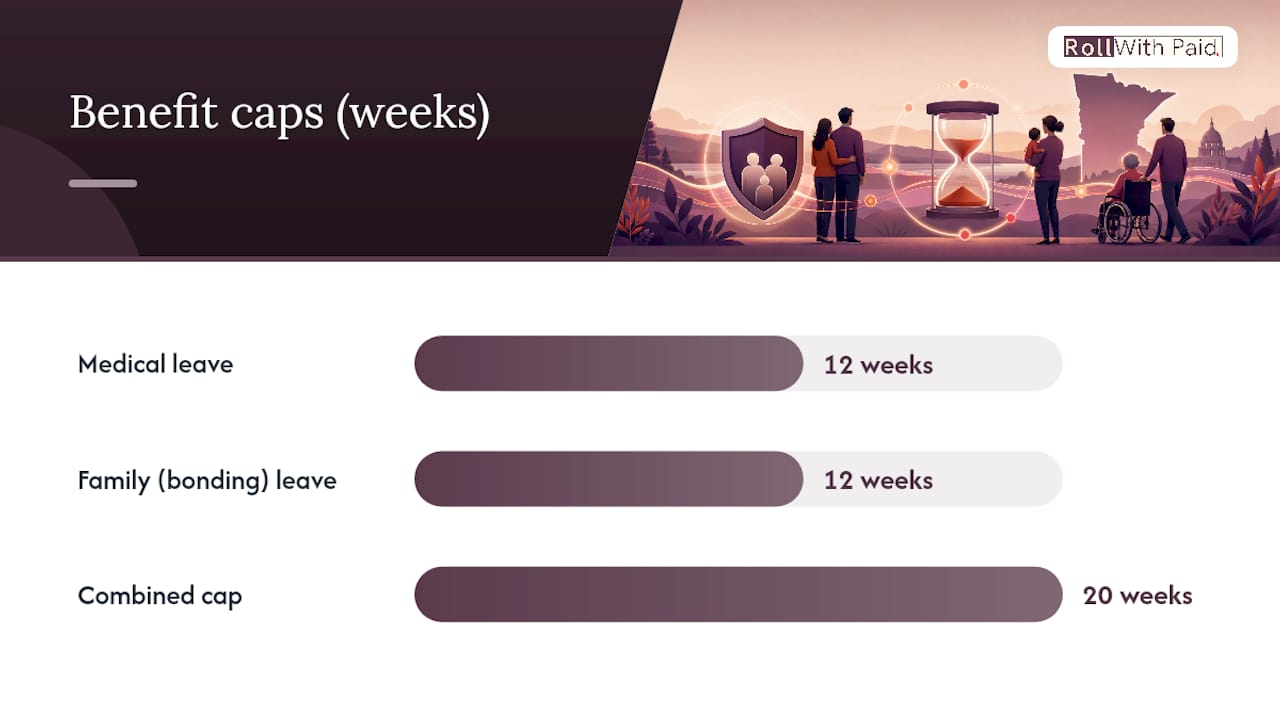
As of 2026, Minnesota caps benefits at 12 weeks of medical leave, 12 weeks of family leave, and 20 weeks combined within a single benefit year. That combined cap matters: someone recovering from surgery and then bonding with a newborn in the same year doesn’t get 24 weeks. They get 20.
A few structural notes worth knowing before you plan around this:
- The first week of leave is generally paid, unlike many short-term disability policies that impose a waiting period.
- Leave can be taken continuously or intermittently, depending on the qualifying event and the certification supporting it.
- Payments come out of the state’s family and medical benefit insurance account, not directly from the employer’s payroll account.
Who Is Eligible for Minnesota Paid Family Leave?
Coverage is broad by design. Full-time, part-time, temporary, and most seasonal employees qualify, regardless of company size. That’s a meaningful difference from federal FMLA, which only applies to employers with 50 or more employees.
Two eligibility checks matter most in practice:
- Financial eligibility: you need to have earned wages during a base period, verified against the state’s minimum earnings threshold, which is why HR teams should confirm quarterly wage detail reports are accurate before an employee ever files a claim.
- Job protection: under Minnesota Statutes chapter 268B, employers must restore an employee to their same or an equivalent position once they’ve been employed for at least 90 days. Employers also can’t force workers to burn through PTO or sick time before Paid Leave benefits kick in.
Self-employed workers get a different path entirely. They aren’t automatically covered. They have to opt in during a designated enrollment window, and once enrolled, there’s a one-year waiting period during which premiums must be paid before benefits become available. That timing catches people off guard.
Pro Tip: If you’re self-employed and thinking about a growing family or a health issue on the horizon, opt in now. Because premiums have to be paid for a full year before benefits activate, waiting until you need coverage means you’ll already be too late.
How Much Does Minnesota Paid Leave Pay?
Weekly benefit amounts are calculated from your earnings during a base period, using a high-quarter wage formula similar to unemployment insurance calculations. The exact dollar figure depends on your income level, and the state’s premium and benefit calculators give the most accurate estimate for your specific wages, since the formula applies different replacement rates at different income tiers with a statutory maximum weekly cap.
A few mechanics employers and employees both need to understand:
- Lower-wage earners receive a higher percentage of their usual pay replaced; higher earners receive a lower percentage, capped at the maximum weekly benefit set under chapter 268B.
- If a claim overlaps with an active workers’ compensation claim for the same condition, Paid Leave benefits are offset, and the state can pursue recoupment if both were paid for the same period.
- Overpayments, whether from employer reporting errors or applicant mistakes, get flagged and may require repayment, so accuracy on both sides of the claim matters.
Employers are allowed to offer supplemental pay on top of the state benefit, but the combined total can’t exceed what the employee would have earned in a normal pay period. If you’re structuring a supplemental pay policy, document the agreement in writing. The statute treats this as a straightforward math problem, but overpayment recoupment disputes get messy fast when there’s no paper trail showing what was promised.
What Are Minnesota Employers Required to Do?
Premiums fund the entire program, and calculating them correctly is the first real compliance task. The state’s premium rate and contributions page lets employers estimate the employer and employee share based on total wages, and most employers will split the premium with employees through payroll deduction rather than absorbing it entirely.
Here’s the practical sequence for getting ready:
- Set up an employer account on the Paid Leave portal and designate a Paid Leave Administrator, the person responsible for filing wage detail reports and responding to state requests.
- Calculate your premium obligation using the official rate calculator, and confirm whether you’re splitting the cost with employees or covering it fully.
- Run a test payroll deduction cycle before your first real filing. Map the new benefit code into your payroll system, and make sure pay stub descriptions clearly identify the Paid Leave premium as its own line item.
- Update your PTO and leave policies in writing so managers understand they cannot require employees to exhaust vacation or sick time before Paid Leave benefits start.
- Build a recordkeeping habit for wage detail reports and certification responses. Missing a state deadline on a certification request can result in an application being closed, which creates a headache for both the employee and your HR team.
Pro Tip: Treat your first quarterly filing like a dry run, not the real thing. A reconciliation report comparing what you deducted against what you owe catches errors before they become a compliance problem the state notices first.
For employers in cannabis and other high-risk industries already juggling multi-state payroll and strict regulatory reporting, this is one more filing cadence to build into your calendar. Roll With Paid’s guidance on employer obligations walks through account setup in more detail.
How Do You Apply for Minnesota Family Leave?
Employees apply directly through the state, not through their employer. Here’s the process:
- Create an applicant account on pl.mn.gov and gather documentation before you start.
- Apply within the correct window. You can apply up to 60 days before your leave begins, but for unplanned events, you generally have seven days after the qualifying event to file without jeopardizing your claim timeline.
- Submit the right certification form for your leave type. Medical leave needs a health care provider’s certification. Bonding leave needs proof of birth, adoption, or placement. Safety leave requires documentation appropriate to the situation, and military family leave needs proof tied to the service member’s orders.
- Respond quickly to any follow-up requests. The state sets specific response windows, and missing one is a common reason applications get closed before benefits are ever approved.
The biggest pitfall isn’t eligibility. It’s paperwork timing. Employees who wait too long to gather certification documents, or who miss a follow-up request buried in an email, end up restarting a process that should have taken weeks, not months.
How Does Paid Leave Interact With FMLA, ESST, and Workers’ Comp?
Minnesota Paid Leave can run concurrently with FMLA, but they’re two things wearing one name for the same event. FMLA protects your job for up to 12 weeks; Paid Leave pays you during qualifying weeks. DEED’s comparison guidance confirms that leave time under overlapping programs is counted only once toward the total for that event, not stacked separately.
A few things employers should track carefully:
- Earned Sick and Safe Time (ESST) covers short absences differently than Paid Leave, and employees may use both depending on the situation, so don’t assume one replaces the other.
- Workers’ compensation benefits and Paid Leave benefits generally can’t both be paid for the same condition during the same period; one offsets the other.
- Keep separate documentation for each program an employee touches. Overlapping eligibility doesn’t mean overlapping paperwork requirements.
An Employer’s Real-World Compliance Checklist
Getting ready for Paid Leave isn’t complicated, but it does require sequencing. Designate your Paid Leave Administrator first, because that person needs account access before anything else moves forward. Run a payroll deduction test before your live filing, not during it. Rewrite your PTO policy language now so nobody on your management team accidentally tells an employee they need to burn vacation days first.
Train whoever handles certification paperwork on the state’s response deadlines. A missed follow-up isn’t a minor administrative slip. It closes the application and forces the employee to start over. For high-risk industry employers already managing tight regulatory margins, that kind of avoidable delay is the difference between a smooth compliance year and a preventable dispute.
— Leah
How Roll With Paid Keeps Minnesota Employers Ahead of Paid Leave Compliance
Rollwithpaid built its payroll and HR service around exactly this kind of regulatory complexity, because cannabis operators and other high-risk businesses can’t afford a late filing or a misclassified premium. Rollwithpaid handles premium calculation, payroll deduction mapping, and account administration so Paid Leave becomes one more line item your payroll runs correctly every time, not a quarterly fire drill.
Through its Employer of Record model, Rollwithpaid takes on the compliance risk directly, which is part of why clients have seen zero late filings across their payroll and regulatory reporting. If you run a dispensary, cultivation facility, or any operation where payroll mistakes carry outsized legal exposure, start with Roll With Paid’s home page to see how the Employer of Record model fits your Paid Leave setup, or review the HR compliance tips for dispensaries and cultivators for a sector-specific starting point.
Official Minnesota Paid Leave Resources
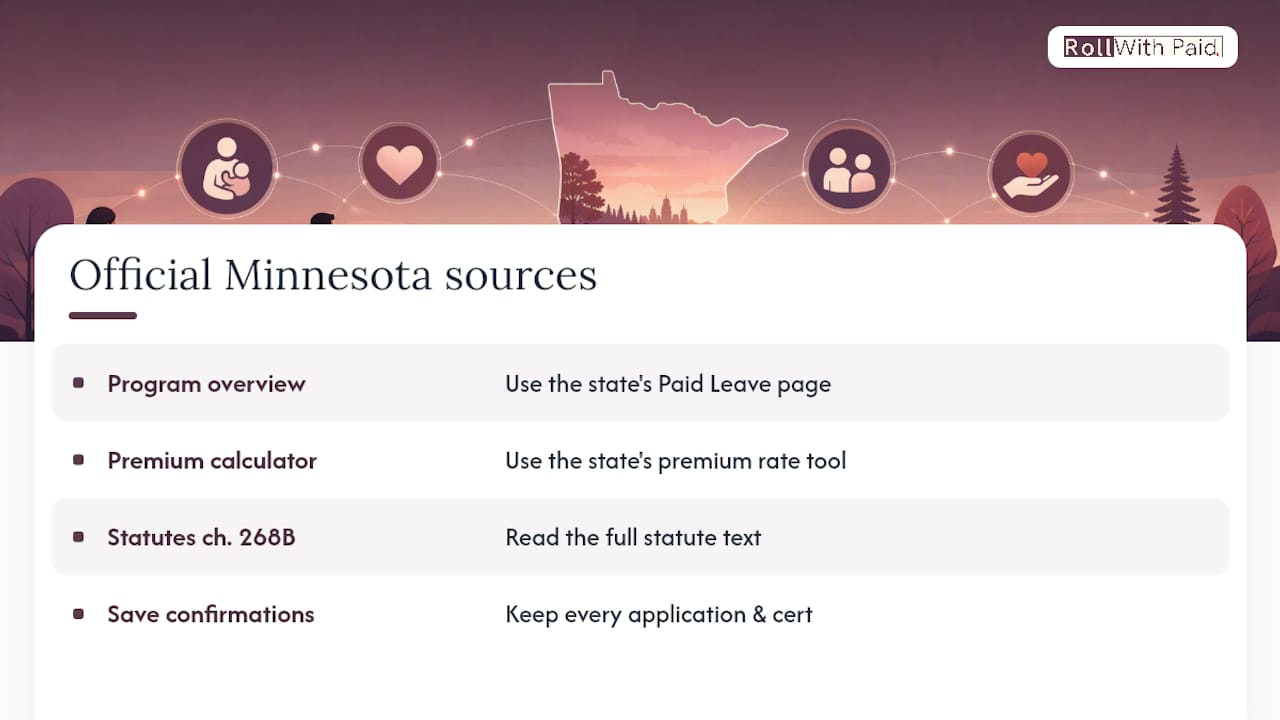
For direct verification, use the state’s own sources: the Paid Leave program overview, the premium rate calculator, and the full text of Minnesota Statutes chapter 268B. Save every application and certification confirmation you receive. If a dispute ever arises over timing or documentation, that paper trail is your best evidence.
Sources
- How Paid Leave works | Minnesota Paid Leave
- CHAPTER 268B. FAMILY AND MEDICAL BENEFITS (Minnesota Revisor of Statutes)
FAQ
Is Minnesota Paid Leave Really Up to 20 Weeks?
Yes. The maximum is 12 weeks of medical leave, 12 weeks of family leave, and 20 weeks combined within a single benefit year, so a worker using both types in the same year is still capped at 20 total weeks.
Who Pays for Minnesota Paid Leave in 2026?
The program is funded through premiums split between employers and employees and collected via payroll deduction, with the exact split depending on employer size and choices made during account setup.
Who Is Not Eligible for Minnesota Paid Leave?
Workers who haven’t met the base-period earnings threshold don’t qualify financially, and self-employed people who never opted in during their enrollment window aren’t covered until they complete that opt-in process and the required waiting period.
How Much Does Paid Leave Pay in Minnesota?
Weekly benefits are calculated as a percentage of your earnings during your base period, with lower earners receiving a higher replacement percentage up to a statutory maximum weekly cap; the official calculator gives the most accurate individual estimate.
Recommended
- Minnesota Paid Leave: Employer Obligations After Launch
- How to Report a Payroll or Wage Issue in Minnesota (Step by Step)
- MN Wage Theft Prevention Act: What Employers Need to Know
Roll With Paid. is not a law firm and does not provide legal advice. This article summarizes Minnesota law as of August 2026 and is general information only. Tip arrangements are fact-specific; before changing a policy, consult employment counsel or contact DLI Labor Standards at 651-284-5075.