
$16.37 Minneapolis Minimum Wage 2026: Payroll Steps Employers Must Take
The Minneapolis minimum wage for 2026 is $16.37 per hour, effective January 1, 2026, and it applies to every employer regardless of size. A scheduled inflation adjustment is expected on January 1, 2027. Coverage hinges on where the work physically happens, not where the business is headquartered or where an employee lives.
TL;DR:
- Employers must pay at least $16.37 per hour for work performed within Minneapolis city limits, regardless of business size or employee age.
- Coverage depends solely on physical work location and the employee working at least two hours inside city boundaries in a week.
- Minneapolis’s rate will automatically adjust for inflation on January 1, 2027, but the final amount is not yet publicly listed.
- Employers need to update payroll systems, issue notices, and track hours by location to comply, especially for split shifts or remote workers.
- The Minnesota statewide minimum wage remains lower at $11.41 for 2026, so employers must pay the higher local rate for applicable hours.
Table of Contents
- What Is the Minneapolis Minimum Wage for 2026?
- Who Is Covered Under the Minneapolis Wage Ordinance?
- Employer Obligations Beyond the Hourly Rate
- Enforcement and Recordkeeping: What Employers Should Track
- Minneapolis Rate vs. Minnesota Statewide Rate: Which One Applies?
- A Practical Payroll Checklist for the New Minneapolis Rate
- Priorities for Minneapolis Payroll Teams This Year
- How Roll With Paid Helps You Implement the 2026 Rate Change
- Sources
- FAQ
What Is the Minneapolis Minimum Wage for 2026?
The City of Minneapolis set the 2026 rate at $16.37 per hour for all employees performing work within city limits, with no separate tier for small employers. The city’s own announcement confirms the increase took effect January 1, 2026, and notes the rate now sits well above Minnesota’s statewide floor.
Minneapolis adjusts its rate annually based on inflation, which is why payroll teams should expect another increase on January 1, 2027. The city has not published a final locked figure for that date at the time of this writing, so treat any 2027 number you see elsewhere as preliminary until the city posts its formal notice, typically in the fall before the effective date.
For your payroll calendar, build in these steps before the rate changes:
- Update the effective date in your payroll system to January 1, not the pay period start date, since Minneapolis wages are earned in the calendar year they’re worked.
- Flag any pay periods that straddle December 31 and January 1 for split-rate calculation.
- Confirm your rounding rules don’t inadvertently pay below $16.37 for any Minneapolis-covered hour.
- Run a retro-pay check for the first two pay cycles after the change to catch missed rate updates.
Who Is Covered Under the Minneapolis Wage Ordinance?
Coverage turns on one test: does the employee perform at least two hours of work inside Minneapolis city limits during a calendar week? That’s the city’s own coverage rule, and it applies no matter how big the employer is or how old the worker is. There’s no small-business exception and no youth-wage carve-out at the city level.
Here’s how that plays out in practice:
- A retail employee working a shift split between a Minneapolis store and a suburban location triggers city coverage for the hours worked in Minneapolis only, once that two-hour threshold is met.
- A remote worker who lives outside the city but comes into a Minneapolis office for occasional meetings becomes covered for any week those in-office hours hit two hours or more.
- A delivery driver whose route includes stops inside Minneapolis is covered for the portion of the week spent driving or delivering within city boundaries, even if the employer’s warehouse sits elsewhere.
Wage registries and payroll guides sometimes suggest using ZIP codes or mailing addresses to determine coverage. That’s the wrong test. The city’s guidance is explicit that physical work location, tracked week by week, is what controls.
Employer Obligations Beyond the Hourly Rate
Raising the hourly rate is the easy part. Minnesota law does not allow a tip credit, so tipped employees must be paid the full $16.37 before tips are counted, unlike states where tips can offset part of the base wage. That single rule trips up a lot of restaurant and hospitality employers who assume Minnesota mirrors federal tip-credit rules. It doesn’t.
Beyond the rate itself, here’s what belongs on your compliance checklist:
- Issue written notice to employees before the rate change takes effect, ideally 30 days ahead, even though Minneapolis doesn’t mandate a specific notice window.
- Update your employee handbook and any posted wage notices in break rooms or common areas.
- Recalculate overtime using the new $16.37 base for any Minneapolis-covered hours, since time-and-a-half must reflect the higher local rate, not the state minimum.
- Watch pay-period boundaries closely if your cycle doesn’t align with the calendar year.
- Document every rate-change notice with a timestamp and delivery method (email, paycheck stub insert, handbook acknowledgment).
Pro Tip: Run a parallel payroll test with the new $16.37 rate at least one full cycle before go-live. Compare it against your current system’s output line by line. Catching a rounding error or a misapplied pay code in a sandbox costs you nothing; catching it after three pay periods have already run means retro pay, corrected W2 forms, and an uncomfortable conversation with affected employees.
Enforcement and Recordkeeping: What Employers Should Track
Minneapolis enforcement is largely complaint-driven, meaning the city typically investigates after an employee raises a concern rather than through routine audits. That makes your own records your best defense, since accurate, contemporaneous time and wage records are what you’ll lean on if a claim comes in.
Keep these records on hand, and hold onto them longer than you think you need to:
- Daily hours worked, broken out by physical work location, for every employee who splits time between Minneapolis and elsewhere.
- Written pay-rate change notices with delivery dates, filed by employee and by effective date.
- Payroll journal entries showing the rate applied for each pay period, cross-referenced against location data.
- If a claim is filed, pull the relevant employee’s location and pay records immediately, verify the calculation against the $16.37 rate, and correct any shortfall before the city’s investigation moves further.
A simple self-audit twice a year, exporting hours by employee by location and checking each Minneapolis-covered shift against $16.37, catches most problems before they become claims.
Minneapolis Rate vs. Minnesota Statewide Rate: Which One Applies?
Minneapolis employers juggle two numbers, and picking the wrong one is one of the most common payroll errors in the metro. The Minnesota statewide minimum wage is $11.41 per hour for 2026, scheduled to rise to $11.87 on January 1, 2027. Compare that to Minneapolis’s $16.37, and the gap is nearly $5 an hour.
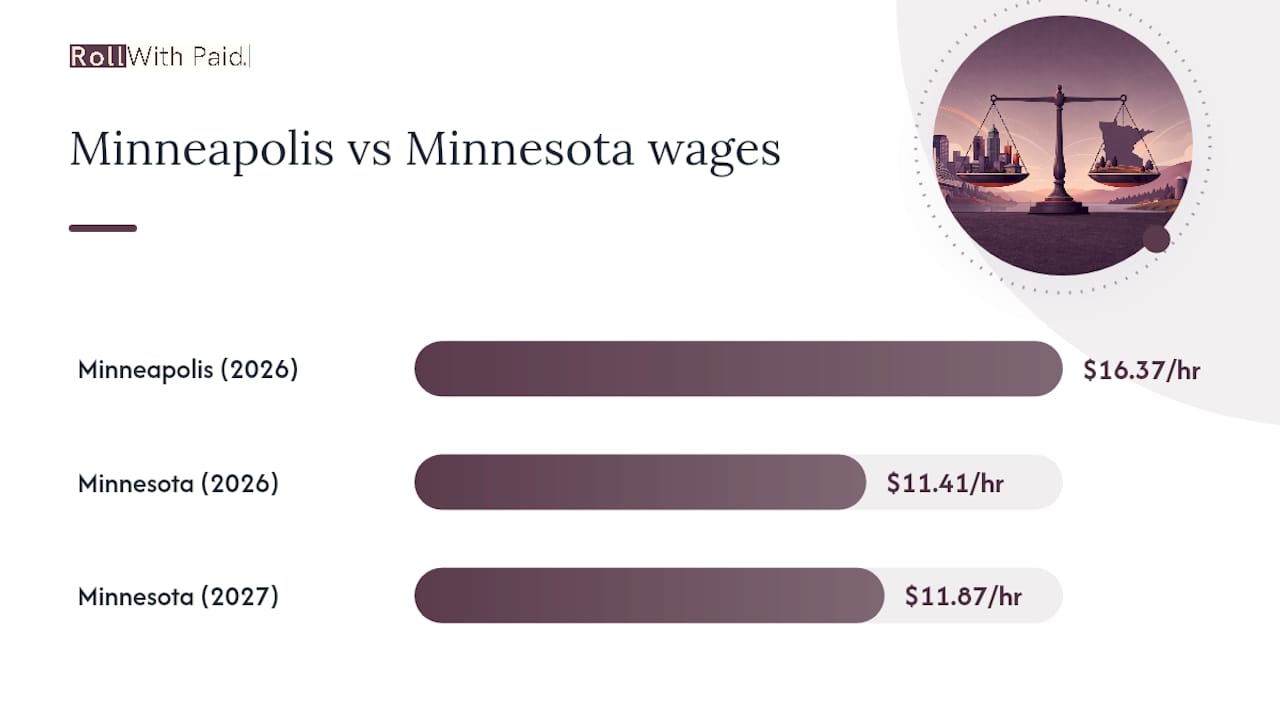
The state rate adjusts through a statutory indexing mechanism under Minnesota Statutes §177.24, which ties annual increases to inflation with a cap. Minneapolis runs its own separate annual adjustment process, so the two rates move on different schedules and by different amounts.
The practical rule employers should apply:
- Always pay whichever rate is higher for the hours physically worked in that location.
- If an employee works in Minneapolis for any qualifying hours, those hours get $16.37, not the state rate, even if the rest of the week is spent outside the city.
- Multi-location employers need location-aware payroll coding, not a single flat rate applied company-wide.
A Practical Payroll Checklist for the New Minneapolis Rate
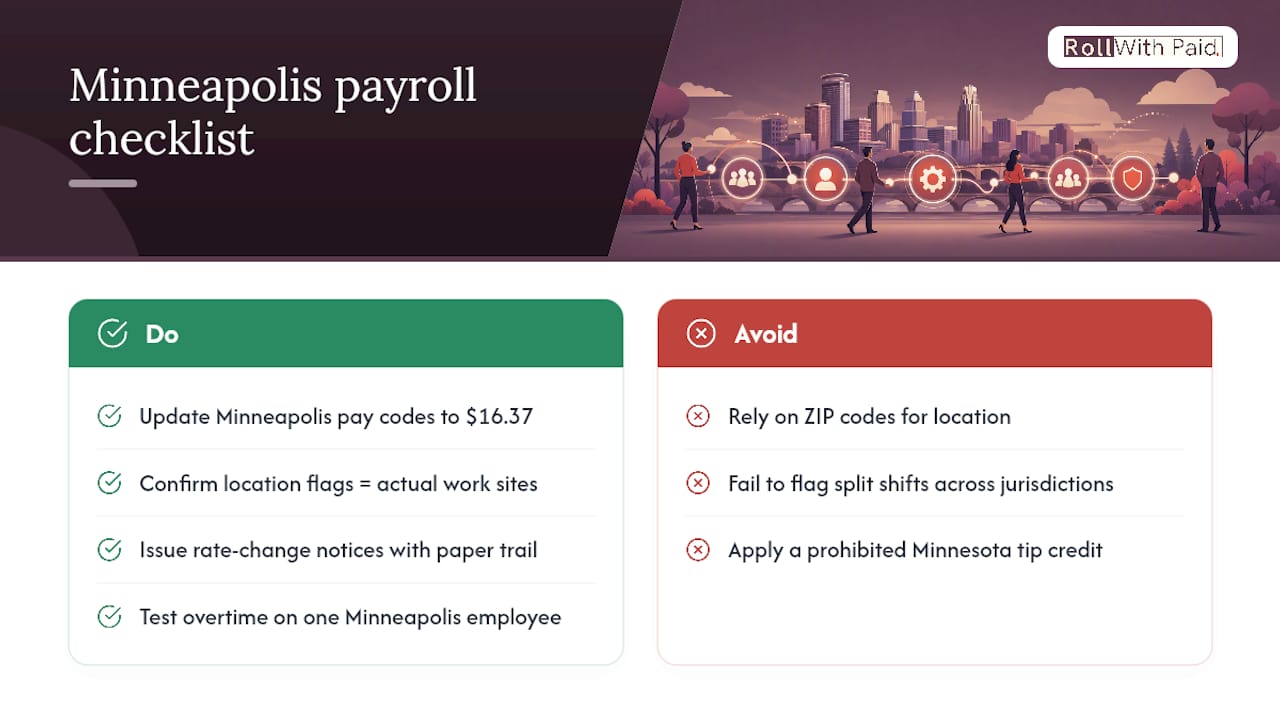
Before your first payroll run under the 2026 rate, walk through this list. Update all Minneapolis-tagged pay codes to $16.37. Confirm every employee’s location flag reflects actual work sites, not their home address or the office listed on their offer letter. Issue rate-change notices with a paper trail. Test overtime calculations on at least one Minneapolis-covered employee before processing the full run.
The mistakes we see most often at Roll With Paid come from three habits: relying on ZIP codes instead of tracked work location, failing to flag split shifts across jurisdictions, and applying a tip credit that Minnesota law simply doesn’t allow.
Pro Tip: If your workforce moves between Minneapolis and suburban locations in the same week, code location at the shift level, not the employee level. An employee-level flag misses every week where hours actually split.
Priorities for Minneapolis Payroll Teams This Year
If you’re triaging, rank it this way: accuracy first, documentation second, employee communication third. A correct rate calculated on the wrong location record is still a compliance failure waiting to surface. Acting before your first 2026 pay run, rather than after a complaint lands, is what keeps retro pay and back-wage exposure off your desk. When the math gets complicated, especially across multiple work sites, bring in payroll help rather than guessing.
— Leah
How Roll With Paid Helps You Implement the 2026 Rate Change
Some payroll providers offer alternatives to handling this rate change with spreadsheets and guesswork. For cannabis dispensaries and other high-risk operators juggling mixed-location staff across Minneapolis and the suburbs, they can update pay codes, issue compliant wage-change notices, and keep location-tracked records needed if a wage claim arises, without requiring you to manage the payroll system directly.

Consider a Minneapolis dispensary with budtenders working shifts split between a city storefront and a suburban cultivation site. That’s exactly the split-location scenario that trips up in-house payroll teams, and it’s exactly what Roll With Paid’s Employer of Record model is built to handle for high-risk industries. Visit Roll With Paid’s home page to see how payroll, recordkeeping, and wage-change compliance get handled for you, or check out the five payroll mistakes cannabis businesses can’t afford before your next pay run.
Sources
- min wage – City of Minneapolis
- Minneapolis minimum wage increases to $16.37 for all employers – City of Minneapolis
- Minimum wage in Minnesota
- Minnesota Statutes 177.24 — Payment of minimum wages (PDF)
FAQ
Is $27 an hour a good wage in Minnesota?
At an hourly wage well above $16.37, a full-time worker earns well above both the Minneapolis rate and the statewide rate of $11.41, putting it comfortably above minimum wage anywhere in Minnesota.
Is the minimum wage in Minnesota currently $15?
No. The Minnesota statewide minimum wage is $11.41 per hour for 2026, while Minneapolis sets its own higher city rate of $16.37 for work performed within city limits.
What will the minimum wage in Minnesota be in 2027?
The statewide rate is scheduled to rise to $11.87 per hour on January 1, 2027, while Minneapolis has its own separate inflation adjustment expected the same date, though the exact figure had not been finalized as of this writing.
Did Minnesota raise the minimum wage?
Yes. Minnesota’s statewide rate increased to $11.41 per hour effective January 1, 2026, and Minneapolis separately raised its city rate to $16.37 the same day, reflecting two distinct adjustment processes.
Does the tip credit apply to Minneapolis employers?
No. Minnesota law prohibits a tip credit statewide, so Minneapolis employers must pay tipped staff the full $16.37 hourly rate before tips, a rule employers coming from tip-credit states often miss.
Recommended
- How to Report a Payroll or Wage Issue in Minnesota (Step by Step)
- MN Wage Theft Prevention Act: What Employers Need to Know
- Minnesota Paid Leave: Employer Obligations After Launch
Roll With Paid. is not a law firm and does not provide legal advice. This article summarizes Minnesota law as of August 2026 and is general information only. Tip arrangements are fact-specific; before changing a policy, consult employment counsel or contact DLI Labor Standards at 651-284-5075.