
Avoid Taxable Wage Errors: Minnesota Mileage Reimbursement and 2026 Rates

The 2026 IRS standard mileage rate for business travel is 72.5 cents per mile from January 1 through June 30, then 76 cents per mile from July 1 through December 31. Minnesota does not force every private employer to pay mileage, but it does require that unreimbursed driving costs never push an employee’s pay below the state minimum wage. Pay above the IRS rate, and the excess becomes taxable wages.
TL;DR:
- Minnesota relies on the IRS mileage rate for private employers, which is 72.5 cents per mile until June 30 and 76 cents afterward in 2026.
- Reimbursements above the IRS rate are taxable wages, so accurate documentation and rate application are essential to avoid payroll compliance issues.
- State employees follow stricter mileage rules, including a 7-cent reduction if they decline a state vehicle, and mileage is capped at the shortest reasonable route.
- Employers must ensure reimbursements do not reduce an employee’s effective pay below Minnesota’s minimum wage, which could lead to wage violation claims.
- Private contractors generally negotiate mileage in their contracts, as Minnesota’s wage laws exclude them from statutory mileage reimbursement requirements.
Table of Contents
- What Is the Mileage Reimbursement Rate in Minnesota for 2026?
- How Do You Calculate Mileage Reimbursement?
- What Are Minnesota’s Mileage Rules for State Employees and Teleworkers?
- How Should Mileage Reimbursements Be Documented for Payroll and Taxes?
- Building a Mileage Reimbursement Policy That Holds Up
- Why Integrated Payroll Matters for Mileage Compliance
- Does Minnesota Law Require Mileage Reimbursement for All Employers?
- How Do Minnesota Rules Differ From Federal IRS Guidance?
- Are Independent Contractors Entitled to Mileage Reimbursement in Minnesota?
- What Mileage Disputes Come Up Most Often in Minnesota?
- What This Guide Gets Right That Most Advice Misses
- Let Roll With Paid Handle Mileage Compliance for You
- Sources
- FAQ
What Is the Mileage Reimbursement Rate in Minnesota for 2026?
Minnesota does not set its own separate mileage rate for private-sector employers. Instead, the IRS standard mileage rate governs almost every reimbursement conversation in the state, including how state agencies process employee travel claims. For 2026, that means 72.5 cents per mile for business driving done between January 1 and June 30, jumping to 76 cents per mile for the second half of the year. Medical, moving, and charitable mileage rates run separately and typically sit lower than the business rate.
Minnesota Management and Budget confirmed the 2026 figure in its own bulletin to state agencies, which also flags a wrinkle unique to public-sector travel: if a state vehicle was offered and the employee declined it, the reimbursable rate drops by 7 cents per mile.
Rates have climbed steadily since the pandemic-era travel slump, and knowing where the current number sits against recent history helps HR teams spot outdated policy language fast.
Apply the rate that was in effect on the date the trip actually happened, not the date the expense report gets filed. A June 28 trip uses 72.5 cents even if the claim lands on a manager’s desk in July.
How Do You Calculate Mileage Reimbursement?
The math itself is simple: miles driven multiplied by the applicable cents-per-mile rate. The complexity comes from picking the right rate for the right date and documenting the trip correctly.
- Confirm the trip date and match it to the correct 2026 period (72.5 cents through June 30, 76 cents afterward).
- Log the odometer start and end points, or use mapping software to confirm mileage between confirmed addresses.
- Multiply total business miles by the applicable rate.
- Subtract any personal-mile detours (a stop at home between two work sites, for example).
- Apply the same math to each leg if the trip has multiple stops, since employers must treat local errands and longer travel days as separate mileage segments.
A worked example: an employee drives 40 miles round trip to a client meeting on March 3. That’s 40 × $0.725 = $29.00. If the same employee later takes a multi-stop day covering a dispensary visit, a supply pickup, and a return to base, each leg gets logged and summed separately rather than estimated as one lump trip.
In a spreadsheet, the formula is just =Miles*Rate, with the rate pulled from a lookup table keyed to trip date so the sheet updates automatically after July 1.
Pro Tip: Build two rate columns into your mileage spreadsheet, one for each half of 2026, and use a date-based formula to select automatically. It prevents the single most common reimbursement error: paying the wrong half-year rate on trips filed late.
What Are Minnesota’s Mileage Rules for State Employees and Teleworkers?
State employees follow reimbursement rules that go further than anything required of private businesses, and HR teams at private companies often borrow this structure because it is well documented and audit-tested.
- The default rate matches the current IRS figure, currently 72.5 cents per mile.
- If a state vehicle was made available and the employee chose to drive their own instead, MMB’s bulletin permits a 7-cent-per-mile reduction from the standard rate.
- Minnesota DHS guidance separates workers into teleworker, non-teleworker, and remote worker categories, each with different rules for what counts as reimbursable travel.
- The “shortest distance” rule applies broadly: mileage claims are generally capped at the shortest reasonable route between two points, not the route the employee actually chose to drive.
- Teleworkers typically measure mileage from their home office rather than a traditional headquarters, which changes what portion of a trip counts as commuting versus reimbursable business travel.
Private Minnesota employers are under no blanket legal duty to reimburse mileage the way state agencies are. But wage and hour law still bites: if unreimbursed vehicle costs cut into an employee’s earnings enough to drop their effective hourly pay below Minnesota’s minimum wage, this becomes a wage violation, not just an HR oversight.
How Should Mileage Reimbursements Be Documented for Payroll and Taxes?
Auditors care less about the total dollar figure and more about whether every mile can be traced back to a real, dated, business trip.
- Date of travel and the specific rate period it falls into (Jan–Jun or Jul–Dec 2026).
- Starting and ending addresses for each leg, distinguishing local miles from longer trip miles.
- Business purpose (client visit, site inspection, supply run).
- Total miles claimed and the rate applied.
- Employee signature or digital approval, plus a supervisor sign-off.
Retain these records for at least four years to align with standard payroll audit windows.
Reimbursements paid at or below the IRS rate stay nontaxable. Pay above that rate, though, and SEMA4 guidance shows exactly how the system handles it: the portion up to the IRS rate stays nontaxable, and everything above it gets coded as taxable supplemental wages subject to withholding.
Statistic Callout: Minnesota payroll guidance treats reimbursements filed outside a reasonable submission window, commonly understood as 60 days, as taxable wages rather than expense reimbursements, even if the rate itself never exceeded the IRS figure.
Building a Mileage Reimbursement Policy That Holds Up
A written policy protects the employer as much as the employee, and it doesn’t need to be complicated to be effective.
- Pick a default rate. Most Minnesota employers default to the current IRS rate to avoid taxable-wage complications and to stay consistent with how public-sector plans operate.
- Build in a midyear update trigger. Since 2026 has two different rates, your policy language should state plainly that the applicable rate follows the travel date, not the filing date.
- Define eligibility clearly: which roles qualify, whether telework changes the calculation, and how commuting miles are excluded.
- Set a submission window, ideally 30 to 60 days, and state what happens to late claims.
- Include an exception process for paying above the IRS rate, requiring manager sign-off, so any taxable-wage exposure is a deliberate decision rather than an accident.
- Reserve the right to audit mileage logs against calendars, client records, or GPS data.
Pro Tip: Write your policy’s rate language as “the IRS standard business mileage rate in effect on the date of travel” instead of hardcoding “72.5 cents.” That single phrasing choice means your policy never needs a rewrite when the rate changes again in 2027.
Why Integrated Payroll Matters for Mileage Compliance
Mileage errors rarely show up as one big mistake. They show up as a dozen small ones: a rate applied a week too late, a reimbursement paid above the IRS figure with no tax coding attached, a claim filed 90 days after the trip and treated as nontaxable anyway. Roll With Paid works with high-risk industry employers, including cannabis operators, where audit exposure is already elevated and payroll errors carry outsized consequences. Integrating mileage tracking directly into payroll processing, rather than handling it as a side spreadsheet, closes the gap between what a policy says and what actually gets paid.
Does Minnesota Law Require Mileage Reimbursement for All Employers?
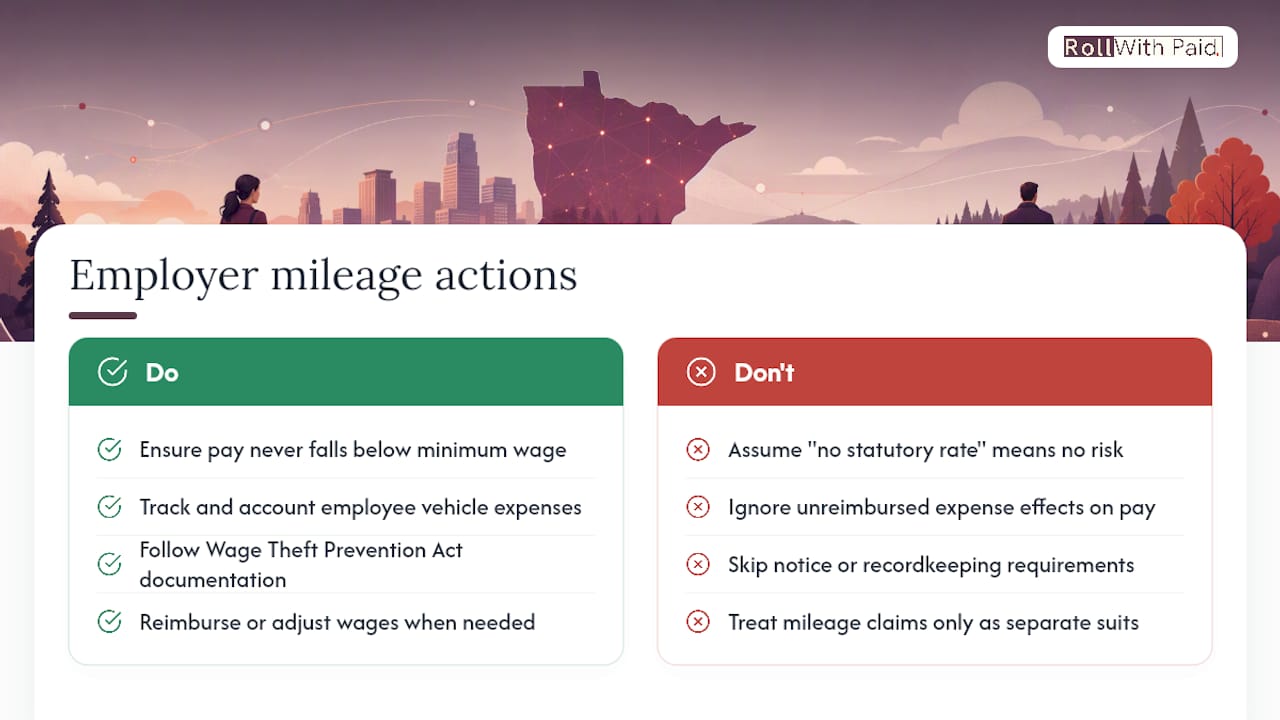
No single Minnesota statute mandates that every private employer pay mileage at a specific rate. What state law does require is that unreimbursed business expenses, including vehicle costs, never push an employee’s effective pay below Minnesota’s minimum wage. This distinction trips up a lot of employers who assume “not required” means “no risk.”
Consider an hourly employee earning close to minimum wage who regularly drives 30 to 40 miles a day for work and receives no reimbursement at all. Once fuel, maintenance, and depreciation are factored in, that employee’s real take-home pay per hour worked can fall below the legal floor, even though their paycheck shows a compliant hourly rate. Minnesota wage guidance treats this as a deduction problem: unreimbursed necessary expenses function like an improper wage deduction when they erode pay below minimum wage.
There is no reported Minnesota court decision creating a stand-alone “mileage reimbursement” cause of action the way some states have through class-action wage litigation. Instead, mileage disputes in Minnesota tend to get folded into broader wage and hour claims, handled under the same statutes and enforcement mechanisms that cover unpaid overtime or improper deductions. That makes the Minnesota Wage Theft Prevention Act more relevant to mileage compliance than most employers realize. It sets documentation and notice requirements that, if ignored, compound the risk when a mileage-related wage complaint surfaces.
How Do Minnesota Rules Differ From Federal IRS Guidance?
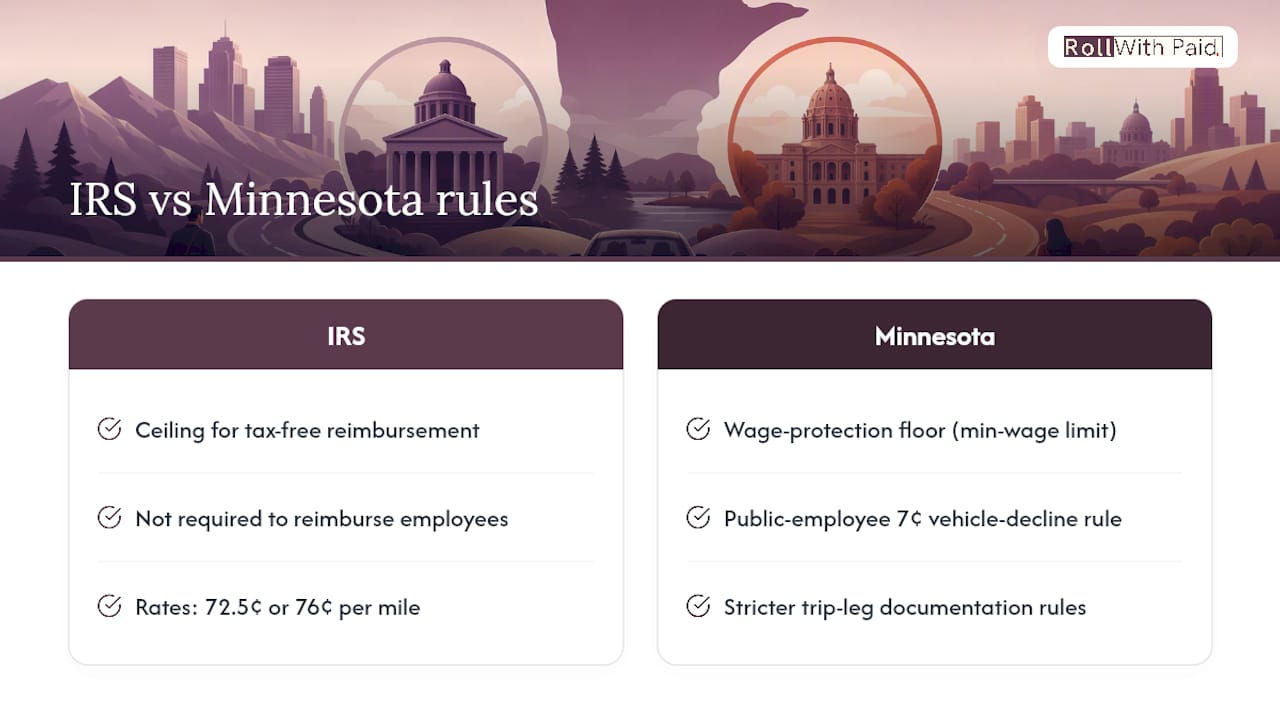
The IRS mileage rate itself is not a legal mandate. It is a ceiling for tax-free reimbursement, not a floor requiring payment. Federal law doesn’t force any employer, in Minnesota or elsewhere, to reimburse mileage at all for W-2 employees. Minnesota’s contribution isn’t a competing rate structure. It’s a wage-protection backstop layered on top of federal tax rules.
That layering creates three practical differences worth understanding:
Rate ceiling versus wage floor. The IRS sets the maximum an employer can reimburse tax-free (72.5 or 76 cents per mile depending on when the trip happened). Minnesota law sets a wage floor, meaning employers can pay $0 in mileage and still comply federally, but only if doing so doesn’t drag effective pay under the state minimum wage.
Public-sector specificity. Federal rules apply the same rate uniformly. Minnesota’s own state employee bulletin adds a public-sector-only wrinkle, the 7-cent reduction for declining an offered state vehicle, that has no federal equivalent and doesn’t extend to private employers.
Documentation expectations. IRS recordkeeping standards focus on substantiating a tax deduction. Minnesota’s DHS and MMB guidance goes further for public employees, requiring trip-leg detail, addresses, and the shortest-distance calculation, a stricter documentation bar many private employers adopt voluntarily to reduce audit risk.
Are Independent Contractors Entitled to Mileage Reimbursement in Minnesota?
Independent contractors in Minnesota generally negotiate mileage or travel costs as part of their contract terms rather than relying on any statutory entitlement. Minnesota’s minimum-wage protections, the ones that indirectly force private employers to watch mileage costs for W-2 workers, don’t extend to properly classified independent contractors, because minimum wage law applies to employees, not contractors.
That makes the contract itself the only real source of mileage rights for a 1099 worker. If a services agreement is silent on travel expenses, the contractor typically absorbs those costs and may deduct unreimbursed business mileage on their own tax return using the same IRS standard rate that applies to employer reimbursements.
This is also where worker misclassification becomes a serious exposure point. An employer who treats a worker as a contractor, pays no mileage, and exercises the kind of day-to-day control that actually looks like employment risks a reclassification finding. If that happens, Minnesota’s minimum-wage and expense rules apply retroactively, and unpaid mileage can become part of a back-wage claim. Businesses relying heavily on drivers, delivery staff, or field techs classified as contractors should treat mileage terms as a classification risk indicator, not just a budgeting line.
What Mileage Disputes Come Up Most Often in Minnesota?
Most mileage disputes in Minnesota never reach a courtroom. They get resolved, or escalated, through Minnesota Department of Labor and Industry wage complaints, internal HR grievance processes, or, in workplaces with union representation, grievance arbitration.
The most common triggers include:
- Employees receiving no reimbursement at or near minimum wage, raising the wage-floor issue described above.
- Reimbursements paid at outdated rates after a midyear IRS change, like continuing to pay 72.5 cents in August instead of 76 cents.
- Disputes over what counts as a business trip versus ordinary commuting, especially for employees working hybrid or telework schedules.
- Denied claims tied to missing documentation, where the real dispute is about proof rather than entitlement.
- Delayed reimbursement processing that stretches past a company’s own stated submission window, creating tax complications if the state treats the late payment as taxable wages.
When employees believe they’ve been shortchanged, the practical first step is an internal complaint through HR, followed by a formal wage claim with the Minnesota Department of Labor and Industry if that fails. Employers facing a pattern of disputes are usually better served by tightening policy language and documentation requirements than by fighting individual claims one at a time. Guidance on reporting a payroll or wage issue in Minnesota walks through exactly how that escalation path works for employees and what employers should expect once a claim is filed.
What This Guide Gets Right That Most Advice Misses
Most mileage reimbursement guides treat the IRS rate as the whole story. It isn’t. The rate answers “how much can I pay tax-free,” not “am I required to pay anything at all,” and conflating the two is where Minnesota employers get into trouble. The real compliance question is a wage-floor question, and that’s a much narrower, more specific risk than most generic HR advice acknowledges.
The conventional wisdom oversells the danger of paying too little mileage and undersells the tax mess of paying too much without proper coding. An employer who pays 80 cents a mile out of generosity, without splitting the taxable overage correctly on a pay stub, has created a payroll compliance problem just as real as underpaying an hourly employee.
If you take one thing from this guide, prioritize the split: know exactly where the nontaxable IRS-rate portion ends and the taxable overage begins, every time your company pays above standard. That single habit, more than any policy document, is what keeps a mileage program from becoming a payroll liability. Everything else, spreadsheets, submission windows, telework rules, is scaffolding around that one number.
— Leah
Let Roll With Paid Handle Mileage Compliance for You
Roll With Paid provides payroll and HR services designed to handle compliance challenges faced by employers in high-risk industries, including cannabis, in Minnesota. Its services integrate mileage reimbursement rate logic, taxable overage calculations, and submission-window enforcement directly into payroll processing, helping manage changes in rates without manual spreadsheet updates.

That matters most for employers already managing audit exposure on multiple fronts: workers’ compensation classification, multi-state filings, and wage and hour rules that don’t forgive small mistakes. Roll With Paid’s Employer of Record services fold mileage tracking into the same system handling onboarding, tax withholding, and compliance filings, cutting the number of places an error can hide.
If your current mileage policy hasn’t been touched since before the 2026 rate change, that’s a reasonable place to start. Visit Roll With Paid to talk through your payroll setup and see where mileage compliance fits into a broader risk reduction plan.
Sources
Save the IRS standard mileage rates page and Minnesota’s MMB bulletin for effective dates, and recheck both before every rate change.
This article is general information, not a substitute for advice from a qualified financial advisor. Consult a qualified financial professional about your own circumstances before acting on anything here.
- Standard mileage rates | Internal Revenue Service
- BULLETIN: IRS Mileage Rate Effective January 1, 2026
FAQ
How Much Is Mileage Reimbursement in Minnesota for 2026?
The 2026 IRS business mileage rate, which Minnesota employers and state agencies use as the standard, is 72.5 cents per mile from January 1 through June 30 and 76 cents per mile from July 1 through December 31.
Is There a New Mileage Reimbursement Rate for 2026?
Yes. The rate increased partway through the year, from 72.5 cents per mile in the first half of 2026 to 76 cents per mile starting July 1, based on the IRS’s official announcement.
What Are the Rules for Mileage Reimbursement in Minnesota?
Private employers aren’t universally required to reimburse mileage, but unreimbursed vehicle costs cannot reduce an employee’s effective pay below Minnesota’s minimum wage. State employees follow stricter MMB and DHS rules, including a 7-cent reduction if a state vehicle was offered and declined.
Is 70 Cents Per Mile a Good Reimbursement Rate?
A 70-cent rate was accurate for 2025, but it’s now below the 2026 IRS standard of 72.5 cents (first half) and 76 cents (second half), meaning employers still paying 70 cents are reimbursing under the current federal benchmark.
Do Independent Contractors Get Mileage Reimbursement in Minnesota?
Independent contractors typically negotiate mileage terms directly in their service contract, since Minnesota’s minimum-wage protections that indirectly require reimbursement for employees don’t extend to properly classified contractors.
Recommended
- MN Wage Theft Prevention Act: What Employers Need to Know
- How to Report a Payroll or Wage Issue in Minnesota (Step by Step)
- Tip Pooling in Minnesota: What’s Allowed and What Isn’t
- Understanding Your Pay Stub: Every Deduction Explained
Roll With Paid. is not a law firm and does not provide legal advice. This article summarizes Minnesota law as of August 2026 and is general information only. Tip arrangements are fact-specific; before changing a policy, consult employment counsel or contact DLI Labor Standards at 651-284-5075.