
Audit Ready HR: Lab vs Instant Drug Testing and SAMHSA DOT Rules
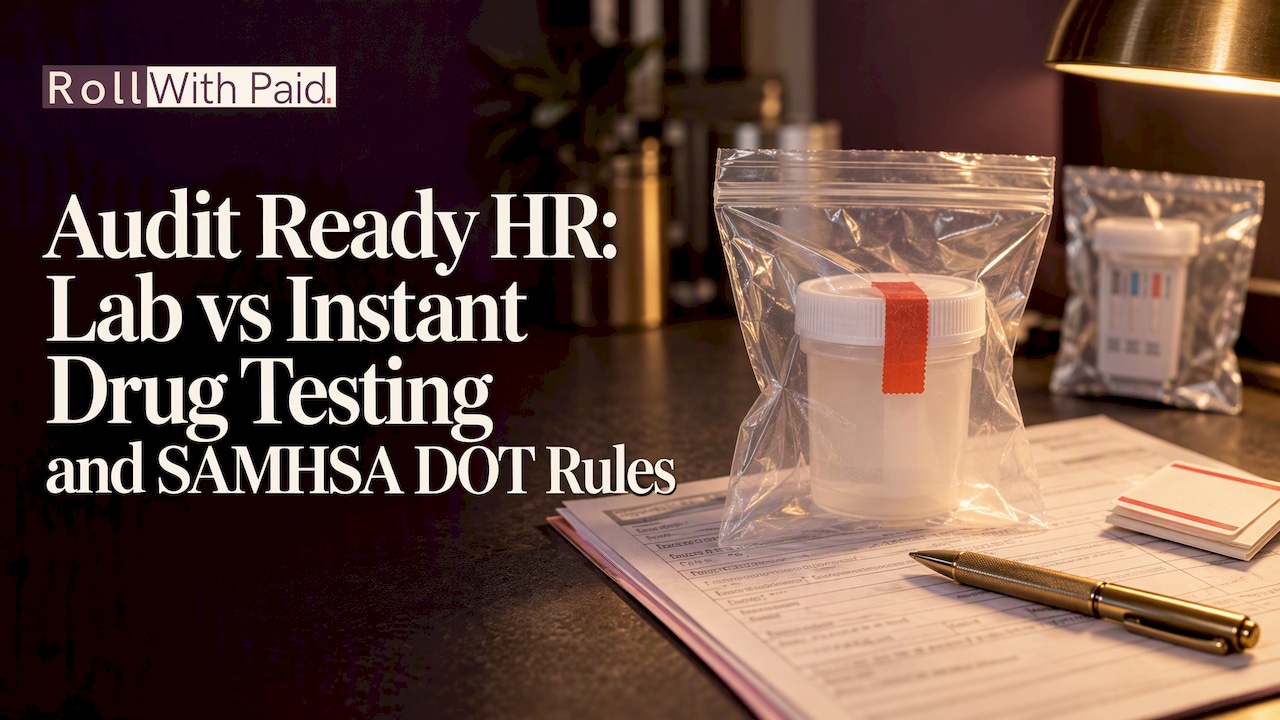
Instant (POCT) tests give presumptive results on-site in minutes; lab-based tests provide confirmatory, legally defensible results after laboratory analysis. Choose instant when speed drives the decision and your policy already requires confirmation on any non-negative. Choose lab-based when you need a reportable positive, a DOT-regulated result, or a decision that could survive a legal challenge. Federal and DOT programs skip the choice entirely: they require certified labs and Medical Review Officer review.
TL;DR:
- Instant tests provide presumptive on-site results that require laboratory confirmation before acting on non-negative outcomes, especially for regulated positions.
- Lab-based testing involves a confirmatory process with mass spectrometry, ensuring legally defensible results suitable for legal or regulatory scrutiny.
- Federal and DOT programs mandate certified labs and MRO review, forbidding instant devices for official DOT testing or reportable results.
- Detection windows vary: urine offers the longest detection period, while oral fluid detects recent use, and panels must match specific workplace risks for effectiveness.
- Employers should prepare follow-up policies, verify vendor certifications, and integrate testing with compliant HR recordkeeping to ensure audit readiness.
Table of Contents
- What Is Instant (Point-of-Collection) Drug Testing?
- What Is Lab-Based Drug Testing?
- Lab vs Instant Drug Testing: A Side-by-Side Comparison
- SAMHSA, DOT, and MRO Rules Employers Need to Know
- How to Choose Between Instant and Lab-Based Testing
- Which Testing Method Fits Which Situation?
- [Building an audit-ready HR testing program Inside HR](#building-an-audit-ready-hr-testing-programhttpsvergelijkverzuimnlblogwet-verbetering-poortwachter-inside-hr)
- An Editorial Take on Speed vs. Defensibility
- A Compliance Partner for High-Risk Employers
- Sources
- FAQ
What Is Instant (Point-of-Collection) Drug Testing?
Instant testing, often called point-of-collection testing (POCT), screens a specimen on-site and delivers a result in minutes rather than days. Common formats include urine cups with built-in dipsticks, lateral flow devices, instrumented POCT readers, and saliva swabs used for oral fluid screening.
These devices rely on immunoassay chemistry, which detects drug classes rather than specific compounds. That’s efficient, but it’s also why cross-reactivity happens: certain cold medications, poppy seed consumption, or other legal substances can trigger a non-negative that has nothing to do with illicit drug use. Most employers stock 5-panel instant kits covering the substances most relevant to workplace risk, though broader panels exist.
- Urine cups and dipsticks (most common, lowest cost)
- Lateral flow oral fluid swabs
- Instrumented POCT readers for higher-volume sites
Any non-negative result from an instant device is presumptive only. SAMHSA’s collection guidance treats these results as a screening trigger, not a final answer. Every non-negative screen should route to laboratory confirmation before anyone acts on it.
What Is Lab-Based Drug Testing?
Lab-based testing follows a two-step workflow: screen, then confirm. A specimen travels to a laboratory, where an immunoassay screen filters out clear negatives, and any non-negative moves to confirmatory testing using gas chromatography-mass spectrometry (GC-MS) or liquid chromatography-tandem mass spectrometry (LC-MS/MS). Mass spectrometry confirmation is the gold standard for definitive results, because it identifies the exact compound rather than a drug class.
Certification matters here more than most employers realize. Federally regulated urine testing must run through an HHS-certified laboratory or an HHS-certified instrumented initial test facility, not just any commercial lab.
- Specimen collected under documented chain-of-custody procedures
- Screened by immunoassay, confirmed by mass spectrometry when non-negative
- Confirmed results reported to a Medical Review Officer before the employer sees them
Turnaround typically runs from a day to several days, sometimes longer for extended panels. In exchange, you get quantitative, defensible results tied to a documented chain of custody.
Lab vs Instant Drug Testing: A Side-by-Side Comparison
The real lab vs instant drug testing decision comes down to six factors, and they rarely all point the same direction.
Accuracy and confirmability. Immunoassay screening (used in both instant devices and initial lab screens) is sensitive but not highly specific. Confirmatory testing by mass spectrometry resolves that gap, which is why any instant non-negative needs lab follow-up before it becomes a personnel decision.
Turnaround time. Instant devices deliver a result in 5 to 10 minutes. Lab confirmation takes 24 to 72 hours, occasionally longer for less common analytes. That gap forces a real trade-off: fast information now, or slower information you can actually act on.
Cost. Instant kits carry a lower per-test price and no shipping or lab fees. Lab testing adds specimen handling, screening, and confirmatory analysis charges, though high-volume employers often negotiate down the per-test cost.
Detection windows and specimen type. Urine offers the longest detection window and lowest cost, while oral fluid better reflects recent use; blood is useful when correlating drug concentration with observed impairment, and hair extends detection to a matter of months.
- Urine: longest standard detection window, most widely used
- Oral fluid: best for recent-use detection, harder to adulterate
- Blood: ties concentration to acute symptoms, more invasive
- Hair: longest lookback period, limited for recent use
Panel flexibility. Instant kits usually cover a fixed 5-panel. Labs can build extended panels that add fentanyl, designer opioids, or benzodiazepines, and matching the panel and cutoff to your actual workplace risk matters more than the screening format itself.
Defensibility. This is where labs win outright. A certified lab, documented chain of custody, and MRO review turn a screening result into evidence you can stand behind in a termination hearing or workers’ compensation dispute. An instant cup, by itself, rarely does.
SAMHSA, DOT, and MRO Rules Employers Need to Know
Federal and DOT-regulated testing programs don’t leave the lab vs instant drug testing decision up to preference. SAMHSA requires urine specimens in federally regulated programs to be tested at an HHS-certified laboratory or HHS-certified IITF, and DOT guidance is explicit that instant-result devices are not authorized for DOT testing.
An IITF can run the initial screen, but it cannot issue a final result on a non-negative. That specimen still moves to a certified laboratory for confirmation.
- Initial screen: performed at an IITF or certified lab, never an unauthorized instant device
- Confirmation: mass spectrometry at a certified laboratory
- MRO review: verification interview, documented medical explanations, final reporting to the employer
- Chain of custody: the Federal CCF documents specimen handling from collection to final report
The Medical Review Officer’s job isn’t a formality. MROs conduct verification interviews and document any legitimate medical explanation before a confirmed non-negative becomes a reportable result, and that step, paired with the CCF paper trail, is what makes a lab result stand up to legal scrutiny.
How to Choose Between Instant and Lab-Based Testing
Run through this checklist before you commit to a testing vendor or program:
- Define your speed requirement. Do you need a same-day hiring decision, or can the process absorb a 48-hour wait for lab confirmation?
- Check your regulatory obligations. DOT-covered positions and federally regulated safety roles require certified lab pathways, full stop.
- List the substances that matter. Standard 5-panel kits may miss fentanyl or designer opioids; confirm the panel matches your actual risk.
- Set your budget per test, including confirmation. An instant kit looks cheap until you add lab confirmation fees for every non-negative.
- Write your follow-up policy before you test anyone. Decide now what happens after a non-negative screen, not after you’re holding one.
Ask any vendor these questions before signing: What specimen type do you use? Which lab performs confirmation, and is it HHS-certified? Do you have MRO access built in? What’s your turnaround SLA? How is chain of custody documented?
Pro Tip: If a vendor won’t name their confirmatory laboratory or can’t describe their chain-of-custody process in plain terms, treat that as a disqualifying red flag, not a minor gap.
Which Testing Method Fits Which Situation?
Pre-employment screening often works well with an instant prescreen backed by a lab confirmation policy, though employers in safety-sensitive roles frequently skip straight to lab testing for the added defensibility.
- Post-accident or reasonable-suspicion testing: lean toward lab confirmation, or an immediate instant screen followed by lab confirmation without delay
- Random testing programs: blend instant screens for volume with periodic lab confirmations to control cost
- DOT and other federal programs: certified lab pathways only, no exceptions
Building an audit-ready HR testing program Inside HR
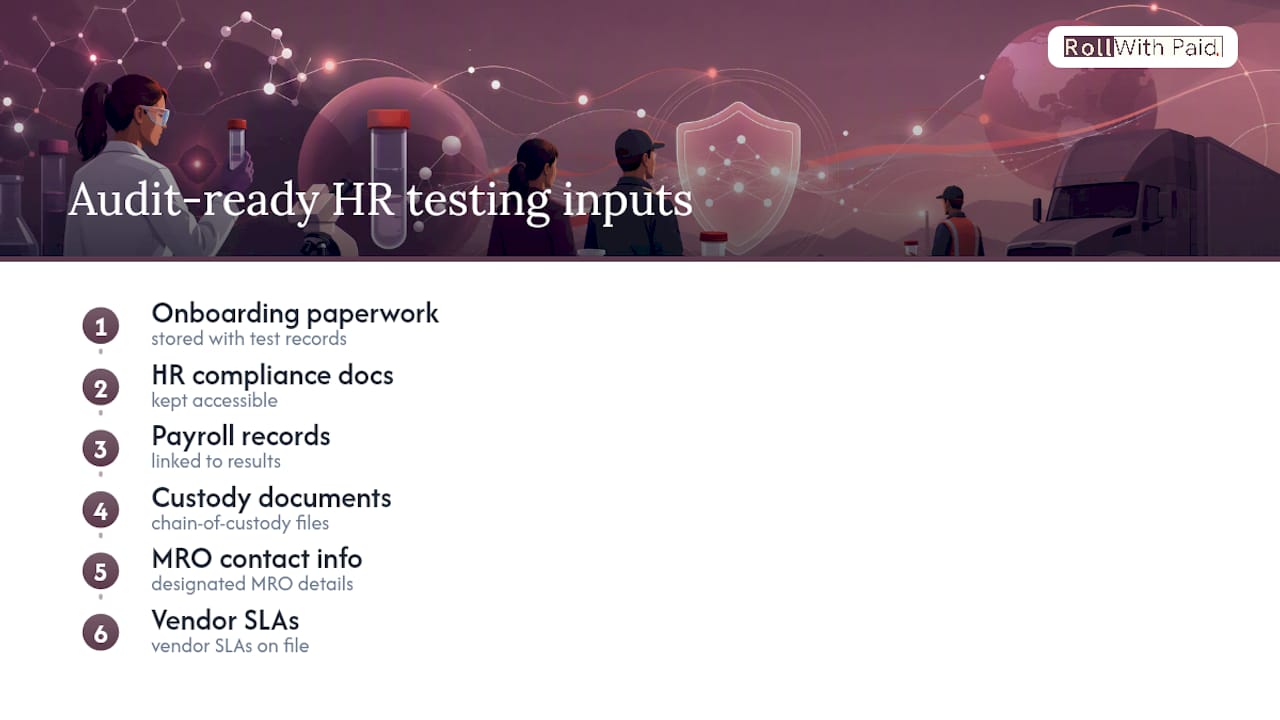
Your testing method choice doesn’t live in isolation. It has to connect to onboarding paperwork, HR compliance documentation, and payroll recordkeeping, or you end up with results you can’t actually use when a dispute arises. Audit-ready programs keep custody documents, MRO contact information, and vendor SLAs organized and accessible, not buried in someone’s inbox. High-risk employers, cannabis operators especially, often find a managed HR and compliance partner handles this administrative load more reliably than an internal team stretched across other priorities.
An Editorial Take on Speed vs. Defensibility
Most employers treat this as a technology choice. It’s really a policy choice. Instant testing is a legitimate tool when speed matters and your program is built to follow every non-negative with lab confirmation. The mistake is treating a presumptive result as a final one.
Lab-based testing isn’t optional once DOT or other federal rules apply, and it’s the safer default whenever a result could lead to termination or a legal challenge. What actually protects an employer isn’t the brand of device on the collection counter. It’s whether the chain of custody holds up, whether an MRO reviewed the result, and whether the paperwork exists to prove it.
— Leah
A Compliance Partner for High-Risk Employers
Roll With Paid is the alternative to piecing together your testing program alone. Cannabis operators and other high-risk employers get compliance built around the sector’s realities: audit-ready documentation, chain-of-custody recordkeeping, and HR processes designed for businesses traditional providers often turn away.

Testing policy is only one piece of a defensible HR program. Roll With Paid handles payroll execution, HR and compliance solutions, and onboarding documentation so your testing records sit inside a system that’s already built for audits, not scrambled together after the fact. If you’re weighing an Employer of Record model to handle this alongside payroll, learn what an Employer of Record actually covers. Current service rates and HR retainer options are on the pricing page. Reach out to the team to start building a testing and compliance program that holds up when it’s actually tested.
Sources
FAQ
Is an Instant Drug Test the Same as a Lab Test?
No. An instant test gives a presumptive on-site result using immunoassay screening, while a lab test adds confirmatory analysis by mass spectrometry. Federal programs require certified labs for any reportable result, so the two aren’t interchangeable for regulated testing.
How Accurate Are Home or Instant Drug Tests Compared to Lab Tests?
Instant tests are reasonably sensitive but prone to cross-reactivity, which can produce false non-negatives from legal substances. Lab confirmation by mass spectrometry is considered the gold standard for accuracy because it identifies the specific compound rather than a drug class.
Is a Urine Drug Test Considered Lab Work?
A urine test only counts as lab work when it’s processed at a certified laboratory or HHS-certified IITF, not when it’s read from an instant cup on-site. Collection sites and testing laboratories are not automatically the same thing.
Can Employers Use Instant Tests for DOT-Regulated Positions?
No. DOT guidance explicitly states that instant-result devices are not authorized for DOT testing, and urine specimens must go to certified laboratories for analysis and MRO review.
Does Roll With Paid Help Employers Set Up Compliant Testing Programs?
Roll With Paid supports high-risk employers with HR compliance documentation, onboarding, and audit-ready recordkeeping that testing programs depend on. Specific service rates are available on the pricing page.
Recommended
Roll With Paid. is not a law firm and does not provide legal advice. This article summarizes Minnesota law as of August 2026 and is general information only. Tip arrangements are fact-specific; before changing a policy, consult employment counsel or contact DLI Labor Standards at 651-284-5075.