
Dispensary Overtime Rules: What Cannabis Employers Must Pay
Dispensary employees are covered by federal overtime law like workers in any other retail business. Unless an employee qualifies for a specific exemption, you owe one and one-half times the regular rate for every hour over 40 in a workweek. Your state may add stricter rules on top. Federal cannabis illegality is not a defense, and a manager title or a salary alone does not make someone exempt.
This guide covers where the rules come from, who really is exempt, the timekeeping mistakes that most often create back-wage exposure, and a checklist you can run this month.
TL;DR
- Non-exempt dispensary staff (budtenders, cashiers, trimmers, packagers, security) must receive overtime at 1.5 times their regular rate after 40 hours in a workweek, and some states set stricter triggers.
- The Tenth Circuit has held that a state-licensed cannabis employer cannot dismiss an FLSA overtime claim by pointing to the Controlled Substances Act.
- Exempt status depends on duties and salary, not on job title. The employer carries the burden of proving it.
- Most claims come from timekeeping: auto-deducted meal breaks, rounding that always favors the house, off-the-clock closing tasks, and bonuses left out of the regular rate.
- Accurate, contemporaneous time records are your best defense.
Table of Contents
- Where dispensary overtime rules come from
- Does federal overtime law apply to cannabis businesses?
- Who is exempt, and who only looks exempt
- How to calculate overtime correctly
- Timekeeping traps in dispensary operations
- Recordkeeping that holds up
- Our perspective: overtime is a payroll design problem
- How Roll With Paid supports overtime compliance
- An overtime compliance checklist for dispensary owners
- FAQ
- Sources
Where dispensary overtime rules come from
Three layers apply at once, and you follow whichever is most protective of the employee.
- Federal law. The Fair Labor Standards Act (FLSA) sets the baseline: overtime at not less than time and one-half the regular rate after 40 hours in a workweek, for covered, non-exempt employees. The Department of Labor’s FLSA questions and answers state this plainly.
- State law. Many states add rules of their own, such as higher minimum wages, daily overtime, or different weekly thresholds. A state summary for Minnesota describes overtime at 1.5 times the regular rate once the applicable threshold (40 or 48 hours) is exceeded, which shows why you need to check which threshold governs a given employee.
- Local rules and contracts. Some cities set their own minimum wages, and union or employment agreements can promise more than the law requires.
A “workweek” is a fixed, recurring period of 168 hours (seven consecutive 24-hour days). You choose when it starts, but you cannot average hours across two weeks. A worker who puts in 50 hours one week and 30 the next is owed overtime for the first week.
The federal minimum you build on
The Department of Labor’s May 2026 announcement confirms that the federal standard remains 1.5 times the regular rate after 40 hours, and that the salary threshold for the executive, administrative and professional exemptions is back to $684 per week following the court vacatur of the 2024 rule. The federal minimum wage stays at $7.25 per hour, though many states set higher figures. For example, Minnesota’s 2026 minimum is $11.41 per hour.
The $684 figure is a floor for the white-collar exemptions, not a safe harbor. A salary above it still does not exempt anyone whose duties fail the test.
Does federal overtime law apply to cannabis businesses?
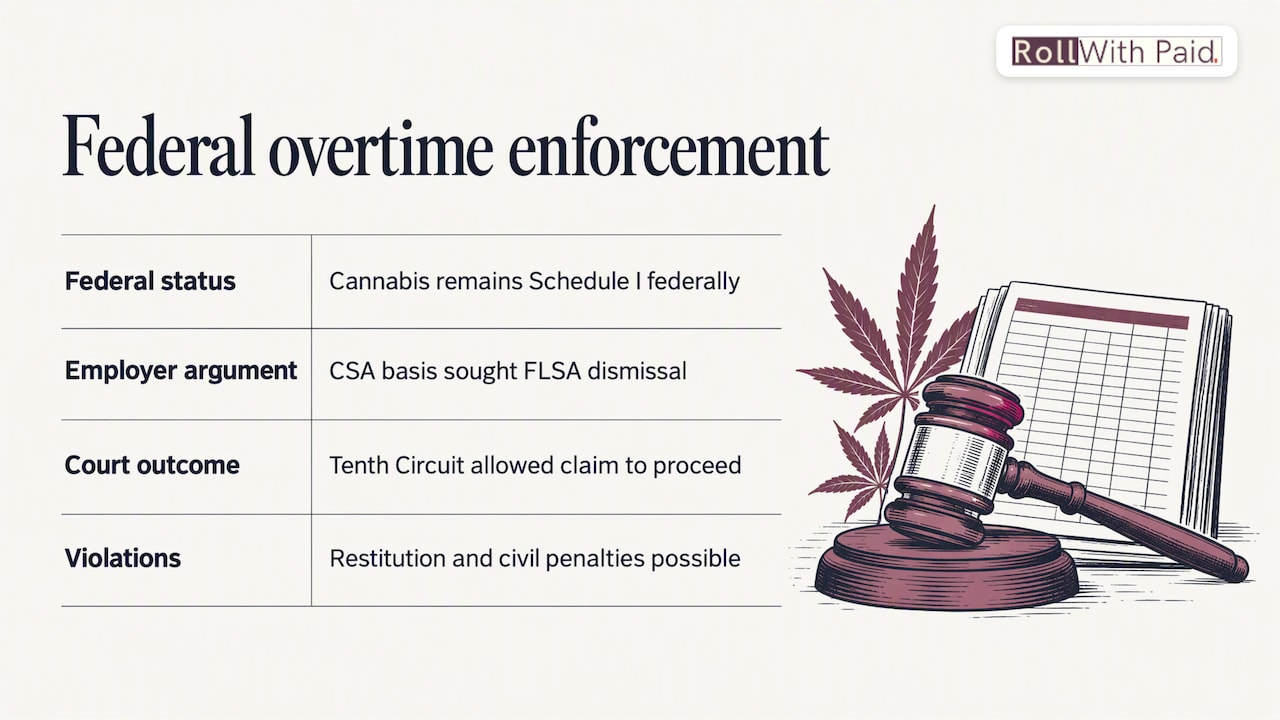
Yes. Operators sometimes assume that because cannabis remains a Schedule I substance federally, wage claims against them are somehow unenforceable. Courts have rejected that argument.
In a case against a Colorado cannabis company, a security guard alleged he had been misclassified as exempt from overtime. The employer moved to dismiss on the basis of the Controlled Substances Act. The Tenth Circuit’s opinion allowed the FLSA claim to proceed. Legal commentators at the time read the ruling as meaning marijuana-industry employers are unlikely to avoid an FLSA claim on those grounds, and the decision was widely covered in the trade press, including MJBizDaily.
The practical takeaway for you: treat wage-and-hour compliance exactly as a grocery or pharmacy owner would. State regulators agree. The Massachusetts Attorney General’s office, for example, reports ongoing enforcement and outreach on wage rules in its Fair Labor Division annual report, and the consequences of violations can include restitution and civil penalties.
Who is exempt, and who only looks exempt
Overtime exemptions are narrow. The Department of Labor places the burden on the employer to show an employee is exempt, and the white-collar tests look at what a person actually does all week. The salary-basis rules are laid out in Fact Sheet #17G.
To be exempt under the executive exemption, for example, an employee generally must:
- be paid on a salary basis at or above the current threshold;
- have management of the business or a recognized department as the primary duty;
- regularly direct the work of at least two other full-time employees (or equivalent); and
- have genuine input into hiring, firing or promotion decisions.
Those are general descriptions of the federal test. Read the regulations or ask counsel before relying on an exemption, particularly if your state’s test is stricter.
Typical dispensary roles, sorted by risk
| Role | Common assumption | Reality check |
|---|---|---|
| Budtender, cashier, receptionist | Hourly, non-exempt | Overtime applies after the weekly threshold, plus any state daily rules. |
| Assistant manager or shift lead | Salaried, so exempt | Exempt only if management is the primary duty and the other requirements are met. If they spend most of the shift ringing sales, stocking, and cleaning, they are likely non-exempt. |
| Inventory or compliance coordinator | Office job, so exempt | Depends on whether duties involve independent judgment on significant matters, not on data entry and reconciliation. |
| Trimmers, packagers, cultivation technicians | Paid by the piece or the pound | Piece rates still count toward the regular rate. Overtime is owed on top. |
| Security guards, delivery drivers | Contractors or exempt | Guards were the plaintiffs in the Tenth Circuit case. Classification as a contractor is also heavily scrutinized. |
The ‘assistant manager’ row is where the largest exposure usually sits. Salary alone does not carry the exemption: if an employee performs non-exempt tasks such as budtending, cleaning, or stocking for too large a share of the week, that person may be non-exempt regardless of how they are paid. If you cannot document the management duties, assume you will have to pay overtime.
How to calculate overtime correctly
The overtime rate is built on the regular rate, which is more than the hourly wage.
Step 1: Total all straight-time pay for the workweek. Include hourly wages, piece-rate earnings, shift differentials, and non-discretionary bonuses (attendance bonuses, sales-target or commission-style incentives).
Step 2: Divide by total hours worked. That gives the regular rate.
Step 3: Pay the premium. For each hour over the threshold, you owe an additional half of the regular rate on top of the straight time already counted.
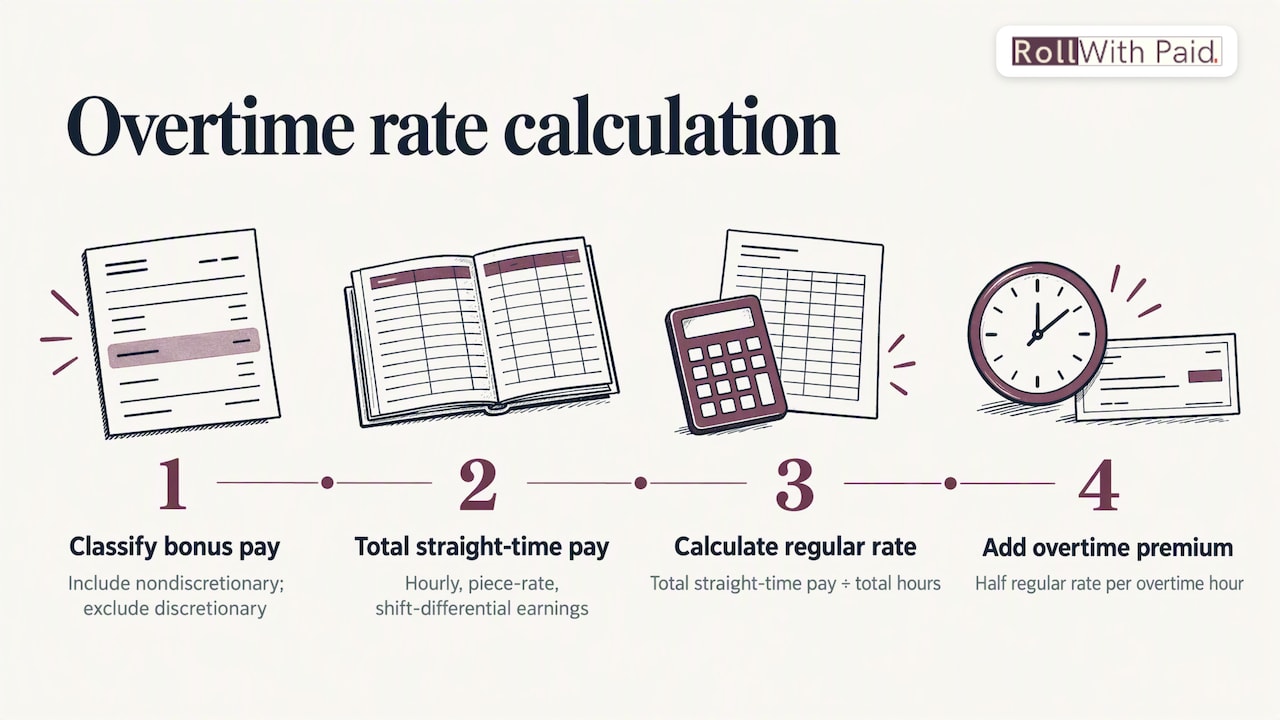
The Department of Labor’s opinion letter FLSA2026-6 explains that the Act excludes certain payments from the regular rate, such as discretionary bonuses, while non-discretionary payments are generally included. A monthly budtender sales bonus announced in advance is not discretionary, so it raises the overtime rate.
A worked example
A budtender earns $18.00 per hour and works 44 hours in the week. She also earns a $60 sales-target bonus that was promised in advance.
- Straight-time pay: 44 × $18.00 = $792.00
- Add the bonus: $792.00 + $60.00 = $852.00
- Regular rate: $852.00 ÷ 44 = $19.36 (rounded to the cent)
- Overtime premium: 4 hours × ($19.36 × 0.5) = $38.72
- Total due for the week: $852.00 + $38.72 = $890.72
Paying 4 hours at 1.5 × $18.00 and ignoring the bonus would shortchange her by a few dollars each week. Across a staff of 25 and a two-year lookback, the figures add up quickly, and liquidated damages can double them.
Timekeeping traps in dispensary operations
Most wage claims against retailers are less about the overtime multiplier than about hours that never made it onto the timesheet. The Department of Labor’s position is that work not requested but “suffered or permitted” is work time, and that waiting, on-call, training and travel time can all be compensable.
Automatic meal deductions
Many timeclocks subtract 30 minutes for lunch whether or not anyone took it. If a budtender eats at the counter while watching the floor, or breaks a lunch to check an ID at the door, that time was worked. The employee has to be completely relieved of duty for the break to be unpaid. A Wage and Hour investigation of a Hawaii company, summarized in a Department of Labor news release, is a reminder of how recordkeeping failures end: $59,888 in back wages and liquidated damages owed to 12 employees. That case involved trucking, not cannabis, but the timekeeping principle is the same.
Fixes that work: require employees to punch out and in for meals, let them attest to missed or interrupted breaks, and have managers approve corrections rather than quietly overriding punches.
Rounding
Rounding to the nearest quarter hour is permitted only if it is neutral over time. Department of Labor guidance in Fact Sheet #53 gives the standard example: punches 1 to 7 minutes past a quarter hour round down, and 8 to 14 minutes round up. A system that always rounds clock-outs down, or clock-ins to the later time, favors the employer and invites a claim. Dispensary staff who clock out at close and then count drawers are especially exposed.
Opening and closing tasks
Cash counts, safe reconciliation, seed-to-sale (track-and-trace) data entry, restocking, and end-of-shift security walkthroughs all happen near the edges of a shift. If employees do them after clocking out, or before clocking in, that is unpaid work. Build these tasks into the scheduled shift and have employees stay clocked in until they finish.
Pre-shift screening and waiting time
If employees must pass through a security checkpoint, wait for a vault to be opened, or attend a mandatory pre-shift huddle before they can punch in, ask whether that time is required for the job. If it is, it is generally paid.
Multiple locations
An employee who works at two of your stores for the same employer in the same week must have the hours combined for overtime. Operators with several licenses sometimes run separate payrolls by location, which can hide the total. For a deeper look at multi-state wage compliance, see our guide to audit-ready multi-state cannabis payroll.
Recordkeeping that holds up
The Department of Labor’s own enforcement staff stress that accurate records are the most reliable defense when a complaint arrives. Aim for time records that are contemporaneous (captured at the time of work, not reconstructed later), tied to the person who worked the hours, and kept in a form you can produce quickly.
A workable standard for a dispensary:
- Hours worked each day and each workweek, captured by a timeclock or app, with an audit trail for any edit.
- Written reasons for manual changes, approved by someone other than the employee.
- Pay-rate history, including bonuses and differentials, so you can recompute the regular rate.
- Documentation of exemption decisions: job descriptions, duty analyses, and salary records.
Regulators elsewhere also treat working-time records as a compliance matter. For a sense of how another country frames it, a Slovenian app maker publishes a guide to its 2026 working-time recording rules (in Slovenian). The legal details differ from US law, but the logic of reliable, complete hours records is similar. In the US, we cover how this ties to tax audits in our piece on cannabis time and attendance for 280E audits.
Our perspective: overtime is a payroll design problem
We work with cannabis dispensaries, cultivation facilities and other high-risk employers, and the overtime problems we see rarely come from owners who want to underpay. They come from systems that were set up for convenience: a generic timeclock with auto-deducted lunches, a salaried assistant manager role created to cap labor costs, a bonus plan that payroll never connected to the regular rate.
Three things matter most in our view:
- Classify first, then pay. Decide who is exempt based on documented duties, and revisit the decision when the job changes. Many payroll mistakes cannabis businesses make start with a classification made on day one and never reviewed.
- Make the timeclock match the floor. If your closing procedure takes 20 minutes, your schedule and your clock settings should say so.
- Keep payroll and HR in the same conversation. Overtime exposure, workers’ compensation class codes, and 280E-related labor allocation all draw from the same time data. When they diverge, you have a problem in an audit, a claim, or both.
Traditional payroll vendors often treat cannabis as an add-on or turn it away. Our approach is to run payroll as the employer of record where it fits, keep records audit-ready, and give owners someone to call before a pay period closes rather than after a claim lands.
— Leah Kollross
How Roll With Paid supports overtime compliance
If you want a second set of eyes on how your dispensary classifies employees, tracks hours and calculates the regular rate, our payroll execution, time and attendance, and HR compliance services are built for cannabis and other high-risk industries. Pricing depends on gross payroll, worker classification codes and headcount, with an optional flat-rate HR retainer. See the pricing page for how it works, or read what an employer of record does for high-risk businesses.
An overtime compliance checklist for dispensary owners
- [ ] List every position and mark it exempt or non-exempt, with the duties that support each exemption.
- [ ] Check that every salaried exempt employee meets the current salary threshold and the state’s threshold, if higher.
- [ ] Review your state’s overtime triggers (weekly, daily, seventh-day) and apply the more protective rule.
- [ ] Confirm that your workweek definition is fixed and applied the same way for every employee.
- [ ] Turn off automatic meal deductions or add a process for missed and interrupted breaks.
- [ ] Test rounding settings against a sample of real punches to confirm they are neutral.
- [ ] Include non-discretionary bonuses and differentials in the regular rate.
- [ ] Combine hours worked across all locations and entities for each employee.
- [ ] Move closing tasks inside scheduled, paid time.
- [ ] Keep time records and payroll records where you can retrieve them quickly. Check your state and the Department of Labor’s recordkeeping rules for retention periods.
- [ ] Review what you do when you hire: new hire paperwork matters too, for instance Minnesota new hire reporting.
If you find a past mistake, speak with an employment attorney about how to correct it. Back pay owed to current and former employees can be a legal question, not just a payroll fix.
FAQ
Do salaried dispensary managers get overtime?
Only if they do not qualify for an exemption. A salary at or above the threshold, plus a duties test that makes management the primary duty, are both required. If a manager spends most of the week budtending, stocking or cleaning, they probably qualify for overtime regardless of title or salary.
Is overtime always after 40 hours a week?
Under federal law, yes: overtime applies after 40 hours in a workweek. Some states use different rules, including daily overtime in certain states such as California, where cannabis workers’ overtime can be triggered by hours within a single shift. Check your state labor department for the exact triggers.
Can a cannabis employer refuse overtime because cannabis is federally illegal?
No. The Tenth Circuit’s decision in a security guard’s case allowed an FLSA overtime claim against a state-licensed cannabis company to go forward, and employers in the industry are unlikely to defeat such claims on that argument. Consult an employment attorney for how this applies in your circuit and state.
Do budtender tips and bonuses affect overtime pay?
Non-discretionary bonuses generally must be included in the regular rate, which raises the overtime rate. Discretionary bonuses can be excluded under the FLSA, but the label alone does not decide it. Review each plan against the Department of Labor’s guidance, such as opinion letter FLSA2026-6.
What records should I keep to defend an overtime claim?
Keep daily and weekly hours worked, pay rates, total pay per period, bonus plans, and the documentation behind any exemption. Contemporaneous records with an audit trail for edits carry far more weight than reconstructed timesheets.
Sources
- DOL: Questions and Answers About the FLSA
- DOL news release, May 14, 2026
- Tenth Circuit opinion, September 20, 2019
- Hall & Hammond summary of the ruling
- MJBizDaily coverage of the ruling
- Massachusetts Attorney General Fair Labor report
- DOL Fact Sheet #17G
- DOL Fact Sheet #53
- DOL opinion letter FLSA2026-6
- DOL warehousing initiative on hours worked
- DOL news release, February 19, 2019
- Minnesota overtime summary
- Minnesota minimum wage 2026
- California cannabis worker rights overview
Recommended
- Your Rights as a Cannabis Worker in Minnesota
- 5 Payroll Mistakes Cannabis Businesses Can’t Afford
- I-9 and E-Verify: A Compliance Guide for Cannabis Employers
- Cannabis Payroll: 8 Compliance Checks, Clutch vs. Roll With Paid
Roll With Paid. is not a law firm and does not provide legal advice. This article summarizes Minnesota law as of August 2026 and is general information only. Tip arrangements are fact-specific; before changing a policy, consult employment counsel or contact DLI Labor Standards at 651-284-5075.