
Does the DEA Register Dual Medical and Recreational Cannabis Licensees?

No. The DEA has refused registration to operators holding a single state license that covers both medical and adult-use sales, and Minnesota’s dual-purpose license was named in a DEA order. Federal registration under Schedule III is going to businesses in medical-only states. Minnesota operators still need compliant payroll and HR as Schedule I employers.
TL;DR
- The DEA told a Minneapolis dispensary that Minnesota’s dual-purpose license falls outside the federal definition of a “state medical license.”
- Registration covers only medical marijuana activity. Adult-use cannabis remains Schedule I.
- Unregistered Minnesota operators appear shut out of the Schedule III tax advantages that registered medical businesses may receive.
- Payroll, workers’ compensation and HR obligations do not change with the DEA’s decision. Audit-ready records matter more, not less.
- Rules are moving. Confirm the current status with the DEA and Minnesota’s Office of Cannabis Management (OCM) before you act.
Table of Contents
- What did the DEA decide about dual medical and recreational licenses?
- What does DEA registration actually mean for a state-licensed cannabis business?
- Which licenses qualify for DEA registration, and which do not?
- How does the DEA application process work for operators who are eligible?
- Why are Minnesota operators shut out, and what does the state say?
- What challenges do Minnesota cannabis employers face when federal status is unsettled?
- How do the best payroll and HR integrations fit a cannabis operation?
- What questions do cannabis employers ask us about the DEA decision?
- What are real use cases for operators in different positions?
- How does an Employer of Record compare with a traditional payroll provider?
- What is our perspective on the DEA decision?
- How can Roll With Paid support Minnesota cannabis employers now?
- FAQ
- Sources
What did the DEA decide about dual medical and recreational licenses?
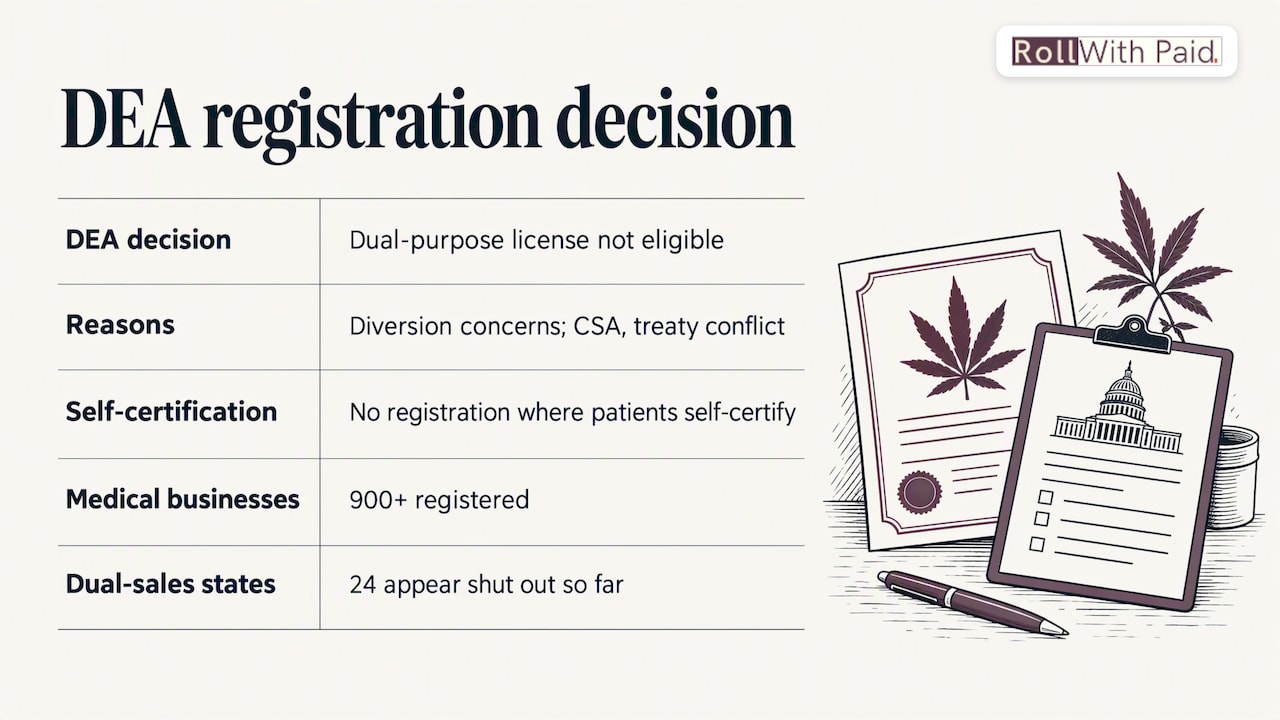
The DEA decided that a license permitting both medical and non-medical dispensing does not qualify for federal registration. Cheri Oz, assistant administrator of the DEA’s Diversion Control Division, signed an order to show cause sent to In-Dispensary in Minneapolis. Marijuana Moment reported that the order calls the dual-purpose license outside the new definition of a state medical license.
The order gives two reasons, as reported. Minnesota’s regime lacks robust protections against diversion, and registering such conduct would be inconsistent with the Controlled Substances Act and U.S. treaty obligations.
The same report says DOJ announced registrations for more than 900 medical cannabis businesses. All sit in Alabama, Florida, Mississippi, South Dakota, Texas, Virginia and West Virginia.
The Minnesota Star Tribune adds a second detail. The DEA said it cannot register businesses in states that let some patients self-certify, as Minnesota does for veterans. The paper also reports that the 24 states with both medical and recreational sales appear shut out so far.
What does DEA registration actually mean for a state-licensed cannabis business?
DEA registration authorizes covered medical marijuana activity under federal controls, and only within the scope of the state license. Under 21 CFR § 1301.13, entities holding state medical marijuana licenses may seek registration as manufacturers, distributors or dispensers.
The state license is the foundation. If the state license ends, the federal registration is tied to it and suspends automatically. Registration does not authorize non-medical marijuana activity.
The background is the April 2026 final order. According to Sidley’s analysis, it placed marijuana products subject to state medical licenses in Schedule III, and licensed entities must obtain or timely seek DEA registration.
Which licenses qualify for DEA registration, and which do not?
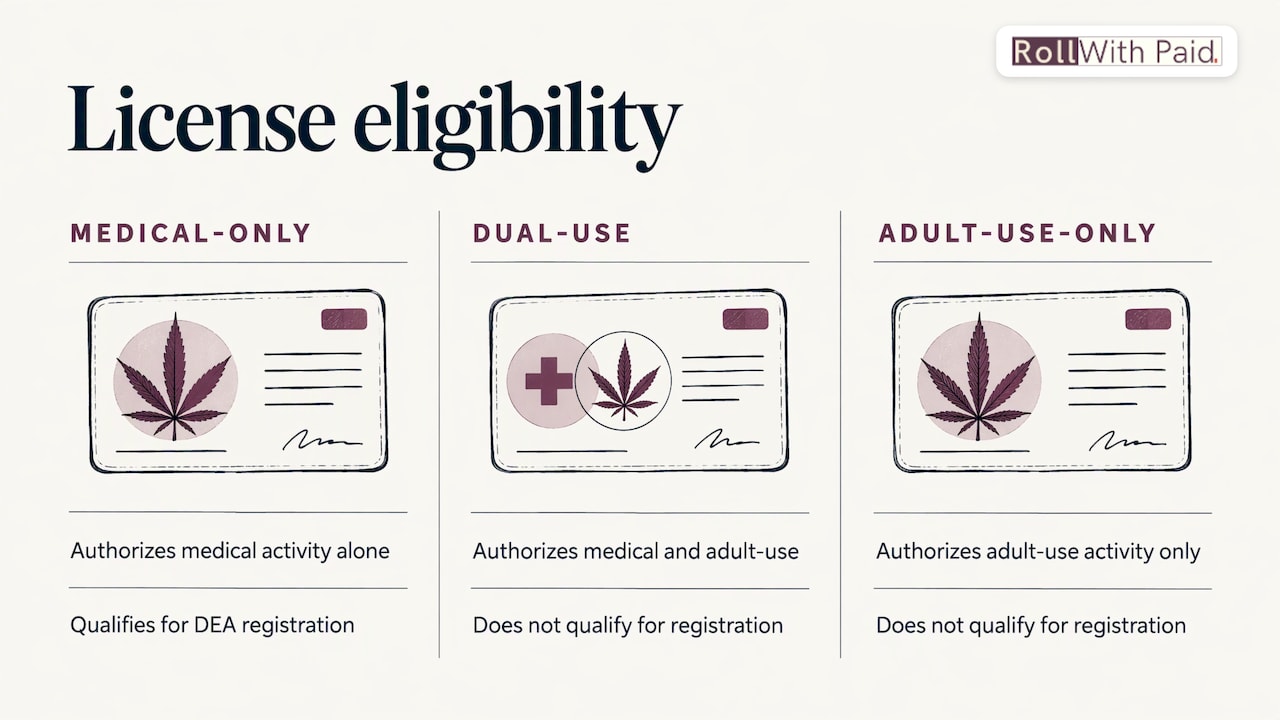
Only licenses that authorize medical activity alone qualify. The three common license structures sort out differently, and each gets its own treatment below.
Does a medical-only state license qualify?
Yes. A license that authorizes only medical marijuana manufacturing, distribution or dispensing can apply for registration. Applicants must show final state authorization. The Maryland Cannabis Administration’s FAQ says conditional licensees likely do not meet the proof-of-authorization requirement.
Does a dual medical and adult-use license qualify?
No, based on the DEA’s order to a Minnesota dispensary. The agency treats a single license covering both markets as falling outside the definition of a state medical license. Minnesota’s regime is the one the DEA has criticized by name.
Does an adult-use-only license qualify?
No. Adult-use cannabis stays in Schedule I. Arnold & Porter notes that limiting registration to medical purposes leaves recreational marijuana in Schedule I.
| License type | Eligible to register? | Federal schedule for the product |
|---|---|---|
| Medical-only state license | Yes, with final state authorization | Schedule III |
| Dual medical and adult-use license | Not under the DEA’s order to a Minnesota dispensary | Schedule I |
| Adult-use-only license | No | Schedule I |
How does the DEA application process work for operators who are eligible?
Eligible businesses apply online through the DEA portal. The DEA’s general instructions require business details, a Tax ID and valid, active state licenses. Application fees are not refundable. Knowingly furnishing false information is punishable by up to four years’ imprisonment and a fine of up to $250,000, or both.
The regulation also set a priority window. The Administrator must make every effort to process applications submitted within 60 days of publication within six months, and those applicants may operate under their state license while review is pending. That window opened with the April 2026 order and has passed. Check the DEA Diversion Control site for how late applications are handled.
After registration, the burden is lighter than many expect. Registered entities submit only the reports and records needed to meet federal statutory and treaty obligations, and the DEA must accept state-required records to the maximum extent permissible. State security requirements are sufficient under the same rule.
Why are Minnesota operators shut out, and what does the state say?
Minnesota operators hold licenses under a single state law that authorizes both medical and adult-use programs. The Star Tribune reports that the Office of Cannabis Management said it had received no communication from the DEA about either program. It also said medical cannabis remains available to patients in the state.
The practical effect is on tax. Edina cannabis attorney Carol Moss told the Star Tribune that the biggest impact is that dual-market businesses will not receive the tax advantages Schedule III gives federally registered medical businesses. Section 280E of the tax code continues to apply to Schedule I and II trafficking. That is why payroll classification and cost allocation stay under scrutiny. Our page on protecting cannabis payroll from 280E covers how we handle it.
None of this changes the federal exposure of the underlying activity. The Congressional Research Service states that marijuana activity not authorized under the CSA remains a federal crime. It also says moving marijuana to Schedule III alone would not bring state-legal markets into compliance with federal law.
What challenges do Minnesota cannabis employers face when federal status is unsettled?
The challenge is making decisions today under rules that may shift. Our business development and implementation teams see the same patterns with cannabis clients, and the DEA decision sharpens each one.
- Payroll providers that exit. Operators tell us a previous provider froze or dropped them with little notice. Federal headlines make mainstream providers more cautious. Our comparison with Paychex covers the payroll-freeze risk.
- Worker misclassification. Plant-touching and non-plant-touching roles carry different treatment. Owners often group everyone under one class code, which creates problems at audit and in workers’ compensation premiums.
- Multi-state complexity. Operators with a Minnesota location and a medical-only state location can end up on opposite sides of the DEA line. That affects tax planning and the records each location keeps. See our guide to audit-ready multi-state payroll.
- Banking and payments. Federal scheduling affects how financial institutions view licensed operators. Operators exploring cannabis merchant accounts and payments should expect providers to ask about registration status and license type.
- Training and documentation gaps. State regulators still expect records. Minnesota’s requirements are laid out in our post on cannabis workforce training.
How do the best payroll and HR integrations fit a cannabis operation?
The integrations that work best connect payroll to time tracking, seed-to-sale or POS reporting, and a central document store. We base this on what our implementation team sets up most often.
- Time and attendance feeding payroll directly. Hours flow by job code, so plant-touching and support time stay separated without manual re-keying.
- POS and inventory data kept separate from payroll. Sales data informs staffing, but payroll needs its own classification logic.
- Onboarding tied to I-9 and new-hire reporting. Minnesota has penalties for missed new hire reports. See our Minnesota new hire reporting checklist.
- A single HR document repository. Handbooks, acknowledgments and incident reports belong in one place an auditor can open.
- Accounting export by classification. A clean cost split by code gives your tax adviser what they need under 280E.
What questions do cannabis employers ask us about the DEA decision?
These are the questions that come up most in conversations with owners and operators, answered directly.
“We hold a Minnesota dual license. Should we apply to the DEA anyway?” The DEA’s order to a Minneapolis dispensary says dual-purpose licenses fall outside the medical definition. Talk to a cannabis attorney before filing, because false statements on an application carry criminal penalties.
“Does Schedule III mean our employees are covered differently?” No. Wage, hour, tax-withholding and workers’ compensation rules apply to your staff regardless of federal scheduling.
“Do we still have to be audit-ready?” Yes. State regulators, the IRS and insurers examine your records whether or not you hold a DEA registration.
“Could the rules change again?” They have changed repeatedly this year. Our cannabis HR compliance calendar tracks IRS deadlines, OSHA scrutiny and DEA changes in one place.
What are real use cases for operators in different positions?
A Minnesota dual-license dispensary. The business stays Schedule I and plans around full 280E exposure. It needs clean classification between plant-touching and non-plant-touching labor and complete records for every pay period.
A medical-only operator outside Minnesota. The business can seek registration, so it needs final state authorization, valid licenses and a Tax ID in order. Payroll must support the same entity details the DEA application asks for.
A multi-state operator. Different locations may hold different federal status. One payroll system with location-level reporting avoids mixing records across licenses.
A cultivation facility seeking a new provider. The facility has been dropped before and wants continuity. An Employer of Record model moves employment liability and workers’ compensation administration to the provider. Read more on Employer of Record for high-risk industries.
How does an Employer of Record compare with a traditional payroll provider?
An Employer of Record takes on employment responsibilities that a traditional provider leaves with you. Our comparison reflects our own model, which we design for cannabis and other high-risk businesses.
| Factor | Traditional payroll provider | Employer of Record with Roll With Paid |
|---|---|---|
| Industry fit | Often declines cannabis clients | Built for high-risk and cannabis employers |
| Employment liability | Stays with your business | Shared through the EOR structure |
| Workers’ compensation | You source and manage coverage | Handled within the EOR model |
| Compliance filings | Often self-managed | Managed as part of the service |
| Support | Ticket or call center | Personalized support |
For named side-by-side reviews, see Roll With Paid vs. Paragon Payroll and Roll With Paid vs. Greenleaf HR.
What is our perspective on the DEA decision?
We have watched owners read each federal headline as though it rewrites their obligations overnight. It rarely does. The DEA’s refusal to register dual-license operators in Minnesota changes tax planning and risk assessment. It does not change what an employee is owed on payday.
What we ask every client to do is separate what is uncertain from what is not. Federal scheduling is uncertain and moving. Classification, withholding, new hire reporting, I-9 files and workers’ compensation are not. A business with those in order can absorb almost any ruling.
That is why we built Roll With Paid around the Employer of Record model for cannabis and other high-risk industries. Our approach is designed to keep clients audit-ready, so a regulatory shift becomes a planning question instead of a payroll emergency.
Leah Kollross
How can Roll With Paid support Minnesota cannabis employers now?
We provide payroll execution, Employer of Record services, HR and compliance solutions, onboarding, multi-state hiring support and time and attendance tools for cannabis and other high-risk businesses. Our clients benefit from streamlined onboarding and personalized support, and we focus on keeping filings on time.

If you are preparing a Minnesota license application or reviewing your current provider, start with our Minnesota OCM preparation guide. Rates are based on gross payroll and worker classification. Details are on our pricing page, or talk to us about your operation.
FAQ
Can a Minnesota cannabis business register with the DEA?
Not under the DEA’s current position toward dual-purpose licenses. The DEA’s order to a Minneapolis dispensary says Minnesota’s license falls outside the federal definition of a state medical license. Rules may change, so check the DEA Diversion Control site and OCM for updates.
Does DEA registration make recreational cannabis federally legal?
No. Registration covers only medical marijuana activity within the state license’s scope. Adult-use cannabis remains in Schedule I, and unauthorized marijuana activity remains a federal crime.
What happens to a DEA registration if the state license ends?
The registration is tied to the state license and suspends automatically when the license ends. For that reason, keep state renewals, ownership changes and final authorization documents current.
Do payroll and HR obligations change if the DEA denies registration?
No. Wage, tax and workers’ compensation rules apply to your employees either way. A denial affects tax treatment and federal risk, so ask your attorney and tax adviser about 280E.
Sources
- DEA Refuses To Approve Marijuana Businesses In States That Allow Dual Medical And Recreational Licensing, Marijuana Moment
- DEA proceeds with federal medical cannabis changes, but Minnesota is shut out, Star Tribune
- 21 CFR § 1301.13, Application for registration
- DOJ and DEA Loosen Medical Marijuana Restrictions, Sidley
- Medical Cannabis Rescheduling Webinar FAQs, Maryland Cannabis Administration
- DOJ Announces Controlled Substances Act Scheduling Changes, Arnold & Porter
- DEA registration applications, general instructions
- State Marijuana Legalization and Federal Law, Congressional Research Service
Recommended
- Cannabis HR Calendar 2026: IRS Deadlines, OSHA Scrutiny, DEA Changes
- Before Your First Paycheck: Audit Ready Multi-State Cannabis Payroll
- Dispensary Overtime Rules: What Cannabis Employers Must Pay
Roll With Paid. is not a law firm and does not provide legal advice. This article summarizes Minnesota law along with other states and jurisdictions law and is for general information only. Before changing a policy, consult employment counsel or contact DLI Labor Standards at 651-284-5075.