
Cannabis Employee Handbook: What to Include in 2026
A cannabis employee handbook should document wages, schedules, breaks, overtime, discipline, safety, security, and a drug and impairment policy, then be tailored to each state where you operate and reviewed by employment counsel. Some regulators make the handbook mandatory: New York’s Office of Cannabis Management (OCM) regulations require licensees to prepare and maintain one, and New Mexico requires documented employee policies for cannabis retailers.
TL;DR
- Cover the core areas: pay and hours, benefits, discipline, safety, security, drug and impairment rules, and reporting procedures.
- Write the drug policy around impairment and reasonable suspicion. Minnesota allows random testing only for safety-sensitive positions.
- Follow the FLSA: overtime at 1.5 times the regular rate after 40 hours in a workweek for covered nonexempt workers.
- Keep dated versions. Update the title-page date with every change and archive the old edition.
- Have an employment attorney review the final draft for each state you operate in.
Table of Contents
- What should a cannabis employee handbook include?
- Is a cannabis employee handbook legally required?
- What wage and hour policies belong in a dispensary handbook?
- How should a cannabis handbook handle drug testing and impairment?
- What safety and security policies do cannabis employers need?
- How do you write discipline and reporting policies?
- What challenges do employers run into with handbooks?
- How do the options compare: template, custom handbook, or managed HR?
- How do handbooks work in real dispensary and cultivation scenarios?
- How often should you review and update the handbook?
- Our perspective on the cannabis handbook
- Can Roll With Paid help with handbooks and policy documentation?
- FAQ
- Sources
What should a cannabis employee handbook include?
A cannabis employee handbook should include wages, benefits, schedules, discipline, workplace safety, security, and any information the state regulator requires. The Cannabis Workforce Initiative’s sample handbook for New York licensees lists these areas, and they make a sound baseline in any state.
A working outline for a dispensary or cultivation looks like this:
- Employment basics: at-will language where your state allows it, equal opportunity, classification (exempt or nonexempt), and onboarding paperwork such as the I-9.
- Pay and time: pay periods, payday, time reporting, rounding rules, overtime approval.
- Schedules and attendance: shift swaps, call-outs, open-and-close duties, breaks.
- Conduct and discipline: standards of behavior, progressive discipline, reporting channels.
- Cannabis-specific rules: on-duty use, product access, employee purchases, impairment, testing.
- Safety and security: emergency procedures, cash handling, inventory controls, injury reporting.
- Acknowledgment page: a signed receipt for every employee and every revision.
A template is a starting point only. The Cannabis Workforce Initiative itself tells operators to adapt the document to their operations and to the local, state, and federal laws that apply, and to have counsel review it.
Is a cannabis employee handbook legally required?
In some states a cannabis employee handbook is required, and in others written policies are required without the word “handbook.” The rule depends on the regulator. Five examples show how it differs.
Minnesota
Minnesota does not make a handbook the headline requirement, but its drug testing statute leans on written policy. Under Minn. Stat. § 181.951, an employer may require reasonable suspicion testing when an employee has violated written work rules on drugs, cannabis, or alcohol, and those rules must be in writing. A handbook is the natural home for them.
New York
New York’s OCM regulations require licensees to prepare and maintain an employee handbook, according to the Cannabis Workforce Initiative sample. New York licensees also need to keep the handbook current, since regulators can ask to see it.
New Mexico
New Mexico requires cannabis retailers to have documented employee policies covering safety, security, emergencies, and an alcohol and drug-free workplace under N.M. Admin. Code § 16.8.2.39.
Illinois
Illinois sets a records rule that a handbook should support: training records must be kept for 5 years and be available for inspection on 48 hours’ notice, per Illinois Administrative Code tit. 8, § 1300.155, as summarized by Cannabis Business Times. Signed handbook acknowledgments belong in that file.
Michigan
Michigan restricts overlapping employment across license types, such as retail and secure transport, under Michigan Administrative Code r. 420.602a, also summarized in the same Cannabis Business Times report. A Michigan handbook should address outside employment and conflicts of interest directly.
The pattern is consistent: even where no statute says “handbook,” a regulator, an insurer, or a wage claim will ask for your written policies.
What wage and hour policies belong in a dispensary handbook?
A dispensary handbook should document work schedules, breaks, time-reporting procedures, overtime calculation and approval, pay periods, and payday. Cannabis Business Times also notes that employers must keep time records for all nonexempt employees.
The federal floor is the Fair Labor Standards Act. The Department of Labor’s FLSA reference guide states that covered nonexempt workers must receive overtime at not less than 1.5 times the regular rate after 40 hours in a workweek. The same guide says the FLSA does not require vacation, holiday, severance, or sick pay, or meal and rest periods. Your state may require them, so the handbook should follow the stricter rule, not the federal minimum.
For the scheduling question dispensary managers ask most, put these in writing:
- The workweek definition. Overtime is counted per fixed workweek, so state the start day and hour.
- Pre-approval for overtime. Unapproved overtime still has to be paid if the employee worked it, so approval controls scheduling, not pay.
- Pre-shift and post-shift tasks. Opening the safe, counting the drawer, and reconciling inventory are work time.
- Shift-swap rules. A swap that pushes someone past 40 hours creates overtime the schedule did not plan for.
- Break practice. State your required break rules, and require employees to record any missed break.
Our guide to dispensary overtime rules walks through the calculations in more detail.
How should a cannabis handbook handle drug testing and impairment?
A cannabis handbook should state the prohibited substances, the circumstances that trigger testing, what counts as reasonable suspicion, and the consequences of a violation. The American Employers Council guidance recommends exactly these elements, and also says to separate past use from on-the-job impairment.
Minnesota gives a concrete example of why wording matters. Under Minn. Stat. § 181.951, an employer may require random cannabis testing only for employees in safety-sensitive positions (or certain professional athletes). Most budtenders, packagers, and trimmers would not fall in that category by default, so a handbook promising random testing of everyone would overreach for a Minnesota employer.
Three drafting rules follow:
- Define on-duty conduct separately from off-duty use. Many states protect certain off-duty or medical use, with exceptions for safety-sensitive roles and federal obligations, as the American Employers Council notes.
- Train supervisors to document. Foley & Lardner’s August 2026 advice is that managers should record objective, contemporaneous behaviors such as erratic conduct or a drop in performance, rather than relying only on a test that may not prove current impairment.
- Keep federal testing carve-outs. Drivers and other federally regulated roles follow federal testing rules, and the handbook should say so.
Prescribed medication needs the same care. OSHA’s 2006 interpretation letter says employers must use reasonable diligence to prevent safety violations and should keep an impaired employee from operating machinery once they know of the impairment. Write the policy so a supervisor knows to act on observed impairment from any cause.
What safety and security policies do cannabis employers need?
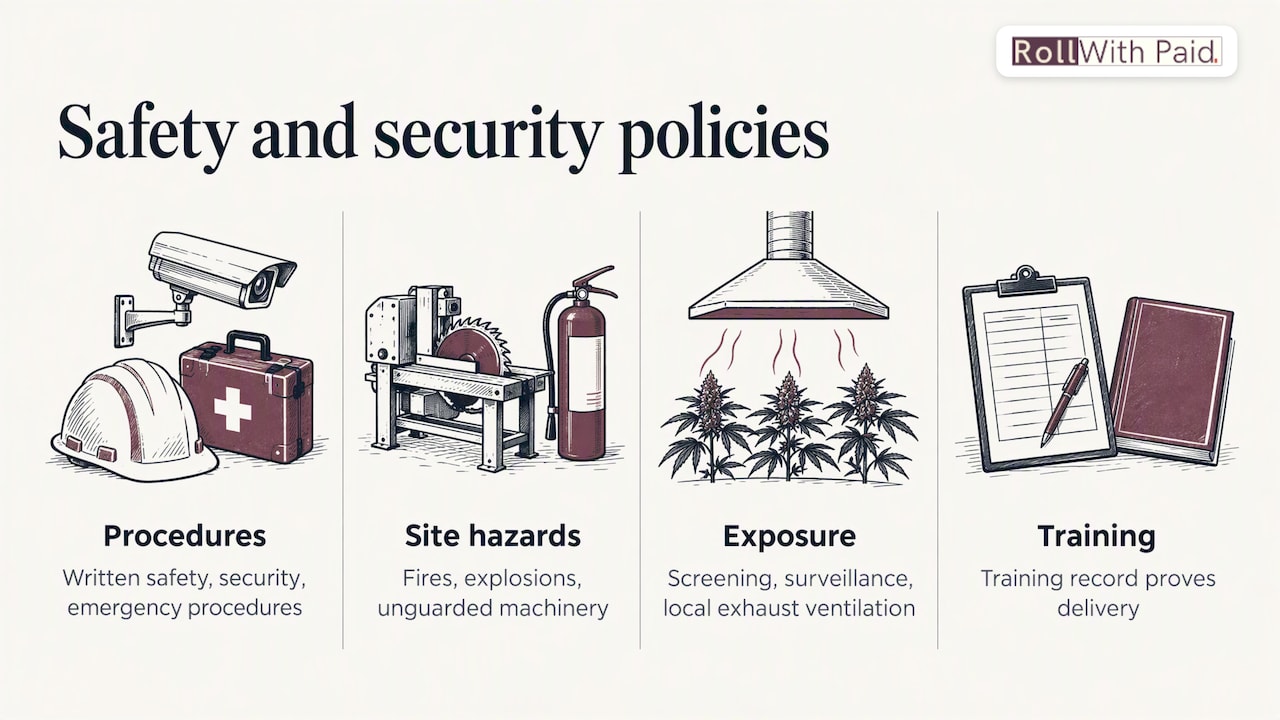
Cannabis employers need written procedures for safety, security, and emergencies, and cultivation and processing sites need hazard-specific rules on top. New Mexico lists safety, security, and emergency procedures as required policy content for retailers, and the Cannabis Workforce Initiative sample covers workplace safety and security as core handbook sections.
Cultivation and manufacturing carry their own risks. OSHA’s Local Emphasis Program directive CPL 24-04 targets cannabis processing and manufacturing in parts of Colorado because of fires, explosions, and unguarded machinery. It is a Colorado program, but its hazard list is a useful checklist anywhere.
OSHA’s publication on occupational allergies and asthma in cannabis recommends medical screening, surveillance programs, and exposure controls such as local exhaust ventilation for cultivation and production workers exposed to cannabis dust. A cultivation handbook should reference these controls and tell employees how to report breathing or skin symptoms.
Our cannabis safety training guide covers what employers should include in training, and the handbook should point to it as the training record that proves delivery.
How do you write discipline and reporting policies?
A handbook should set standards for behavior, performance, and professional conduct, and pair them with a progressive discipline policy so employees know the consequences in advance. The Cannabis Workforce Initiative sample also says to outline reporting procedures for harassment and misconduct clearly, and Cannabis Business Times recommends progressive discipline because it gives employees a path to improve.
Dispensary-specific conduct rules to name explicitly:
- Consuming or sampling product on shift, unless your state and license allow it and your policy says how.
- Diverting product, skipping inventory tracking, or altering sales records.
- Violating ID checks and purchase limits.
- Sharing access credentials or leaving secured areas open.
- Retaliating against someone who reports a concern.
Add at least two reporting routes, so an employee whose manager is the problem can go elsewhere. Our incident reporting guide covers how to keep those reports organized.
What challenges do employers run into with handbooks?
The same few problems show up repeatedly in cannabis HR work, and each one has a fix.
| Challenge | Why it happens | What fixes it |
|---|---|---|
| A generic template with no cannabis rules | Mainstream templates skip product access, tracking, and impairment | Add a cannabis section reviewed by counsel |
| One handbook for several states | Multi-state operators copy one state’s rules | Use a core handbook with a state supplement for each state |
| Policy says one thing, payroll does another | Handbook promises meal breaks or PTO that timekeeping does not track | Align the handbook with your time and PTO systems |
| No proof employees received it | Acknowledgments live in a manager’s drawer | Collect signed or electronic acknowledgments and store them centrally |
| Outdated edition still in use | Rules change and nobody owns updates | Name an owner and a review date |
Multi-state operators feel the second row hardest. Cannabis Business Times advises that multi-state employers adapt HR policies to each state and consult experienced employment counsel. Our page on audit-ready multi-state cannabis payroll explains how payroll setup follows the same state-by-state logic.
How do the options compare: template, custom handbook, or managed HR?
A template is cheapest to start, a custom handbook fits your license and states, and a managed HR partner keeps the document current for you. The right pick depends on headcount, number of states, and who owns compliance internally.
| Option | Best for | Main strength | Main gap |
|---|---|---|---|
| Free or purchased template | A single-location startup preparing for licensing | Fast and low cost | Needs heavy editing for cannabis and your state |
| Custom handbook with an attorney | An established operator in one state | Fits your operations and license terms | Needs an owner to update it as rules change |
| Managed HR and Employer of Record partner | Multi-state operators and teams without an HR lead | Policies, payroll, and onboarding stay aligned | Requires a service relationship |
If you are weighing providers, our comparison pages, such as Roll With Paid vs. Greenleaf HR, set out the differences on the criteria that matter to cannabis employers. For tool choices on the paperwork itself, see our review of HR document management options.
How do handbooks work in real dispensary and cultivation scenarios?
These are illustrative scenarios, not client case reports. They show how the policy language decides the outcome.
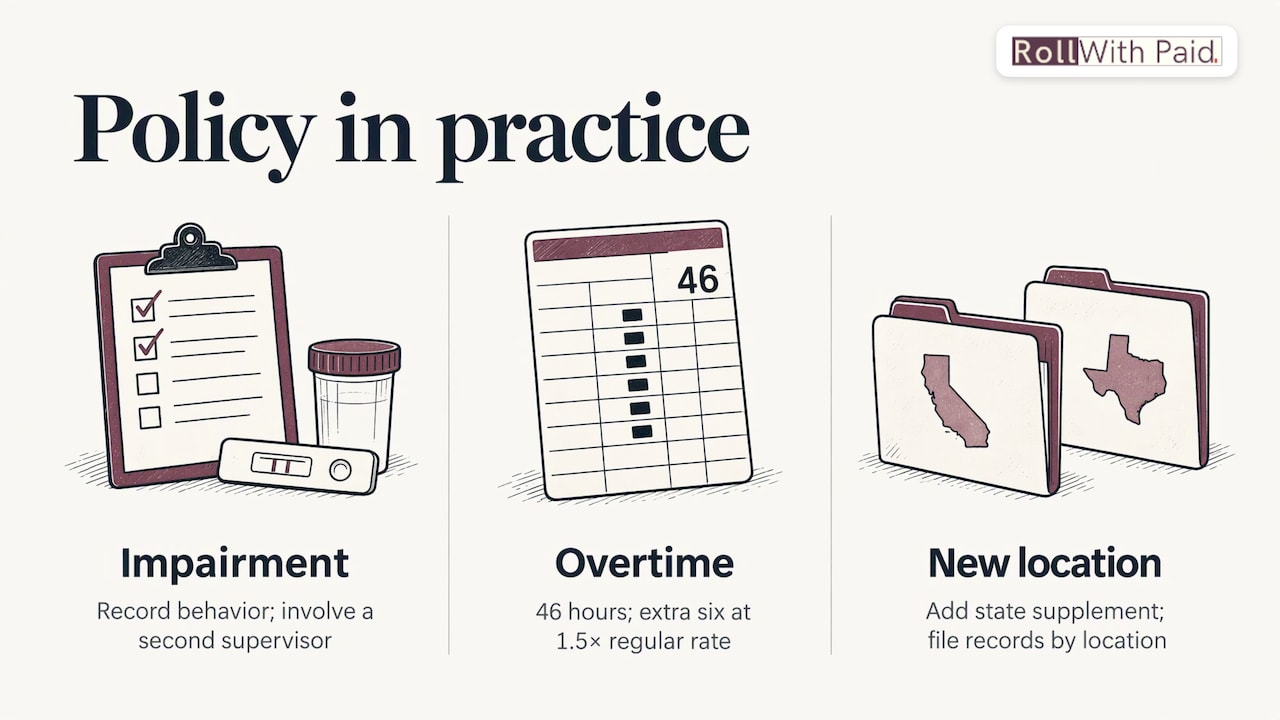
A budtender is flagged by a manager as seeming impaired. A handbook with a reasonable suspicion procedure tells the manager to record what they saw, involve a second supervisor, and follow the testing steps. Without it, the manager improvises, and the employer faces a discrimination or testing claim. In Minnesota, the written work rules must exist before reasonable suspicion testing under the work-rule route in § 181.951.
A cultivation lead works 46 hours after a harvest push. The handbook’s workweek definition and overtime approval rule decide how the extra six hours are paid. For a covered nonexempt worker, the FLSA requires 1.5 times the regular rate for those hours. Misclassifying the lead as exempt is where the larger exposure sits.
An operator opens a second location in another state. The core handbook carries over, but the drug testing, leave, and licensing rules need a state supplement. Training and acknowledgment records should be filed per location, since regulators such as Illinois can request records on short notice.
How often should you review and update the handbook?
Review the cannabis handbook whenever the law changes, and at least on a set schedule you name in the document. The Cannabis Workforce Initiative sample advises keeping current on legal changes, revising as needed, updating the title-page date with every policy change, and archiving prior versions.
A practical routine:
- Assign one owner, usually the HR lead or the owner-operator.
- Review twice a year and after any new state rule, license change, or incident.
- Reissue acknowledgments when material policies change.
- Keep the old version with its dates, so you can show which rule applied on a given day.
Version control sits next to payroll record-keeping. For the recordkeeping side of the finance function, this explainer on payroll tax obligations is a good companion, and cannabis operators should also read our note on 280E and payroll.
Our perspective on the cannabis handbook
We see the handbook as the document that connects three things employers often manage separately: what you promise employees, what your payroll actually does, and what a regulator or auditor can see.
When those three disagree, the cost shows up as a wage claim, a misclassification finding, or a late filing. When they agree, the handbook becomes the evidence that your operation runs the way you say it does.
That is why we build cannabis HR support around audit-ready processes, an Employer of Record model, and onboarding that gets the right acknowledgments and I-9 paperwork on file from day one. Traditional providers often turn cannabis businesses away. We specialize in them, so the policy, the paycheck, and the paperwork are written by people who know the industry.
Start with a handbook that fits your license and your states, then make sure payroll and timekeeping follow it.
Leah Kollross
Can Roll With Paid help with handbooks and policy documentation?
Yes. Roll With Paid provides HR and compliance solutions, policy documentation, onboarding, time and attendance tools, and Employer of Record services for cannabis and other high-risk businesses, so your handbook and payroll stay aligned.
If you want the handbook, the paycheck, and the filings handled by one team that knows cannabis, see our HR and compliance services or ask about rates on our pricing page. You can also read our HR compliance tips for dispensaries and cultivations first.
FAQ
Does a dispensary need its own employee handbook, or can it use the parent company’s?
Each licensed entity should confirm that the handbook matches its own license, state, and location. A parent company’s handbook can serve as the base, but state supplements are needed where rules differ, such as drug testing or leave. Counsel should review the final version.
Can a cannabis employer fire someone for off-duty cannabis use?
It depends on the state. Many states restrict action against registered medical users or protect lawful off-duty use, with exceptions for safety-sensitive roles and federal requirements. In Minnesota, testing is limited by Minn. Stat. § 181.951, so consult an employment attorney before disciplining on a positive test alone.
What should an employee handbook say about breaks and sick pay?
It should state your actual practice and follow your state law. The FLSA does not require vacation, holiday, severance, or sick pay, or meal and rest periods, but many states do. Whatever the handbook promises, your timekeeping must track.
How long should we keep handbook acknowledgments and training records?
Follow your state’s rule. Illinois requires training records to be kept 5 years and produced on 48 hours’ notice. In states without a stated period, keeping acknowledgments for the length of employment plus your longest wage claim window is a prudent practice to confirm with counsel.
Sources
- Cannabis Workforce Initiative: Sample Employee Handbook (New York)
- N.M. Admin. Code § 16.8.2.39, Cannabis Retailer Policies
- Minnesota Statutes § 181.951, Authorized Drug and Alcohol Testing
- Cannabis Business Times: Cannabis Employment Compliance
- Cannabis Business Times: How to Create Your Employee Handbook
- U.S. Department of Labor: Handy Reference Guide to the FLSA
- American Employers Council: Cannabis Legalization and Employer Drug Policies
- Foley & Lardner: Tips for Employers Trying to Grapple with Cannabis Use
- OSHA: Interpretation Letter on Impaired Equipment Operators (2006)
- OSHA: CPL 24-04 Local Emphasis Program for Cannabis
- OSHA: Occupational Allergies and Asthma in the Cannabis Industry
- Payroll Tax Obligations Explained for Small Business Owners
Recommended
- Cannabis HR Calendar 2026: IRS Deadlines, OSHA Scrutiny, DEA Changes
- Cannabis Safety Training: What Employers Must Cover
- I-9 and E-Verify: A Compliance Guide for Cannabis Employers
- Best Cannabis HRIS in 2026: What to Compare Before You Buy
Roll With Paid. is not a law firm and does not provide legal advice. This article summarizes Minnesota law along with other states and jurisdictions law and is for general information only. Before changing a policy, consult employment counsel or contact DLI Labor Standards at 651-284-5075.