
Cannabis Safety Training: What Employers Must Cover
Cannabis safety training is a state-by-state patchwork layered on top of federal and state OSHA rules. Most licensed operators must train every worker on hazards, emergency response and their role-specific procedures, and then keep proof of it. Harassment training is usually a separate obligation, and the safest approach is to treat it as part of the same annual training calendar. Below we lay out what the regulators say, where states differ, and the patterns we see when operators bring this to our business development and implementation teams.
TL;DR
- Cannabis safety training is required by license rules, workplace safety law or both, and the content differs by state. Minnesota, California, New York, Ohio and New Jersey all set different expectations.
- Hazards to cover include chemical exposures, heat, electrical issues, machine hazards, slips and falls, and workplace violence with emergency response.
- Keep records of who was trained, by whom, on what and when. Regulators in New York and Ohio expressly expect them.
- Harassment training is a separate policy question from licensing rules. Build it into the same annual schedule so nobody is missed.
- Payroll and HR data should connect, because training status follows hire dates, job roles and locations.
Table of Contents
- What safety training means in a cannabis business
- How requirements differ by state
- What about harassment training?
- Challenges we see most often
- Issues we have worked through with operators
- Integrations that work best
- Comparing ways to deliver the training
- Use cases
- Questions operators ask us
- Safety program costs and employee wellbeing
- How Roll With Paid supports your training program
- FAQ
- Sources
What safety training means in a cannabis business
There are really two things wearing one name. The first is licensing-driven training: the state cannabis regulator tells licensees what employees must learn, such as cannabis law, security controls and inventory documentation. The second is workplace safety training: OSHA or a state OSHA plan expects you to find and control hazards, and to teach employees how.
A dispensary and a cultivation facility share the first category and differ a great deal in the second. A budtender needs customer-facing responsible-use training, security procedures and emergency response. A grow technician also needs to understand the hazards of the room itself.
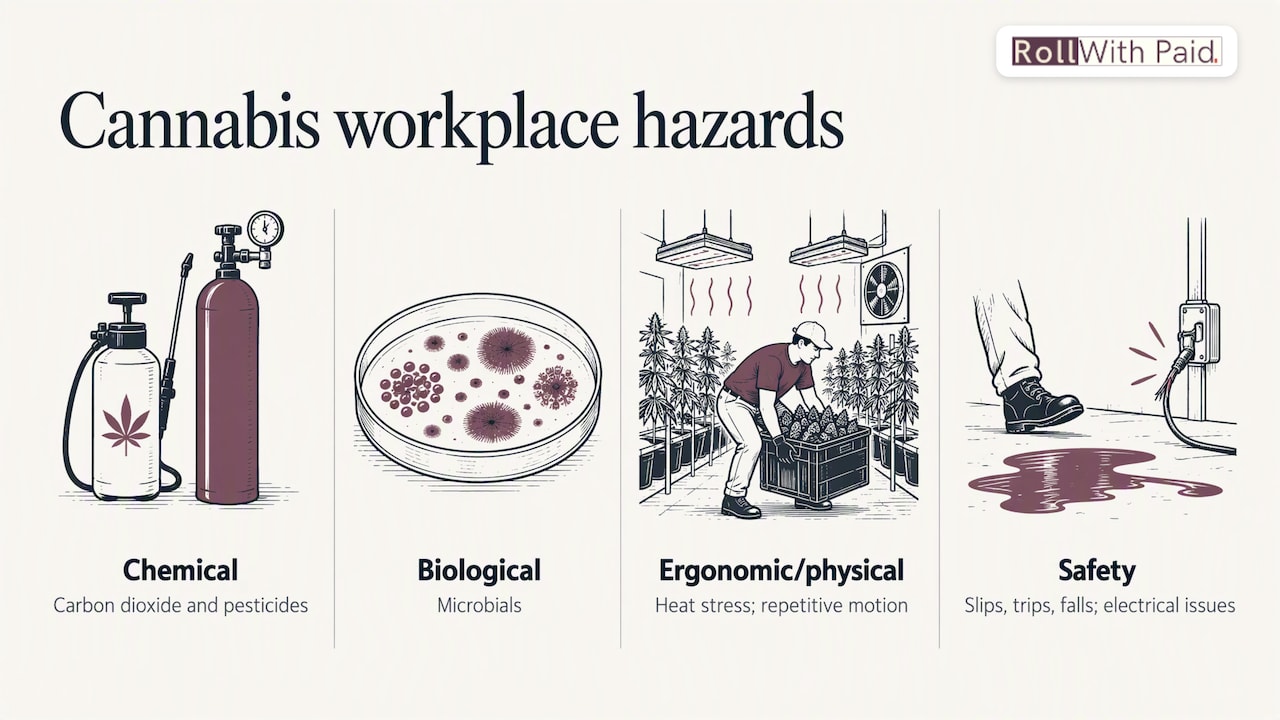
The CDC’s cannabis workplace resources point to chemical exposures such as carbon dioxide and pesticides, biological exposures such as microbials, ergonomic and physical hazards such as heat stress and repetitive motion, and safety hazards such as slips, trips, falls and electrical issues. California’s Cal/OSHA adds electrical hazards, airborne contaminants, flammable liquids and gases, heat illness, machine hazards, PPE and workplace violence to the list of topics training should address.
That is a useful checklist for any state, even where the rules are less specific.
How requirements differ by state
The table summarizes what each state’s official pages say. It is a snapshot, so confirm current text with the regulator before you build a program.
| State | What the rules say | Notable detail |
|---|---|---|
| Minnesota | License holders provide annual, role-specific training covering standard operating procedures, cannabis laws, data privacy, security controls and emergency response such as workplace violence | Premises must also comply with federal OSHA rules, including emergency procedure displays and Right to Know hazardous materials information |
| California | Written Injury and Illness Prevention Program (IIPP) with effective training for all employees | Labor Code 6401.9 adds a workplace violence prevention plan with training, an incident log and non-retaliatory reporting |
| New York | Responsible Workforce Training (RWT) for all persons performing activities under a licensed business | Includes OCM and DOL courses, at least two hours of activity-specific training and implicit-bias training |
| Ohio | Employee training program, effective January 1, 2026 | Covers policies, Metrc documentation, inspections, badge requirements, cannabis law and responsible use |
| New Jersey | At least eight hours of ongoing annual training tailored to roles | Applies to owners, principals, employees, volunteers and management services contractors |
Sources: Minnesota Rules 9810.1102, Cal/OSHA, New York OCM, Ohio Division of Cannabis Control guidance and N.J. Admin. Code § 17:30-9.8.
Minnesota: annual, role-specific, and tied to OSHA
Minnesota operators have two layers to manage. The licensing rule asks for annual training that fits the person’s role. Separately, Minnesota’s workplace safety program rules apply. Minnesota requires most employers to maintain an AWAIR program, a written workplace accident and injury reduction program with five elements: management and supervisor safety responsibilities, hazard identification, communication of safety programs, accident investigation and enforcement methods.
We covered the recordkeeping side in our Roll Call newsletter on MNOSHA recordkeeping and AWAIR for Minnesota cannabis employers. For the licensing side, see our page on what Minnesota requires for cannabis workforce training.
California: the IIPP and workplace violence plan
California is the most prescriptive on the safety side. Employers need a written IIPP that finds and corrects hazards, and effective training is part of it. The workplace violence prevention plan is its own requirement, with employee training, an incident log and procedures for taking and responding to reports without retaliation.
New York: paid time and records
New York’s regulation says required workforce training happens during work hours at the employee’s usual rate of pay, with records available to the Office on request. That matters for payroll: training hours are paid hours, and they need to land in time records correctly.
Ohio: a training record form
Ohio licensees document training on an Employee Training Record Form, with trainer names and qualifications, materials, employees trained, certificates and dates. Ohio also requires records to be kept for two years. Cultivators and processors must have a registered Responsible Party or safety supervisor complete OSHA 30-hour General Industry training, or use a Division-approved OSHA consultant for regular training and safety audits.
What about harassment training?
Most readers searching for cannabis harassment training want to know whether the state cannabis regulator requires it. The answer varies, and the licensing rules above focus on operations, security and safety rather than harassment as such. The clearest official example we found is New York, where applicants for state procurement certify a written sexual-harassment prevention policy and annual training for all employees.
Our practical view: even where no cannabis-specific rule exists, harassment prevention belongs in the annual training cycle. Cannabis teams are often young, fast-growing and shift-based, with customer-facing staff alone on the floor and managers promoted quickly. California’s workplace violence plan shows how regulators think about this: reports must be accepted and answered without retaliation. A harassment policy that works the same way protects your people and your license.
As for your own state’s employment law on harassment training, check with employment counsel, since it is outside cannabis licensing and varies widely.
Challenges we see most often
The observations below come from the kinds of conversations our business development and implementation teams have with dispensary and cultivation owners. They are patterns, not statistics.
Training happens once, at hire. Annual rules, like Minnesota’s, mean the clock restarts for every employee. Owners who treat onboarding as the whole program find gaps at the first anniversary.
Records live in five places. A sign-in sheet in the break room, a certificate in an email, a spreadsheet at the manager’s desk. When an inspector or insurer asks, nobody can produce one clean file per employee.
Role changes are missed. A budtender becomes a shift lead, or a trimmer moves into a cultivation technician job. Role-specific training should change with the role, and so should the workers’ compensation classification. We cover classification trouble in 5 payroll mistakes cannabis businesses can’t afford.
Multi-state operators copy one program everywhere. A single national slide deck rarely satisfies Ohio’s record form, New Jersey’s eight hours and New York’s RWT at once. See our guide to audit-ready multi-state cannabis payroll for how we think about it.
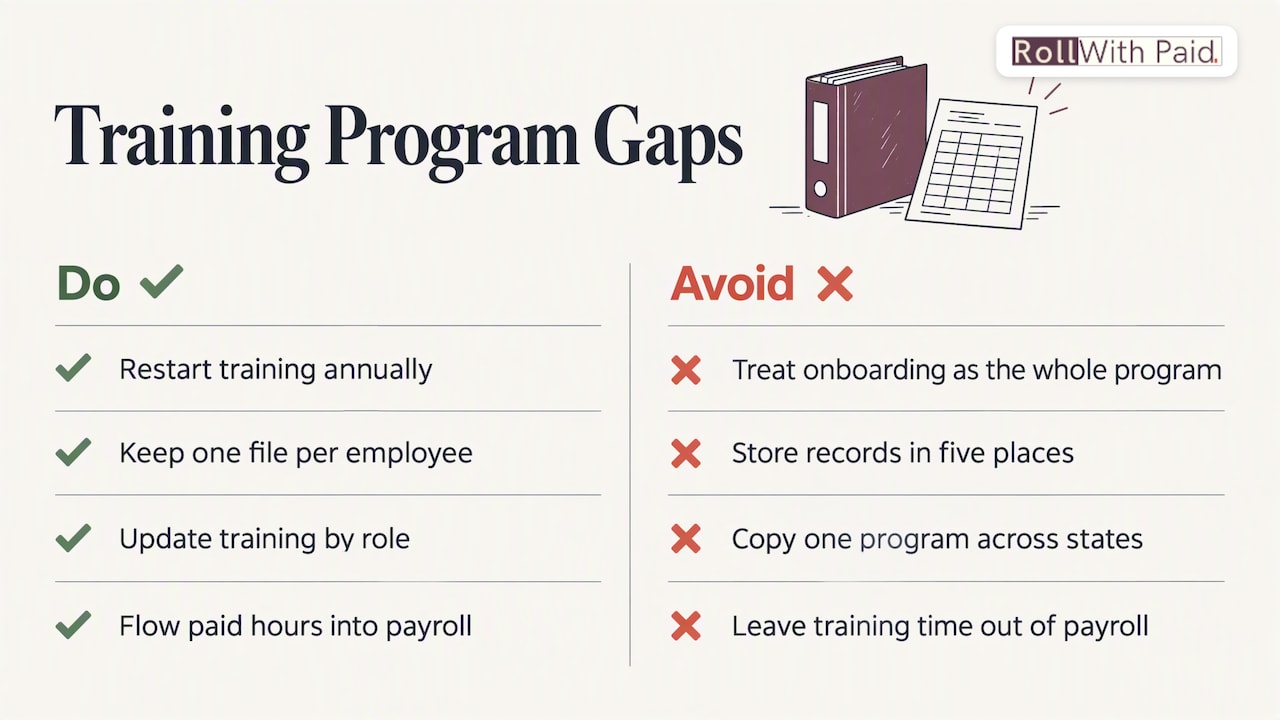
Training time isn’t treated as paid time. Where the rule says usual rate of pay, as in New York, the hours need to flow into payroll.
Issues we have worked through with operators
- Incident documentation that matches the training. If your plan says reports are accepted without retaliation, your incident process has to prove it. Our page on incident reporting software for cannabis employers covers the options.
- Orientation checklists that mix employment paperwork with safety content. We separate I-9 and tax onboarding from role training so one doesn’t hide the other. Our I-9 and E-Verify guide covers the first part.
- Handbooks that contradict practice. A policy says one thing, the floor does another. We help align documents with how the business really runs, and our overview of employee handbook software for multi-state firms compares tiers.
- Document sprawl. See HR document management tools versus a managed HR partner.
Integrations that work best
From our team’s experience, the systems that matter are the ones that hold dates and roles. Training compliance is a data problem as much as an education problem.
- Payroll and time and attendance together. When clock-in data and payroll live in the same flow, training hours are paid correctly and counted once. That is why we offer time and attendance tools alongside payroll execution.
- HR records tied to hire date and job code. Anniversary reminders, role changes and classification codes should come from one source.
- Seed-to-sale documentation. Ohio expressly names Metrc documentation as foundational training content, so whoever touches inventory needs training on it. Keep that training record next to the employee’s HR file.
- Incident reporting linked to HR. Reports, investigations and follow-up training should reference each other.
We would rather tell you to simplify than to bolt on another tool. Where tools multiply, records fragment.
Comparing ways to deliver the training
| Option | Best for | Watch for |
|---|---|---|
| State-provided or state-approved courses | New York RWT, where the state defines the courses | Activity-specific hours still need your own content |
| Third-party online courses | Baseline cannabis handler or responsible-vendor content | Ohio expects documented trainer qualifications and materials, so keep the course details |
| In-house sessions | Site-specific hazards, SOPs, emergency response | Needs a qualified trainer and written records |
| Managed HR partner | Multi-state or fast-growing teams that need records and payroll aligned | Content still has to match each state’s rule |
An external course helps with generic content. In-house or partner-led sessions handle what a generic course cannot: your room layout, your extraction or CO2 setup, your security procedures and your reporting channels. Most operators end up with a mix.
Use cases
These scenarios are illustrations of common situations, not client case studies. For a real result, see our compliant cannabis payroll and EOR case study.
A Minnesota dispensary adding three hires before a busy season. The owner needs role-specific training done, documented and paid, plus new hire reporting. Our Minnesota new hire reporting checklist covers the filing piece.
A cultivation facility with a heat or airborne contaminant concern. Training on heat illness, PPE and chemical exposure should be specific to the grow rooms, with a written record and a clear reporting path. The CDC list above is a sound starting point for hazard identification.
A multi-state operator opening in Ohio. The company needs the Employee Training Record Form, trainer qualifications and a safety supervisor holding OSHA 30-hour training, or a Division-approved consultant, for cultivation and processing sites.
A new applicant preparing a Minnesota license. Training planning belongs in the application work. See preparing your Minnesota OCM license application.
Questions operators ask us
These are paraphrased from the kinds of questions that come up in onboarding conversations.
“If a worker completed a course at another dispensary, do we skip it?” Not automatically. Minnesota’s rule is role-specific and annual for your license, so training should reflect your SOPs, security controls and emergency procedures. Prior certificates can supplement it.
“Do we pay people for training time?” In New York the regulation says usual rate of pay during work hours. Treat that as the safest default elsewhere and confirm with your regulator.
“How long do we keep records?” Ohio sets two years. For other states, check your regulator, and keep them accessible by employee.
Safety program costs and employee wellbeing
Training carries real costs: paid hours, trainer time and materials. Some teams also invest in stress and resilience support for high-pressure floors. If that’s on your list, this overview of trauma-informed workplace wellness is worth a look. It doesn’t replace required safety or harassment training, but it can sit alongside it.
Better safety practice also supports your insurance position. Our Employer of Record model is designed to reduce legal liability and workers’ compensation costs for high-risk employers, and consistent training records are part of an audit-ready file.
Our perspective
We work with employers that mainstream payroll providers often turn away, and the pattern is consistent: training fails at the seams, not at the classroom. A good course gets delivered, then the hire date, job code, pay record and certificate sit in four different systems.
That is why we believe safety and harassment training should be run through the same system as payroll and HR. When one team owns onboarding, classification, time records and documentation, the annual cycle stops being a quarterly fire drill and becomes routine.
Our Employer of Record model is designed to give cannabis operators that structure: audit-ready records, compliant payroll and personalized support, so owners can spend time on the business.
Leah Kollross
How Roll With Paid supports your training program
We provide Employer of Record, payroll execution, HR and compliance solutions, onboarding, multi-state hiring support and time and attendance tools for cannabis and other high-risk businesses. We help you keep training records, hire dates and job classifications in step. Rates depend on gross payroll, worker classification code and headcount, and the details are on our pricing page.

If you want a second set of eyes on your onboarding and annual training calendar, talk to our team. For a broader view, read our HR compliance tips for dispensaries and cultivations and the cannabis HR calendar.
FAQ
Is cannabis safety training required?
In most licensed states, yes, through licensing rules, workplace safety law or both. Minnesota requires annual role-specific training, California requires an IIPP with training, and New Jersey requires at least eight hours annually. Check your regulator for the current text.
What topics should dispensary and cultivation training cover?
Cover hazards such as chemical exposure, heat, electrical issues, machine hazards, PPE and slips and falls. Add workplace violence and emergency response, plus cannabis law, security and your SOPs. Cultivation sites need more hazard-specific content than retail.
Do cannabis employers need harassment training?
It depends on your state’s employment law and any licensing or procurement conditions. New York’s procurement forms, for example, call for a written policy and annual training for all employees. Ask employment counsel about your state.
What records should we keep?
Keep who was trained, trainer names and qualifications, materials, certificates and dates. Ohio requires these for two years, and New York says records must be available to the Office on request.
Sources
- Cal/OSHA: Cannabis Industry Health and Safety
- CDC NIOSH: Workplace Safety and Health Hazards, Cannabis
- Minnesota Rules 9810.1102
- New York OCM: Responsible Workforce Training
- N.Y. Comp. Codes R. & Regs. Tit. 9 § 125.5
- Ohio Division of Cannabis Control: Employee Training Guidance
- N.J. Admin. Code § 17:30-9.8
- New York OCM: Required Forms, Appendix B
- Minnesota Safety Council: AWAIR Workshop
- Roll Call newsletter: MNOSHA recordkeeping and AWAIR
Recommended
- Cannabis Workforce Training: What Minnesota Requires
- Your Rights as a Cannabis Worker in Minnesota
- I-9 and E-Verify: A Compliance Guide for Cannabis Employers – Roll With Paid.
Roll With Paid. is not a law firm and does not provide legal advice. This article summarizes Minnesota law as of August 2026 and is general information only. Tip arrangements are fact-specific; before changing a policy, consult employment counsel or contact DLI Labor Standards at 651-284-5075.