
Avoid Compliance Gaps: Paycard Providers That Tie Cards to Payroll
For employers who need audit-ready payroll and can’t afford a compliance misstep, One strong paycard solution pairs card issuance with full payroll and Employer of Record support, rather than handing you a card program and walking away. Standalone card issuers and off-the-shelf paycard platforms remain reasonable choices for simpler, single-state operations with lower compliance exposure.
TL;DR:
- Standalone paycard platforms are suitable for single-state, low-turnover businesses with basic compliance management needs.
- Employers handling multi-state payroll or operating in regulated industries should consider integrated payroll and EOR support to manage compliance risks effectively.
- Key vendor evaluation points include consent documentation, funding speed, fee transparency, security measures, and seamless reconciliation reports.
- Proper rollout planning, including pilot testing and legal review of consent language, reduces implementation issues and ensures regulatory compliance.
- Using a managed provider like Roll With Paid helps maintain audit readiness, track dormant balances, and integrate paycard management with payroll processes.
Table of Contents
- What Are the Best Paycard Providers, and Why Do They Matter?
- What Should Payroll Teams Compare When Evaluating Paycard Vendors?
- How Do You Roll Out a Paycard Program Without Surprises?
- What Compliance and Security Checks Actually Protect Employers?
- What Do Paycards Actually Cost Employers and Employees?
- Managed Provider or Standalone Card Issuer: Which Fits Your Business?
- How Roll With Paid Supports a Compliant Paycard Rollout
- Sources
- FAQ
What Are the Best Paycard Providers, and Why Do They Matter?
A paycard is a reloadable prepaid card that receives a worker’s net pay by direct deposit instead of a paper check or a personal bank account. For employers, the pitch is straightforward: fewer checks to print, mail, and reissue, and less exposure to the kind of fraud that comes with paper. Check fraud has become widespread enough that the Federal Reserve Bank of Boston has flagged fraud awareness as critical to slowing the surge, and every paper check an employer eliminates is one less check that can be intercepted, forged, or altered.
The employee side matters just as much. A paycard gives an unbanked or underbanked worker access to their wages the moment payroll runs, no bank account required. Most cards load into a digital wallet, work at ATMs, and function anywhere a debit card is accepted. That’s a real difference for hourly and transient workers who might otherwise wait days for a check to clear or pay a check-cashing fee just to access their own money.
Where providers diverge is in what sits behind the card. A pure card-issuing platform gives you the plastic (or the virtual card) and a portal. What it usually doesn’t give you is a compliance backbone: someone tracking state consent rules, multi-state wage law, or how paycard funds interact with your quarterly filings. That’s the gap Roll With Paid closes. Because paycard distribution runs through the same Employer of Record infrastructure that handles your payroll execution and HR compliance, every card issuance ties back to documented consent, a verified pay stub trail, and a system built for audits, not just for pay days.
- Employers cut administrative time spent on check printing, mailing, and stop-payment requests.
- Employees get same-day access to wages without needing a traditional bank account.
- Fraud exposure drops because there’s no paper instrument to intercept or forge.
- Multi-state employers get one compliance layer instead of juggling separate state rules card by card.
Pro Tip: If your payroll spans more than one state or touches a high-risk industry like cannabis, don’t evaluate paycard vendors in isolation. Ask whether the same partner handles your payroll tax filings and consent documentation, because a mismatch between your card vendor and your payroll system is where compliance gaps usually start.
A simple card-issuing platform can work fine for a single-location retailer with a stable, low-turnover staff in one state. It starts to strain the moment you add multiple states, seasonal hiring spikes, or an industry where regulators already scrutinize your payroll practices closely.
What Should Payroll Teams Compare When Evaluating Paycard Vendors?
Run through this checklist before signing with any paycard provider. Skipping any one of these steps is how employers end up with a program that looks fine on paper and creates liability in practice.
- Enrollment and consent documentation. Confirm the vendor generates and retains the state-mandated consent notices employees sign before enrollment, and that those records are retrievable years later if a state agency asks.
- Card issuance speed. Ask whether the vendor offers instant virtual card issuance so new hires can access pay immediately, with physical cards shipped afterward as a backup rather than a requirement.
- Funding mechanics. Same-day or API-driven funding beats a standard ACH schedule that can leave a one- to two-day gap between payroll processing and money hitting the card.
- Fee structure transparency. Get every fee in writing: monthly maintenance, ATM withdrawal, balance inquiry, inactivity, and card replacement. Vague fee schedules are a red flag.
- Security and issuing bank details. Confirm the issuing bank, FDIC pass-through coverage, and whether the card carries EMV chip protection and zero-liability fraud coverage.
- Employee support and dispute resolution. Ask how fast disputed transactions get resolved and whether support is available in the languages your workforce actually speaks.
- Portability at termination. A departing employee should be able to keep using the card as a standard prepaid card or easily transfer the balance, not lose access the day they’re terminated.
- Reconciliation and reporting. Your payroll team needs clean reports that match card loads to payroll runs without manual cross-checking every cycle.
Small-business buyer guides that compare providers like Skylight ONE, Wisely, FlexWage, and rapid! tend to weigh pricing transparency and payroll integration most heavily, which tracks with what actually causes friction after a vendor is chosen. Pricing surprises and clunky integration are the two things employers complain about most once a program is live.
How Do You Roll Out a Paycard Program Without Surprises?
A paycard launch fails less often because of the card itself and more often because of a rushed rollout. Build in real lead time.
Before launch, finalize your written consent language with legal review, confirm your vendor contract spells out fee schedules and termination terms, and draft the employee-facing notice explaining opt-in and opt-out rights. Most states require employees have a genuine alternative to a paycard, usually direct deposit or a paper check, so your policy needs to say so explicitly.
During the pilot, start with a small group, ideally one department or location, and run two full payroll cycles before expanding. Reconcile every pilot payment against your payroll system manually, even though the vendor’s reporting should eventually make that automatic.
- Test enrollment in the language(s) your workforce speaks, not just English.
- Confirm HR or payroll staff know how to answer basic employee questions before launch week.
- Stock a one-page FAQ covering fees, ATM locations, and how to report a lost card.
- Track adoption rate weekly for the first month; a low uptake usually signals a communication gap, not a card problem.
Pro Tip: Schedule your pilot to avoid a state’s unclaimed-property reporting window if you’re already tracking dormant paycard balances. Timing a launch around escheatment deadlines, rather than into them, saves a scramble later.
After full launch, monitor adoption metrics, track any balances heading toward escheatment thresholds, and keep a standing process for resolving employee card issues within 48 hours. Managed providers that combine payroll execution with paycard delivery tend to handle this monitoring as part of the existing payroll cycle rather than as a separate task nobody owns.
What Compliance and Security Checks Actually Protect Employers?
The regulatory side of paycards is where employer liability actually lives, and it’s the part most vendor sales pitches gloss over.
Every state that permits paycards has its own consent rules, and several require employers to document that the employee had a real alternative before enrolling. Payroll trade guidance consistently points employers toward retaining these consent records and enrollment notices, because a state wage complaint years later can hinge on whether that paperwork exists. Escheatment adds another layer: unused paycard balances can eventually become reportable to the state as unclaimed property, and employers need a system tracking which balances are approaching that threshold.
Card security checks matter just as much. Confirm the issuing bank relationship and FDIC pass-through coverage before signing, since that’s what protects employee funds if the vendor itself runs into trouble. Ask directly about data encryption practices and whether the vendor can produce SOC 2 or ISO certification, and confirm breach notification timelines are spelled out in the contract, not left implied.
- Written state-specific consent, retained and retrievable for audits
- Escheatment tracking on dormant balances
- Confirmed issuing bank and FDIC pass-through coverage
- EMV chip protection and zero-liability fraud policies for cardholders
- SOC 2 or ISO data protection claims, verified rather than assumed
More than 64% of small businesses reported facing attempted or actual check fraud, a figure that makes the security case for electronic pay rails harder to dismiss. Employers operating in Minnesota should also review their wage theft prevention obligations, since paycard documentation often overlaps with the same recordkeeping the state already requires.
What Do Paycards Actually Cost Employers and Employees?
Paycard pricing usually breaks into employer-side fees and employee-side fees, and the split varies by vendor.
Employers typically face a per-employee monthly fee, a setup or implementation charge, and sometimes a card-issuance fee for each new employee enrolled. Employees may see ATM withdrawal fees (especially out-of-network), inactivity fees after a set number of dormant months, paper statement fees, and card replacement charges.
- Setup and monthly employer fees are usually negotiable, especially at higher headcounts.
- Out-of-network ATM fees are almost never negotiable since they flow through a separate ATM network.
- Watch for interchange passthrough language and international transaction fees; these hide in contracts and surprise employees who travel.
- International use fees can be steep even on domestic paycards, so flag this for any multi-location or seasonal workforce.
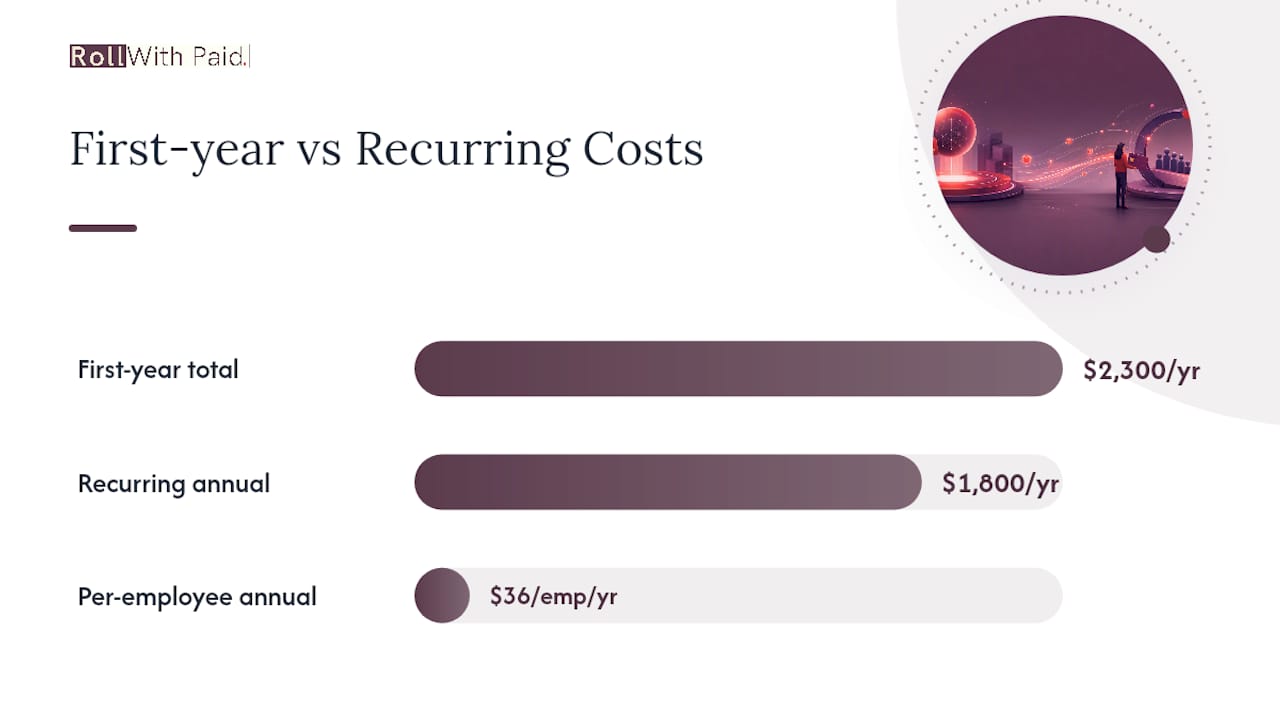
A rough sample calculation: 50 employees at a $3 monthly employer fee runs $1,800 a year before any setup cost. Add a one-time $500 implementation fee and you’re looking at roughly $2,300 in the first year, dropping to $1,800 annually after that, assuming no fee increases. Run this math against your current check-printing and reissuance costs before assuming a paycard program adds expense; for many employers it doesn’t.
Managed Provider or Standalone Card Issuer: Which Fits Your Business?
The honest answer depends on how much compliance complexity you’re carrying, not on which vendor has the flashiest app.
A standalone card-issuing platform works when you operate in one state, your workforce is stable, and your HR team already has bandwidth to manage consent documentation and escheatment tracking on its own. That’s a legitimate, lower-cost path for straightforward operations.
A managed payroll and EOR partner makes more sense once you’re juggling multiple states, high turnover, or an industry where regulators already look closely at your payroll practices. At that point, the compliance burden of running paycards as a separate system from payroll starts outweighing whatever you’d save by piecing together vendors yourself. The payroll mistakes that cost cannabis operators the most rarely trace back to the paycard itself. They trace back to gaps between systems that nobody was watching.
— Leah
How Roll With Paid Supports a Compliant Paycard Rollout
If your business operates in a high-risk industry, cannabis especially, the paycard decision is really a compliance decision wearing a payment-method disguise. Roll With Paid built its Employer of Record model around exactly that reality: payroll execution, HR compliance, multi-state hiring support, and onboarding all run through one system, so a paycard program doesn’t sit disconnected from your consent records or your quarterly filings.

Clients working with similar providers may experience fewer late filings and stronger audit readiness because the compliance work happens continuously, not as a scramble before a state review. Whether you’re rolling out paycards for the first time or replacing a vendor that’s given you fee surprises, Roll With Paid’s HR and compliance solutions can fold that work into your existing payroll cycle instead of adding a separate system to manage. Service rates are based on your gross payroll and headcount, and pricing details are available on the Roll With Paid pricing page. Reach out through that page to get a rate quote and see how a compliance-first payroll partner fits your rollout timeline.
Sources
For employers doing their own vendor research, the Paycard Providers directory from the payroll trade association lists established vendors and practical guidance. FitSmallBusiness’s comparison of payroll card providers breaks down pricing and standout features across several platforms. The Boston Fed’s column on check fraud explains why electronic pay rails matter beyond convenience.
- Paycard Providers
- Check fraud is rampant — fraud awareness is key to slowing the surge
- 4 Best Payroll Card Providers for Small Businesses
FAQ
Who Is the Best Payroll Provider for Paycard Programs?
The best choice depends on your compliance exposure. For employers with multi-state payroll or high-risk industry status, Roll With Paid stands out for combining payroll execution with Employer of Record compliance support, while simpler single-state operations may do fine with a standalone card issuer.
Is Direct Deposit or a Paycard Better for Employees?
Direct deposit works best for employees who already have a bank account, since there are typically fewer fees involved. A paycard is the better option for unbanked or underbanked workers who need immediate access to wages without opening a traditional account.
Who Is the Largest Payroll Provider in the Industry?
Large national payroll processors like ADP handle payroll at massive scale and offer paycard products such as Wisely as part of broader financial-wellness features. Scale doesn’t always translate to specialized compliance support for high-risk industries, which is a separate consideration from sheer processing volume.
What Is a Major Disadvantage of Payroll Cards?
The biggest drawback is fee exposure for employees, particularly out-of-network ATM fees and inactivity charges that can quietly erode a paycheck. Employers should also weigh the compliance burden of tracking state consent rules and escheatment on dormant balances, which a managed provider can absorb but a standalone card platform typically leaves to the employer.
How Much Does Roll With Paid Charge for Payroll and Paycard Support?
Roll With Paid’s service rate is based on gross payroll and worker classification, and current pricing is available on the Roll With Paid pricing page.
Recommended
- I-9 and E-Verify: A Compliance Guide for Cannabis Employers
- What Is an Employer of Record — and Why It Matters for Your Benefits
- 280E and Payroll: What Cannabis Employers Need to Understand
Roll With Paid. is not a law firm and does not provide legal advice. This article summarizes Minnesota law as of August 2026 and is general information only. Tip arrangements are fact-specific; before changing a policy, consult employment counsel or contact DLI Labor Standards at 651-284-5075.