
Classify Exempt vs Nonexempt: 3 FLSA Tests U.S. Employers Must Run
A worker is nonexempt and owed overtime under the FLSA unless the employer can prove all three tests: salary basis, salary level, and duties. Nonexempt employees earn 1.5× their regular rate for hours over 40 in a workweek and need their hours tracked. Exempt employees are paid a fixed salary of at least $684 a week and perform executive, administrative, professional, computer, or outside sales work as their primary duty.
TL;DR:
- Paying a salary does not automatically qualify an employee for exemption unless they meet all three tests: salary basis, salary level, and duties.
- Employers must thoroughly document actual duties, verify fixed salary arrangements, and compare pay against state and federal thresholds to ensure correct classification.
- Remote and part-time employees can be exempt if their duties and salary meet exemption criteria, but state laws may impose stricter requirements than federal standards.
- Misclassification risks include back pay, damages, and increased audits, especially for multi-state employers or those with inconsistent payroll practices.
- Outsourcing payroll to specialists with multi-state compliance experience can reduce classification errors and ensure ongoing adherence to evolving laws.
Table of Contents
- What Exempt and Nonexempt Mean in Payroll Practice
- The Three Legal Tests to Claim a White-Collar Exemption
- Common Exemption Categories and Quick Role-Focused Criteria
- Step-by-Step Classification Checklist (How to Audit or Classify a Job Now)
- How State and Local Laws Interact With the FLSA
- Recordkeeping, Payroll Mechanics, and Overtime Calculation Details
- Consequences of Misclassification and Common Triggers for DOL Audits
- How a Specialist Payroll Partner Reduces Classification Risk
- Guidance on Reclassification Procedures for Existing Employees
- How to Handle Exemptions for Part-Time, Temporary, and Remote Employees
- Author Note: Why Rechecking Borderline Roles Annually Is Best Practice
- A Compliance Partner Built for Classification Risk in High-Risk Industries
- Essential Regulatory Links for Classification Decisions
- Sources
- FAQ
What Exempt and Nonexempt Mean in Payroll Practice
In payroll terms, nonexempt means every hour gets tracked, and every hour past 40 in a workweek gets paid at time and a half. Exempt means the employee receives a fixed salary regardless of hours worked, and federal law does not require you to log their daily clock times, though many employers do it anyway for scheduling or PTO purposes.
Two myths cause most of the classification trouble Rollwithpaid sees among high-risk employers.
- Paying someone a salary does not make them exempt. Salary is one of three required tests, not the whole answer.
- A fancy job title (like “budtender lead” or “cultivation manager”) means nothing to the Department of Labor if the actual work doesn’t meet the duties test.
- Nonexempt employees can still be salaried. Salaried nonexempt is a real, legal, and fairly common setup.
The Three Legal Tests to Claim a White-Collar Exemption
An exemption claim only holds up if the role passes three separate tests at once. Miss one, and the position defaults to nonexempt, no matter how senior it sounds on an org chart.
- Salary-basis test. The employee must receive a predetermined, fixed amount each pay period that doesn’t fluctuate based on hours worked or quality of output. Docking pay for a partial-day absence, or suspending pay without notice for a minor policy violation, can blow up salary-basis status for that entire job classification, not just one worker.
- Salary-level test. The federal floor for most white-collar exemptions is $684 per week, or $35,568 annualized. Highly Compensated Employees face a separate, higher total-compensation threshold with a lighter duties requirement. States can set this bar higher than the federal number, and often do.
- Duties test. This evaluates what the employee actually does most of the time, not what the offer letter says. A manager who spends 90% of their shift ringing up sales and stocking shelves, with occasional scheduling input, likely fails the executive duties test even on a $60,000 salary.
Pro Tip: Save examples, not adjectives. “Approved three hires and set Q3 staffing budget” holds up in an audit far better than “manages team.”
Common Exemption Categories and Quick Role-Focused Criteria
Each white-collar exemption has its own duties fingerprint. Here’s the fast version HR teams actually use when triaging a role:
- Executive: Primary duty is managing the business or a department, regularly directs two or more full-time employees, and has genuine input on hiring, firing, or promotion decisions.
- Administrative: Office or nonmanual work tied to business operations (finance, HR, compliance, marketing), combined with independent judgment on matters of real consequence, not just following a checklist.
- Professional: Learned professionals need advanced knowledge from prolonged specialized education (think accountants, RNs); creative professionals need invention, imagination, or talent in a recognized artistic field.
- Outside sales: Primary duty is making sales away from the employer’s place of business, with no salary minimum required at all.
- Computer employees: Systems analysis, programming, or software engineering work qualifies; help-desk troubleshooting generally does not.
- HCE: Total compensation clears the higher threshold, and the employee performs at least one exempt duty regularly. It’s a lower duties bar, not a free pass.
Step-by-Step Classification Checklist (How to Audit or Classify a Job Now)
Run every role, new or existing, through the same sequence:
- Document real duties. List what the person actually does, with rough percentages of time, not the job posting language.
- Confirm the pay method holds up. Verify the salary is fixed and identify any deductions that could violate salary basis, like unpaid partial-day suspensions.
- Check salary against thresholds. Compare pay to the federal $684/week floor and any state minimum that applies where the employee physically works. Run HCE math if compensation is high and duties are thin.
- Apply the duties test. Match responsibilities to the specific exemption category and gather supporting evidence: org charts, approved budgets, hiring decisions.
- Record the decision. Write down the classification, the evidence used, and a date to revisit it.
Pro Tip: Build a simple one-page memo per role: pay method, salary math, duties evidence, and exemption claimed. That memo is your best defense if the DOL comes calling.
How State and Local Laws Interact With the FLSA
The FLSA sets a floor, not a ceiling. Whenever state or local law is more protective than federal law, the employer must follow the stricter standard for that worksite.
Multi-state employers run into a few recurring traps:
- Higher state salary thresholds that exceed the $684/week federal number.
- Municipal overtime or predictive-scheduling ordinances layered on top of state law.
- State-specific duties tests that define “primary duty” more narrowly than federal guidance.
If you operate across several states, maintain separate payroll settings, written policies, and classification files per state rather than a single national template. A cannabis operator running dispensaries in three states, for example, may need three different job descriptions for the same “assistant manager” title.
Recordkeeping, Payroll Mechanics, and Overtime Calculation Details
For nonexempt employees, you need records of hours worked each day and week, the basis on which wages are paid, the regular hourly rate, and total wages per pay period. These aren’t optional file-drawer items; they’re what auditors ask for first.
Calculating overtime correctly means including nondiscretionary bonuses and shift differentials in the regular rate, not just base hourly pay. Discretionary bonuses and certain reimbursements are excluded.
Nonexempt employees are entitled to overtime pay of at least 1.5× their regular rate for every hour worked past 40 in a workweek.
Two payroll habits quietly destroy exempt status for entire job groups:
- Docking a salaried employee’s pay for a partial-day absence.
- Making unplanned payroll corrections that treat salary like an hourly wage.
Test any new payroll rule on a single employee before rolling it out company-wide.
Consequences of Misclassification and Common Triggers for DOL Audits
Misclassification exposure adds up fast: back overtime pay, liquidated damages equal to the back pay itself, attorney’s fees, and potential class or collective action claims covering every similarly titled employee, not just one complainant.
Audits and lawsuits rarely come out of nowhere. Watch for these triggers:
- A single employee complaint about unpaid overtime, which often opens a broader DOL inquiry.
- Blanket exempt titles applied across a whole department regardless of actual duties.
- Inconsistent payroll practices, like docking some salaried staff but not others.
If you find a misclassified group, voluntary correction, prompt back-pay remedies, and clear documentation of the fix go a long way toward limiting liability if the DOL ever asks questions.
How a Specialist Payroll Partner Reduces Classification Risk
Classification decisions don’t happen in a vacuum. They live inside payroll runs, pay stubs, and state filings, and that’s exactly where high-risk employers tend to get tripped up.
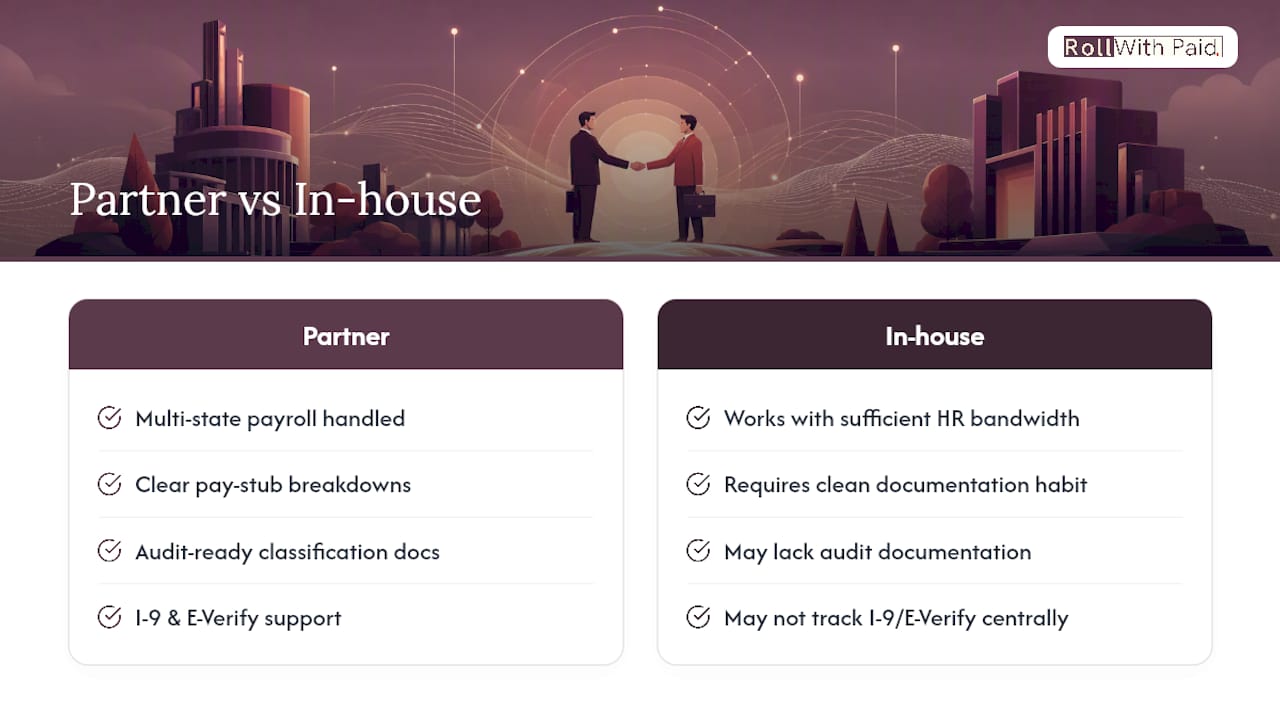
Rollwithpaid’s Employer of Record model handles multi-state payroll settings, clear pay-stub breakdowns, and classification documentation that holds up under scrutiny, alongside I-9 and E-Verify support for hiring compliance. Cannabis employers juggling retail, cultivation, and processing roles across state lines benefit most from outsourcing this piece, since state-specific duties tests and salary floors multiply fast with each new location. If your HR team already has bandwidth and a clean documentation habit, keeping classification in-house works fine. If you’re stretched thin across states, a partner that already tracks those state-by-state rules removes a real liability blind spot.
Guidance on Reclassification Procedures for Existing Employees
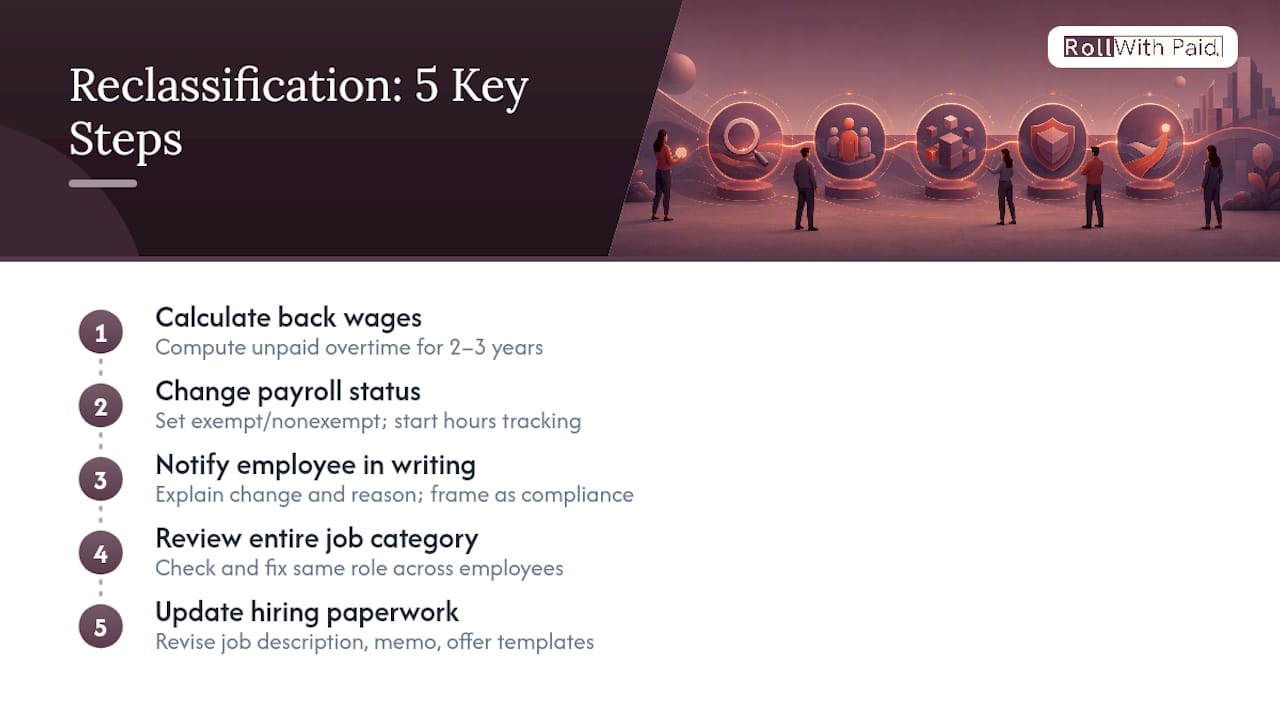
If an audit or internal review turns up a misclassified employee, don’t wait for a complaint to force your hand. Start by calculating the back wages owed: unpaid overtime for however far back the applicable statute of limitations reaches, which is typically two years and can stretch to three for willful violations under the FLSA.
Reclassify the role going forward first. Change the employee’s status in payroll from exempt to nonexempt (or the reverse, in rarer cases), set up hours tracking immediately, and notify the employee in writing of the change and the reason behind it. Frame it as a compliance correction, not a demotion. Employees who feel blindsided are far more likely to escalate to a wage complaint.
Next, address the back pay. Paying it promptly and documenting the calculation method shows good faith if the DOL ever reviews the file. Waiting for a demand letter or lawsuit removes that goodwill and often adds liquidated damages to the bill.
Check whether the misclassification affected other employees in the same role or job title. Misclassification is rarely a one-person problem; it’s usually a job-category problem. Fix the whole category at once rather than patching it person by person as complaints roll in.
Finally, update the job description, the classification memo, and any offer letter templates tied to that role so the same mistake doesn’t repeat with the next hire. A reclassification that isn’t backed by updated paperwork tends to drift back to the old, wrong status within a year or two.
How to Handle Exemptions for Part-Time, Temporary, and Remote Employees
Part-time status has no bearing on exempt classification. An employee working 25 hours a week can still be exempt if they clear the salary-level test on a prorated basis in some states, though federal law generally still expects the full weekly salary threshold regardless of reduced hours. Cutting a part-time exempt employee’s salary below $684 a week to match reduced hours typically converts them to nonexempt, since the salary-basis test requires a fixed amount unrelated to hours worked.
Temporary employees follow the same three-test framework as anyone else. Duration of employment doesn’t factor into the FLSA test at all. A temporary controller brought in for a six-month close process can be exempt if the duties and salary genuinely qualify; a temporary receptionist cannot, no matter how the staffing agency titles the role.
Remote work adds a jurisdictional wrinkle rather than a duties wrinkle. The controlling state law is generally the one where the employee physically performs the work, not where the company is headquartered. An employer based in Minnesota with a remote employee working from California needs to check California’s salary threshold and duties rules, which are often stricter than federal minimums. This catches multi-state employers off guard constantly, especially as remote hiring has expanded well beyond a company’s home state.
The safest approach for all three categories: run the same checklist you’d use for any full-time, in-office role, adjusted for the state where the person actually sits down to work each day.
Author Note: Why Rechecking Borderline Roles Annually Is Best Practice
I’d recommend revisiting borderline classifications every year, or immediately after a reorg, title change, or new state hire. The most common mistake I see isn’t a bad initial call. It’s a good call that quietly stopped being true two years later as duties shifted. When in doubt, the DOL’s own guidance or a payroll partner familiar with your industry beats guessing.
— Leah
A Compliance Partner Built for Classification Risk in High-Risk Industries
Cannabis and other high-risk employers carry a heavier classification burden than most industries, thanks to multi-state operations, cash-heavy payroll, and job titles (budtender lead, cultivation supervisor) that regulators scrutinize closely.

Rollwithpaid built its Employer of Record services specifically for this gap: multi-state payroll runs configured to each state’s salary thresholds, classification documentation that holds up in an audit, and pay-stub clarity that keeps employees from filing complaints out of confusion rather than actual wrongdoing. Where a generic payroll vendor treats every state the same, specialized payroll services build per-state settings so operations in different states don’t share a compliance blind spot. If you’re carrying classification risk across more than one state right now, start by reviewing what an Employer of Record actually changes for your payroll setup and get a sense of what a corrected structure would look like.
Essential Regulatory Links for Classification Decisions
Bookmark these for every classification memo you write. The FLSA overview covers the baseline law; Fact Sheet #17A breaks down salary levels and duties by exemption category; the small entity compliance guide walks through audit-style application; and IRS guidance on worker status clarifies employee versus independent contractor questions, a separate decision from exempt versus nonexempt. Cite these directly in internal memos rather than paraphrasing secondhand summaries.
This article is general information, not a substitute for advice from a qualified lawyer. Consult a qualified legal professional about your own circumstances before acting on anything here.
FAQ
How Do I Tell if I Am Exempt or Nonexempt?
Check your pay structure and duties: if you’re paid a fixed salary of at least $684 a week and your primary duty matches an executive, administrative, professional, computer, or outside sales role, you’re likely exempt. If not, you’re nonexempt and entitled to overtime under the FLSA.
What Is an Exempt Employee Under U.S. Law?
An exempt employee is excluded from FLSA overtime and minimum wage protections because they meet the salary-basis, salary-level, and duties tests for a recognized exemption category, such as executive or administrative work.
Can an Employee Be Both Exempt and Nonexempt?
Not for the same role at the same time.
Why Would Someone Be Salaried Nonexempt?
Employers often pay a fixed salary for budgeting or scheduling simplicity even when the role doesn’t meet the duties test for exemption. That employee still must receive overtime for hours over 40, calculated from an equivalent hourly rate derived from the salary.
Recommended
- 280E and Payroll: What Cannabis Employers Need to Understand
- MN Wage Theft Prevention Act: What Employers Need to Know
- 5 Payroll Mistakes Cannabis Businesses Can’t Afford
Roll With Paid. is not a law firm and does not provide legal advice. This article summarizes Minnesota law as of August 2026 and is general information only. Tip arrangements are fact-specific; before changing a policy, consult employment counsel or contact DLI Labor Standards at 651-284-5075.