
Pass a 280E Audit: Cannabis Time and Attendance for U.S. Operators

A compliant cannabis time and attendance system tracks hours by function, not just by clock-in and clock-out, so wages split cleanly between deductible production costs and non-deductible operating expenses. It needs tamper-resistant capture, minute-level records, and a documented allocation methodology that survives an audit. Roll With Paid builds exactly this into its payroll workflows. Your next move: pull last quarter’s time records and check whether they show what each employee was doing, not just when.
TL;DR:
- A cannabis timekeeping system must track hours by activity and retain detailed, tamper-resistant records tied to employee IDs and permits for at least three years.
- Payroll systems require activity codes, geofencing, biometric capture, and integrations with POS and METRC to document labor function and ensure audit compliance.
- Transitioning to a compliant system should be carefully planned, piloted for 30 to 60 days, and synchronized with quarter boundaries to prevent reporting gaps.
- Maintaining ongoing audit readiness involves quarterly reconciliations, documented allocation rules, and storing immutable records and receipts accessible to auditors.
- Specialized payroll providers like Roll With Paid, designed for high-risk industries, streamline compliance with 280E, multi-state rules, and permit tracking, reducing audit risks.
Table of Contents
- What Should a Cannabis Compliance Checklist Cover?
- What Features Should You Require From a Time-and-Attendance System?
- How Do You Roll Out a Compliant System Without Breaking Payroll?
- How Should Time Data Flow Into Payroll for 280E Reporting?
- How Do You Stay Audit-Ready Year-Round?
- Why Specialized Payroll Support Changes the Compliance Equation
- How Roll With Paid Gets You There
- Sources
What Should a Cannabis Compliance Checklist Cover?
Most cannabis operators lose 280E deductions not because they underpay taxes on purpose, but because their timekeeping cannot prove what workers actually did. The IRS does not take your word for it. It wants a paper trail that ties labor hours to production activity, and labor costs must be tracked by function so only production-related wages land in cost of goods sold.
Run through this list before your next payroll cycle:
- Track hours by activity, not just by shift. A budtender who spends an hour restocking the sales floor and three hours trimming should show both, tagged separately.
- Use minute-level, contemporaneous records tied to employee ID and permit number. A time entry without a permit reference is a liability waiting to surface.
- Retain reconciled records for at least three years under federal wage law, longer where your state requires it, as many states do.
- Confirm your system blocks scheduling or paying anyone without a current permit or completed I-9. Lapsed credentials are one of the fastest ways to trigger a state licensing problem.
- Document meal and rest break compliance, including pre-shift prep and post-shift cash counts, which are often compensable even when they happen off the clock.
Pro Tip: Pull a random sample of ten employee time cards from last month and ask whether you could hand them to an auditor today without editing them first. If the answer is no, you have a gap worth fixing now.
What Features Should You Require From a Time-and-Attendance System?
Not every workforce management tool built for retail or restaurants will hold up under a cannabis audit. The feature set has to map directly to what a 280E exam or state labor inspector will ask for.
- Function and task codes. Every clock punch needs an activity tag (production, retail, administrative) so payroll can allocate wages to COGS correctly. Systems without this force finance teams to guess after the fact, which does not survive scrutiny.
- Badge or biometric capture with geofencing and minute-level timestamps. Paper timesheets are easy to fabricate and hard to audit; software that stamps location and time removes the guesswork.
- Split-shift and in-shift reclassification. A grower who also covers front-desk hours during harvest season needs a system that can split a single shift across two function codes without manual spreadsheet gymnastics.
- APIs or exports that keep function metadata attached to each time entry all the way into payroll. A clean CSV that loses the task code the moment it hits payroll defeats the entire purpose.
- Integrations with your POS and METRC. Reconciling labor hours against sales and seed-to-sale inventory data is how you catch discrepancies before an examiner does.
Skip any of these, and you are building your compliance case retroactively instead of in real time.
How Do You Roll Out a Compliant System Without Breaking Payroll?
Switching systems mid-quarter is where most operators get burned. Vendor transitions typically take 30 to 60 days, and rushing it usually means a messy first payroll run with mismatched allocation codes.
- Audit current roles and write down your allocation rules. If a cultivation technician also handles trimming and packaging, decide now how those hours split, and put it in writing.
- Configure the new system for your task codes and tamper-resistant capture before you touch live payroll.
- Pilot for 30 to 60 days, reconciling daily against POS and METRC data, not just at month’s end.
- Train supervisors on lockouts tied to permit expiration dates so nobody accidentally schedules an employee whose license lapsed last week.
- Migrate historical data carefully, and time your go-live near a quarter boundary to avoid splitting one reporting period across two systems.
- Build a first-payroll checklist: verify every function code mapped correctly, confirm withholding settings by state, and keep a backup export before you submit.
Pro Tip: Run your first live payroll a week before your actual deadline, not on it. That buffer is the difference between catching a misallocated code and explaining one to an auditor.
How Should Time Data Flow Into Payroll for 280E Reporting?
The mechanics matter here as much as the policy. Time data that loses its function-code metadata somewhere between the clock and the paycheck is functionally useless for 280E purposes, no matter how accurate the original punch was.
- Preserve function-code metadata through every export or API call into your payroll system. If your provider strips it during import, you are back to manual reconciliation.
- Map each code to the correct chart-of-accounts line, separating COGS-eligible production wages from non-deductible operating expense wages.
- Configure multi-state payroll settings correctly, since overtime thresholds and withholding rules differ significantly between states like California, Colorado, and Michigan.
- Document cash payroll processes with signed receipts. When banking access is limited, check or armored-car disbursement needs the same paper trail as a direct deposit.
- Produce quarter and year-to-date reconciliations that tie payroll totals back to POS and METRC records.
Federal wage law sets a three-year minimum retention window for time records, and that floor is exactly the kind of detail an examiner checks first. If your state requires longer, your retention policy needs to reflect the stricter number, not the federal minimum.
How Do You Stay Audit-Ready Year-Round?
Audit readiness is not a project you finish once. It is a quarterly habit, and the operators who treat it that way rarely get blind sided.
- Run a quarterly reconciliation across time records, payroll, POS/METRC data, and your general ledger. Catching a mismatch in March beats explaining one in an exam in October.
- Classify every labor expense immediately into COGS, non-deductible operating expense, or deductible non-cannabis expense, rather than sorting it retroactively at tax time.
- Keep immutable exports, signed receipts, and your written allocation methodology in one accessible archive, not scattered across three systems.
- Run a periodic wage-and-hour self-check for off-the-clock work and missed breaks. These are the most common audit triggers in cannabis retail.
- Maintain a short audit playbook with your payroll vendor’s and counsel’s contact information already listed, so a request for records does not turn into a scramble.
Pro Tip: Store your allocation methodology document somewhere your payroll provider can access it too. If your HR partner does not know how you split hours, they cannot defend it on your behalf.
Why Specialized Payroll Support Changes the Compliance Equation
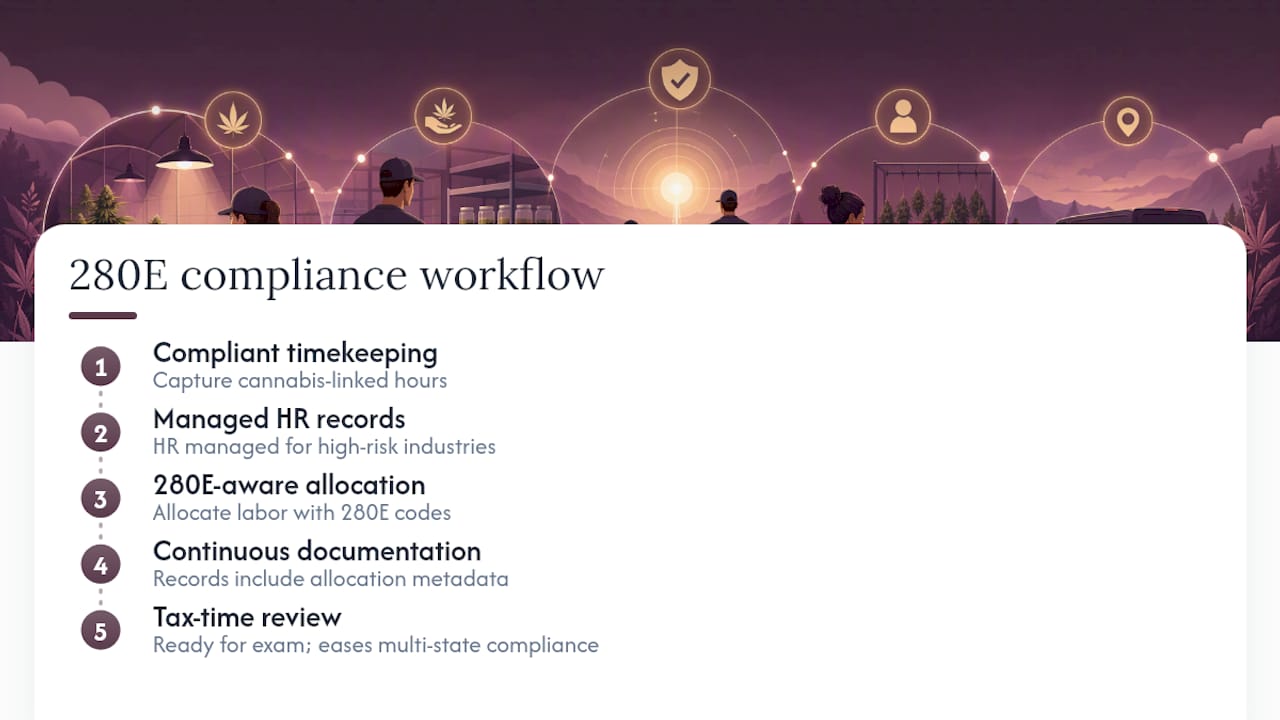
Most cannabis operators did not get into this business to become 280E specialists, and treating payroll like a generic HR function is how gaps creep in. Roll With Paid works exclusively with high-risk industries, which means the Employer of Record model and 280E-aware labor allocation are built into the workflow from day one, not bolted on after an audit notice arrives.
Managed HR and compliant timekeeping together reduce the internal burden dramatically. Instead of a finance team reverse-engineering allocation codes every quarter, the documentation exists as records are created. That difference shows up most clearly at tax time, when payroll classification errors are exactly what examiners look for first. For operators juggling permits and multi-state rules, that is one less fire to fight.
How Roll With Paid Gets You There
Rollwithpaid is the alternative to piecing together generic HR software and a general payroll provider that does not understand 280E. For cannabis operators, that gap shows up at the worst possible time: an audit, a permit renewal, or a multi-state expansion. Roll With Paid handles multi-state payroll, 280E-aware labor allocation, permit and I-9 tracking, and an Employer of Record option for operators who want compliance handled end to end rather than managed in-house.

Onboarding typically runs 30 to 60 days, timed around a quarter boundary to keep your reconciliation clean, and clients have seen zero late filings since making the switch. If your current setup cannot show a clean allocation trail today, schedule a readiness review and find out exactly where the gaps are before an examiner does.
Sources
- Payroll and Labor Cost Classification Under 280E
- Cannabis Payroll Compliance: Banking, 280E, and Tax Rules – LegalClarity
Recommended
- 280E and Payroll: What Cannabis Employers Need to Understand
- I-9 and E-Verify: A Compliance Guide for Cannabis Employers
- 5 Payroll Mistakes Cannabis Businesses Can’t Afford