
Tribal Relations for Agencies: Minnesota Cannabis Compacts in Practice
Tribal relations are government-to-government partnerships that enable respectful consultation, shared decision-making, and protection of tribal sovereignty. Done well, these relationships produce meaningful input from tribal nations, sharper decisions, and fewer conflicts down the line. The practices that make this work are well documented, and nowhere do the stakes show up more clearly than in Minnesota’s cannabis compacts, which we walk through below.
TL;DR:
- Give tribal nations 30 to 60 days’ notice, confirm the authorized council or office, and agree on Indigenous Knowledge access rules before consultation begins.
- Document every comment and agency response, then close the loop in writing; the record supports later discussions when expectations or decisions are disputed.
- Minnesota’s cannabis compacts cover licensing, testing, tracking, taxation, and off reservation retail, but negotiated terms remain private until each agreement is signed and published.
- Operators should check compact terms for each location because tribal rules can change licensing, testing, tax, and sales obligations beyond the state’s general framework.
Table of Contents
- What tribal relations mean: definition, scope, and core principles
- Core consultation practices and protocols
- How universities and state agencies structure tribal relations programs
- How compacting works: Minnesota’s cannabis compacts as a case study
- Practical next steps for starting or improving a tribal partnership
- Historical context and evolution of tribal relations in the United States
- Legal frameworks that govern tribal relations
- The role of tribal councils and leadership in negotiations
- How tribal relations shape business operations in regulated industries
- Best practices for ongoing communication and resolving disagreements
- Specific challenges in tribal relations within cannabis and other high-risk industries
- Why we see tribal relations as core to regulated industry work
- How Roll With Paid supports cannabis businesses navigating tribal compacts
- FAQ
- Sources
What tribal relations mean: definition, scope, and core principles
At its core, tribal relations describes the government-to-government framework through which federal, state, and local institutions engage with tribal nations as sovereign political entities, not as stakeholder groups or interest organizations. That distinction shapes everything else. A university consulting a tribe on a research project, a state agency negotiating a regulatory compact, and a federal office reviewing a land-use decision are all operating within the same basic frame: one government talking to another.
Sovereignty matters here because it determines who has authority to speak, consent, or object. It also means tribes are never a single monolithic bloc. There are hundreds of federally recognized tribal nations in the United States, each with its own government, priorities, and protocols, and an approach that works with one nation may not transfer to the next.
A few principles hold across nearly every credible framework for this work:
- Respect tribal sovereignty as a political, not cultural, status.
- Build reciprocity into every stage, not just the final outcome.
- Protect Indigenous Knowledge shared in confidence, and never repackage it without consent.
Core consultation practices and protocols
Consultation only works when it is planned, not improvised. The NOAA Tribal Consultation Handbook frames effective consultation as government-to-government interaction built on trust, transparency, and timely communication, and recommends giving tribes 30 to 60 days’ notice before a decision point so there is real time to respond. That window shows up across federal guidance for a reason: rushed consultation reads as consultation in name only.
A workable protocol generally includes:
- Identify the decision early enough that notice can go out 30 to 60 days ahead.
- Confirm which tribal office, council, or review board holds authority to respond.
- Share materials in plain language, flagging anything time-sensitive.
- Document every comment received and how the agency responded to it.
- Close the loop with a written summary, not a verbal assurance.
Recordkeeping is not paperwork for its own sake. The BIA’s regional and field guide on treaty and reserved-rights consultation recommends mapping where an agency’s operations intersect tribal interests, training staff on treaty obligations, and keeping records of both the input received and the agency’s response. That record becomes the evidence that consultation happened in substance, not just on a calendar.
Confidentiality deserves its own line item. Indigenous Knowledge shared during consultation is often sensitive, and institutions need a clear policy for who can access it and how it can be used before any conversation starts, not after.
Pro Tip: Before scheduling a consultation, confirm in writing which tribal entity, council, or review board actually holds authority to respond, since assuming a single contact speaks for the tribe is one of the most common missteps institutions make.
How universities and state agencies structure tribal relations programs
Several institutions have turned tribal relations from an ad hoc function into a standing office, and the shape of those offices is fairly consistent. Chico State’s Office of Tribal Relations connects campus services with tribal governments, supports Native students, hosts community events, and facilitates government-to-government partnerships between the university and surrounding nations. South Dakota’s Department of Tribal Relations and Washington State’s Office of Equity: Tribal Relations perform a parallel function at the state level, serving as the formal point of contact between state government and tribal nations within their borders.
What these offices tend to share:
- A liaison role that sits between agency leadership and tribal governments, rather than inside a single program area.
- Regular events and touchpoints that build relationships before a conflict or decision forces one.
- Memoranda of understanding that formalize how the office and a given tribe will work together.
- Support functions, from student services to funding navigation, that give the relationship ongoing substance.
The common thread is durability. A standing office with named staff produces a different relationship than a single project team that disbands once a grant ends.
How compacting works: Minnesota’s cannabis compacts as a case study
A compact is a formal, negotiated agreement between a state and a tribal nation that resolves questions neither side’s law fully answers on its own, typically around jurisdiction, licensing, and how two regulatory systems will operate side by side. Cooperative agreements serve a similar purpose on a narrower scale.
Minnesota’s Office of Cannabis Management compacts page shows this mechanism in practice. The state negotiated tribal-state cannabis compacts to settle jurisdictional questions, licensing standards, testing requirements, seed-to-sale tracking, tax arrangements, and rules for off-reservation retail. Each compact is specific to the tribe that signed it, reflecting that one nation’s priorities on testing standards or revenue sharing may differ sharply from another’s.
Typical compact terms address:
- Which licensing and testing standards apply on tribal land versus off it.
- How seed-to-sale tracking data is shared between the tribe and the state.
- Tax treatment for tribal cannabis sales and any revenue-sharing arrangement.
- Whether and how a tribe can operate retail locations off reservation land.
Minnesota’s compacts are negotiated privately and posted publicly once signed, which means businesses watching the regulatory landscape cannot see terms mid-negotiation but can review the final agreement once it takes effect, as Minnesota’s own compacts page documents. For a business operating in a compacted jurisdiction, this matters operationally: licensing rules, tax obligations, and even where a product can be sold may differ from the state’s general cannabis statute, and getting it wrong is not a paperwork problem so much as a compliance one.
Practical next steps for starting or improving a tribal partnership
Before reaching out, do the homework: research the tribe’s governance structure, relevant treaties, and existing policies, and attend community events if you can. That groundwork signals seriousness and avoids the most common early mistake, treating the first meeting as the relationship’s starting point rather than its midpoint.
- Identify the officially designated tribal representative or office authorized to engage, and ask directly how the tribe vets new partnerships.
- Draft a consultation timeline that builds in the 30 to 60 day notice window, not a rushed turnaround.
- Budget for compensation, travel, and logistics tied to tribal participation from the start, not as an afterthought.
- Assign a named liaison on your side and include tribal leadership in project governance, not just as reviewers of a finished plan.
Pro Tip: Ask the tribe how it prefers to be consulted rather than defaulting to your institution’s standard outreach template; protocols vary by nation, and that single question often prevent months of friction.
Historical context and evolution of tribal relations in the United States
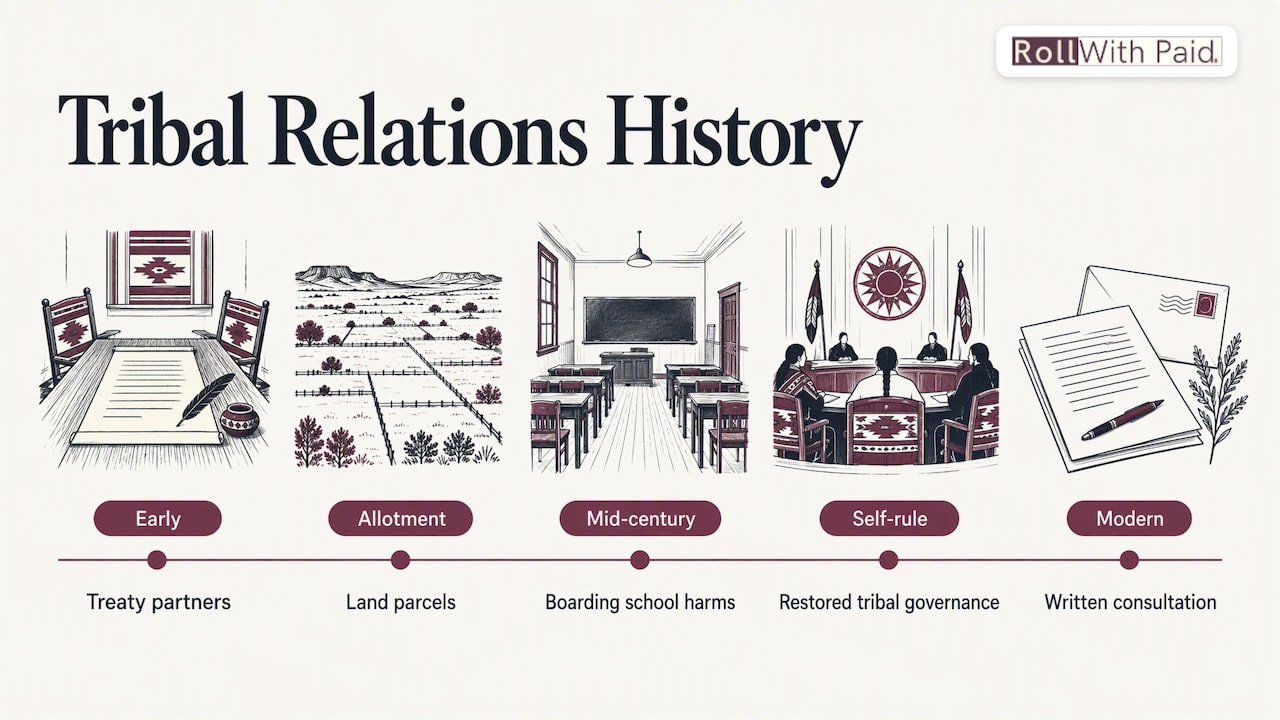
Tribal relations today sit on top of a long and uneven history. Early federal policy toward tribal nations swung between treaty-making that recognized tribes as sovereign negotiating partners and later periods of forced removal, allotment, and assimilation that treated tribal governments as obstacles rather than partners. The allotment era broke up communally held reservation land into individual parcels, weakening tribal land bases and self-governance in ways still being addressed today.
The mid-20th century brought a shift toward restoring tribal self-governance, culminating in federal policy that recognized tribes’ right to manage their own affairs rather than have federal agencies manage those affairs for them. That shift did not happen all at once, and it followed decades where boarding schools, termination policies, and inconsistent federal recognition left lasting damage to tribal communities and their trust in federal and state institutions.
Modern tribal relations practice grew directly out of that history. The emphasis on written consultation records, advance notice, and formal government-to-government protocols exists because informal or one-sided engagement caused real harm for generations. Understanding this background is not a formality before getting to the practical steps. It explains why trust-building takes time, why documentation matters so much, and why a single successful project does not erase decades of prior conduct. Institutions that treat this history as background noise tend to repeat the same missteps that made formal protocols necessary in the first place.
Legal frameworks that govern tribal relations
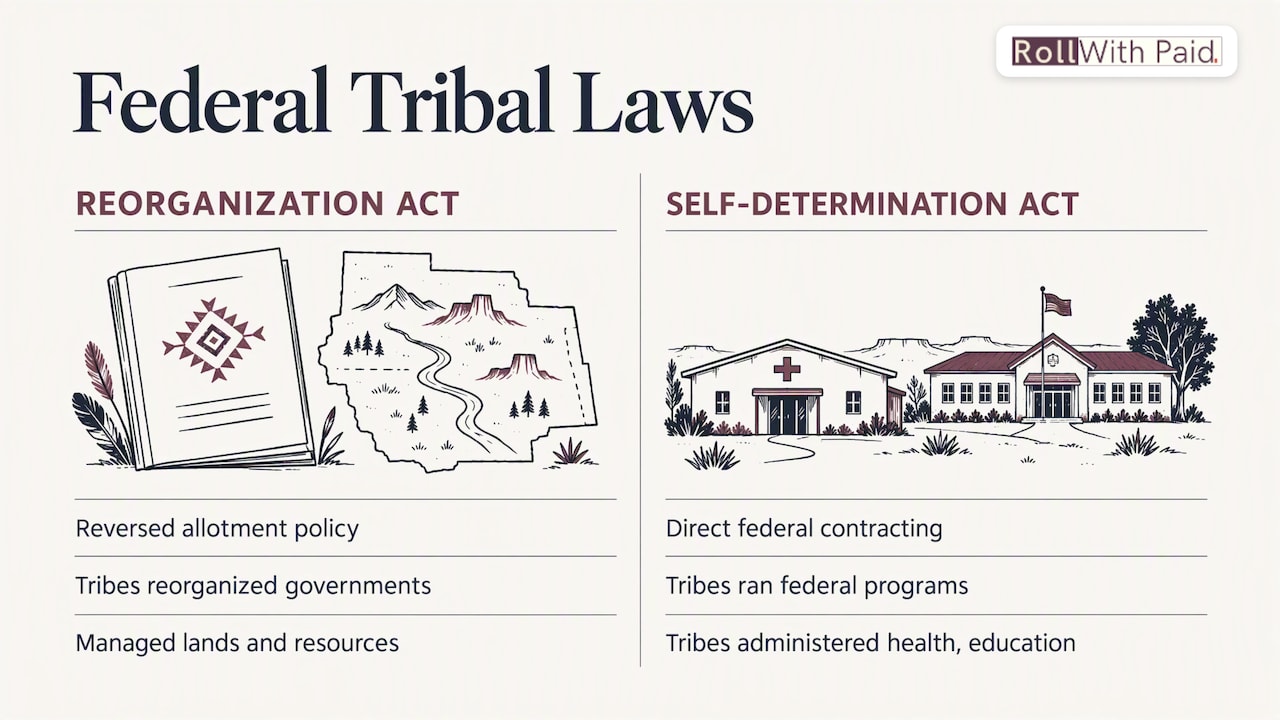
Two federal laws anchor most modern tribal relations work. The Indian Reorganization Act, passed in 1934, reversed the allotment-era push to break up tribal landholdings and gave tribes the ability to reorganize their own governments, adopt constitutions, and manage tribal lands and resources with federal recognition of that authority. It marked a formal federal shift away from assimilation policy and toward recognizing tribal self-governance as a legitimate structure, even though implementation varied widely across different nations.
The Indian Self-Determination and Education Assistance Act, passed in 1975, went further by allowing tribes to contract directly with the federal government to administer programs and services that federal agencies had previously run on their behalf, from health care to education. This law is a big part of why many tribal nations now operate their own health systems, schools, and regulatory programs rather than relying on federal agencies to deliver those services.
Together, these laws form much of the legal foundation beneath government-to-government consultation. They establish that tribes are not simply communities receiving federal services but are governments with the legal standing to negotiate, contract, and self-administer. Any institution engaging in tribal relations work, whether a university research office or a state regulatory agency, is operating inside the authority these laws established, which is part of why consultation protocols carry legal as well as ethical weight.
The role of tribal councils and leadership in negotiations
Tribal councils function as the governing body for most federally recognized tribes, typically elected by tribal members and responsible for everything from budget decisions to negotiating agreements with outside governments. When a state agency or university begins a consultation, the tribal council, or an office it specifically designates, is usually the body with actual authority to consent to or reject a proposal.
Leadership structures vary by nation. Some tribes operate under a council-chairperson model similar to a city council and mayor, others maintain traditional governance structures alongside or instead of elected councils, and some separate business and governmental functions into distinct entities. This is part of why a one-size-fits-all outreach approach fails: the office that handles research partnerships at one nation may be entirely separate from the office that negotiates commercial compacts at another.
For negotiations specifically, tribal councils often work with legal counsel and subject-matter staff who understand both tribal law and the external regulatory system involved, whether that is cannabis licensing, environmental review, or education funding. Outside institutions that assume a single staff contact can finalize terms on the council’s behalf tend to find negotiations stall or reopen later. Confirming decision-making authority before substantive talks begin, not after a draft agreement is already on the table, saves both sides time.
How tribal relations shape business operations in regulated industries
For businesses operating in or near tribal jurisdictions, tribal relations are not an abstract policy topic. They determine which rules apply, where, and to whom. In a compacted industry like cannabis, a business might face one set of licensing and testing requirements on state-regulated land and an entirely different set on tribal land covered by a compact, even within the same metro area.
This has direct operational consequences. A business that assumes state rules apply uniformly can find itself out of compliance the moment its supply chain, retail footprint, or seed-to-sale tracking touches tribal land under compact terms. Tax treatment can differ as well, since compacts often spell out revenue-sharing or tax arrangements specific to the tribe involved, separate from the state’s general cannabis tax structure.
The practical takeaway for operators is to treat compact terms as a distinct compliance layer, not a footnote to state law. That means confirming which compacts, if any, affect a given location before opening, building licensing and tracking systems flexible enough to handle jurisdiction-specific rules, and keeping compliance staff aware that a compact can change testing or retail requirements that otherwise look identical to the state’s standard framework. Businesses that treat every location as governed by the same rulebook, regardless of compact status, are the ones most likely to discover a gap during an audit rather than before one.
Best practices for ongoing communication and resolving disagreements
A single successful consultation does not guarantee a durable relationship. Sustaining tribal relations over years requires the same discipline as building them in the first place, applied continuously rather than at project milestones.
Regular, scheduled check-ins, not just outreach tied to a specific decision, keep a relationship active between major events. Guidance from Michigan State University’s reciprocal partnerships framework recommends including tribal representatives in leadership roles on an ongoing basis, equitably compensating their time, and co-designing how shared data or outputs are used, rather than treating those questions as settled once at the start.
When disagreements arise, the written record built during consultation becomes the reference point both sides return to. Agencies that documented comments and responses have a clear basis for discussing where expectations diverged; agencies that relied on informal conversations often find themselves disputing what was actually agreed. Designating a specific point of contact for resolving disputes, separate from the person managing day-to-day project work, also helps keep disagreements from stalling the broader relationship. The goal throughout is treating conflict as something to work through within the relationship, not a sign the relationship has failed.
Specific challenges in tribal relations within cannabis and other high-risk industries
Cannabis presents a particular set of complications for tribal relations because federal, state, and tribal law do not align cleanly. Cannabis remains federally restricted even where states have legalized it, which puts tribal nations, as sovereign entities with their own relationship to federal law, in a genuinely complicated position when deciding whether and how to participate in a state-legal cannabis market.
Compacts like Minnesota’s exist precisely because this misalignment needed a negotiated solution rather than a one-size-fits-all statute. Banking access, interstate commerce restrictions, and inconsistent testing standards across jurisdictions all complicate compact negotiations further, since a tribe weighing whether to enter a compact has to consider federal exposure alongside state and tribal priorities.
For businesses and institutions working in this space, the practical challenge is staying current. Compact terms, testing standards, and licensing rules can differ from one tribal jurisdiction to the next and can change as agreements are renegotiated. High-risk industries generally, including cannabis, also carry compliance burdens around payroll, workers’ compensation, and employment classification that compound when a business operates across both state-regulated and tribal-compacted locations. Treating tribal relations as a one-time legal review rather than an ongoing operational factor is where most of these challenges originate.
Why we see tribal relations as core to regulated industry work
We think durable government-to-government partnerships do more than satisfy a consultation requirement. They reduce the regulatory uncertainty that trips up businesses operating across jurisdictions, and they tend to produce better outcomes faster than relationships rebuilt from scratch every time a new project or compact comes up. Ethical, reciprocal engagement is not a compliance checkbox for us. It is the difference between a partnership that holds up under pressure and one that does not.
— Leah Kollross
How Roll With Paid supports cannabis businesses navigating tribal compacts
Operating across state-regulated and tribal-compacted jurisdictions adds a layer of payroll and compliance complexity that most general providers are not built to handle. We built our tribal relations services specifically for high-risk industries, so multi-jurisdiction rules do not become a liability on top of everything else a compact adds to the mix.

What we offer for operators working in compacted or multi-jurisdiction environments:
- Employer of Record services that absorb employment liability and keep you audit-ready across jurisdictions.
- Payroll Execution built around the compliance realities of cannabis and other high-risk sectors.
- HR & Compliance Solutions including Multi-State Hiring Support and Time & Attendance Tools for operations that span state and tribal-compacted locations.
If your business operates near or within a tribal compact and you want payroll and HR handled by a provider that already understands high-risk industry compliance, visit our pricing page to see current service rates and the HR retainer option, or explore how our Employer of Record model works for operators in your position.
FAQ
What is the definition of tribal relations?
Tribal relations refers to government-to-government partnerships between tribal nations and other governments or institutions, built on respectful consultation, shared decision-making, and protection of tribal sovereignty. These relationships cover everything from university research partnerships to state regulatory compacts, as seen in Minnesota’s cannabis compact framework.
How long should notice be given before tribal consultation?
Federal guidance, including the NOAA Tribal Consultation Handbook, recommends giving tribal nations 30 to 60 days’ notice before a decision point. This window allows time for genuine review and response rather than a rushed sign-off.
Who has authority to sign or consent to a tribal agreement?
Authority typically rests with the tribal council or a specifically designated office, such as a research review board, rather than any single individual contact. It is worth confirming this directly with the tribe before assuming a given contact can speak for the nation as a whole.
How does a tribal-state compact actually work?
A compact is a negotiated agreement between a state and a tribal nation that settles jurisdictional, licensing, and regulatory questions neither government’s law fully covers alone. Minnesota’s cannabis compacts, for example, address testing standards, seed-to-sale tracking, taxation, and off-reservation retail, and are negotiated privately before being posted publicly once signed.
Why do tribal relations matter for businesses in regulated industries?
Businesses operating in or near tribal-compacted jurisdictions can face different licensing, testing, and tax rules depending on whether a location falls under a compact. Understanding tribal relations and tracking compact terms is an ongoing compliance task, not a one-time legal check, particularly for high-risk industries like cannabis.
Sources
- NOAA Tribal Consultation Handbook (2023)
- Guidebook to Centering Community in Partnerships with Indigenous Nations (MSU)
- Compacts and Cooperative Agreements / Office of Cannabis Management (Minnesota)
Recommended
- Your Rights as a Cannabis Worker in Minnesota
- 6 Contract Must Haves for Minnesota Cannabis Background Checks
- Responsibility Matrix: KPMG vs Roll With Paid for Cannabis Employers
- Cannabis Payroll: Avoid 280E Exposure: Roll With Paid vs Greenleaf HR
Roll With Paid. is not a law firm and does not provide legal advice. This article summarizes Minnesota law as of August 2026 and is general information only. Tip arrangements are fact-specific; before changing a policy, consult employment counsel or contact DLI Labor Standards at 651-284-5075.