
Social Equity Hiring in Cannabis: A Compliance Guide

Social equity hiring in cannabis means recruiting, hiring and keeping people who were harmed by past cannabis enforcement, and in some cities and states it is a legal condition of your license, not just a goal. The practical rule: if a program applies to you, you must be able to prove what you did, with dates, job orders and payroll records. Intent does not count in an audit. Paperwork does.
This guide is for dispensary, cultivation and multi-state operators who want to hire for equity without creating payroll and HR exposure. It covers the rules that exist, how verification works, and the records to keep. It is general information, not legal advice. Your license conditions and your local ordinance control, and your cannabis attorney should confirm how they apply to you.
TL;DR
- “Social equity” can mean two different things: who owns the license, and who you hire. Check which one your state or city regulates before you plan anything.
- Where hiring requirements exist, they are usually measured and documented. Long Beach, for example, sets a 40% equity-hire threshold measured in total annual work hours, not headcount.
- Good-faith efforts must be provable: job orders, certificates of eligibility, and time records that tie hours to the right employees.
- Equity hires still fall under every ordinary rule: I-9, wage and hour, workers’ compensation, and cannabis-specific badging and background checks.
- Treat equity hiring as a payroll and HR process from day one, not a side project run in a spreadsheet.
Table of Contents
- Two meanings of social equity, and why the difference matters
- What the rules actually look like
- Good faith is a documentation standard
- The ordinary rules still apply to every hire
- Pay, hours and the wage theft problem
- Retention matters as much as the hire
- Our perspective
- Building the process: a practical sequence
- How Roll With Paid. can help
- FAQ
- Sources
Two meanings of social equity, and why the difference matters
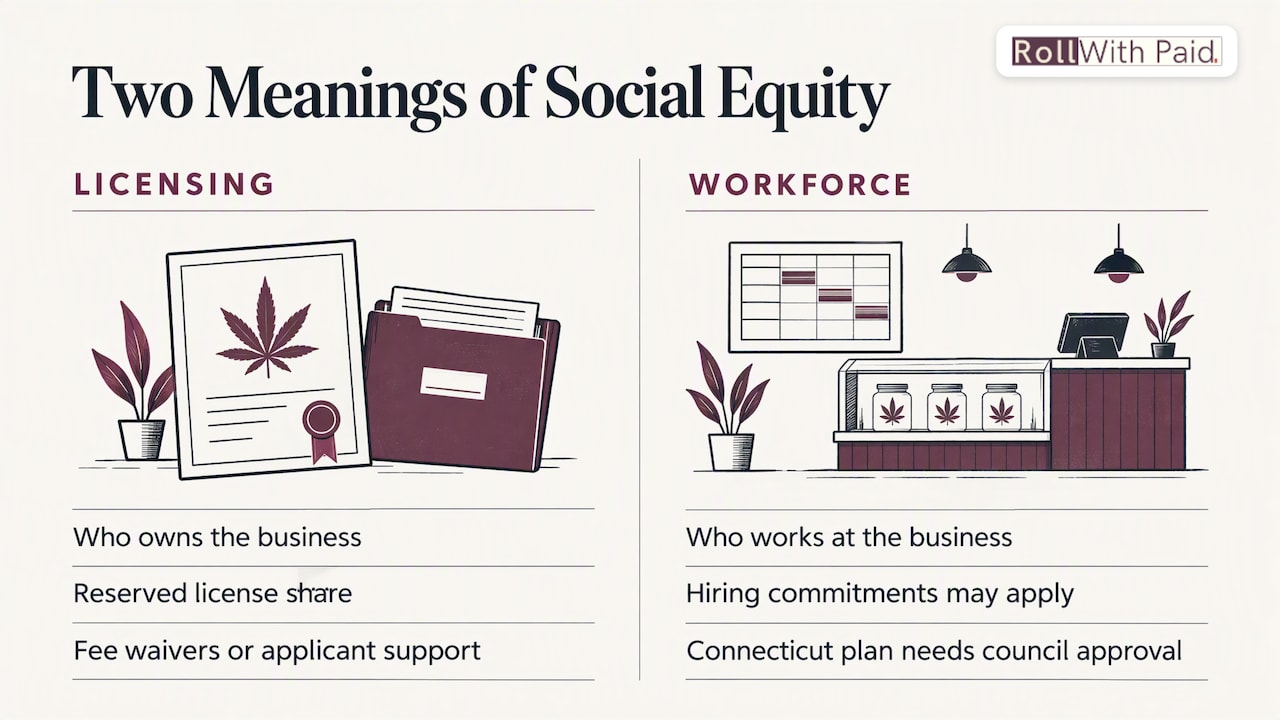
Most search results about social equity in cannabis are about licensing: who gets to own a business. That is the first meaning. Programs reserve a share of licenses, waive fees or offer support to applicants from communities affected by prior enforcement.
The second meaning is workforce: who works there. Some jurisdictions add hiring commitments, either as a license condition or as a scored part of an application plan. Connecticut, for example, requires cannabis establishments seeking a final license to submit a social equity plan to its Social Equity Council for review and approval.
The two meanings overlap but are not the same. A business can be owned by a verified equity applicant and have no hiring quota. A conventionally owned dispensary can face a strict equity-hire requirement. Before you write a job post, find out which of these applies to you, and in which city and state.
What the rules actually look like
Requirements vary widely. Three examples show the range, from a numeric quota to a documentation duty.
A quota measured in hours: Long Beach, California
Long Beach’s equity hire program requires adult-use cannabis businesses that do not qualify for its Equity Business Owner Program to employ equity-verified individuals for at least 40% of total annual work hours, starting in the second full year of operation. The city’s rules and procedures also call for a Workforce Development Employer Orientation within 90 days of licensing.
Notice the unit: hours. A business with a few full-time equity employees can still fall short if part-time non-equity staff log most of the hours. That makes accurate time and attendance data a compliance input, not a convenience.
Certification and job orders: Los Angeles
In Los Angeles, the city’s Good-Faith Hiring Requirements are explained in an official FAQ for licensees, including who must complete the survey and what happens if you hire more people or hold multiple licenses. The Long Beach rules describe the same mechanics from the other side: only employees with a Certificate of Eligibility count, and employers document their efforts by submitting Employer Job Order Forms to the local workforce office. That certificate stays valid for the individual even if their income or residency later changes.
The lesson is that you generally cannot self-declare an employee as an equity hire. The city or state certifies the person, and you document the match.
Diversity reporting: New York
New York’s Marijuana Regulation and Taxation Act sets a goal of awarding 50% of adult-use licenses to social and economic equity applicants. According to a state Department of Labor guide, it also requires documented reports on the racial, ethnic and gender diversity of workforce and owners as a condition of license renewal. Here the burden is data: you need clean, current employee records to report from.
What this means in Minnesota
Minnesota’s approach starts with ownership. Under Chapter 342, half of the statutorily capped licenses are for verified social equity applicants, and the Office of Cannabis Management (OCM) guidance says those applicants must hold at least 65% of the controlling ownership. The same guidance lists an attestation of a labor peace agreement among the application items. OCM verifies social equity status on a rolling basis at no charge, and each person making up the 65% must be verified.
That is licensing, not a workforce quota. Even so, a Minnesota operator with an equity-verified owner often wants to hire from the same communities, and a multi-state operator may face hiring rules in other places. Read your own license conditions and current OCM guidance, because rules in this area change.
Good faith is a documentation standard
A recurring theme in these programs is good faith. A diverse team does not by itself prove compliance. Cities typically want evidence that you made a genuine, verifiable effort to source candidates from eligible lists. The Long Beach procedures show the pattern: formal job listings, submitted job orders, and records that connect hires to certification.
The owners who get penalized in audits are usually not the ones who hired badly. They are the ones who cannot show what they did. A workable file for each hiring cycle includes:
- The job order or posting, with the date it went to the workforce office or city job board.
- Candidate referrals received and what happened to each one (interviewed, hired, declined, withdrew), with a neutral reason.
- Certificates of eligibility or verification letters for each equity hire, stored with the personnel file.
- Hours worked by every employee, so you can calculate any hours-based share.
- Orientation and training confirmations required by the program.
Keep the file in one place, retained under your license’s record rules. If you ever have to answer a question from a regulator, you want a folder, not a search through email.
The ordinary rules still apply to every hire
Equity status does not change the baseline. Every new employee, equity-verified or not, has to clear the same cannabis-specific hurdles, and these are where operators get hurt.
Identity and work authorization
Form I-9 is required for every hire. A rushed onboarding wave, which is common when a program sends many referrals at once, is where errors multiply. Our guides on I-9 and E-Verify for cannabis employers and remote I-9 verification walk through the process.
Badging, background checks and overlapping employment
Beyond wage and hour law, cannabis employers must manage state-specific requirements for identification badges, mandatory background checks and limits on overlapping employment, as Cannabis Business Times explains. In Michigan, for example, working across certain license types at once is prohibited, so you verify a candidate’s current employment before making an offer.
This matters for equity hiring because many state programs and training pipelines place people quickly. Build the check into your offer process rather than discovering a conflict after the first shift.
Budtender requirements differ by state
If you hire for retail, remember that training and credential rules are not uniform. A 2024 review of state requirements examined what budtenders need in the 20 states with active nonmedical markets, and the findings show how much the rules differ by state. Check your own state’s licensing board before you promise a start date.
The cost of one mistake
As one Troutman Pepper Locke transcript on managing compliance in regulated industries puts it, errors roll downhill to the owner. In many jurisdictions, a single bad ID check by a budtender can lead to fines exceeding $10,000 or license revocation. Training new hires on that task belongs in week one.
Pay, hours and the wage theft problem
Equity hiring programs often bring in workers who are new to the industry and less likely to know their rights. That raises your duty to run clean payroll. A worker-codesigned study of cannabis workers found wage theft affecting up to 63% of workers, through practices such as interrupted breaks and working off the clock.
For an equity-hire quota measured in hours, there is a second reason to care. If your time records are weak, you cannot prove your hours share, and you cannot defend a wage claim. Our guide on cannabis time and attendance for 280E audits covers how clean records serve both tax and labor purposes.
A short checklist for the first 90 days of any equity hire:
- Written offer with pay rate, classification and schedule.
- Completed I-9 within the legal timeframe, and any required state badge or background check.
- Timekeeping that captures meal breaks and actual start and end times.
- Policy acknowledgments signed and filed (handbook, safety, cash handling, ID checking).
- Workers’ compensation class code matched to the real job duties. Misclassification here is expensive.
- State new-hire reporting filed on time. In Minnesota, see our new hire reporting checklist.
Retention matters as much as the hire
A hiring commitment that only counts the offer date is rare. Hours-based rules reward the employees who stay and work. That makes retention a compliance metric as well as a business one.
What helps most is unglamorous: predictable schedules, accurate and on-time pay, a clear path to a better role, and a manager who handles issues through documented HR channels. The Denver cannabis business and employment opportunity study points to a related lesson: owners cite licensing complexity and entry costs as barriers, and compliance works best as a core business function rather than a form-filling exercise.
Our perspective
We work with cannabis and other high-risk employers, and the pattern we see is consistent: equity hiring rarely fails because an owner did not care. It fails in the back office. The job order was sent but not saved. The certificate was never put in the file. The part-time hours did not add up the way the owner assumed. Then an audit turns a good-faith effort into an unprovable one.
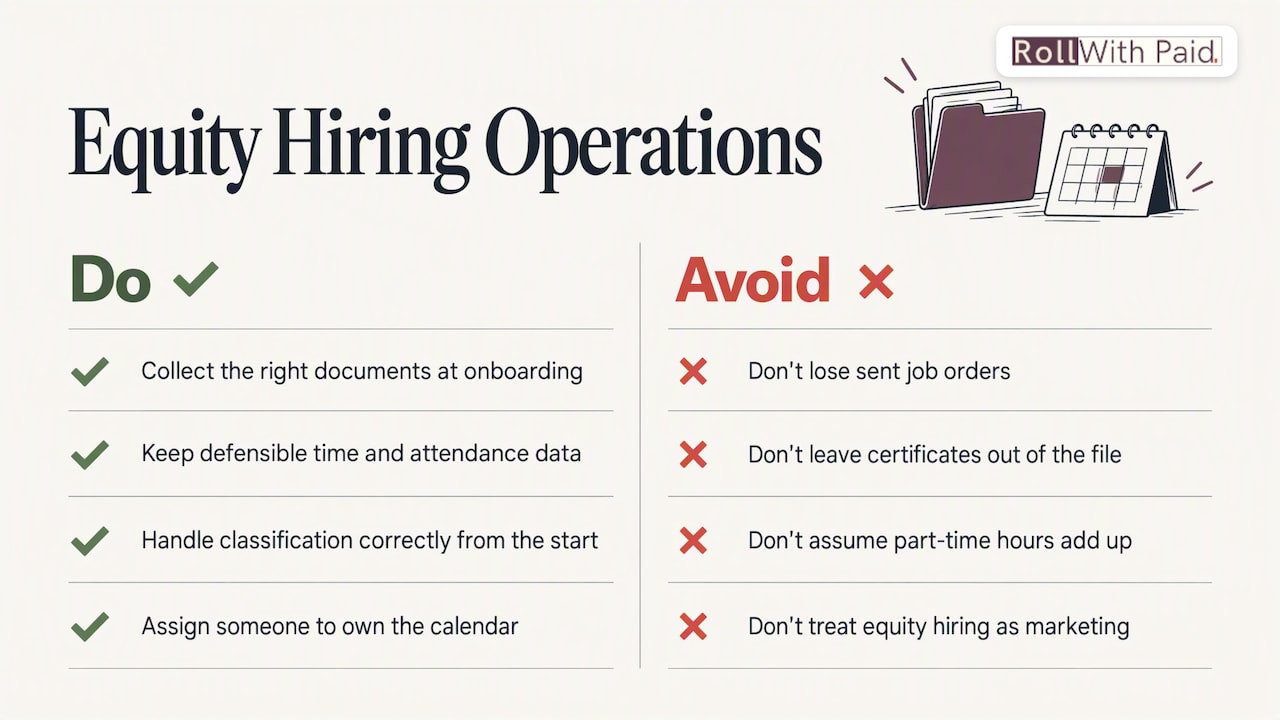
Our view is that equity hiring should run on the same rails as the rest of your payroll and HR compliance. That means onboarding that collects the right documents the first time, time and attendance data you can defend, and workers’ compensation and classification handled correctly from the start. It also means someone owns the calendar, so the quarterly fire drill never starts the night before a deadline.
We would also push back on one common idea, that you can treat equity hiring as a marketing message. Communities notice when a company hires people and then loses them to a missed paycheck or a safety incident. The most credible equity employer is the one with a boring, accurate payroll.
— Leah Kollross
Building the process: a practical sequence
- Identify the rule. Confirm with your attorney or the licensing body whether any hiring requirement, plan commitment or reporting duty applies in each city and state where you operate.
- Set up the file structure before the first posting: one folder per hiring cycle, one per employee.
- Post through the required channels and record dates.
- Verify, then hire. Collect the certificate or verification letter, run background and overlapping-employment checks, and complete the I-9.
- Track hours by employee and by location, and review the equity share monthly, not annually.
- Reconcile at renewal. Pull your file, check it against what the regulator asks for, and fix gaps while there is time.
Multi-state operators should expect a different version of step 1 in every state. Our guide to audit-ready multi-state cannabis payroll explains how to keep the records consistent while the rules differ, and our HR compliance tips for dispensaries and cultivations cover the day-to-day habits.
How Roll With Paid. can help
We provide payroll execution, HR and compliance support, employee onboarding, time and attendance tools and an Employer of Record model for cannabis and other high-risk businesses. For an operator with an equity-hiring obligation, that puts onboarding documents, hours data and payroll in one audit-ready system. Pricing depends on gross payroll, worker classification codes and headcount, with an optional flat-rate HR retainer. See our pricing page or talk to us about Employer of Record and payroll services.
FAQ
Is social equity hiring required for every cannabis business?
No. Requirements depend on the state and, often, the city. Some places set hiring quotas, some score hiring plans in license applications, and some regulate ownership only. Check your license conditions and local ordinance, and ask a cannabis attorney if the language is unclear.
Who counts as a social equity employee?
Usually the government decides, not the employer. In Long Beach and Los Angeles, for example, an individual needs a Certificate of Eligibility from the city’s workforce office before the hire counts. Ask the program office for its current criteria and keep the certificate in the personnel file.
What records should I keep to show good-faith hiring?
Keep job orders and postings with dates, referral and outcome notes, certificates of eligibility, hours worked by employee, and training or orientation confirmations. Store them where you can produce them quickly. Check your license’s retention period.
Does Minnesota require cannabis employers to hire social equity workers?
We did not find a workforce quota in the OCM material we reviewed. What OCM does publish concerns ownership: verified social equity applicants must hold at least 65% of a social equity business, and applications include a labor peace agreement attestation. Confirm current requirements with the Office of Cannabis Management, since rules can change.
Can an Employer of Record handle equity hiring compliance?
An Employer of Record can take on payroll, onboarding paperwork, workers’ compensation and many HR filings. Your licensing obligations, including any good-faith hiring duties, remain yours, so the EOR is a way to keep the records clean, not a way to transfer the license risk. Our explainer on Employer of Record for high-risk industries covers the model.
Sources
- Long Beach: Rules and Procedures Implementing the Equity Hire Program
- Los Angeles: Good Faith Hiring Requirements FAQ for Cannabis Licensees
- New York State Department of Labor: Adult-Use Cannabis
- Connecticut Social Equity Council: Social Equity Plan Criteria
- Minnesota OCM: License Application Review and Qualifications Guidance
- Minnesota OCM: Social Equity Verification Process
- Cannabis Business Times: Cannabis Employment Compliance
- State Requirements for Non-Medical US Cannabis Retail Personnel
- Troutman: Managing Employee Compliance in Highly Regulated Industries (transcript)
- High Stakes: cannabis worker study (eScholarship)
- Cannabis Business and Employment Opportunity Study (Denver)
Recommended
Roll With Paid. is not a law firm and does not provide legal advice. This article summarizes Minnesota law as of August 2026 and is general information only. Tip arrangements are fact-specific; before changing a policy, consult employment counsel or contact DLI Labor Standards at 651-284-5075.