
Four Week Switch for Cannabis Employers: Roll With Paid vs Green Leaf

For most cannabis and other high-risk employers, Roll With Paid is the stronger choice because it pairs an Employer of Record structure with payroll processes built around 280E and audit readiness, rather than bolting cannabis onto a generic system. If you want to confirm that for your own operation, use the evaluation checklist below, and then the transition timeline before you sign anything. Learn how a comprehensive payroll and HR solution beats a generalist Roll With Paid. vs Green Leaf Business Solutions.
TL;DR:
Cannabis-specific payroll providers like Roll With Paid use an Employer of Record model and process payroll with 280E considerations to mitigate industry risks.
Contractors must clarify contractual liability for tax deposits, penalties, and corrections, as responsibility varies based on the contractual arrangement, not provider claims.
Migrating payroll typically requires about four weeks, including records audit, employee document verification, parallel payroll runs, and reconciliation, with skipping steps increasing errors.
Support quality depends on understanding cannabis-specific tax treatment, so ask prospects for named contacts, response times, and experience with agency notices.
Providers’ pricing varies by worker classification and headcount; confirm contractual terms for missed deposits and late filings, and verify liability allocation in writing before switching.
Table of Contents
-
What to evaluate when choosing a cannabis payroll or HR provider
-
Key compliance issues every cannabis employer must get right
-
Switching payroll providers: checklist and realistic timeline
-
Detailed feature comparison between Roll With Paid and Green Leaf Business Solutions
-
Contract terms and conditions, including cancellation policies
-
Scalability and flexibility of payroll services to different business sizes
What to evaluate when choosing a cannabis payroll or HR provider
Picking a payroll partner in this industry is less about features and more about who holds the risk when something goes wrong. Before you sign a contract, get clear answers on a handful of points that separate a provider built for cannabis from one that simply tolerates it.
-
Contractual liability: confirm in writing who bears federal employment tax liability, who pays penalties, and how corrections to prior filings get handled. Outsourcing payroll does not automatically shift that responsibility to the provider, and the IRS is explicit that the allocation depends entirely on the arrangement and the contract language.
-
Provider model: understand whether you are hiring an Employer of Record, a PEO, or a standard payroll processor, since each carries different liability and day-to-day involvement. If a vendor claims CPEO status, verify it directly against the IRS CPEO listings rather than taking their word for it.
-
Banking and cash workflows: ask how the provider handles ACH limitations, cash payroll runs, armored transport, and receipt documentation, since cannabis banking restrictions do not disappear just because payroll is outsourced.
-
280E-aware accounting: confirm the provider can categorize wages into cost of goods sold versus non-COGS and produce documentation that would hold up in an audit.
-
Escalation and audit support: get specifics on response timelines, a named contact for agency notices, and sample service-level language rather than vague promises of support.
-
Integrations and data handling: check compatibility with your time and attendance system, your point-of-sale platform if wages tie to it, and ask about data security and record retention practices.
Pro Tip: Ask any provider to put their liability allocation in writing before your first payroll run, not after your first agency notice.
Key compliance issues every cannabis employer must get right
Cannabis employers face the same baseline labor law as everyone else, plus a tax code section written to work against them. Getting the fundamentals wrong compounds fast in this industry because the margin for error is already thin.
The Fair Labor Standards Act sets minimum wage, overtime, and recordkeeping obligations that apply to private employers, cannabis businesses included, regardless of the federal-state legal tension around the product itself. Missing overtime calculations or incomplete time records creates exposure that has nothing to do with cannabis specifically and everything to do with basic wage and hour law.
Section 280E is the sharper edge. It prevents businesses trafficking in Schedule I or II substances from deducting ordinary business expenses, which means cannabis employers must allocate wages correctly between cost of goods sold and non-COGS categories or risk a large and avoidable tax liability. Misclassifying a budtender’s wages the same way you would a cultivation technician’s can turn into a costly correction later.
Missing a required tax deposit triggers escalating penalties under Section 6656. Deposit timing is not a paperwork formality in this industry, it is a direct line to penalty exposure.
Documentation matters just as much. The IRS requires a completed Form W-4 and Form I-9 for every new hire, and missing or incorrect forms affect withholding accuracy while opening the door to enforcement action. A few other points worth locking down early:
-
Keep W-4 and I-9 records complete and retrievable, since gaps here surface during audits and during any provider transition.
-
Understand that a third-party arrangement does not automatically transfer tax liability. The type of arrangement and the contract terms decide who is on the hook.
-
Verify CPEO status independently if a provider claims it, since that designation changes liability in ways a standard PEO or payroll processor does not.
Switching payroll providers: checklist and realistic timeline
Cannabis payroll migrations take longer than a standard switch because of banking constraints and cash workflows that most mainstream providers never build for. Specialized providers typically need custom processes for cash handling, which adds steps a conventional migration skips.
-
Audit your records first: gather payroll registers, tax deposit history, W-2 and W-3 filings, worker classifications, and workers’ compensation codes before you contact a new provider.
-
Confirm employee documents are complete: make sure every W-4 and I-9 is filled out and retained, then prepare electronic exports the new provider can ingest without manual re-entry.
-
Run a staging period: process parallel payrolls to catch discrepancies, reconcile outstanding tax liabilities, and get the new provider’s process for correcting prior-period errors in writing.
-
Go live and follow up: reconcile the first two payroll cycles closely, confirm deposits and filings actually posted, and get written confirmation of exactly which liabilities the new provider is assuming.
Pro Tip: Never cancel your old provider’s access until your first two payrolls on the new system have reconciled cleanly.
Plan for roughly four weeks for a careful migration. Skipping the parallel-run step is the most common cause of rushed mistakes, and the same source notes that failing to reconcile prior-period liabilities before go-live tends to produce missed deposits or incorrect filings down the line.
How Roll With Paid meets these needs
Roll With Paid builds its payroll and HR solutions specifically for high-risk industries, cannabis operators in particular, which is a narrower and more demanding scope than most payroll vendors take on. That focus shows up in how the company structures its core offering rather than in a generic feature list bolted onto a mainstream product.
The company’s Employer of Record model is the centerpiece. Under this structure, Roll With Paid takes on defined employment functions, which can reduce the operational exposure that comes with running payroll, workers’ compensation, and compliance in-house for a cash-heavy, tightly regulated business. The company’s own materials describe audit-ready processes built around the compliance demands specific to cannabis employers, along with customized onboarding for clients that traditional payroll providers often decline to serve.
Before signing with any provider, including this one, verify the specifics that matter to your business:
-
Ask for a clear onboarding timeline so you know what the first thirty to sixty days actually look like.
-
Request documentation of the company’s filing record and ask directly about its zero late filings track record.
-
Get sample service-level language in writing, covering escalation contacts and response times for agency notices.
-
Ask for references or case studies from other cannabis or high-risk clients in a similar business size or state.
For deeper detail on the mechanics, Roll With Paid publishes resources on 280E and payroll, onboarding, and pricing so prospective clients can check specifics before committing.
Detailed feature comparison between Roll With Paid and Green Leaf Business Solutions
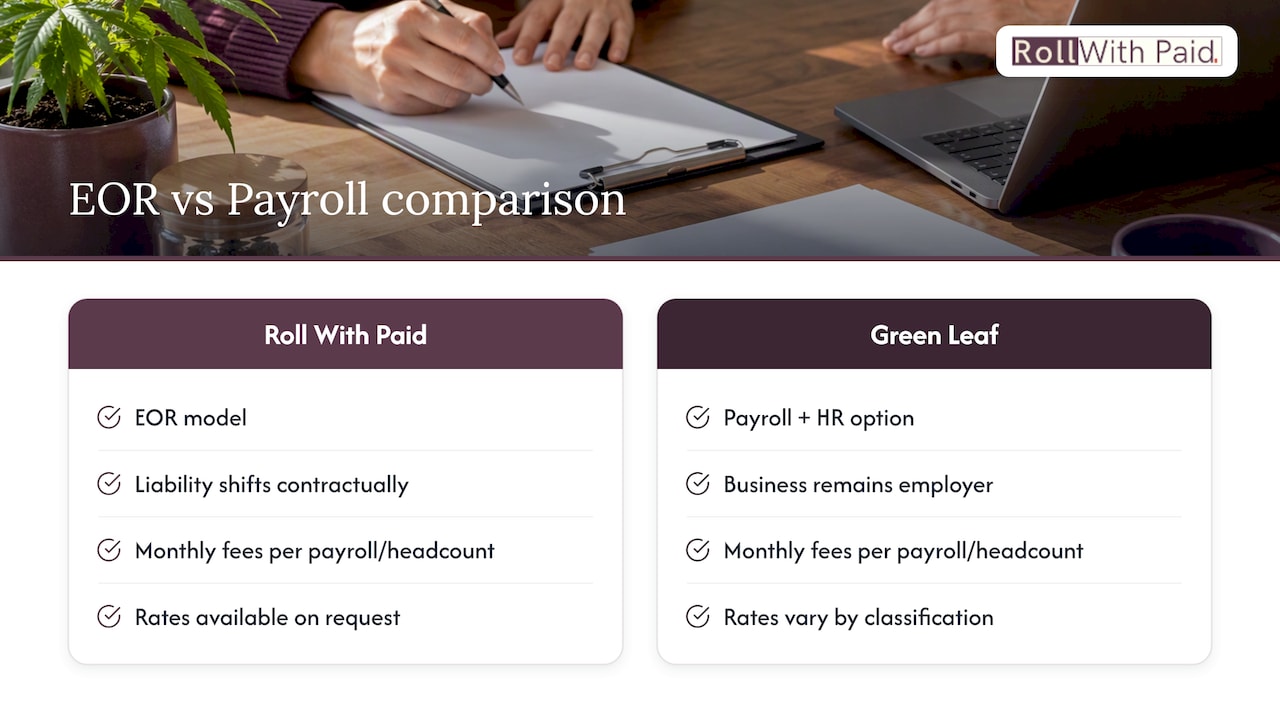
Green Leaf Business Solutions markets itself as a payroll and HR option for cannabis businesses, but the meaningful comparison is not a feature checklist, it is which model each company runs and what that means for your liability. Roll With Paid’s stated approach centers on an Employer of Record structure, meaning it takes on defined employment functions rather than acting purely as a payroll processor that files on your behalf while you retain full liability.
That distinction matters more than most marketing pages let on. A payroll processor handles calculations and filings, but the employer of record typically remains the business itself. An EOR arrangement shifts specific responsibilities under contract, which is why the contract language, not the sales pitch, is what actually determines your exposure.
Pricing on both sides tends to follow the same general pattern in this industry: monthly fees tied to gross payroll or headcount, often with an optional HR retainer layered on top. Roll With Paid lists its service rate and HR retainer as available on request rather than published outright, since rates vary by worker classification and headcount. Any provider quoting a flat number without asking about your classification codes first is worth a second look.
When comparing the two, ask each vendor the same question: what happens contractually if a deposit is missed or a filing is late. The answer tells you more than any feature list will.
Customer support quality and user experience reviews
Support quality in cannabis payroll is not about hold times, it is about whether the person on the other end of an agency notice actually understands cannabis-specific tax treatment. A generic payroll help desk that has never dealt with 280E allocation or cash-handling workflows will slow you down exactly when speed matters most.
Roll With Paid positions its support around personalized service for high-risk clients rather than a tiered call center model, according to the company’s own description of its services. That structure fits an industry where a single misclassified wage category can cascade into a larger tax problem, and where generic scripts do not answer specific questions.
Before relying on any provider’s support claims, cannabis or otherwise, ask for specifics: a named point of contact, expected response time for a time-sensitive notice, and whether support scales down during your slow season or stays consistent year-round. User experience with the payroll platform itself, meaning how easy it is to run a cycle, pull a report, or correct an error, is worth testing with a demo before you commit rather than assuming it works the way the sales page implies.
Contract terms and conditions, including cancellation policies
Contract terms in cannabis payroll deserve more scrutiny than they usually get, because the fine print is where liability actually lives. Before signing with any provider, read the sections covering term length, renewal, and what happens if you need to cancel or switch providers again later.
Specifically, look for language addressing who retains liability for tax deposits and filings during the contract term, what the correction process looks like if an error surfaces after the fact, and how much notice either party owes before cancellation takes effect. A vendor that will not put liability allocation in writing, or that buries it in ambiguous language, is a sign to keep looking regardless of how strong the sales pitch sounds.
Rates typically vary by worker classification and headcount, with current pricing available directly from providers rather than published in a fixed table. This variation is common since gross payroll volume and classification mix influence cost structures. Ask directly about cancellation notice periods and what documentation you receive upon exit, including access to historical payroll records, since you will need those regardless of which provider you move to next.
Scalability and flexibility of payroll services to different business sizes
A single-location dispensary and a multi-state cultivation operation need very different things from a payroll provider, even though both are technically “cannabis payroll.” The question worth asking any vendor is whether their process actually changes as you grow, or whether you are the one doing the extra work as headcount and locations multiply.
Roll With Paid’s service list includes multi-state hiring support alongside its core payroll execution, which matters for operators expanding across state lines where cannabis regulation, tax treatment, and even banking access can differ from one jurisdiction to the next. Time and attendance tools and benefits administration round out the offering for businesses that need more than basic wage processing as they add staff.
For a smaller operation, the priority is usually simplicity: clean onboarding, accurate filings, and support that does not require a dedicated HR hire to manage. For a larger one, the priority shifts toward consistency across locations and classification codes, since a workers’ compensation error in one state can complicate audits across all of them. Either way, ask a prospective provider directly how their process changes at twenty employees versus two hundred, and get a specific answer rather than a general assurance that they “scale with you.”
When to pick a specialized provider vs. another path
A specialized EOR makes sense when your operation is cash-heavy, spans multiple states, or carries real 280E exposure, since those are exactly the conditions where a generic payroll processor tends to fall short. If your banking access is stable and you have internal HR capacity to manage classification and recordkeeping yourself, a mainstream provider or in-house setup can still work.
Either way, do not assume outsourcing removes risk by default. Read the contract, confirm liability allocation, and verify escalation processes before you decide, since that is where the real protection lives, not in the sales pitch.
— Leah
Next steps with Roll With Paid
If you are ready to compare costs directly, Roll With Paid’s pricing page lays out its service rate and HR retainer options, and current rates are available on request since they depend on your worker classification and headcount. For a broader look at the Employer of Record model and how it applies to high-risk industries, the company’s overview walks through the core services, from payroll execution to multi-state hiring support.

Before a consultation, have a few numbers ready:
-
Your approximate monthly payroll volume and headcount by role.
-
Any banking or cash-handling constraints specific to your state.
-
Copies of any past tax notices or agency correspondence, if applicable.
Providers can often provide a transition checklist or onboarding summary on request to illustrate the process before committing to a switch.
Sources
-
Handy Reference Guide to the Fair Labor Standards Act | U.S. Department of Labor
-
Cannabis payroll compliance: banking, 280E, and tax rules – LegalClarity
-
Outsourcing payroll and third-party payers | Internal Revenue Service
-
Why marijuana operators need to find reliable payroll provider | MJBizDaily
FAQ
Is Roll With Paid better than Green Leaf Business Solutions for cannabis payroll?
Roll With Paid is the stronger fit for most cannabis and high-risk employers because its Employer of Record model and 280E-aware processes are built specifically for this industry rather than adapted from a general payroll platform. The right choice still depends on your contract terms, so confirm liability allocation and support specifics before signing with either provider.
What does an Employer of Record do for a cannabis business?
An Employer of Record takes on defined employment functions such as payroll execution, compliance filings, and workers’ compensation administration under a formal contract, which can reduce the operational burden on the business itself. A legitimate EOR arrangement still requires verified contract language, since the structure does not automatically remove all liability from the client business.
How long does switching cannabis payroll providers take?
A careful migration typically takes about four weeks, covering a records audit, employee document verification, a parallel payroll test, and reconciliation after go-live. Skipping the parallel-run step is a common reason migrations run longer or produce missed deposits.
What happens if my cannabis business misses a payroll tax deposit?
Missing a required deposit triggers escalating penalties under Section 6656, which makes deposit scheduling one of the highest-stakes parts of cannabis payroll. Clear deposit schedules and a provider that tracks them closely reduce that risk significantly.
Does outsourcing payroll remove my business’s tax liability?
No, outsourcing payroll does not automatically shift federal employment tax liability to the provider. The IRS is explicit that liability allocation depends on the type of arrangement and the contract terms, so verifying this in writing before signing is essential.
Recommended
Roll With Paid. is not a law firm and does not provide legal advice. This article summarizes Minnesota law as of August 2026 and is general information only. Tip arrangements are fact-specific; before changing a policy, consult employment counsel or contact DLI Labor Standards at 651-284-5075.