
I-9 & 280E for Cannabis: Roll With Paid vs. PeopleGuru in 1–2 Pay Cycles

For cannabis dispensaries, cultivators, and other plant-touching businesses, a specialist Employer of Record model like Roll With Paid fits better than a general HR platform such as PeopleGuru, because specialist EOR structures carry banking acceptance, tax filing accountability, and workers’ compensation risk that generic payroll software was never built to handle. A larger, low-risk national employer with an internal compliance team may still prefer a general HRIS platform for its broader integrations.
TL;DR:
- Specialist Employer of Record models better handle banking acceptance, tax filings, and workers’ compensation classification specific to cannabis businesses.
- Using standard payroll software leaves liability and audit exposure with the business, especially if filings are made under the business’s FEIN.
- Confirm in advance that vendors clearly specify who is responsible for late filings, penalties, and audit support, and ensure banking relationships are transparent.
- Meeting federal I-9 deadlines within three days and understanding Section 280E restrictions are critical for compliance in high-risk industries.
- Transitioning to an EOR usually takes one to two pay cycles, requiring careful cash flow planning and legal consultation.
Table of Contents
- EOR, PEO, or Payroll Software: What Each Model Actually Covers
- A Vetting Checklist Before You Sign With Any Payroll Vendor
- I-9, 280E, and the Deadlines That Make Specialist Payroll Necessary
- How Our Employer of Record Model Closes These Gaps
- Roll With Paid vs. PeopleGuru: Feature and Service Comparison
- Support Quality When Your Business Can’t Afford a Payroll Delay
- Compliance Beyond Tax: State Employment Law for Cannabis Employers
- Comparing Pricing, Fees, and Contract Terms
- User Experience and Integration With Other HR Systems
- What Cannabis Clients Report About Switching Payroll Providers
- When a Specialist EOR Beats a Standard HR Platform
- Ready to Evaluate Roll With Paid for Your Business
- FAQ
- Sources
EOR, PEO, or Payroll Software: What Each Model Actually Covers
Vendors use these terms loosely, so it helps to separate what each model transfers from what stays with you.
Payroll software, the category PeopleGuru occupies, calculates wages, generates pay stubs, and files some reports, but your business remains the employer of record. You still own the tax filings, workers’ compensation policy, and legal liability. A PEO shares employer responsibilities under a co-employment arrangement, which can work for standard industries but often runs into banking and underwriting refusals when a client operates in cannabis. A true Employer of Record, our approach at Roll With Paid, becomes the legal employer for payroll and compliance purposes, filing under its own FEIN and assuming much of the audit exposure that would otherwise sit with you.
That FEIN detail matters more than it sounds. When a dispensary files taxes under its own number through generic software, every late deposit, misclassified worker, or clerical slip becomes a direct audit trail back to the business owner. Under an EOR structure, that filing responsibility sits with the provider, which narrows your exposure considerably.
Workers’ compensation classification is another place generic platforms fall short. Cannabis job titles do not map cleanly onto standard class codes, and misclassification drives up premiums or triggers audits. Specialist providers track classification drift and correct it before it becomes a renewal surprise.
- Payroll software calculates and reports but leaves you as the legal employer of record.
- A PEO shares employer duties but may decline cannabis clients outright.
- An EOR model shifts tax filing and much of the compliance burden to the provider.
- Banking acceptance and payout methods vary sharply between vendors built for mainstream industries and those built for high-risk ones.
Pro Tip: Ask any payroll vendor which FEIN appears on your quarterly filings. If the answer is yours, you are still the one standing in front of an auditor.
A Vetting Checklist Before You Sign With Any Payroll Vendor
Before committing to a payroll partner, especially one evaluating cannabis clients for the first time, work through a short, deliberate checklist rather than relying on a sales pitch.
- Request contract language specifying who holds tax liability if a filing is late or incorrect.
- Ask whether the vendor indemnifies you against penalties caused by its own errors.
- Confirm whether the vendor provides audit support documentation, not just payroll reports.
- Get a direct answer on banking: which institutions accept the funds, and what happens if a bank account is frozen.
- Ask how payroll gets funded and whether check or cash-pay alternatives exist if electronic banking falls through.
Cost transparency deserves its own line of questioning. Ask for pricing by workers’ compensation class code rather than a flat quote, since high-risk classifications price very differently from office staff. Ask about setup fees, minimum contract terms, and whether retainer pricing scales with headcount.
- A vendor that cannot explain 280E’s effect on payroll classification likely has not worked with cannabis clients before.
- Vague or shifting answers about banking relationships are a signal to keep looking.
- A provider unfamiliar with workers’ comp classification nuances will cost you more at renewal, not less.
Our common payroll mistakes guide walks through several of these red flags in more detail, including the classification errors that trigger the most audits.
I-9, 280E, and the Deadlines That Make Specialist Payroll Necessary
Two federal rules shape most of the urgency behind choosing payroll carefully in high-risk industries: I-9 timing and Section 280E.
Under USCIS guidance, employers must complete Form I-9 within three business days of an employee’s first day of work, and for engagements shorter than three days, Section 2 must be completed by the first day itself. The USCIS employer handbook is specific that the same person who examines the employee’s documents must complete and sign Section 2, and employers remain liable for the actions of any authorized representative they designate, including remote examination services.
Section 280E, meanwhile, disallows standard business expense deductions for any business trafficking in a federally controlled substance, according to an IRS memorandum on 280E, which directly affects how cannabis employers should classify and report payroll-related costs.
Deposit timing compounds the pressure. Federal failure-to-deposit penalties start at 2% for deposits one to five days late and climb from there, according to the cannabis payroll compliance rules governing the space, which also note that cannabis businesses face heightened banking scrutiny, higher processing fees, and sometimes a need for alternative payout methods when electronic banking options are unavailable.
- Complete Form I-9 within three business days of the start date, sooner for very short engagements.
- Keep 280E implications in mind when classifying payroll-adjacent expenses.
- Treat deposit deadlines as fixed, since penalties escalate with every day of delay.
- Confirm banking arrangements in writing before funds are at risk of being frozen.
Our I-9 and E-Verify guide for cannabis employers breaks these steps down further for operators handling verification in-house.
How Our Employer of Record Model Closes These Gaps
Our Employer of Record structure is built to take on the liability and documentation burden that trips up cannabis employers using generic payroll tools. Because we assume much of the employer relationship for payroll purposes, workers’ compensation classification and cost control become our responsibility to manage rather than yours to discover during a premium audit.
Onboarding runs through a structured, audit-ready process: documentation is collected and verified up front, filings are organized for inspection rather than reconstructed after the fact, and I-9 completion follows the same timing rules outlined above.
Zero late filings is the outcome we point to most often when operators ask what sets our process apart.
We encourage every prospective client to ask for specifics on how filing timelines are tracked.
- We take on much of the payroll tax filing and workers’ compensation exposure through the EOR structure.
- Onboarding documentation is organized for audit readiness from day one.
- We are not a law firm and do not provide legal counsel on licensing or regulatory matters.
- We do not manage seed-to-sale tracking or other plant-touching regulatory systems.
Read more on how the model works in our Employer of Record explainer.
Roll With Paid vs. PeopleGuru: Feature and Service Comparison
PeopleGuru positions itself as a broad HR and payroll platform aimed at general industries, with modules for time tracking, benefits administration, and workforce analytics built for a wide customer base. That breadth is a strength for a retail chain or a logistics company with no federal classification problem to navigate.
The gap shows up the moment a plant-touching business tries to use that same platform. A general HR system has no built-in handling for 280E’s effect on deductible payroll costs, no workflow tuned to cannabis-specific workers’ compensation classification, and no relationship with banks that specifically underwrite cannabis payroll funding. It calculates wages accurately, but it does not solve the underlying compliance and banking problems that make cannabis payroll different.
Our services at Roll With Paid, including Employer of Record, payroll execution, HR and compliance support, onboarding, and multi-state hiring support, are built around that specific gap. We are not trying to out-feature a general platform on dashboards or analytics; we are built to carry the liability, classification, and banking complexity a platform like that was never designed to touch.
Support Quality When Your Business Can’t Afford a Payroll Delay
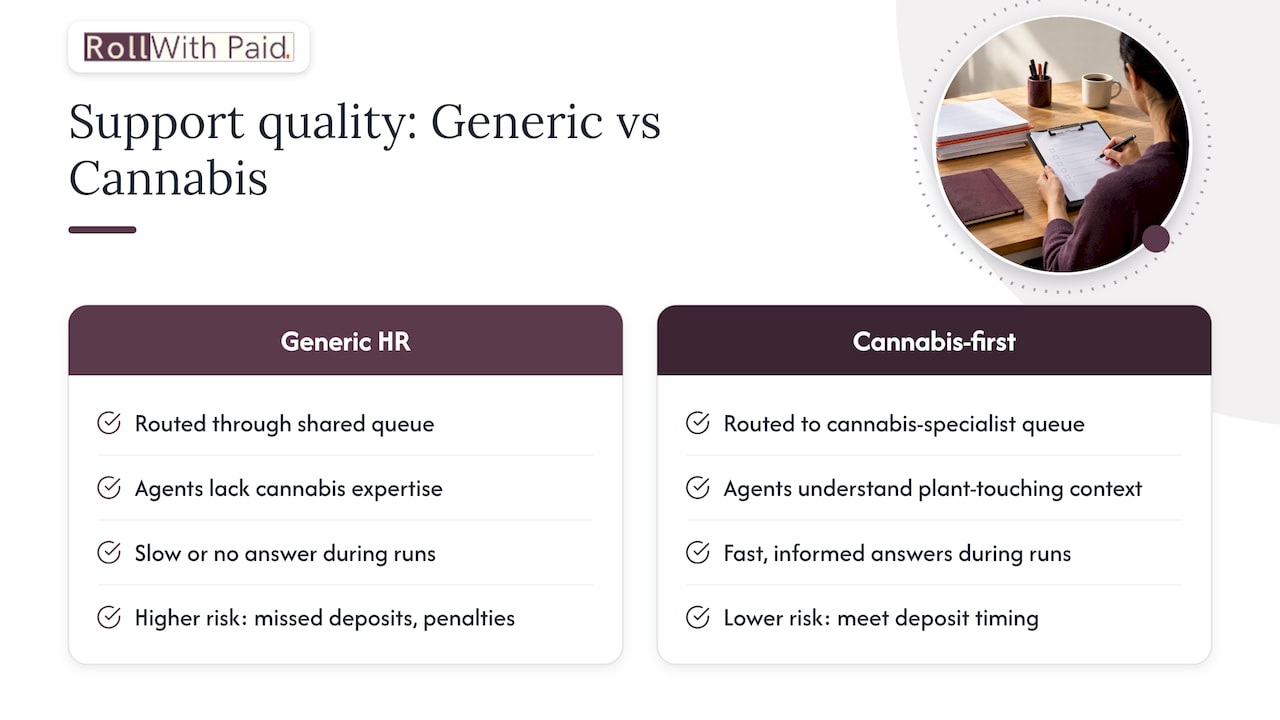
Generic HR platforms route cannabis-industry support tickets through the same queue as every other client, regardless of whether the question involves a 280E classification issue or a frozen bank transfer tied to cannabis-specific underwriting. A support agent unfamiliar with plant-touching businesses often cannot answer those questions quickly, if at all.
We built our support process around the assumption that every client operates in a high-risk category, so questions about banking disruptions, classification changes, or audit documentation go to people who already understand the context. That matters most during a payroll run that is at risk of being late, since federal deposit penalties begin accruing within days, as outlined in the cannabis payroll compliance rules on deposit timing.
Responsiveness in this industry is not a convenience feature. A delayed answer about a frozen payment can mean a missed deposit deadline, a workers’ comp audit complication, or an I-9 timing violation. Personalized support built around cannabis operations is part of why we structure the EOR relationship the way we do, rather than leaving clients to interpret general-purpose help documentation written for industries with none of these constraints.
Compliance Beyond Tax: State Employment Law for Cannabis Employers
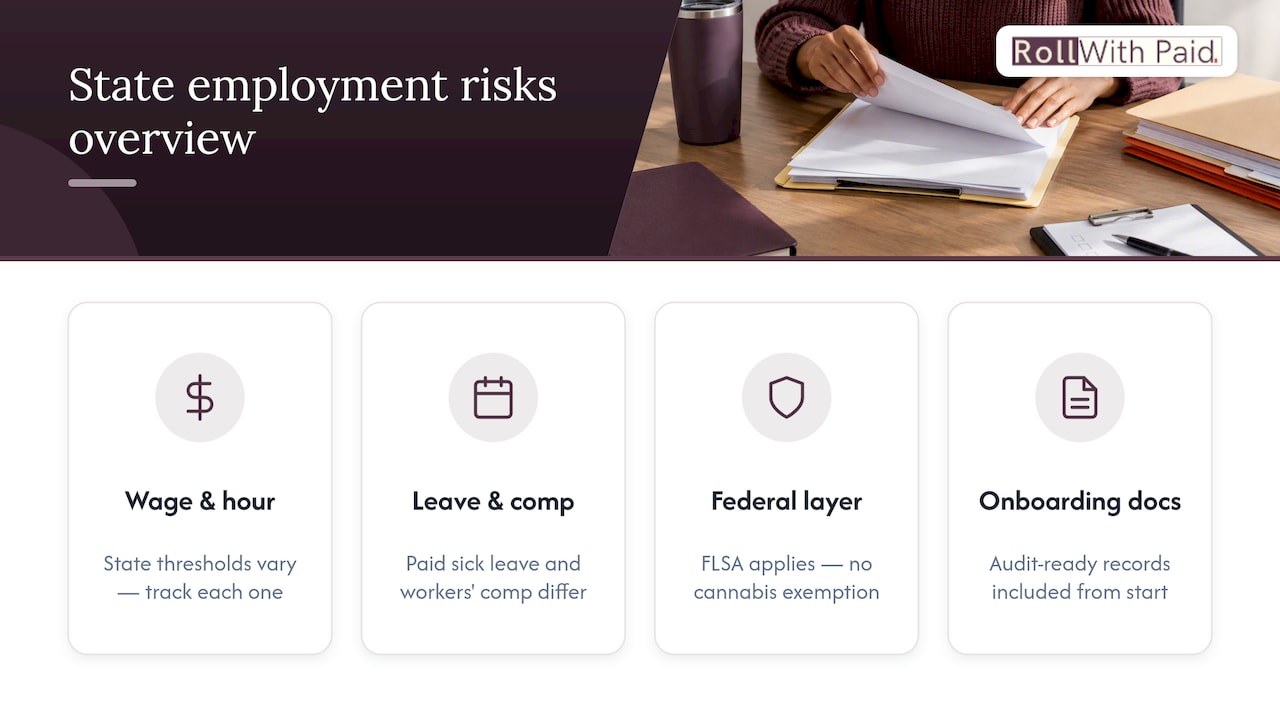
Federal tax rules get most of the attention, but state-level employment law creates just as much exposure for cannabis operators. Wage and hour rules, paid sick leave mandates, and state-specific workers’ compensation requirements vary widely, and a national HR platform built for mainstream retail or logistics clients is not necessarily configured for the patchwork of cannabis-specific state statutes layered on top of standard labor law.
Labor law applies to cannabis employees exactly as it does in any other industry, a point underscored by a federal appeals ruling confirming FLSA coverage for marijuana industry workers. That means overtime, minimum wage, and recordkeeping rules all apply in full, with no cannabis-specific exemption to soften the obligation.
Our HR and compliance support is structured to track state-level wage and hour rules alongside the federal layer, which matters for multi-state operators juggling different thresholds in each jurisdiction. Audit-ready documentation, the kind we build into onboarding from the start, becomes the difference between a routine state labor inquiry and a drawn-out investigation. Our HR compliance guidance for dispensaries and cultivators covers several of these state-level exposures in more depth.
Comparing Pricing, Fees, and Contract Terms
Pricing comparisons in this space are harder than they look, because the headline rate rarely tells the whole story. General HR platforms, including PeopleGuru, typically price per employee per month with tiered feature access, but cannabis clients often discover additional underwriting or risk surcharges once a provider learns the nature of the business, assuming the platform accepts cannabis clients at all.
Our pricing structure is built around a service rate tied to gross payroll, with an optional flat-rate HR retainer for businesses that want ongoing compliance support beyond payroll execution itself. Rates vary by workers’ compensation classification code and headcount. Full rate details are available on our pricing page.
When comparing vendors, ask specifically about setup fees, minimum contract length, and whether pricing scales predictably as headcount grows across multiple locations or states. A platform that looks inexpensive at ten employees can become considerably more expensive, or simply unavailable, once a cannabis operator tries to scale into a second state with different banking and licensing requirements.
User Experience and Integration With Other HR Systems
General HR platforms tend to win on breadth of integration, since they are built to connect with common accounting software, benefits marketplaces, and time-tracking tools used across mainstream industries. That broad compatibility is genuinely useful for a business with no high-risk classification to manage.
Our focus runs in a different direction. Rather than building the widest possible integration library, we prioritize time and attendance tools and onboarding workflows that match the documentation and classification needs specific to cannabis payroll, including the audit-ready recordkeeping referenced earlier. For scheduling and field coordination needs outside our core payroll scope, tools like ServlyPro’s job assignment software illustrate the kind of operational scheduling layer some operators pair alongside a compliance-first payroll partner.
The practical takeaway: if integration breadth with existing mainstream software is your top priority and your compliance exposure is low, a general platform may serve you well. If audit readiness and banking-compatible payroll execution matter more than a long integration list, a specialist model built around those constraints tends to serve plant-touching businesses better.
What Cannabis Clients Report About Switching Payroll Providers
Specific client case studies are not something we publish, but the pattern operators describe when they reach out is consistent: a mainstream payroll provider either declines to work with a disclosed cannabis business or quietly terminates the relationship once the nature of the business becomes clear, often after funds have already been deposited.
A payroll provider that refuses plant-touching clients creates a real shortage of compliant options, and specialist providers exist specifically to fill that gap with processes banks and auditors are willing to accept, a dynamic described directly by a Roll With Paid founder’s guest commentary on the realities of cannabis payroll transitions.
That same commentary notes that switching providers typically takes one to two full pay cycles to complete cleanly, which matters when comparing timelines against a platform like PeopleGuru that was not built with cannabis onboarding friction in mind. If a sales conversation with any vendor, including us, cannot produce a clear account of a client’s actual transition experience, treat that as a prompt to ask more pointed questions rather than an absence of proof.
When a Specialist EOR Beats a Standard HR Platform
The decision usually comes down to exposure, not preference. If your business carries meaningful 280E tax exposure, faces banking friction, or operates under a lender that requires audit-ready payroll documentation, a specialist Employer of Record is worth the switch. If none of those pressures apply and your main concern is dashboard convenience, a general platform may be the simpler choice.
Plan for a real transition window: expect one to two pay cycles before a new provider is fully operational, and budget your cash flow accordingly rather than assuming an instant cutover.
Bring your CPA and, where tax structuring is involved, your attorney into the conversation before signing anything. Payroll decisions in this industry touch tax treatment and legal liability at the same time, and neither one should be settled by a payroll vendor’s sales team alone.
— Leah
Ready to Evaluate Roll With Paid for Your Business
We built our services around the compliance and banking realities that plant-touching businesses actually face: Employer of Record coverage, payroll execution, HR and compliance support, onboarding, and multi-state hiring assistance all in one relationship.

- Review our service rates and HR retainer structure to see how pricing lines up with your headcount and classification.
- Start with our Employer of Record overview if you are new to the model.
- Request a compliance review or a sample onboarding checklist to see the documentation process before you commit.
If a payroll disruption during a transition is a cash-flow concern. Resources like emergency payroll funding options can help bridge a short gap while a new provider gets fully operational.
FAQ
What’s the best HR payroll software for high-risk industries?
For plant-touching and other high-risk businesses, a specialist Employer of Record model tends to outperform general HR platforms because it addresses banking acceptance, 280E-related classification, and workers’ compensation risk directly. A low-risk, standard employer is often better served by a broad HRIS platform with wider integration options.
What are the four types of payroll systems?
Payroll is commonly run in-house with software, outsourced to a payroll service bureau, handled through a PEO under co-employment, or managed through an Employer of Record that assumes the legal employer role. Each model shifts a different amount of tax filing responsibility and liability away from the business owner.
Can you do payroll in BambooHR for a cannabis business?
General HR platforms can calculate wages and generate reports for any business, including cannabis operators, but they do not resolve the banking acceptance, 280E tax treatment, or workers’ compensation classification issues specific to the industry. Those gaps are the reason specialist EOR providers exist alongside general software options.
How does Section 280E affect cannabis payroll decisions?
Section 280E disallows standard business expense deductions for businesses trafficking in a federally controlled substance, which shapes how cannabis employers should treat payroll-related costs, according to IRS guidance. Payroll providers familiar with 280E structure classification and reporting with that limitation in mind from the start.
What does Roll With Paid charge for payroll and HR services?
Our pricing is structured as a service rate tied to gross payroll, with an optional flat-rate HR retainer, and rates vary by workers’ compensation classification code and headcount. Exact figures are available on our pricing page rather than as a flat published rate.
Sources
- Form I-9, Employment Eligibility Verification | USCIS
- IRS memorandum on 280E and marijuana-related businesses
- Cannabis payroll compliance: banking, 280E and tax rules | LegalClarity
Recommended
- 280E and Payroll: What Cannabis Employers Need to Understand
- I-9 and E-Verify: A Compliance Guide for Cannabis Employers
- 5 Payroll Mistakes Cannabis Businesses Can’t Afford
- What Is an Employer of Record — and Why It Matters for Your Benefits
Roll With Paid. is not a law firm and does not provide legal advice. This article summarizes Minnesota law as of August 2026 and is general information only. Tip arrangements are fact-specific; before changing a policy, consult employment counsel or contact DLI Labor Standards at 651-284-5075.