
Minnesota OCM: Prepare Your Cannabis License Application Before Paying
The Minnesota Office of Cannabis Management (OCM) issues and enforces cannabis and hemp licenses under Minnesota Statutes, chapter 342 and Minnesota Rules, chapter 9810. Applicants work through Accela, OCM’s online licensing system, completing worksheets, preliminary approval, local zoning review, site inspection, fee payment and Metrc registration before opening. Recent rulemaking and lotteries decide timing and which license types are capped.
TL;DR:
- Accela locks document uploads after payment, so assemble ownership disclosures, capitalization records, preliminary operating procedures, and business plans before submitting the application.
- OCM may take up to 90 days to review final site materials and background checks, while local governments have 30 days to certify zoning.
- Cultivator, mezzobusiness, manufacturer, and retailer licenses are capped and allocated by lottery; check current availability before committing money or choosing a site.
- Local zoning certification must precede state licensing, and retailers generally need separate local registration before sales begin; contact officials before signing a lease.
- Schedule Metrc registration and training before your planned opening, because both must be completed before the business can legally operate.
Table of Contents
- What the Office of Cannabis Management does
- Which license types and endorsements exist?
- From Accela account to license: the path and timing
- Zoning, retail registration and local officials
- Rule approvals, lotteries and supply chain proposals
- Your readiness checklist before applying
- How OCM licensing connects to payroll and HR compliance
- How OCM regulations shape workforce management
- Supply chain regulations and traceability under OCM
- Why early compliance and payroll planning pay off
- How we support applicants preparing to open
- FAQ
- Sources
What the Office of Cannabis Management does
OCM implements chapter 342 and the rules in chapter 9810, and it houses the Division of Medical Cannabis alongside community and economic development functions. Minnesota’s cannabis law, passed in 2023, created the office and the licensing framework it runs.
Its stated priorities are public health and safety, eliminating illicit markets, supporting a craft industry, and prioritizing communities disproportionately affected by prohibition. In practice, that means OCM issues licenses and endorsements, conducts inspections, enforces the rules, and runs the rulemaking and lottery processes.
The OCM Local Government Guide lays out the office’s structure and responsibilities. For you as an applicant, the takeaway is simple: OCM decides whether you hold a license, but it relies on city and county officials for local sign-off, so you will answer to both.
Which license types and endorsements exist?
OCM identifies 10 cannabis business license types. Knowing which one fits your plan is the first decision, and it shapes everything after it.
- Microbusiness
- Mezzobusiness
- Cultivator
- Manufacturer
- Retailer
- Wholesaler
- Transporter
- Testing facility
- Delivery service
- Medical combination business
Hemp businesses follow a separate track. The lower-potency hemp edible (LPHE) guide describes three license types: LPHE manufacturer, LPHE retailer and LPHE wholesaler. Depending on your activities, you may also need an edible handler, extraction or artificially derived cannabinoid endorsement.
Some limited-availability license types go through a lottery. Check OCM’s business licensing pages for current availability and application requirements. OCM’s business licensing pages list what is currently available and link to Accela and the worksheets.
From Accela account to license: the path and timing
The Qualified Applicant Guide and the Cannabis Accela User Guide describe the sequence. Because you cannot add documents after payment, gather everything first.
- Create your Accela account and compile the required worksheets and attachments, including the Disclosure of Ownership, Capitalization Table, preliminary SOPs and preliminary business plan.
- Earn preliminary approval, then follow OCM’s instructions for completing the licensing process.
- Submit your site location and final plans of record, and register the site.
- Wait for OCM’s review of the final site information and background checks, which can take up to 90 days.
- Obtain local zoning certification, which local governments must provide within 30 days of OCM’s request.
- Pass the OCM site inspection and pay the license fee in Accela.
- Receive your digital license and complete Metrc registration and training before operating.
Renewal is annual through Accela. Under OCM’s renewal guidance, the office sends notices 90 days before expiration, the first renewal is included in the initial license, and later renewals require payment.
Pro Tip: Combine related exhibits into single files and name them clearly before you start uploading, since Accela will not let you add documents after payment.
Zoning, retail registration and local officials
OCM forwards your site to the local government through Accela for zoning and land-use certification, and the local unit has 30 days to respond. A missed or negative certification can stall or block licensure, so this step deserves as much attention as the state application.
- Zoning certification: Confirms your site complies with local land-use rules, and it comes before OCM can license the location.
- Retail registration: Issued by the local government, separate from your state license, and generally required before retail sales begin. Even LPHE retailers still need it before selling.
- Compliance checks: Local governments conduct compliance checks and report results to OCM.
Identify your local Accela contact early and open the conversation before you sign a lease. Local zoning and registration remain local authorities, and mismatched timelines between city hall and the state are a common source of delay.
Rule approvals, lotteries and supply chain proposals
Rulemaking sets the pace. OCM announced that an administrative law judge approved the draft cannabis rules. Approved rules must publish in the State Register before they take effect and before certain licenses can be issued.
- Lotteries: OCM’s lottery overview documents drawings held June 5 and July 22, 2025, run with Smartplay and Baker Tilly. Selected application numbers, not business names, are posted. If you are selected, OCM emails you instructions for the next steps.
- Supply chain proposals: OCM’s January 15, 2026 proposal to streamline the medical and adult-use supply chains would align cultivation and manufacturing, allow co-location and shared equipment, and create a macrobusiness license while preserving patient protections. It anticipates legislative action and phased implementation in 2027 if adopted.
Treat these as signals, not settled law, and check OCM’s pages for the current status before you commit capital.
Your readiness checklist before applying
- Assemble every OCM worksheet and supporting document and name each file clearly before you upload.
- If you are applying as a social equity applicant, confirm the certification requirements and have your documentation ready, along with complete capitalization and ownership records.
- Contact local planning and zoning officials early, identify your Accela contact, and confirm local retail registration rules and fees.
- Build calendar buffers around OCM’s review, the local certification process, and your inspection and Metrc registration.
Pro Tip: Write down your target opening date, then count backward through each window, adding a cushion at every step. A single slipped deadline shifts everything after it.
Many applicants also overlook insurance. A short read on employers liability coverage will help you line up coverage that inspectors and lenders may ask about.
How OCM licensing connects to payroll and HR compliance
Licensing and payroll look like separate projects, but they meet at inspection time. OCM’s process is built on documentation: SOPs, business plans, ownership disclosures and, eventually, a site that can run lawfully on day one. The people you hire are part of that picture.
Before your first employee clocks in, you need a hiring process that holds up. That means Form I-9 completion and, where applicable, E-Verify, which our I-9 and E-Verify compliance guide walks through. It also means correct worker classification, a time and attendance system that produces clean records, and written policies that match what your SOPs promise OCM.
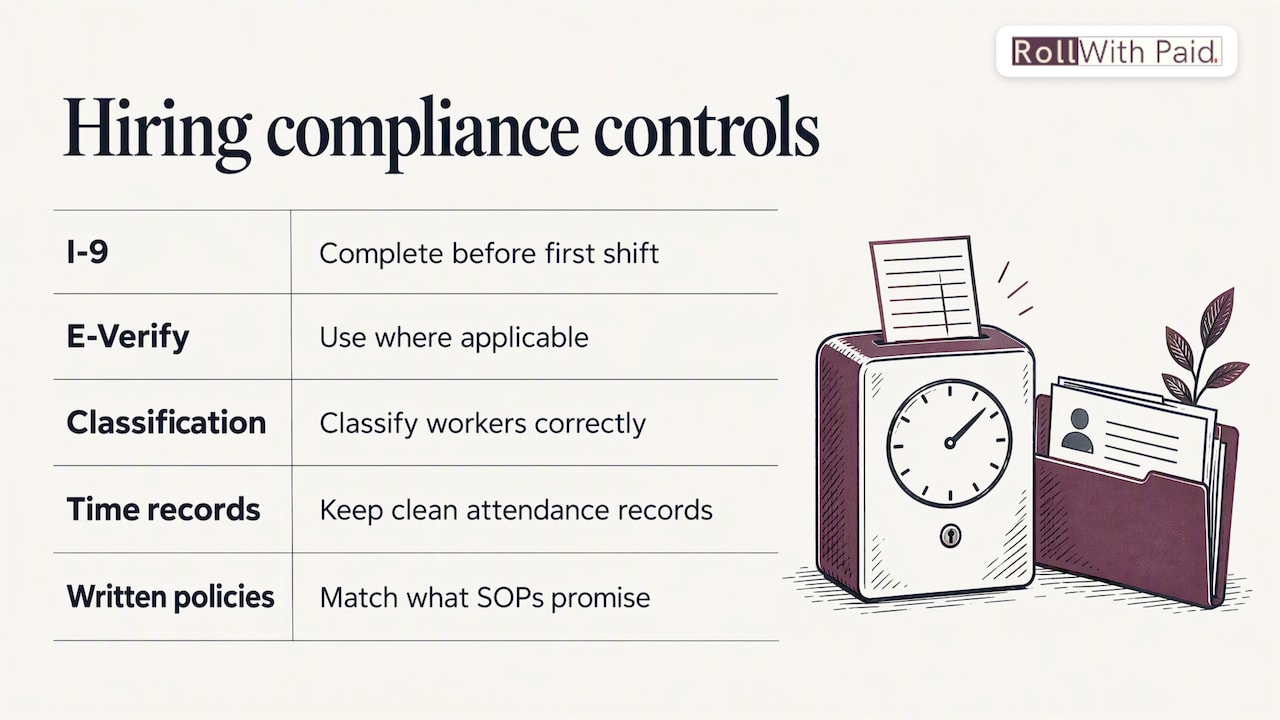
Cannabis operators face an added wrinkle: records must withstand scrutiny from regulators and tax authorities alike. Payroll files that contradict your licensing paperwork create avoidable questions. Our HR compliance tips for dispensaries and cultivators cover the habits that keep both sets of records consistent.
The practical approach is to settle these systems while your application is under review. That waiting period is the cheapest time to choose a payroll and HR setup, because nothing is operating yet and nothing needs to be migrated later.
How OCM regulations shape workforce management
Once you are licensed, OCM rules and state employment law both define your responsibilities as an employer. Your workforce is no longer a back-office detail. It is part of how you stay in good standing.
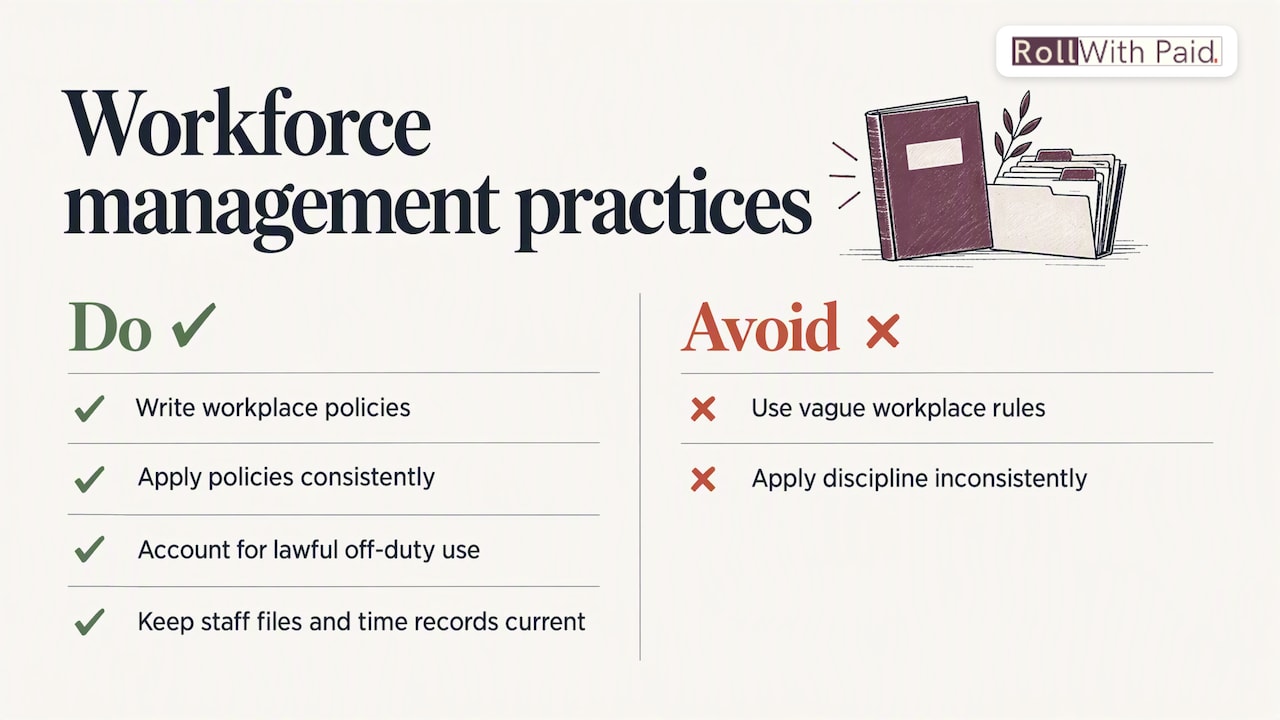
On the employment side, OCM’s guidance for employers explains that Minnesota protects lawful off-duty cannabis use by employees while preserving your right to enforce workplace policies. Those policies need to be written, consistently applied and understood by staff. Vague rules lead to inconsistent discipline, and inconsistent discipline leads to disputes.
Other obligations stack on top. Paid leave rules affect how you budget and schedule, and we cover them in our post on Minnesota paid leave employer obligations. Workers also have rights of their own, which we outline in your rights as a cannabis worker in Minnesota, and knowing both sides helps you write fair policies.
Day to day, expect to manage training records, scheduling around inspections, and clear role definitions for anyone who touches product or tracking systems. Annual local compliance checks and OCM inspections are easier when your staff files, policies and time records are organized and current. Build that discipline early, and it becomes routine rather than a scramble before each visit.
Supply chain regulations and traceability under OCM
Every licensed cannabis business operates inside a tracked supply chain. The practical anchor is Metrc, the tracking system you must register with before opening, as the Qualified Applicant Guide describes. Plan that training early so it does not become the last obstacle before opening.
Traceability means product movement is recorded from one licensed business to the next. That is why license type matters so much: cultivators, manufacturers, wholesalers, transporters, retailers and testing facilities each play a defined role, and a transaction only works when both parties hold the right license. Capped and uncapped categories also shape who can enter the chain and when.
Hemp businesses have their own requirements. The LPHE guides describe endorsements for edible handling, extraction and artificially derived cannabinoids, and inspection authority sits with OCM. If your plans touch more than one activity, confirm which endorsements apply before you build your floor plan.
Expect change here. OCM’s January 2026 proposal would let cultivation and manufacturing align more closely, permit co-location and shared equipment, and introduce a macrobusiness license. None of that is law yet, and it depends on legislative action. For now, design your operation around today’s rules, keep your SOPs flexible, and watch for updates.
Staffing matters in traceability, too. Anyone entering inventory data needs training, and clear accountability keeps records accurate. Sloppy data entry is a payroll problem and a compliance problem at the same time.
Why early compliance and payroll planning pay off
Here is where we land after working with cannabis operators: the applicants who open smoothly treat payroll and HR as part of licensing readiness, not as a task for after the license arrives. I-9s, hiring workflows, worker classification and time and attendance are all things you can settle while OCM reviews your file. Choosing a vendor is one of the few milestones fully in your control during that wait, and using it well reduces operational delays and supports inspection readiness.
— Leah Kollross
How we support applicants preparing to open
If you are preparing for a licensed cannabis or hemp business, we can help you line up your workforce systems with your licensing timeline. At Roll With Paid, we handle high-risk industries that mainstream payroll providers often turn away. Our services for applicants include:
- Employer of Record
- Payroll execution
- HR compliance, including I-9 and hiring support
- Time and attendance tools
- Multi-state hiring support
- Audit-ready documentation
To see how we price our work, visit our pricing page, or contact us through our homepage to coordinate payroll and HR readiness with your licensing schedule.
FAQ
What does the Minnesota Office of Cannabis Management do?
OCM issues cannabis and hemp licenses, conducts inspections, enforces the rules, and runs rulemaking and lottery processes. It operates under chapter 342 of Minnesota Statutes and Minnesota Rules, chapter 9810.
How long does OCM take to review a final application?
After you submit complete site information and final plans of record, OCM has up to 90 days to review them and complete background checks, according to the Qualified Applicant Guide. Local governments have a separate 30-day window to certify zoning.
Which license types are subject to a lottery?
Cultivator, mezzobusiness, manufacturer and retailer licenses are capped by statute, so they are entered into lotteries. OCM’s FAQ confirms that limited-availability license types go through the lottery and explains how selection notices work.
Do I need local approval as well as an OCM license?
Yes. Local governments certify zoning and land use, and retail operators generally need a separate local retail registration. Both are distinct from your state license.
Sources
- License Lottery Overview / Office of Cannabis Management
- Office of Cannabis Management announces approval of cannabis rules by administrative law judge
Recommended
- 6 Contract Must Haves for Minnesota Cannabis Background Checks
- Before Your First Paycheck: Audit Ready Multi-State Cannabis Payroll
- Your Rights as a Cannabis Worker in Minnesota
- 5 Payroll Mistakes Cannabis Businesses Can’t Afford
Roll With Paid. is not a law firm and does not provide legal advice. This article summarizes Minnesota law as of August 2026 and is general information only. Tip arrangements are fact-specific; before changing a policy, consult employment counsel or contact DLI Labor Standards at 651-284-5075.